two suspects killed
| |

Two suspects, who killed cops in Lahore. killed in…


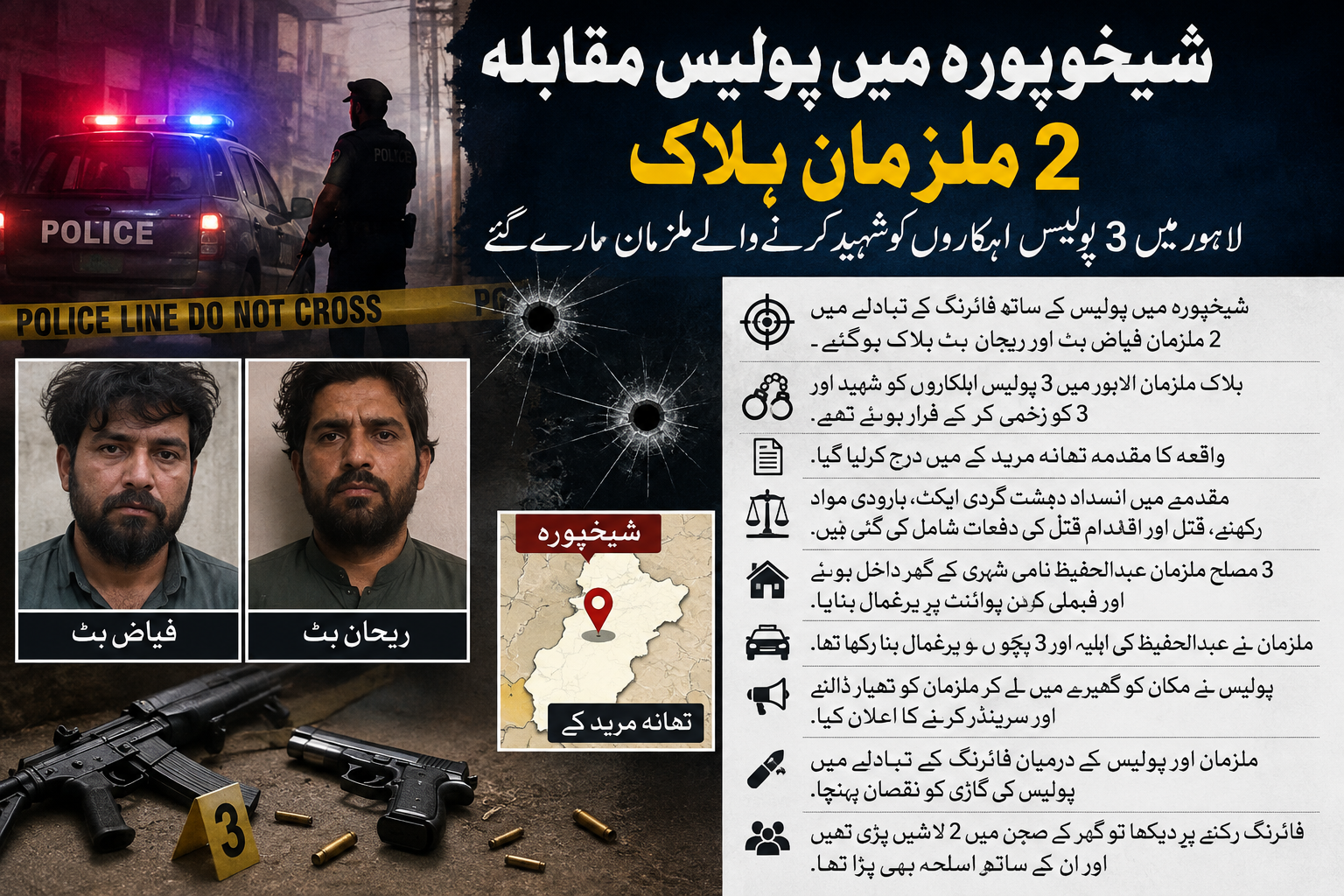
Two suspected criminals, identified as Fayyaz Butt and Rehan Butt, were killed during an exchange of fire with police in Sheikhupura. A case has been registered at Muridke Police Station in connection with the incident, according to police officials.

According to the First Information Report (FIR), the two deceased suspects were allegedly involved in a previous attack in Lahore in which three police personnel were killed and three others were injured. The FIR includes charges under the Anti-Terrorism Act, possession of explosives, murder and attempted murder.

The incident occurred after three armed suspects allegedly entered the house of a citizen identified as Abdul Hafeez. According to the FIR, the suspects took the family hostage at gunpoint after forcibly entering the residence.

The FIR stated that Abdul Hafeez’s wife and their three children were among those held hostage by the armed men. The situation prompted police to launch an operation to secure the house and rescue the hostages.

Police surrounded the house and announced that the suspects should lay down their weapons and surrender. However, according to the FIR, the suspects did not surrender and an exchange of gunfire subsequently took place between the police and the armed men.

During the exchange of fire, the police vehicle was also damaged. Police personnel remained positioned around the house while attempting to control the situation and prevent the suspects from escaping.

According to the details contained in the FIR, the firing eventually stopped. When police officers entered the premises and inspected the area, they found two bodies lying in the courtyard of the house. Weapons were also found near the bodies.

The deceased suspects were subsequently identified as Fayyaz Butt and Rehan Butt.

Police officials said the two suspects had allegedly fled from Lahore after the deadly attack on police personnel. The FIR registered in Muridke includes several serious charges, reflecting the nature of the allegations against the suspects.

The charges include provisions of the Anti-Terrorism Act, along with sections relating to murder, attempted murder and possession of explosive material. The case will now form part of the investigation into the suspects’ alleged activities and their involvement in the earlier Lahore incident.

The hostage situation also raised concerns regarding the safety of the family inside the residence. According to the FIR, the police operation was carried out after the armed suspects allegedly took the family members hostage and refused to surrender.

The authorities are expected to investigate the circumstances surrounding the encounter, including the sequence of events leading to the exchange of fire and the deaths of the two suspects.

The incident highlights the challenges faced by law enforcement agencies when dealing with armed suspects accused of serious crimes. Police personnel are required to respond quickly in such situations, particularly when civilians are being held hostage.

Further details regarding the identities and alleged criminal backgrounds of the suspects, as well as the investigation into the Lahore attack, may emerge as authorities continue their inquiry.

The case registered at Muridke Police Station will provide the legal basis for investigating the incident and the allegations against the deceased suspects. Police officials will also examine the weapons recovered from the scene and other available evidence to establish the exact circumstances of the encounter.

Authorities have yet to provide further details regarding the condition of the hostages following the operation. The investigation is expected to determine the full sequence of events and establish the suspects’ alleged links to the earlier attack on police personnel in Lahore.

Similar Posts

  • | |

    AJK polls disrupted as clash erupts at Bhimber pol…

    Voting was suspended at a polling station in Azad Jammu and Kashmir’s Bhimber district after a clash broke out between workers of two political parties during the first phase of the AJK elections. The incident took place at the Darbar Baba Shadi Shaheed polling station in constituency LA-6 Bhimber. Following the confrontation, polling was halted temporarily. Pakistan Muslim League-Nawaz (PML-N) candidate Abdul Razzaq Chaudhry alleged that workers of an opposing political party started the fight at the polling station. District Returning Officer (DRO) confirmed that a clash had taken place at one of the polling stations at Darbar Baba Shadi Shaheed. According to the official, miscreants snatched a ballot box and set it on fire. The DRO said the ballot box contained 232 votes when it was set ablaze. Returning officials and security personnel are currently present at the polling station. The DRO said legal action would be taken against those involved in disrupting the polling process. Officials have yet to decide whether polling will be held again at the affected polling station. The DRO said a decision on re-polling would be taken later in accordance with the relevant election rules. Apart from the affected polling station, polling is continuing normally at all other polling stations across the constituency. Meanwhile, the DRO also said that former AJK prime minister Anwar-ul-Haq had raised a complaint regarding polling arrangements in constituency LA-7. Officials visited the polling stations where complaints had been received and found that the relevant polling agents were present there.

  • |

    French DJ Kavinsky dies at 50, investigation underway

    French electronic music artist Kavinsky, best known for his internationally acclaimed track Nightcall, has died at the age of 50. The musician was reportedly found dead at his home in Paris on Tuesday, prompting an official investigation into the circumstances surrounding his death. Kavinsky, whose real name was Vincent Belorgey, became one of France’s most recognizable electronic music producers through his distinctive blend of synthwave and electro sounds. His music gained worldwide popularity for its retro-inspired style, drawing influence from 1980s cinema, video games, and electronic music. Authorities in Paris have confirmed that an investigation has been launched following the discovery of the artist’s body. Officials have not yet announced the exact cause of death, and no conclusions have been reached as the inquiry continues. While some reports have suggested that he may have suffered a stroke, authorities have not confirmed those claims, and the investigation remains ongoing. Born as Vincent Belorgey, Kavinsky launched his music career in the early 2000s. He quickly attracted attention within France’s electronic music scene and released his debut extended play, Teddy Boy, in 2006. The project introduced listeners to his signature cinematic sound, which later became his trademark. His career reached a major milestone when he was selected to open for legendary French electronic music duo Daft Punk during their 2007 tour. The opportunity exposed his music to a global audience and helped establish him as one of the leading names in the growing synthwave movement. Kavinsky achieved international fame with Nightcall, a track that became one of his defining works. The song earned even greater recognition after being featured in the 2011 film Drive, starring Ryan Gosling. Its haunting melody and atmospheric production introduced millions of listeners to his music and cemented his reputation as a pioneer of modern retro-electronic sound. Following news of his death, tributes poured in from across France and the international music community. French Culture Minister Catherine Pégard honored the late musician in a message shared on X, describing him as one of France’s most distinctive artistic voices. She praised his contribution to electronic music and said his work would continue to inspire future generations of musicians. French President Emmanuel Macron also paid tribute, calling Kavinsky a source of pride for France and acknowledging the lasting impact he made on the country’s cultural landscape. Throughout his career, Kavinsky remained admired for creating a unique musical identity that blended nostalgia with futuristic electronic production. His influence extended beyond music into film, fashion, and popular culture, making him one of the most recognizable figures in contemporary French electronic music. As investigators continue to examine the circumstances surrounding his death, fans around the world are remembering Kavinsky for his innovative sound and the timeless music that defined his remarkable career. His legacy is expected to endure through the recordings that introduced a generation of listeners to his unmistakable style.

  • | |

    Kinza Hashmi visits National Assembly after praise…

    Pakistani actor Kinza Hashmi visited the National Assembly after receiving praise from lawmakers for her portrayal of a politically influential woman in the drama Leader. Hashmi was invited to the parliament by MNA Romina Khurshid Alam. The actor shared highlights from her visit in an Instagram reel on Thursday. During the visit, Alam accompanied Hashmi through different parts of the National Assembly building. She showed the actor several artworks, historical displays, dioramas and other artefacts kept inside the building. Hashmi also visited the National Assembly floor and met staff members. She later spent time in Alam’s office, where the lawmaker presented her with a token of appreciation. Alam praised Hashmi for bringing the experiences and challenges of women involved in politics to television. She said she was proud of the actor’s work and appreciated the way she represented female politicians through her performance. The lawmaker described Hashmi’s portrayal as meaningful and said her work had helped bring greater attention to the role of women in political life. Hashmi also met Federal Minister for Information and Broadcasting Attaullah Tarar during her visit. According to the actor, they held a productive discussion about several important matters. She said the conversation particularly focused on issues faced by women working in Pakistan’s media industry. Reflecting on her parliamentary visit, Hashmi said the experience gave her a better understanding of the character she plays in Leader. She noted that politics is not simply about privilege or power. It also involves responsibility, public service, duty and long-term commitment. The actor said visiting the parliament allowed her to see the political system from a different perspective. The experience also helped her connect more deeply with the themes explored through her character. Hashmi’s performance in Leader has recently attracted attention from several politicians. In July, Romina Khurshid Alam and Balochistan MNA Jamal Raisani publicly praised her acting. Alam said Hashmi had fully embraced the character and described her performance as outstanding. Raisani also expressed appreciation for the actor’s portrayal. Hashmi thanked both lawmakers for their supportive comments and recognition of her work. In Leader, Hashmi plays Rubab, the daughter of a powerful politician from a feudal background. Her character initially grows up under the influence of her father and his political network. As the story develops, Rubab begins to establish her own identity. She eventually takes control of her father’s political organisation and emerges as a determined party leader. Her character’s political journey has made the drama a talking point among viewers, while Hashmi’s portrayal has drawn attention from audiences as well as people working in politics.

  • | |

    Pakistan’s military tightens grip on Islamis…

    Munir’s family background feeds into this shift as well. He is the son of an imam and considers himself a devout, conservative Muslim, and religious identity remains deeply woven into Pakistan’s state institutions. Even so, he has pushed the country toward international engagement through cryptocurrency partnerships, foreign investment deals, a mediating role in the conflict between the United States and Iran, and a mutual defence pact with Saudi Arabia. Data shared with a foreign news agency by the Armed Conflict Location and Event Data Project, a group that tracks conflict incidents worldwide, shows the scale of the shift. Pakistan averaged more than seven blasphemy related riots or attacks annually between 2021 and 2024, but recorded only one such incident over the past twelve months. Economic pressure appears to have played a significant role in prompting the crackdown. Two Pakistani government sources said officials grew alarmed during the summer of 2025 that rising hostility from fundamentalist groups toward France and other European countries threatened to jeopardize a European Union duty waiver covering Pakistani exports. Nearly a third of Pakistan’s total exports go to the EU, and losing that preferential access could have dealt a severe blow to the national economy. Neither the European Commission nor Pakistan’s commerce ministry responded to requests for comment on the matter. Washington has added its own pressure over religious freedom concerns. The US Commission on International Religious Freedom, a government watchdog, recommended last year that Pakistan be placed back on a list of countries of particular concern due to its blasphemy laws, a designation Islamabad has firmly rejected. Analyst Abdul Basit of Singapore’s S. Rajaratnam School of International Studies said worsening insurgent violence in Balochistan and Khyber Pakhtunkhwa, Pakistan’s two most mineral rich provinces, likely added urgency to Munir’s campaign, particularly since he has pitched foreign investment in the country’s mining sector to American officials over the past year. Basit noted that religious groups have lost favor within the state’s priorities, though he cautioned that the militias driving these regional insurgencies are not formally tied to the newly banned Islamist organizations, even if both draw recruits from the same pool of young, radicalized men. Elizabeth Threlkeld, who directs the Stimson Center’s South Asia program, said the open question going forward is whether Pakistan can sustain this level of focus over time. Crackdown targets country’s largest fundamentalist movement The largest of the groups swept up in the crackdown, Tehreek e Labbaik Pakistan, built its identity around the slogan “Death to blasphemers” before authorities banned it late last year. Many of its leaders now sit in jail, its mosques have been sealed shut and its financial accounts frozen. A previously undisclosed government document that laid the groundwork for the ban argued the organization had become a serious threat to Pakistan by damaging both domestic stability and the country’s standing internationally. A spokesperson for the group pointed to a statement it issued last year describing the ban as illegal and unconstitutional. The move against Tehreek e Labbaik follows earlier crackdowns on groups such as Lashkar e Taiba and Jaish e Muhammad, which Pakistan pursued under pressure from the Financial Action Task Force, the international body that monitors terrorism financing. Basit linked the newest crackdown to a period of internal reflection within Pakistan over its historical backing of the Afghan Taliban, whom Islamabad now blames for stoking Islamist insurgencies against the Pakistani state from across the border. The Taliban government in Kabul has dismissed that accusation as baseless, and a spokesperson for its foreign ministry declined to comment further, describing Pakistan’s crackdown as an internal matter. For Pakistan’s Christian, Shia and Ahmadi communities, the change in atmosphere has been dramatic. In the past, suspects in blasphemy related killings, including police officers, were sometimes greeted with rose petals or celebratory receptions, and individuals accused of burning churches or minority mosques often received public praise. Blasphemy remains a capital offense under Pakistani law, and even a rumor of an accusation has historically been enough to spark riots or lynchings. Human rights organizations say victims’ families have rarely obtained justice, since judges and lawyers have often been too frightened to take on such cases. Officer Malik said everyone who confronted the crowd during last month’s incident in Karachi felt genuine fear. The Christian family targeted that day was eventually moved to safety, and an initial investigation has since found the accusations against them to be false. Group’s military links trace back a decade Tehreek e Labbaik formed in 2015 while its founder was imprisoned for shooting and killing a Pakistani provincial governor in 2011 over his support for a Christian woman accused of blasphemy. That gunman, a former police bodyguard, was later convicted and executed months after the group’s founding. Analysts have long suspected the group’s creation received at least tacit support from Pakistan’s military establishment, including its intelligence services, as a tool to keep civilian governments and mainstream political parties in check. Following violent riots led by the group in 2017, then army chief General Qamar Javed Bajwa referred to its protesters as the country’s own people. Pakistan’s Supreme Court later ordered the military and intelligence agencies to stay out of politics but stopped short of directly tying them to the organization. Analysts and former officials say the effects of years of tolerance for the group will not disappear simply because of a ban, and that the shock felt by its supporters could still trigger backlash. Ihsan Ghani, who served as Pakistan’s counter terrorism chief during the 2017 riots, said he worries the group could resurface at full strength if its usefulness to the state changes again. He compared decades of state backed nurturing of the movement to something that cannot simply be switched on and off at will. Within Pakistan’s minority communities, the sudden shift still feels fragile. One of the Christian women rescued during last month’s incident in Karachi said she and her family are now physically safe, but admitted the fear has not fully faded.

  • |

    Colombia’s new president takes office with hardline pledge on security and economy

    Abelardo De La Espriella has been sworn in as Colombia’s president in Cali, breaking with the tradition of holding the inauguration ceremony at the congressional building in Bogotá. The 48-year-old former lawyer and ally of US President Donald Trump won June’s runoff election on a platform focused on hardline security measures, significant cuts to state spending, and the expansion of national energy production. During his inaugural speech at the Pichincha Battalion military base, De La Espriella declared that peace negotiations with armed groups are completely exhausted. He stated that criminal syndicates must either submit to the rule of law or face a direct response from security forces. To combat drug trafficking, he announced plans to resume aerial spraying to eradicate coca crops and confirmed that Colombia will join the US-led Shield of the Americas programme. On the economic front, De La Espriella pledged to freeze public spending and simplify the tax regime to stimulate private investment, while proposing to reduce the size of the state by up to 40%. He confirmed that established social programmes would remain intact. To boost declining reserves, the new administration plans to expand oil and gas exploration, including the use of responsible fracking, alongside efforts to strengthen state-owned energy firm Ecopetrol. De La Espriella’s inauguration reflects a wider political shift across Latin America. Incoming Finance Minister Miguel Gomez noted a fiscal deficit between 7% and 8% of GDP, indicating that initial governance will depend on executive decrees whilst navigating a divided congress. Meanwhile, opposition figures led by Senator Ivan Cepeda organized peaceful demonstrations in Barranquilla, pledging to defend democratic institutions and monitor potential rollbacks of social protections.

  • |

    Monsoon rains trigger flood warnings across Pakistan

    Persistent monsoon rains continued to lash several parts of Pakistan on Tuesday, triggering fresh flood alerts, increasing river flows, and prompting disaster management authorities to remain on high alert as another spell of rain is expected over the next 24 to 48 hours. According to the Pakistan Meteorological Department (PMD), weak monsoon currents are currently affecting the country’s upper and eastern regions, while a westerly weather system continues to influence northwestern areas. The department has forecast humid weather across much of Pakistan, with rain and thunderstorms likely in Kashmir, Gilgit-Baltistan, Khyber Pakhtunkhwa, and upper Punjab through Wednesday. The Flood Forecasting Division (FFD) reported that the Indus River remains in a low flood situation at Kalabagh and Chashma, while water levels in all other major rivers are currently within normal limits or below the low-flood threshold. Authorities believe the overall hydrological situation is expected to remain stable over the next 24 hours, although scattered rainfall in the upper catchments may slightly increase river flows. Chenab River Under Close Watch Officials are closely monitoring the Chenab River after India released additional water from the Baglihar Dam following heavy rainfall in the upper catchment of the river. According to available reports, three spillway gates of the dam were opened on Monday, adding to the two spillways that had already been opened several days earlier, resulting in higher downstream water flows. In response, the FFD has issued a low to medium flood alert for Head Marala during the next 24 hours. The latest hydrological data shows inflows of approximately 93,900 cusecs, while outflows stand at around 76,200 cusecs. Forecasts indicate inflows may range between 80,000 and 100,000 cusecs, with the river expected to remain in the low flood category. Heavy Rainfall Recorded Across the Country During the last 24 hours, widespread rainfall was reported in Khyber Pakhtunkhwa, Punjab, Balochistan, Gilgit-Baltistan, and Azad Kashmir. Among the highest rainfall recorded by the PMD, Saidu Sharif received 86 millimetres, Kakul 71 millimetres, and Faisalabad 77 millimetres. Meanwhile, Sibbi remained the hottest city in the country with a maximum temperature of 44 degrees Celsius. The FFD’s rainfall monitoring system recorded exceptionally heavy downpours in Faisalabad, where Ghulam Muhammad Abad Water Works received 126 millimetres of rain, while the WASA Head Office recorded 123 millimetres. Significant rainfall was also reported in Lahore, Sialkot, Gujrat, and several surrounding areas. PDMA Warns of Urban Flooding and Landslides Punjab’s Provincial Disaster Management Authority (PDMA) stated that monsoon rains affected most districts of the province over the past day. The authority said advance planning, timely deployment of drainage machinery, and emergency response teams helped clear accumulated rainwater from urban areas despite the heavy showers. The PDMA warned that the current monsoon spell is likely to continue until August 5, with additional rainfall in upper catchment areas expected to increase water levels in eastern rivers and seasonal streams. Authorities have cautioned that urban flooding remains a significant risk in Lahore, Rawalpindi, Gujranwala, Gujrat, Sialkot, Faisalabad, and Multan. At the same time, the possibility of landslides persists in Murree, Galliyat, and other mountainous regions due to continuous rainfall. Authorities Urge Public to Take Precautions Disaster management authorities have established flood relief camps in vulnerable districts to facilitate emergency response if required. Residents living near riverbanks, seasonal streams, and flood-prone areas have been advised to relocate to safer locations as a precaution.

Leave a Reply

Your email address will not be published. Required fields are marked *