parliament hears fresh
|

UK Parliament hears fresh concerns over human rights in Indian-Occupied Jammu & Kashmir

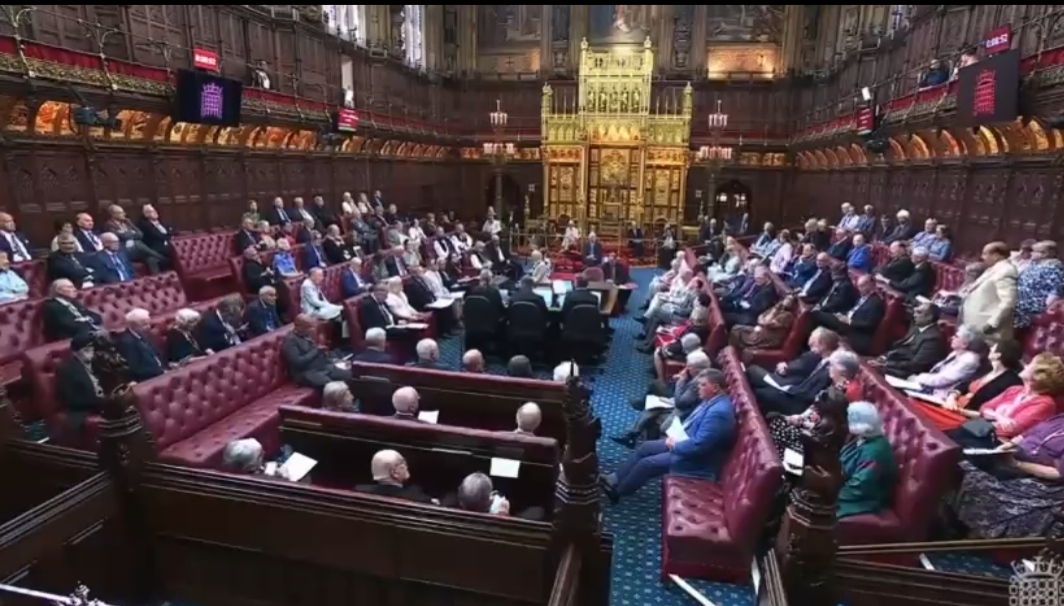
The human rights situation in Indian-occupied Jammu and Kashmir (IIOJK) came under renewed scrutiny in the House of Lords on Thursday after Lord Qurban Hussain urged the British Government to clarify its position in light of a Genocide Watch report published earlier this year.

During the debate, Lord Qurban Hussain said the report warned that the situation in Indian-occupied Jammu and Kashmir had reached a critical stage and alleged that eight of the ten recognised stages associated with genocide had already been reached. He asked how seriously the British Government viewed the report and what action it was taking to help prevent further deterioration.

The British peer, who said members of his family live on both sides of the Line of Control, urged the Government to explain its assessment of the report and its approach towards the human rights situation in Indian-occupied Jammu and Kashmir.

Responding for the Government, Lord Collins of Highbury, Parliamentary Under-Secretary of State at the Foreign, Commonwealth and Development Office (FCDO), reiterated the UK’s longstanding position on human rights.

He said the UK continues to express concern over violence and loss of life and supports full, transparent and impartial investigations into allegations of abuse by Indian police and security forces. He added that the British Government continues to raise human rights issues with India through diplomatic channels.

Lord Qurban Hussain’s intervention highlights continuing concern among a number of British parliamentarians over the human rights situation in Indian-occupied Jammu and Kashmir, with renewed calls for accountability, respect for fundamental rights and a peaceful resolution of the longstanding dispute.


Similar Posts

  • |

    Turkish parliament passes landmark law to advance PKK peace process

    Turkey’s parliament passed a law on Monday establishing a legal framework for the disbandment of the outlawed Kurdistan Workers’ Party (PKK), marking a major step toward ending a decades-old conflict that has killed tens of thousands. The legislation provides legal protections for many former militants who have not committed specific crimes and facilitates the suspension of prison sentences for some people convicted of PKK membership, paving the way for their reintegration into society. The law was approved by a 468-vote majority in the 600-seat parliament after securing support from President Tayyip Erdogan’s ruling AK Party, its nationalist MHP allies, and the pro-Kurdish DEM Party. This measure represents the most concrete step taken by Ankara in the peace process since jailed PKK leader Abdullah Ocalan called on the group in February 2025 to disarm and disband. Following Ocalan’s call, the PKK announced in May 2025 that it would end its armed struggle, leading to a symbolic ceremony in northern Iraq two months later where a group of militants burned their weapons. The PKK launched its insurgency in 1984, leading to a conflict that has killed over 40,000 people, placed a heavy economic burden on southeast Turkey, and fuelled decades of political and social division. This new legislation specifically addresses the long-standing question of how to manage thousands of PKK members as the organisation dismantles its military and organizational structures. The current public peace initiative began in October 2024 when MHP leader Devlet Bahceli unexpectedly suggested that Ocalan could address parliament to announce the PKK’s dissolution. A parliamentary commission established in August 2025 subsequently heard testimony from politicians, officials, and civil society groups before recommending legislation to oversee disarmament and reintegration. While the law addresses reintegration, it does not by itself resolve broader Kurdish demands regarding expanded political and cultural rights, anti-terrorism amendments, or the detention status of Ocalan. The Turkish government frames the initiative as a pathway toward creating a “terror-free Turkey,” whereas Kurdish politicians emphasize that achieving lasting peace requires broader democratic and legal reforms.

  • |

    Mirzapur movie trailer sparks excitement among fans worldwide

    The trailer for Mirzapur: The Movie was released on Tuesday, immediately creating a buzz among fans who have been waiting for years to see the popular crime drama make its way to the big screen. The highly anticipated film brings back several familiar faces from the original series while introducing new characters and expanding the story beyond the world audiences have previously seen. The trailer launch also offered insight into how the movie came to life, with producer and filmmaker Farhan Akhtar crediting the show’s passionate fan base for playing a major role in turning the idea into reality. According to Akhtar, the popularity of Mirzapur continued to grow after its debut, with fans across different parts of the world constantly asking when the next installment would arrive. The demand became even stronger after the movie was officially announced, as viewers began asking about its release date and eagerly following every update. Akhtar expressed his gratitude toward the audience for their continued support, saying that the movie was ultimately a result of the love and enthusiasm shown by fans over the years. He also praised the original cast as well as the new additions for helping bring the cinematic version to life. The filmmaker also recalled the unusual beginnings of the franchise. He revealed that when writer Puneet Krishna first presented the story, his initial reaction was so surprised that he jokingly thought the writer might need to see a brain specialist. However, the team eventually recognized the potential of the idea and decided to develop it into a series. Akhtar credited Krishna and director Gurmmeet Singh as key figures behind the success of the franchise. The movie’s trailer appears to continue the story established in the series, bringing back some of its most recognizable characters. Pankaj Tripathi returns as Kaleen Bhaiya, while Ali Fazal reprises his role as Guddu Pandit. Divyendu and Rasika Dugal are also part of the returning cast. One of the major changes is the addition of Jitendra Kumar, who takes over the role of Bablu Pandit, a character previously played by Vikrant Massey. His inclusion adds another interesting element to the film and has already attracted attention from viewers familiar with the original series. The struggle for power also appears to become much larger in the movie. While the previous storylines focused heavily on the Purvanchal region, the new chapter promises to take the rivalry into unfamiliar territory, including desert landscapes. The trailer hints at an intense battle involving Kaleen Bhaiya, Munna Tripathi and Guddu Pandit, with political figures and rival gangs becoming increasingly involved in the conflict. As alliances shift and the fight for control grows more dangerous, the movie appears set to deliver the violence, drama and suspense that made Mirzapur a fan favorite. With its original stars, new additions and a much bigger setting, Mirzapur: The Movie is shaping up to be one of the most anticipated adaptations of the popular Indian web series.

  • | |

    US imposes tariffs on Pakistan and more than 60 trading partners

    The United States has introduced a new round of tariffs on imports from more than 60 trading partners, including Pakistan, as part of a broader effort to strengthen measures against goods allegedly linked to forced labour. The new duties officially came into effect on July 24 and are expected to affect trade between the United States and a large number of countries. Under the latest policy, Pakistan has been placed in the group of countries whose exports to the United States will face a 10% tariff. The same tariff rate has also been imposed on imports from countries including India, Bangladesh, the United Kingdom, Canada, Argentina, Cambodia, Ecuador, El Salvador, Guatemala, Honduras, Indonesia, Jordan, Malaysia, Mexico, Sri Lanka and Trinidad and Tobago. Another group of 38 countries will face a 12.5% tariff on goods exported to the US under the same policy. The US administration said the decision was taken because these countries had failed to effectively prevent the import or production of goods allegedly made through forced labour. According to American officials, stronger enforcement of labour laws and better monitoring of supply chains are needed to stop products made under forced labour conditions from entering international markets. The new measures are part of President Donald Trump’s trade agenda, which focuses on using tariffs to address trade and labour-related concerns. The administration has introduced the tariffs under Section 301 of the US Trade Act, a legal provision that allows the United States to take trade action against countries it believes are engaging in unfair trade practices. The latest action follows a major legal setback earlier this year. In February 2026, the US Supreme Court blocked the implementation of an earlier tariff package introduced by the Trump administration. That policy had proposed additional duties ranging from 10% to 50% on imports from several countries. Following the court’s decision, the administration adopted a different legal mechanism to introduce the current tariffs. The decision has drawn criticism from several US trading partners. Australia and Brazil have described the new tariffs as unfair and said they will continue diplomatic efforts to have the measures withdrawn. Norway also rejected the allegations behind the tariffs, saying the decision was based on unsubstantiated claims. Despite the broad scope of the new policy, several important products have been excluded. The tariffs do not apply to imports of crude oil, natural gas, selected agricultural commodities and fertilisers. Goods that are already subject to separate Section 232 national security tariffs, including steel, aluminium, automobiles and copper, are also exempt from the latest duties.

  • |

    Airbus completes record 24-hour flight with plane …

    A specially modified Airbus A350 plane touched down in France on Tuesday after a record 24-hour test flight from Australia, ahead of its joining Qantas’s fleet next year. Its 23,076-kilometre journey across three continents and two oceans, and through two sunsets and two dawns  was one of the most-watched flights shown on the Flightradar24 tracking site. The flight from Australia to France took precisely 24 hours and 24 minutes. On its outbound flight last week, from Toulouse to Melbourne, the test aircraft flew 17,000 kilometres in 19 hours and 12 minutes. The test flight was a crucial step before Australian airline Qantas receives its first A350-1000ULR in April next year, to be followed by 11 others for services able to link Australia non-stop to destinations in the United States and Europe. The ULR in its designation stands for “ultra long distance,” a feat made possible by an additional 20,000-litre rear centre fuel tank being fitted to Airbus’s A350-1000 model. Qantas plans to start offering non-stop flights between London and Sydney from October 2027. Later, it intends to start flying between Sydney and New York. On board the plane was a cockpit crew of eight people from Airbus’s testing division, accompanied by two Qantas pilots. Two Airbus engineers were also on board. Some of the aspects studied on the flight were the modified architecture around the extra fuel tank, changes to make the cabin quieter, and the plane’s air circulation system. Qantas’s ‘Project Sunrise,’ using ultra-long-haul planes, has been on the cards for the past nine years but has been repeatedly delayed. Currently, the longest commercial flight service in the world is Singapore Airlines’ route between Singapore and New York, which covers 15,350 kilometres and lasts more than 18 hours using another variant of the A350. The successful test flight brings Qantas one step closer to realizing its vision of non-stop connections between Australia and some of the world’s farthest destinations.

  • | | |

    US, China, Russia hail Pakistan on Independence Da…

    ISLAMABAD: Pakistan received warm Independence Day greetings from the United States, China, Russia, the European Union and several other countries on Friday, as the nation marked its 79th Independence Day with ceremonies, prayers and patriotic celebrations. US Secretary of State Marco Rubio congratulated the people of Pakistan on behalf of the United States and highlighted the growing cooperation between the two countries. He said Washington and Islamabad were working together in areas including trade and investment, energy, critical minerals, counterterrorism, cultural heritage and regional mediation. Rubio said the two countries were turning their shared capabilities into practical progress and reaffirmed the longstanding friendship between the American and Pakistani peoples. He also expressed confidence that bilateral cooperation would continue to expand. Russian President Vladimir Putin also conveyed his greetings to President Asif Ali Zardari and Prime Minister Shehbaz Sharif. He said relations between Moscow and Islamabad were developing positively, with both sides cooperating in political, economic, trade and humanitarian fields. Putin said Russia and Pakistan were also working together on important regional and international matters. He expressed confidence that the two countries would continue strengthening their partnership in the interests of their peoples and international stability, while wishing Pakistan peace and prosperity. China also extended its traditional goodwill to Pakistan. Chinese Ambassador to Pakistan Jiang Zaidong conveyed congratulations to the Pakistani leadership and people, reaffirming the close and longstanding relationship between the two countries. The European Union congratulated Pakistan on its 79th Independence Day and described the occasion as a celebration of unity, freedom and national solidarity. The bloc also expressed its commitment to further strengthening its friendship and partnership with Islamabad. France similarly conveyed its greetings to the Pakistani people and expressed its desire to deepen bilateral cooperation across areas of mutual interest. Azerbaijan also extended heartfelt wishes to Pakistan, describing the Pakistani people as brothers and reaffirming its friendly ties with the country. The United Kingdom sent Independence Day greetings to Pakistanis living in Pakistan, Britain and around the world, while Gulf countries also joined the celebrations. The United Arab Emirates conveyed congratulations to Pakistan’s leadership, while Qatar’s Amir sent greetings to President Asif Ali Zardari. Oman’s Sultan Haitham bin Tarik also sent a congratulatory message to the Pakistani president. Meanwhile, Pakistan marked the national day with traditional celebrations across the country. A 31-gun salute was held in Islamabad and 21-gun salutes were conducted at provincial headquarters. Special prayers were offered for the country’s peace, unity and prosperity. Flag-hoisting ceremonies were organised at government offices and public institutions, while streets, buildings and markets were decorated with national flags, buntings and lights. Pakistan’s embassies abroad also marked the occasion. The Pakistan Embassy in Tajikistan held a flag-hoisting ceremony where messages from the president, prime minister and deputy prime minister/foreign minister were read out.

  • |

    Finland restricts sea traffic near Russia

    Finland has temporarily closed part of its airspace and restricted maritime traffic along its southern coast near the Russian border due to concerns over possible stray drones. The Finnish military announced the measures on Tuesday. Officials said the restrictions were introduced to ensure authorities can respond safely if drones enter the area. A military spokesperson said the measures would allow authorities to take necessary countermeasures while protecting people in the affected areas. The military did not disclose the source of information about the possible drone activity. The spokesperson said details could not be shared because they were related to ongoing operational matters. The move comes amid growing concerns among NATO countries that the war in Ukraine could spill across alliance borders. Ukrainian drones targeting Russian positions have reportedly entered the airspace of Finland, Estonia, Latvia and Lithuania this year. Ukraine has increased its use of long-range drones against targets inside Russia. Kyiv and several NATO members have blamed Russian electronic interference for causing some Ukrainian drones to deviate from their intended routes and enter NATO airspace. Moscow, however, has accused Ukraine of deliberately directing drones across international borders. Finland’s latest restrictions highlight the security concerns facing NATO’s northern members as drone warfare continues to expand in the region. Authorities are expected to continue monitoring the situation closely and adjust the restrictions depending on the potential threat.

Leave a Reply

Your email address will not be published. Required fields are marked *