gold becomes cheaper
| |

Gold becomes cheaper in Pakistan after major price…

Gold prices in Pakistan witnessed a significant decline on Thursday, providing relief to buyers as rates fell in line with the downward trend in the international bullion market. According to the All Pakistan Sarafa Gems and Jewellers Association, the price of one tola of gold decreased by Rs. 1,800, bringing the new rate down to Rs. 432,036 per tola.

The price of 10 grams of gold also recorded a decline of Rs. 1,543, settling at Rs. 370,401 across the local market.

The drop in domestic gold prices follows a decline in international bullion rates. In the global market, the price of gold fell by $18 per ounce, reaching $4,096 per ounce.

Gold prices in Pakistan are influenced by fluctuations in international markets as well as movements in the exchange rate. Market analysts say changes in global demand, investor sentiment, and economic developments continue to impact bullion prices on a daily basis.

Traders expect gold prices to remain sensitive to international market trends in the coming days, with further fluctuations possible depending on global economic data and investor activity.

Similar Posts

  • | |

    NASA’s roman space telescope to explore dark ene…

    NASA is preparing to launch the Nancy Grace Roman Space Telescope a new observatory designed to explore some of the universe’s biggest mysteries. The nearly $4 billion telescope is scheduled to launch aboard a SpaceX Falcon Heavy rocket from NASA’s Kennedy Space Center in Florida. The Roman Space Telescope is expected to expand scientists’ understanding of dark matter, dark energy, gravity and planets beyond our solar system. It will complement the work already carried out by the Hubble and James Webb space telescopes. Unlike telescopes that focus closely on individual objects Roman will be able to survey enormous sections of the sky quickly. During its main mission, scientists expect it to observe billions of galaxies. These observations could reveal how galaxies formed, how cosmic structures changed over time and how the universe has expanded. A major objective of the mission is to investigate dark energy the mysterious phenomenon believed to be responsible for the accelerating expansion of the universe. Researchers also want to learn more about dark matter which cannot be seen directly but affects stars and galaxies through gravity. Scientists will use Roman to study gravitational lensing a phenomenon in which massive objects bend light traveling through space. These measurements could provide new tests of Albert Einstein’s theory of general relativity and help researchers determine whether our current understanding of gravity works across enormous distances. The telescope will also search for exoplanets which are worlds orbiting stars outside our solar system. Researchers expect the mission to identify thousands of new planets and gather information about how planetary systems are formed. Roman will also test technology that could eventually allow scientists to directly image some nearby exoplanets. After launch the telescope will travel to Lagrange Point 2, approximately 1.6 million kilometers from Earth. The James Webb Space Telescope operates in the same region while Hubble orbits much closer to Earth. NASA has planned an initial five-year mission for Roman. However, the telescope could potentially continue operating for several more years if it has enough fuel. Named after Nancy Grace Roman, NASA’s first chief astronomer the telescope represents another major step in humanity’s effort to understand the universe. Its discoveries could reshape scientists’ knowledge of cosmic evolution, gravity, dark matter, dark energy and distant planetary systems.

  • | |

    Ranbir Kapoor opens up about self-doubt ahead of Ramayana

    Ranbir Kapoor has spoken with rare candour about the weight of playing Lord Rama in the most ambitious Indian film production in recent memory, admitting that when the role was first offered to him, his immediate response was fear rather than excitement. Speaking on a panel at San Diego Comic-Con on Thursday alongside co-star Yash, director Nitesh Tiwari and producer Namit Malhotra, Kapoor was asked to reflect on what it meant to take on a role of this magnitude. His answer was unexpectedly personal. “I remember when the film was first offered to me, there was so much of fear, so much of doubt. Will I be able to do this, am I capable enough?” he said. “But I think that doubt changed into gratitude very early on. I think it was a blessing, an opportunity of a lifetime, and a moral responsibility.” What made the role feel so daunting, he explained, was not simply the scale of the film but the depth of the cultural and spiritual responsibility it carried. Lord Rama is not a fictional character for the hundreds of millions of people who hold him sacred. He is a living presence in the faith and moral imagination of a civilisation stretching back millennia. “The Ramayana is ingrained in our subconscious,” Kapoor said. “Lord Rama is the conscience keeper of millions of people around the world for generations, for more than 4,000 years. He is somebody who embodies the triumph of the human spirit in times of adversities. He stands for courage, compassion, forgiveness, righteousness, and just to have the opportunity to represent that is very daunting.” What helped him move through that initial paralysis, he said, was a shift in his approach from technical preparation to something more spiritual. “Very early on, I understood that it just requires a lot of faith, a lot of belief, a lot of truthfulness, and noble intentions. Our entire cast and crew had one noble intention, and that is to tell the story as authentically as we can.” His co-star Yash, who plays the antagonist Ravana, used his moment on the panel to defend Kapoor’s casting, praising both his humility and his dedication and noting that no actor can truly claim to embody a deity. He called Kapoor a fabulous actor who had worked hard for the role, pushing back on any lingering doubt about whether he was the right choice. The panel also brought an unexpected development. The Ramayana trailer, which had been scheduled for a global unveiling at Comic-Con, was postponed just hours before its planned launch. Producer Namit Malhotra confirmed the delay, saying the trailer would be released worldwide at a later date. He described the film as a moment of great pride for Indian cinema, one that would introduce the richness of Indian culture and storytelling to global audiences in the way major Hollywood productions do for their own traditions. Ramayana Part One is scheduled for a theatrical release in November.

  • Private medical college fees spark Parliamentary debate

    Islamabad: A heated parliamentary debate over private medical college fees has exposed a conflict between the Pakistan Medical and Dental Council and members of the National Health Services Standing Committee. Lawmakers questioned why students are being asked to pay millions of rupees for medical education while some colleges seeking fee increases allegedly have incomplete documents and audit reports. The controversy became more serious when Member Aliya Kamran questioned the approval of higher fees for colleges whose facilities and records were allegedly not good enough to justify such increases. She specifically referred to Rawal Institute of Health Sciences and claimed that photographs showed standing water in classrooms and students unable to attend classes because of poor infrastructure. She questioned how such an institution could qualify for a fee increase and said colleges with poor standards should face action rather than receive permission to charge more. The debate also revealed a major disagreement over whether high fees are responsible for vacant seats in private medical and dental colleges. One PMDC official argued that fees alone cannot explain the vacant seats, pointing out that some colleges charging Rs3.5 million have no vacant seats. The official said students also consider the quality of education, facilities and the reputation of institutions before choosing a college. But the Vice Chancellor of Jinnah Sindh Medical University presented a very different picture. He told the committee that around 8,000 students who passed the Medical and Dental College Admission Test did not take admission because they could not afford the fees. He said many of these students could have joined if more public sector seats had been available. The disagreement over fees comes as the committee is examining a fee range of Rs1.8 million to Rs2.5 million for private medical colleges. According to the PMDC briefing, 61 colleges applied for permission to charge more than the Rs1.8 million baseline. After checking their balance sheets, third party audit reports, specifications and inspection reports, only 35 were declared eligible for fee enhancement. However, eligibility did not mean that all 35 colleges were allowed to charge Rs2.5 million. Some were allowed to charge Rs1.9 million, Rs1.95 million or Rs2 million. The issue of quality also came under strong criticism. Aliya Kamran questioned the argument that better quality should automatically allow a college to charge higher fees. She warned that allowing some institutions to charge Rs2.5 million while keeping others at Rs1.8 million could create the impression that students studying at lower fee colleges belong to inferior institutions. Minister for National Health Syed Mustufa Kamal defended the fee difference by saying that institutions have different facilities and levels of exposure. He cited Aga Khan, which was described as charging Rs3.5 million, and Ziauddin, which was described as charging Rs2 million. He said some colleges hire professors from abroad and provide additional practical training; their audited accounts are used to show their higher operating costs. The debate then turned into a bigger question: should medical education be treated as a business or as a social service? Member Gul Asghar Khan openly argued that medical education is a business and that private investors put money into medical colleges because they expect a return. He warned that imposing strict fee controls could force private colleges to close. He claimed that a major audit could show the actual cost of educating one medical student is more than Rs4 million a year in the public sector. Another member rejected this argument, pointing out that government medical institutions may spend much more on a student while charging students only around Rs5,000 to Rs50,000 in fees. The member said private medical college fees ranging from Rs1.8 million to Rs2.5 million are simply beyond the reach of ordinary families. The committee also heard that medical education fees have increased sharply over the years. A university vice chancellor said the cost per student at a public medical college had earlier been estimated at around Rs750,000 to Rs800,000. An audit conducted after Justice Saqib Nisar sought data had put the private college figure at around Rs900,000, but the fee later increased to Rs1.8 million. The vice chancellor said the higher fee is beyond the ability of most students to pay and stressed that fees are a major factor behind the problem. Another member said medical college fees had earlier been around Rs640,000 before increasing to Rs900,000 and then suddenly reaching Rs1.8 million. The member argued that colleges struggling to fill seats should reduce fees to Rs1.5 million or even Rs1 million rather than leave seats empty. The BDS programme also came under discussion. Officials said the programme is being increased from four years to five years to meet international recognition requirements. This means students will have to pay for an additional year. Officials warned that students already struggling to pay around Rs10 million for four years could face another Rs2.5 million burden for the fifth year, potentially leading to even more vacant seats. The committee was also told about serious questions regarding documentation submitted by colleges seeking fee increases. Aliya Kamran pointed out that Peshawar Medical, Sahara, Liaquat National and Rawal were among colleges whose documents were allegedly incomplete in the list provided to the committee. She questioned how colleges could be included in the fee enhancement process when some did not have audit reports. The PMDC official responded that audit reports had not been demanded from colleges in the past. According to the official, PMDC started demanding third party audit reports after the January 2023 Act. The official said colleges that failed to provide the required documents were rejected, while the 35 colleges approved for fee enhancement had submitted third party audits. The chairman of the committee, Dr. Mahesh Kumar Malani, said the committee had already decided that medical colleges should generally charge between Rs1.8 million and Rs2.5 million and had sought lists of colleges charging higher fees. Complaints had been received that some colleges were charging more than what their standards justified. The discussion also highlighted a major difference between high

  • | | |

    Pakistan needs hard governance to defeat terror: D…

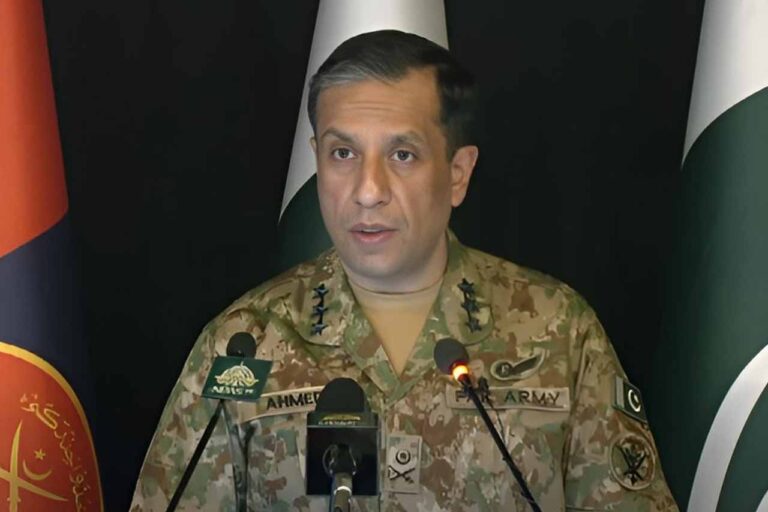
    Director General of Inter-Services Public Relations (ISPR) Lieutenant General Ahmed Sharif Chaudhry has said Pakistan must become a “hard state” where the Constitution and law are applied equally to everyone, stressing that strong governance is essential to defeating terrorism and ensuring lasting peace. He rejected claims that the security situation in Balochistan is worsening, calling them part of a deliberate campaign to create a false perception about the province. Addressing a detailed press conference on Friday, the military spokesperson said Pakistan’s security forces continue to make significant gains against terrorism through sustained intelligence-based operations across the country. Lt Gen Chaudhry said a total of 40,348 intelligence-based operations (IBOs) have been carried out so far this year by the armed forces, police, intelligence agencies and civil armed forces. More than 31,000 of these operations were conducted in Balochistan, reflecting the state’s continued focus on restoring peace in the province. He said Pakistan recorded 3,145 terrorism-related incidents during 2026. Of these, 1,971 incidents occurred in Khyber Pakhtunkhwa, 1,148 in Balochistan and 26 in other parts of the country. The ISPR chief said security forces killed 2,084 confirmed terrorists during operations this year, describing it as the highest average in the country’s history. On average, around 10 terrorists have been eliminated every day, while nearly 200 intelligence-based operations are conducted daily. Highlighting the sacrifices made in the fight against terrorism, Lt Gen Chaudhry said 819 Pakistanis lost their lives in terrorism-related incidents this year. The victims included 303 military personnel, 194 members of police and civil armed forces, and 322 civilians. He also revealed that 28 suicide attacks had taken place across the country during the year. According to him, most of these attacks involved Afghan nationals or individuals linked to groups operating from Afghan territory. The military spokesperson said the rise in terrorist attacks should not be viewed as a sign of weakness. Instead, he argued that militant groups have intensified attacks because of increasing pressure from proactive security operations and repeated battlefield setbacks. Lt Gen Chaudhry also accused the Afghan Taliban administration of allowing terrorist groups to operate from Afghan soil, claiming cross-border support remains a major factor behind terrorism inside Pakistan. Explaining his vision of a “hard state,” he said it does not mean military rule. Rather, it refers to a country where institutions function according to the Constitution, laws are enforced fairly, and no individual or group stands above the law. Referring to Article 5 of Pakistan’s Constitution, he said loyalty to the state and obedience to the Constitution are fundamental duties of every citizen. He added that discussions about rights must also include recognition of civic responsibilities. Speaking specifically about Balochistan, Lt Gen Chaudhry said the province’s real challenge lies with certain elites and tribal leaders who seek to preserve the existing power structure. He alleged that some influential groups oppose educational and economic progress because they fear losing their traditional influence. He further claimed that some individuals benefit from illegal activities, including smuggling and other criminal networks, and promote unrest whenever the state strengthens law enforcement or cracks down on such activities. The military spokesperson reiterated that Pakistan would not negotiate with terrorist groups or those using violence for political purposes. Instead, he said the armed forces would continue engaging directly with the people of Balochistan, whom he described as the province’s true stakeholders. Lt Gen Chaudhry also alleged that hostile foreign powers are attempting to exploit Balochistan’s strategic location and natural resources by supporting anti-state elements in collaboration with local actors opposed to reforms and development. Discussing the issue of missing persons, he said the Commission of Inquiry on Enforced Disappearances has received 10,901 complaints since its establishment. Of these, 9,372 cases have been resolved, with 4,896 individuals returning home, around 1,030 found in prisons, 308 confirmed dead, and nearly 2,400 complaints determined to be incorrectly reported. He added that 2,933 complaints originated from Balochistan, of which 2,767 have already been resolved.

  • | |

    SC rejects Zahir Jaffer’s plea in Noor Mukadam c…

    ISLAMABAD: The Supreme Court has rejected a review petition filed by Zahir Jaffer challenging his death sentence in the Noor Mukadam murder case, ruling that the severity of the crime did not justify any reduction in punishment. In its detailed 12-page judgment, authored by Justice Ishtiaq Ibrahim, the apex court said Jaffer had sought to have his death sentence commuted to life imprisonment on the basis of alleged mental illness. However, the court found that he had failed to provide evidence sufficient to support his claim or warrant reconsideration of the earlier verdict. The judgment stressed that the material on record established the exceptionally serious nature of the offence. It held that the circumstances of the crime provided no basis for reducing the sentence imposed on the convict. The court also clarified that its powers in a review petition are narrowly defined and that such proceedings cannot be used as a substitute for an appeal against an earlier judgment. The Supreme Court further observed that violence against women and the creation of an atmosphere of fear and insecurity are incompatible with both Islamic principles and established legal norms. It emphasised that Islam guarantees women dignity, protection and respect. Moreover, The Supreme Court has issued its detailed written judgment dismissing the review petition filed by convicted murderer Zahir Jaffer against his death sentence in the Noor Mukadam murder case. The 12-page judgment was authored by Justice Ishtiaq Ibrahim. According to the written judgment, Zahir Jaffer had requested the court to reconsider his death sentence and convert it into life imprisonment on the grounds that he was suffering from a mental illness. However, the Supreme Court observed that the convict had failed to present any evidence that could justify reconsideration of the court’s earlier decision. The judgment stated that the available record clearly established that Zahir Jaffer had committed an extremely serious crime. The court noted that the nature and circumstances of the offence did not warrant any reduction in the punishment awarded to him. The Supreme Court further explained that its jurisdiction in a review petition is extremely limited. A review application cannot be treated as an appeal, nor can the petitioner use the review process simply to seek a fresh examination of the entire case. The written judgment also highlighted the protection and respect afforded to women under Islam. The court observed that subjecting women to violence, abuse and insecurity is contrary to both Islamic principles and the laws of the state. The Supreme Court’s decision means that the death sentence awarded to Zahir Jaffer remains intact. The trial court had previously sentenced him to death for the rape and murder of Noor Mukadam. The Islamabad High Court subsequently upheld the death sentence, and the Supreme Court also maintained the punishment before rejecting his review petition.

  • | |

    ECP begins Islamabad local polls preparations

    The Election Commission of Pakistan (ECP) has started the delimitation process for holding local government elections in Islamabad. The commission said the formal process will begin on August 1, 2026, and will continue until October 13, 2026. The delimitation of constituencies is a major step before announcing the election schedule. An ECP spokesperson said that after the completion of the delimitation process and publication of the final constituencies, the commission will consult the federal government regarding the date for Islamabad’s local government elections. The spokesperson also shared updates about local government elections in Punjab and Khyber Pakhtunkhwa. In Punjab, delimitation authorities have been directed to submit their decisions to the relevant committees by August 7. The final delimitation list for the province will be published on August 17. The ECP said it is fully prepared to conduct local government elections in Punjab after completing all necessary legal requirements and consultations. Regarding Khyber Pakhtunkhwa, the commission said delimitation has been completed in 23 districts, while work is continuing in seven more districts. The spokesperson said the ECP held discussions with the Khyber Pakhtunkhwa chief secretary and local government secretary on July 14 about the election schedule. Provincial authorities were given additional time after requesting support for completing arrangements. The commission said recent amendments to the Khyber Pakhtunkhwa Local Government Act created legal issues that affected the delimitation process. The ECP informed the provincial government about these concerns and sought cooperation to resolve the matter. The spokesperson said the commission has faced delays in local government elections because federal and provincial governments often change local government laws close to election dates. He said the ECP has repeatedly completed delimitation exercises and prepared election schedules, but changes in legal frameworks affect the process. The commission recommended that major changes to local government laws and boundaries should be completed at least one year before elections. It said this would help ensure a smooth and timely electoral process.

Leave a Reply

Your email address will not be published. Required fields are marked *