chief urges drastic
| | |

UN chief urges drastic emissions cuts as COP31 wrestles with fossil fuels

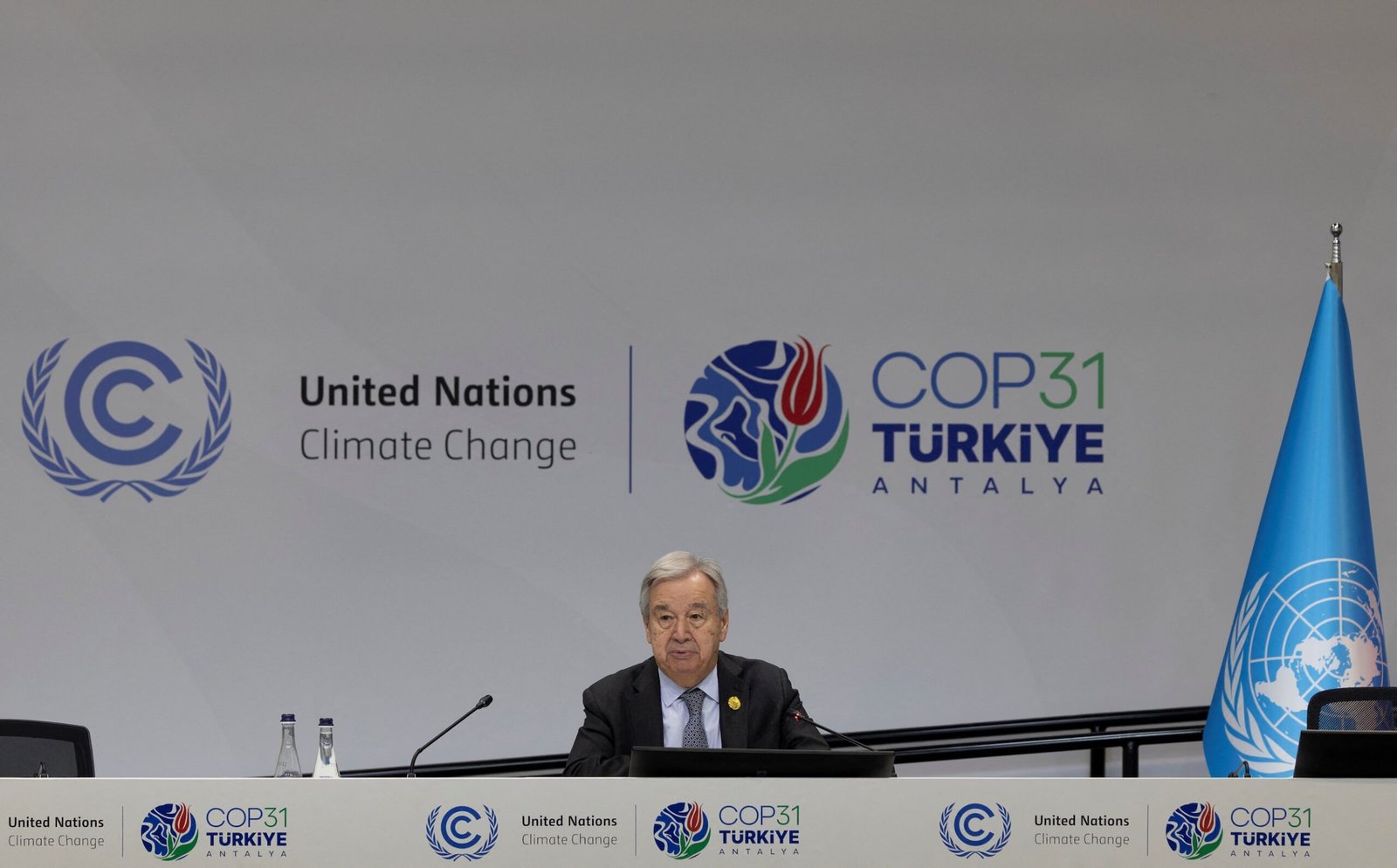
ANTALYA, Turkey – UN Secretary-General Antonio Guterres on Friday, November 13, called for an “immediate and drastic reduction” in greenhouse gas emissions, as divisions over fossil fuels dominated the first week of COP31 climate talks in Turkey.

Big fossil fuel producers and consumers at the talks are resisting any deal that would specify firm new targets or a shift away from oil, gas and coal, observers said as the first week of talks drew to a close.

That poses a challenge for summit host Turkey and lead negotiator Australia, which have another week to land the kind of ambitious agreement climate advocates such as Guterres say is needed.

“The central question is in the hands of member states, particularly the big emitters. They must recognize the need for an immediate and drastic reduction in emissions to keep the 1.5 goal still possible by the end of the century,” he said, referring to the warming limit countries had agreed to pursue under the 2015 Paris Agreement.

A UN report last month found the world is on course to exceed the 1.5 degrees Celsius (2.7 degrees Fahrenheit) warming threshold, a limit scientists say should prevent the worst effects of climate change.

As temperatures have risen, this year has been marked by extreme heatwaves across Western Europe and a glacier collapse in Nepal that triggered a flood that killed more than 1,450 people. Thousands more are still ​missing.

The fossil fuel lobby

Major oil producers such as Saudi Arabia and Russia have traditionally resisted language constraining fossil fuels, while large developing economies such as India have opposed measures they say could limit their development and energy choices, a dynamic that has compromised the outcomes of past deals.

The world’s biggest oil consumer, the United States, meanwhile, has skipped the talks for the second year in a row under President Donald Trump, who has called global warming a hoax and promoted continued use of fossil fuels.

“We must confront the disproportionate influence of the fossil fuel lobby. The future of our planet cannot be negotiated on the terms of those profiting from its destruction,” said Guterres, who is leaving his job at the end of December after two five-year terms.

“But I remain hopeful. I’ve also seen something extraordinary over these 10 years. Renewable energy has moved from the margins to the mainstream. The economics have changed. The technology has advanced. A cleaner, safer, and more secure energy future is in our hands. The question is whether we have the courage and speed to reach for it.”

Electrification and no firm targets

COP31 host Turkey is striving to place a proposal to expand global electrification at the center of an eventual deal, saying the plan will lead to emissions cuts by speeding the shift away from fossil fuel-powered cars, boilers and other equipment.

The proposal does not require the increased electricity use to come from renewable sources, although some countries, including last year’s COP host Brazil, are advocating for progress on a plan to require countries to more clearly map out their transition away from fossil fuels.

Katrine Petersen, an observer for the non-governmental organisation E3G, said whether those measures survive the talks depends on conversations in the days to come.

“We’ve also heard quite clearly from countries like India, the G77, that they don’t want any firm targets. They don’t want any kind of technology or fuel-specific language,” she said. “(These are) the kind of consistent and ongoing divides that we’ve seen from those different parties before.”

Representatives from India, Saudi Arabia and Russia did not immediately comment.

Diana Acconcia, head of the EU delegation, said Europe backed the electrification goal.

“Electrification is, in a way, an inclusive agenda because it is non-prescriptive in a way on how the electrification is achieved,” she said. “Of course, for the European Union electrification is to be achieved by clean sources of energy.”

The Australian team, which is leading negotiations under a split presidency arrangement, spent the first few days of the summit gathering views on what should be included in a political text agreed by consensus that will be followed by all the negotiated technical points.

Australia is taking further submissions from countries until Saturday night, November 14, with a view to formulating a draft text early next week. – Rappler.com

Similar Posts

  • |

    Chances of US-Iran agreement remain uncertain 

      Despite US President Donald Trump’s confident claim that a deal with Iran has effectively been finalized, senior Gulf officials have indicated that the prospects of reaching an agreement this Friday remain uncertain. These officials estimated the likelihood of a successful agreement at only “fifty-fifty,” suggesting that significant obstacles still stand in the way of a final breakthrough. According to the sources, one of the major concerns is the composition of the Iranian delegation currently involved in discussions. They revealed that representatives of Iran’s Islamic Revolutionary Guard Corps (IRGC) are not part of the negotiating team. This absence is viewed as highly significant because the IRGC is widely regarded as the most influential military and political institution in Iran and is expected to have the final authority in approving any interim or broader agreement. Without its backing, even a negotiated framework may struggle to gain official approval in Tehran. President Trump has repeatedly expressed confidence in the ongoing diplomatic efforts between Washington and Tehran. Earlier, he stated that American officials were holding “very good talks” with their Iranian counterparts and suggested that negotiations were progressing positively. However, he also issued a stern warning, saying that if Iran were to back away from a potential agreement as it had in previous rounds of negotiations, the United States would respond with decisive and severe measures. His remarks reflected a combination of optimism about diplomacy and a willingness to adopt a tougher stance should talks collapse. Trump also hinted that an agreement concerning the Strait of Hormuz could be reached as early as today. The Strait of Hormuz is one of the world’s most strategically important maritime routes, carrying a significant portion of global oil exports. Any understanding aimed at ensuring safe navigation through the waterway would be welcomed by international markets and regional governments, given the repeated tensions and security incidents that have threatened shipping in recent years. Despite the optimistic statements coming from Washington, Iran has continued to deny that it is engaged in direct negotiations with the United States. Iranian officials maintain that their current discussions are exclusively with Oman and are focused on resolving issues related to maritime navigation and shipping through the Strait of Hormuz. Tehran has consistently rejected claims that formal talks with Washington are underway, emphasizing that its engagement is limited to regional diplomatic channels. Political analysts believe, however, that the ongoing dialogue between Iran and Oman could serve as an important bridge toward eventual negotiations between Tehran and Washington. Oman has long played the role of a trusted intermediary between the two countries, facilitating discreet diplomatic contacts during previous periods of heightened tension. Analysts argue that if discussions between Iran and Oman produce positive outcomes, they could help build confidence, reduce mistrust, and create the conditions necessary for broader US-Iran negotiations in the near future. For now, uncertainty continues to dominate the diplomatic landscape. While President Trump projects confidence that a breakthrough is close, regional officials remain cautious, pointing to unresolved political and military considerations that could still prevent a final agreement. The coming days are expected to determine whether diplomatic efforts can translate into a meaningful deal or whether tensions between the United States and Iran will persist.

  • | | | |

    US ‘locked and loaded’ as Iran talks continue

    US President Donald Trump has said Washington is engaged in direct talks with Iran, signalling that diplomacy remains active despite rising tensions in the Middle East. However, he warned that the United States remains fully prepared for military action if negotiations fail. Speaking at the White House, Trump said discussions with Tehran are ongoing and described Iranian officials as becoming “very serious” in the negotiations. He stressed that while the US is not rushing to reach an agreement, preventing Iran from acquiring a nuclear weapon remains a top priority. The US president also stated that a previously mentioned “massive” military strike against Iran may not be necessary if diplomatic efforts produce results. Nevertheless, he made it clear that American forces remain on high alert and are fully prepared to respond if required. Trump said senior administration officials, including Secretary of State Marco Rubio and Vice President JD Vance, are involved in the ongoing diplomatic contacts with Iran. He did not provide further details about the negotiations or any possible timeline for an agreement. Iranian Foreign Minister Abbas Araghchi responded by saying Tehran would not be intimidated by threats or external pressure. Speaking during a regional meeting in Kyrgyzstan, he said Iran would continue defending its national interests and would not change its policies under pressure. Meanwhile, regional tensions remain high. Air raid sirens were reported in Bahrain as Iran claimed it continued targeting US military bases in Bahrain, Kuwait and Jordan. The situation has added to concerns over a wider conflict in the Gulf region. The Saudi-led coalition also announced military operations against Houthi positions in Yemen. Coalition officials said the strikes targeted military sites, while Houthi media reported damage to telecommunications and port facilities in Hodeidah and claimed that one civilian was injured. Violence also escalated in the occupied West Bank, where clashes involving Israeli settlers and Palestinians left several people dead. Rights groups have urged the international community to take immediate steps to prevent further violence and protect civilians.

  • |

    North Korea issues fresh warning to US allies

    PYONGYANG: North Korea has accused the United States, Japan and South Korea of creating a new security crisis in the Asia-Pacific, claiming their expanding military cooperation is increasing regional tensions and threatening stability. In a commentary published by the state-run Korean Central News Agency (KCNA), a military commentator alleged that the three allies are strengthening their joint combat capabilities through large-scale military exercises and closer defence coordination. The statement specifically criticized the recently concluded Rim of the Pacific (RIMPAC) naval exercise, describing it as a rehearsal for military aggression rather than a routine multinational drill. According to North Korean officials, the exercise involved more than 30,000 personnel, over 30 warships, five submarines and nearly 190 aircraft. Pyongyang claimed the United States is attempting to strengthen its military influence across the Asia-Pacific with the support of Japan and South Korea. It also objected to recent US-South Korea air force and logistics exercises, plans to expand American military command structures in Japan and the deployment of advanced US missile systems in the region. North Korea warned that it would respond to what it described as growing military threats by further strengthening its own deterrence capabilities. Officials said any increase in external pressure would be met with corresponding defensive measures. Separately, North Korea’s Foreign Ministry rejected recent accusations by the United States and its allies that Pyongyang poses a growing cyber threat. The ministry dismissed the allegations as politically motivated and without evidence. A foreign ministry spokesperson argued that the United States has been expanding military activities in cyberspace through cyber commands, joint cyber exercises and the use of artificial intelligence in defence operations. The spokesperson claimed Washington, rather than Pyongyang, was contributing to rising tensions in the cyber domain. North Korea reaffirmed that it would continue taking measures to safeguard its national security and protect its development interests against what it described as increasing pressure from Western countries.

  • | | |

    Imran Khan breaks silence on gender stereotypes, feminism and Bollywood’s portrayal of men

      Ahead of his much-anticipated return to the big screen, Indian actor Imran Khan has spoken candidly about gender stereotypes, feminism, masculinity, fatherhood and the influence cinema can have on social attitudes. In a recent conversation, the actor explained that his growing concern over the way gender-based assumptions have become part of everyday discussions played an important role in shaping his decision to speak more openly about these issues. Khan said he had become increasingly interested in examining the expectations society places on both men and women. According to him, certain assumptions about how people should behave based on their gender have become so common that they are often expressed without being questioned. The actor said he felt a personal responsibility to contribute to conversations surrounding these issues. Rather than remaining a passive observer, he wanted to use his public platform to encourage people to reconsider ideas that have gradually become normalised in society. Khan also discussed the relationship between feminism and conversations about men’s rights. He argued that debates surrounding both subjects can sometimes become trapped within the same stereotypes they are attempting to challenge. In his view, some men who criticise feminism for being problematic may fail to recognise that their own arguments can be influenced by patriarchal thinking or ideas associated with toxic masculinity. For Khan, feminism should not be understood as an attempt to marginalise men or exclude anyone from the conversation. He stressed that discussions about feminism and masculinity should ultimately focus on equality and creating a society in which people are not restricted by traditional gender expectations. The actor also turned his attention to the portrayal of men in Indian cinema, particularly characters who struggle to cope with romantic rejection. Khan argued that Bollywood has repeatedly presented emotionally immature male characters in a sympathetic manner, often encouraging audiences to overlook their problematic behaviour because the characters are experiencing heartbreak. He criticised films in which a male protagonist responds to rejection with anger, obsession or inappropriate behaviour, while the narrative continues to portray him as a victim deserving sympathy. According to Khan, these stories can unintentionally normalise unhealthy emotional responses and send the wrong message about relationships and masculinity. Khan suggested that cinema has a significant cultural influence and therefore filmmakers should consider how their characters and storylines may shape public perceptions. Instead of constantly justifying problematic behaviour through a character’s emotional pain, films could present more mature and realistic portrayals of men dealing with rejection, relationships and vulnerability. His comments come as he prepares to make his return to acting after a prolonged break from the industry. Khan’s decision to step away from films had kept him largely out of the public eye, making his comeback a significant moment for fans who have followed his career. Now, as he prepares to return to the screen, Khan appears interested not only in acting but also in engaging with wider social conversations. His recent remarks reflect his desire to use his experiences and public platform to question established ideas about gender, relationships and masculinity. With his comeback approaching, audiences will be watching closely to see whether Khan’s renewed presence in cinema also brings a different perspective to the kinds of stories and characters he chooses to be part of.

  • |

    World’s tallest bridge features 300-meter artificial waterfall

    China has completed several remarkable engineering projects in recent years but the Huajiang Grand Canyon Bridge stands out as one of the most extraordinary. Often described as an engineering marvel, the bridge is not for the faint-hearted. Anyone with a fear of heights may find crossing it a nerve-racking experience. The bridge is situated 625 meters (2,051 feet) above the ground and was opened to the public in September 2025 making it the world’s tallest bridge. However, its height is not the only feature that makes it unique. The bridge also includes a spectacular artificial waterfall making it a major tourist attraction rather than just a transportation route. Chinese authorities designed the bridge as both an infrastructure project and a tourist destination. Visitors can enjoy glass walkways, cafes inside the bridge towers and adventure activities such as bungee jumping. The bridge’s most eye-catching attraction is its 300-meter-long artificial waterfall which creates a dramatic curtain of water. A laser lighting system has also been installed allowing the waterfall to put on a dazzling display at night. According to local authorities, thousands of tourists visit the site every day. The bridge gained further recognition when Time magazine ranked it as the No. 1 destination in its list of the World’s Greatest Places for 2026. Located in Guizhou Province in southwestern China, the Huajiang Grand Canyon Bridge was primarily built to reduce travel time across the mountainous region. Guizhou’s rugged terrain previously made travel between many locations slow and difficult. Thanks to the new bridge, a journey that once took two hours can now be completed in about one minute. Constructed from 20,000 tons of steel roughly equivalent to the amount used in three Eiffel Towers, the bridge stretches 9,482 feet (about 2,890 meters) in length. Construction began in January 2022 and the bridge officially opened to the public in September 2025.

  • |

    Israeli strikes kill two in Gaza as hospital medicine warehouses are destroyed

    Two Palestinians were killed in an Israeli air strike in Gaza on Saturday, while separate strikes destroyed warehouses storing medical supplies for Al Aqsa Martyrs Hospital, raising new concerns about access to healthcare in the territory as uncertainty continues over a possible agreement between Israel and Hamas. According to Palestinian health officials, the two people were killed in the Sheikh Radwan area of Gaza City. The Israeli military said the strike targeted Hamas fighters but did not provide further details about the operation or identify those killed. In another strike earlier the same day, two warehouses near Al Aqsa Martyrs Hospital in Deir al Balah were destroyed. Gaza’s Health Ministry said the buildings contained essential medicines and medical equipment used by the hospital to treat patients, including those receiving dialysis for kidney failure. Other supplies such as wound care materials and gauze were also stored there. The attack also damaged two additional medical storage facilities and the hospital’s outpatient clinic. Hospital officials said no injuries were reported among staff or patients during the incident, but they warned that the destruction of medical supplies would make it more difficult to provide treatment to those in need. Dr Khalil al Daqran, who works at the hospital, condemned the strike and said the destroyed warehouse contained critical medical resources needed for daily operations. He said the loss of the supplies would place further strain on healthcare services already struggling under difficult conditions. Witnesses said Israeli forces issued an evacuation warning before carrying out the strike. The Israeli military did not immediately comment on the attack targeting the warehouse complex. Under international humanitarian law, hospitals and civilian medical facilities are protected during armed conflict unless they are being used for military purposes. Israel has repeatedly accused Hamas and other armed groups of operating from within civilian infrastructure, including hospitals and surrounding buildings, an allegation Hamas has denied. Fatima Sharab, a displaced Palestinian staying in a nearby camp, said many families had chosen to shelter close to the hospital because they expected easier access to medical care if needed. She said the strike caused widespread destruction in the area and left many displaced people without shelter. The latest attacks come despite a ceasefire agreement reached last year through US mediation. Fighting and Israeli military operations have continued across Gaza in the months since. Palestinian health authorities say more than 1,200 people have been killed during that period, with many of the victims reported to be civilians, including women and children. Hamas has not regularly disclosed the number of its fighters killed. Attention is now focused on a possible breakthrough in negotiations to end the conflict. US President Donald Trump recently announced that Hamas had agreed to disarm as part of a broader peace initiative aimed at ending the war. However, Israeli Prime Minister Benjamin Netanyahu has not publicly confirmed whether Israel accepts the reported agreement. Israeli National Security Minister Itamar Ben Gvir has openly opposed the proposal, saying Israel should continue military operations and maintain its campaign against Hamas leaders. Meanwhile, Trump’s Board of Peace has released a roadmap outlining the final steps of its proposed plan, stating that Israel would halt military operations as part of the agreement if all parties move forward with its implementation.

Leave a Reply

Your email address will not be published. Required fields are marked *