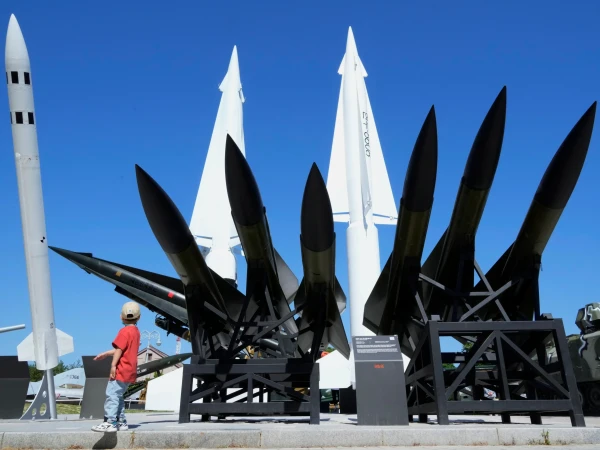
approves 125m missile
|

US approves $125m missile sale to South Korea

WASHINGTON: The United States has approved a potential $125 million sale of advanced air-to-air missiles and related military equipment to South Korea, in a move aimed at strengthening Seoul’s defence capabilities amid continuing security concerns in the region.

According to reports, the US State Department has approved the proposed arms package, which includes AIM-9X Sidewinder Block 103 missiles and tactical guidance units requested by South Korea.

The proposed deal is valued at approximately $125 million and is intended to enhance the South Korean military’s ability to respond to potential aerial threats.

South Korea has requested the purchase of the AIM-9X Sidewinder Block 103, along with 10 tactical guidance units. The missiles are designed to be launched from fighter aircraft against airborne targets and are considered an important component of modern close-range air combat capabilities.

The AIM-9X is an advanced short-range, infrared-guided air-to-air missile. It is designed to provide pilots with rapid engagement capabilities and improved accuracy against highly manoeuvrable aerial targets.

The proposed sale is also significant because of the close defence relationship between Washington and Seoul. The two allies regularly conduct joint military exercises and maintain extensive cooperation aimed at strengthening deterrence and preparedness on the Korean Peninsula.

However, the approval does not necessarily mean that the transaction has been completed.

The proposed arms sale still has to go through the formal US Congressional notification and review process. The process allows lawmakers to examine major foreign military sales before they proceed.

The package comes at a time when security issues in East Asia remain a major focus for both Washington and Seoul. South Korea continues to modernise its military capabilities while maintaining close coordination with the United States.

For Washington, arms sales to South Korea are part of a broader defence relationship that includes military exercises, weapons cooperation, intelligence sharing and the deployment of US forces in the region.

For Seoul, acquiring advanced air-to-air weapons could strengthen the capabilities of its fighter fleet and improve its readiness to respond to potential threats.

The AIM-9X system is already used by several US allies, making interoperability an important factor in joint operations and training.

The proposed $125 million package therefore represents more than a weapons purchase. It also underlines the continuing strategic partnership between the United States and South Korea at a time when regional military preparedness remains under close scrutiny.

The final outcome will depend on the completion of the Congressional review and subsequent steps required for the proposed sale.


Similar Posts

  • | |

    PPP-PML-N row intensifies as AJK polls enter secon…

    Political tensions between the Pakistan Peoples Party (PPP) and the Pakistan Muslim League-Nawaz (PML-N) have deepened as Azad Jammu and Kashmir (AJK) entered the second phase of its elections. Despite several rounds of negotiations, the two coalition partners failed to resolve their dispute over the first phase of polling. The second phase of the elections is being held in nine constituencies of Muzaffarabad division and all 12 refugee constituencies. Authorities have made extensive security arrangements to ensure peaceful polling, while political uncertainty continues to dominate the electoral process. The disagreement began after the first phase of elections in Mirpur, where the PML-N secured key victories. The PPP questioned the election results and alleged irregularities in several constituencies. The PML-N rejected the allegations and insisted that the elections reflected the public mandate. The dispute has led to an exchange of sharp political statements between leaders of both parties. Senior PML-N leader Rana Sanaullah criticized PPP Chairman Bilawal Bhutto Zardari for repeatedly raising allegations of election rigging. He questioned the basis of such claims and also referred to the election of President Asif Ali Zardari while responding to the PPP’s criticism of the 2024 general elections. Rana Sanaullah also commented on Interior Minister Mohsin Naqvi’s recent remarks regarding the country’s governance system and the debate over creating new provinces. He criticized the minister’s statements and questioned his political rise. Meanwhile, PPP leader Saeed Ghani strongly defended his party during a press conference. He claimed that the PPP had never formed a government through election manipulation. He alleged that the PML-N had repeatedly benefited from controversial election outcomes and accused its leadership of making baseless allegations against the PPP. In an effort to reduce tensions, senior representatives from both parties held several meetings over the past few days. The discussions focused on finding a legal and political solution to the dispute over the election results. According to party sources, the PPP initially challenged the results in four constituencies. It later withdrew objections in two constituencies but continued to demand action regarding Charhoi and Nakyal, where its candidates were defeated by PML-N nominees. During the negotiations, PML-N representatives maintained that any irregularities were isolated incidents rather than evidence of systematic rigging. They argued that such incidents had occurred in previous elections and should not be used to question the overall electoral process. The talks, however, failed to produce a final agreement. As a result, political tensions remained high ahead of the second phase of voting. Separately, Prime Minister Shehbaz Sharif met PML-N President Nawaz Sharif at Jati Umra to review the evolving political situation. The meeting focused on the party’s strategy and the growing dispute with the PPP over the AJK elections. Punjab Chief Minister Maryam Nawaz and Deputy Prime Minister Ishaq Dar also attended the consultation. The participants reviewed the political challenges facing the ruling coalition and discussed possible steps to prevent further escalation between the two allied parties. In another development, PPP Chairman Bilawal Bhutto Zardari said he had received a positive response to his proposal for establishing a truth and reconciliation commission in Azad Kashmir. He described the response as encouraging and said the proposal had also received support from the AJK Legislative Assembly. Bilawal said he would carefully review the suggestions before consulting AJK Prime Minister Raja Faisal Mumtaz Rathore. He added that discussions would also be held with the federal government and other stakeholders to determine whether a consensus could be reached on the proposed commission.

  • |

    China introduces brain-controlled robot technology

    Several countries are actively developing Brain-Computer Interface (BCI) technology which enables people to interact with devices using only their thoughts without the need for physical movement. Now, a Chinese company is working to integrate this technology into robots. According to BrainCo, the company has developed the world’s first brain-to-robot interface system allowing robots to be controlled directly through human thought. The company said the system works using EEG headsets which are worn by human operators. These headsets monitor brain activity and translate it into commands that are sent to the robot. Like other BCI technologies, the system relies on extensive training data that maps specific patterns of brain activity to corresponding actions. Artificial intelligence (AI) algorithms are then used to accurately interpret a person’s intended action and convert it into the correct robotic response. The technology called the Brain-Controlled Robot AI Platform was unveiled at the World Artificial Intelligence Conference in Shanghai. BrainCo said the system can be used not only to control robots but also to operate robotic arms and other connected devices. The platform continuously collects data which is used to further improve its AI algorithms and enhance performance over time. According to the company, rapid advances in AI have enabled robots to perform many tasks independently. However, it believes the next major challenge is ensuring that robots can effectively understand and collaborate with the humans working alongside them.

  • |

    Pakistan enlists top global banks for sovereign de…

    The federal government has appointed three consortiums of leading international banks to manage Pakistan’s future sovereign debt issuances under its Global Medium-Term Note (GMTN) and international Sukuk programmes. The move is part of the government’s broader strategy to regain access to international capital markets and strengthen external financing. The Ministry of Finance announced the appointments on Tuesday. Officials said the banks were selected through a competitive and transparent procurement process carried out under pre-defined financial and technical criteria. The selected consortiums will provide advisory and financial services for Pakistan’s future issuance of conventional Eurobonds, Islamic Sukuk and rupee-denominated bonds settled in US dollars. The Eurobond consortium includes Standard Chartered Bank, Citibank, Deutsche Bank AG, Emirates NBD Capital and MUFG Securities Asia Limited. The international Sukuk consortium consists of Standard Chartered Bank, Dubai Islamic Bank PJSC, Citibank, Emirates NBD Capital and Mashreq Bank PSC. The consortium for rupee-denominated, US dollar-settled bonds includes Standard Chartered Bank, Citibank and Deutsche Bank AG. The Finance Ministry said the appointments will remain valid for three years. During this period, the consortiums will support Pakistan’s sovereign borrowing programme through both conventional and Islamic financing instruments. Officials said any future debt issuance will take place after the completion of all required legal documentation, regulatory approvals and market-related formalities. Finance Minister Muhammad Aurangzeb, who is currently visiting Washington, DC, held a virtual meeting with senior executives of the selected banks. The meeting marked the beginning of the government’s strategic partnership with the international financial institutions. The ministry said the inclusion of MUFG Securities Asia Limited and Mashreq Bank has expanded Pakistan’s engagement with leading global financial institutions and is expected to attract a wider range of international investors. According to the ministry, recent improvements in Pakistan’s economic indicators have strengthened investor confidence. Officials pointed to fiscal consolidation, stronger external financial buffers, progress on structural reforms and narrowing sovereign credit spreads as key factors supporting the country’s planned return to international debt markets.

  • |

    Oman proposes gulf-backed plan to ease Strait of Hormuz tensions

      Oman has proposed a new framework for managing the strategically important Strait of Hormuz, with support from Gulf countries, according to a Gulf source and a Western diplomat who spoke to Reuters on Tuesday. The proposal includes a system under which ships using the waterway would be encouraged to make voluntary financial contributions rather than pay mandatory transit fees. The initiative is aimed at easing tensions and restoring stability in one of the world’s busiest maritime trade routes following months of disruption caused by the conflict involving the United States, Israel, and Iran. A senior Iranian official told Reuters that Tehran has not yet responded to Oman’s proposal, which is intended to provide a foundation for a broader agreement to ensure the safe movement of commercial vessels through the strait. The Strait of Hormuz is one of the most critical shipping lanes in the world, carrying around one-fifth of global oil and liquefied natural gas supplies before the conflict intensified. The route has become a focal point of regional tensions, with repeated incidents affecting international trade and energy markets. Meanwhile, US President Donald Trump said there had been “good talks” involving Iran but warned that military action could resume if diplomatic efforts fail to produce results. Trump recently halted a planned two-week US bombing campaign, marking another major shift in his administration’s approach toward the conflict. Despite his comments, Iranian officials continue to deny that Tehran is preparing to restart negotiations with Washington. Earlier this month, the United States launched a renewed military campaign aimed at reducing Iran’s influence over the Strait of Hormuz. Iran had effectively restricted access to the waterway following military strikes by the United States and Israel on February 28, allowing only Iranian vessels to move freely through the area. Although a temporary agreement between Washington and Tehran led to the partial reopening of the strait last month, the arrangement quickly fell apart in early July. According to reports, Iran fired on ships using a navigation channel that it does not officially recognize, reigniting concerns about maritime security and the uninterrupted flow of global trade. Iran has repeatedly stated that it wants to jointly oversee the Strait of Hormuz with Oman, which borders the opposite side of the narrow waterway. Tehran has also proposed charging vessels for navigation-related services. However, the United States argues that international ships should continue to enjoy unrestricted passage without being required to pay mandatory fees, maintaining that such charges would violate international law. Under the proposal put forward by Oman, Iran would not have exclusive authority over the strait. Instead, management responsibilities would be shared, and any payments made by vessels would be entirely voluntary rather than compulsory, according to the Gulf source and the Western diplomat familiar with the discussions. The proposed model is similar to the system used in Southeast Asia’s Strait of Malacca, where Indonesia, Malaysia, and Singapore invite shipping companies to make voluntary contributions. Those funds are used to support navigation safety, environmental protection, and search-and-rescue operations instead of functioning as mandatory transit charges. The Omani initiative is being viewed as a possible compromise that could reduce regional tensions, safeguard international shipping, and help restore confidence in one of the world’s most strategically significant maritime corridors.

  • | |

    DI Khan church still guards colonial memories

    There are some places we pass every day without realising how much history they hold. They remain untapped until some visitors put their eyes on them. During summer vacations, I travelled to Dera Ismail Khan, a district situated in southern Khyber Pakhtunkhwa. It takes six hours from Lahore to arrive in this historic city. During my stay there, I came across one such place that immediately captured my attention, and I thought to write about it. It was St Thomas Church, sacred place of worship for Christian community. A large cross standing at the entrance, old rusty walls, and an ambience of spiritualism. But the Church showcased more than that. Its walls contain historical accounts of colonial past, the military campaigns led by British soldiers in this area and a grave of one Lieutenant Governor of Punjab.   St Thomas Church was built in 1856 during British rule in the Indian subcontinent. It is one of the oldest churches in present-day Pakistan. It has survived political changes, the Partition of 1947, and the passing of time. Even today it stands as a symbol of the rich and diverse heritage of Dera Ismail Khan. The church is not only a place of worship but also a reminder that different faiths and communities have long been part of the history of this region. As we walked inside, we met the old priest and caretaker of the church named Chand. He welcomed us warmly and narrated the remarkable history of this place. There are memorials of British soldiers who lost their lives in this region during military campaigns. The priest stood in front of each tablet inscribed on the church wall and briefed about it. One memorial narrates the names, ranks and units of one hundred and 69 British military officers and other ranks who were killed or died due to injuries or disease in Waziristan military campaigns launched between 1919 to 1921.     Another memorial lists details of sixty-eight officers and other ranks who met a similar fate during the 1936-1938 Waziristan military campaigns. Similarly, one tablet erected by friends and fellow officers mourns the death of Herbert Walter Gee, ICS, deputy commissioner of Dera Ismail Khan, who died in 1901. There are other memorials as well, erected by colleagues in memory of the fallen officers. I thought that these names contain historical accounts year by year about what happened in this part of the world at that time. Every sentence of the Priest carried a new story, such as how the church has witnessed a lot of happenings through generations and that it still serves the small Christian community living in Dera Ismail Khan. As we stepped outside, believing our visit had come to an end, the priest said, “Wait. I have to show you one more thing.” He took me to the back of the building, where I saw a large white grave standing quietly among the dusty bushes. Here rests Lieutenant General Sir Henry Marion Durand (1812-1871). Durdand – a quite familiar name for the people of Pakistan and Afghanistan. Sir Durand was a career British military officer, diplomat, and administrator. He served in the East India Company Army, took part in several military campaigns, and later became the Lieutenant Governor of Punjab from 1870 to 1871. His son Sir Mortimer Durand is the one who drew the contours of the border between British India and Afghanistan in 1893. A man who once held such an important position now lies in silence behind an old church, while many people living nearby are unaware that his grave even exists. Henry Marion Durand died in 1871 at the age of 58 from a tragic accident. He was visiting Nawab of Tank Shahnawaz Khan along with his daughter when he fell from an elephant. The elephant was passing through the gateway by the town of Tank with the Nawab on the same elephant and an official (Chaprassy). The gate was too low to cross an elephant with howdah. The howdah struck the walls of crossing and the elephant got frightened resulting in the fall of Durand. He remained unconscious for a few days and never recovered. He was buried beside St. Thomas’ Church in Dera Ismail Khan. The British suspected some conspiracy into this incident. One of descendent of Nawab Shahnawaz Khan says that The British launched an enquiry into it. But the daughter of Durand gave testimony in favour of the Nawab that it was just an accident and there was no fault on his part. However, as a punishment, the British authorities stripped the powers of Nawab Shahnawaz Khan in 1875 and sent him to Lahore under strict watch. He passed away in 1881 while under surveillance. Standing beside the grave of Sir Henry Durand, I felt as if I had stepped into a forgotten chapter of history. The name engraved on the stone reminded me that many important events and personalities of the past remain connected to places that we often overlook. How easily history can fade from people’s memories, even when it is standing right in front of us. As I left St Thomas Church, I felt that I had walked through a chapter of history that few people ever get to read. Sir Henry Durand ruled Punjab from this soil, and his son later sat across a table in Kabul and drew the line that still separates Afghanistan and Pakistan today. That line appears in newspapers and political debates all the time. Yet the grave of the man whose name it carries lies quietly behind a church in Dera Ismail Khan.

  • | | |

    Rana slams Naqvi’s ‘confusing’ provinces rem…

    Prime Minister Shehbaz Sharif’s Adviser on Political Affairs, Rana Sanaullah, said it was true that former prime minister Nawaz Sharif had instructed party leaders not to respond to Interior Minister Mohsin Naqvi’s recent statements. He added that the Pakistan Muslim League-Nawaz (PML-N) strongly disagreed with both the content and tone of Naqvi’s remarks. Speaking on a television programme, Rana Sanaullah described Mohsin Naqvi’s comments as “meaningless” and lacking context. He said he had listened to Naqvi’s speech but could not understand what message he was trying to convey. “It appeared that he wanted to make a significant point but failed to explain it properly. Once he made the statement, his subsequent remarks contradicted one another. I simply could not understand what he was saying or why he was saying it,” Rana Sanaullah said. He stressed that whenever a person makes a public statement, it reflects their personal opinion, adding that it was up to Mohsin Naqvi to clarify the intent behind his remarks and take responsibility for their interpretation. Responding to Naqvi’s proposal regarding the creation of new administrative units or provinces, Rana Sanaullah said such matters could not be decided merely through public statements. “You cannot simply talk about new provinces and expect them to come into existence. The Constitution clearly defines the procedure for creating new provinces or administrative units,” he said. He maintained that the issue should first be debated in Parliament, while the final decision would rest with the leadership of the political parties. Rana Sanaullah recalled that during the PML-N government in Punjab from 2013 to 2018, the party had formally proposed the creation of new provinces. He said he had personally presented both the resolution and the proposal for establishing a commission to examine the matter. He explained that a national commission would have to be formed to review all aspects of creating new provinces, including financial resources, administrative arrangements and constitutional requirements. “The commission would also need to consult on representation in the National Assembly, provincial assemblies and the Senate. This is a highly complex issue that requires serious deliberation by experienced policymakers,” he said. Rana Sanaullah added that Pakistan could adopt smaller provinces, a stronger local government system, or even both, but such decisions should be made collectively by political parties after thorough consultation

Leave a Reply

Your email address will not be published. Required fields are marked *