deports thousands indians
|

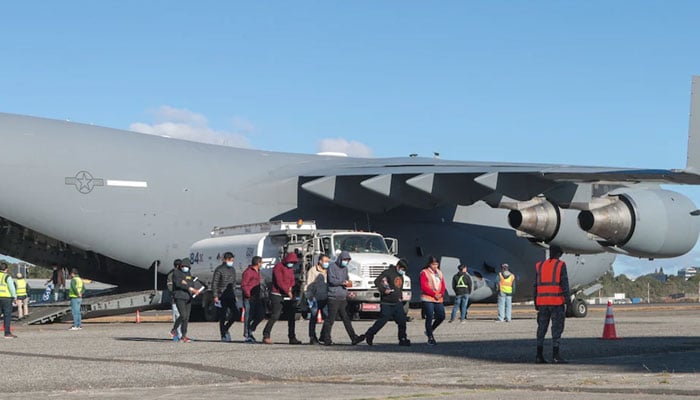
US deports thousands of Indians amid Trump immigration crackdown

The administration of US President Donald Trump has intensified its crackdown on undocumented immigrants, leading to a sharp rise in arrests and deportations across the country.

More than 4,800 Indian nationals have been deported from the United States, according to figures cited by foreign media. The latest enforcement drive has also pushed immigration arrests to record levels as US authorities step up efforts to remove people who lack legal immigration status.

The US Immigration and Customs Enforcement (ICE) arrested around 51,000 people last month, marking a record monthly figure, according to reports. The Trump administration says ICE is now carrying out roughly 2,000 arrests every day, while officials recorded an average of about 4,200 arrests per day during the first week of August.

Indian nationals have emerged as one of the largest Asian groups affected by the intensified enforcement campaign.

According to India’s Ministry of External Affairs, US authorities deported **3,567 Indian citizens in 2025**, the highest annual figure recorded in 16 years. During the first half of 2026 alone, another **1,273 Indian nationals** were deported from the United States, bringing the total number of deportations over the latest period to more than 4,800.

Data from the US-based organisation Stop AAPI Hate also highlights the disproportionate impact on Indian immigrants. Between January 2025 and March 2026, US authorities arrested 14,402 Asian nationals, of whom Indians accounted for around 28 percent.

During the same period, authorities deported 6,218 Asian nationals, with Indian citizens again making up approximately 28 percent of those deported.

The scale of the crackdown has raised concerns among human rights advocates and some former immigration officials. Critics argue that the aggressive enforcement campaign could affect families and long-term residents, particularly those facing uncertain legal or immigration status.

The Trump administration has set an ambitious target of deporting one million people annually. However, ICE figures indicate that the US deported around 400,000 people in 2025, considerably below the administration’s stated goal.

US officials also claim that more than **3 million undocumented immigrants have left the country, including approximately 2.2 million people who voluntarily returned to their home countries.

The administration has presented the figures as evidence that its tougher immigration policies are encouraging undocumented migrants to leave the United States while expanding enforcement against those who remain. Immigration advocates, however, continue to question the methods and broader consequences of the campaign.

Similar Posts

  • | |

    Katy Perry slams Trump administration over ‘Fire…

    WASHINGTON: Pop star Katy Perry has sharply criticized the Trump administration after the White House used her hit song “Firework” in a social media video showing US military strikes on Iran, saying the use of her music was completely contrary to the message behind the song. The White House’s official TikTok account shared a video on Thursday featuring footage related to US attacks on Iran. The clip used the familiar “boom, boom, boom” lyrics from Perry’s 2010 hit alongside images of military strikes. The post carried a blunt warning directed at Iran, adding a strikingly confrontational tone to a song that Perry has long described as being about hope, confidence and personal strength. Perry responded on social media on Saturday, making clear that she had not authorized the use of the song and did not support the way it had been presented. “I’m deeply shocked and angry,” Perry said in her statement, objecting to the song’s appearance alongside images of destruction and military action. She emphasized that no permission had been sought from her for the video and that she did not endorse its message. For Perry, the controversy goes beyond the question of whether her music was used without authorization. She argued that the video fundamentally changed the meaning of a song intended to encourage people facing difficult moments. “Firework,” released in 2010, became one of Perry’s biggest international hits. Its message centers on self-belief, resilience and finding inner strength during challenging periods. The song has also become closely associated with celebrations and inspirational moments. That made its use in a military video particularly jarring for the singer. Perry said her music was created to bring people together rather than celebrate war, arguing that pairing an uplifting song with images of destruction undermined its original purpose. The dispute comes as tensions between Washington and Tehran remain extremely high, with military action and threats dominating international headlines. The White House has not been reported as having received Perry’s approval for the video, while her comments have reignited a wider debate over the use of popular music in political and military messaging. The incident also highlights the complicated relationship between artists and governments when copyrighted music is used in political communications. Musicians have repeatedly objected when their songs appear in campaigns or political videos without their consent. For Perry, however, the central issue appears to be the message. A song written to tell people to find their light in dark times was suddenly placed against scenes of war — a contrast she clearly believes turns its meaning upside down.

  • | |

    Japan PM Takaichi’s approval falls as inflation hits households

    Japanese Prime Minister Sanae Takaichi is facing growing public dissatisfaction as rising prices and higher living costs begin to weaken support for her government. A nationwide poll published by the Yomiuri newspaper showed that approval for Takaichi’s administration fell sharply in July. The cabinet’s approval rating dropped to 57 per cent, compared with 69 per cent in June. It is the first time since Takaichi took office that support for her government has fallen below 60 per cent. The survey was conducted from July 24 to 26. It showed that public disapproval also increased significantly. The share of respondents who opposed the cabinet rose to 34 per cent, up from 21 per cent in the previous month. Inflation has emerged as the biggest concern for voters. About 71 per cent of respondents expressed dissatisfaction with the government’s handling of rising prices and living costs. That figure stood at 56 per cent in June. The findings indicate that economic pressure is increasingly affecting Takaichi’s political standing. Her government had previously enjoyed strong public support, but persistent price increases are creating fresh challenges. Takaichi is also facing criticism over her government’s expansionary fiscal and monetary policy approach. The policies have contributed to higher bond yields and pressure on the yen, which has fallen to levels not seen in several decades. The latest polling results could increase pressure on the government to provide immediate relief to households. While issues such as national security remain important, voters are increasingly focused on everyday expenses and their purchasing power. Takaichi now faces the challenge of demonstrating that her economic policies can control inflation while maintaining broader economic stability.

  • | |

    Makkah Defence pact aims at regional security not …

    Turkish Foreign Minister Hakan Fidan has said the recently signed defense agreement between Pakistan, Saudi Arabia and Turkey is designed to strengthen regional cooperation and security rather than target Iran. Speaking in Ankara, Fidan said the agreement follows the principle of collective defense reflected in Article 5 of the North Atlantic Treaty Organization (NATO), under which an attack on one member is treated as an attack on all. He explained that the new framework will include a ministerial committee and a general secretariat modeled partly on NATO’s structure. The secretariat is expected to be based in Saudi Arabia. Fidan also indicated that Egypt could potentially join the arrangement once outstanding technical matters are resolved, suggesting that the emerging security framework could expand beyond the three founding countries. The Turkish foreign minister stressed that the agreement should not be viewed as an alliance directed against any particular country. Instead, he described it as a mechanism intended to promote cooperation, strengthen defense capabilities and contribute to peace and stability across the region. The agreement, signed by Pakistan, Saudi Arabia and Turkey in Makkah, has attracted considerable attention across the Muslim world amid growing regional security concerns. Several Islamic countries and the Organisation of Islamic Cooperation have welcomed the initiative. Turkish President Recep Tayyip Erdogan has also said the agreement could enhance regional security while encouraging greater cooperation in the defense industry. The development marks another step in the long-standing strategic relations among Pakistan, Saudi Arabia and Turkey and could potentially reshape security cooperation in the wider Middle East and South Asian region.

  • |

    Tanzania opens government debt market to all overseas investors

    Tanzania has relaxed its foreign exchange regulations to permit all international investors to purchase government-issued Treasury bills and bonds. The Bank of Tanzania announced that the policy change aims to deepen domestic financial markets and position the country as an attractive investment destination. Participation in government securities was previously restricted to residents of the East African Community, the Southern African Development Community, and the Tanzanian diaspora. President Samia Suluhu Hassan’s administration is seeking fresh revenue options following recent reductions in aid from international partners.

  • |

    Iran’s army voices readiness for potential renewed US attack

    ‘If Iran cannot trade, if Iran cannot live, no one will be able to trade or live. The Strait of Hormuz is the strait of our dignity and honor, and it will not be allowed for the country’s enemies to use this major logistical chokepoint while the Iranian people are deprived,’ says Iranian army commander-in-chief Amir Hatami

Leave a Reply

Your email address will not be published. Required fields are marked *