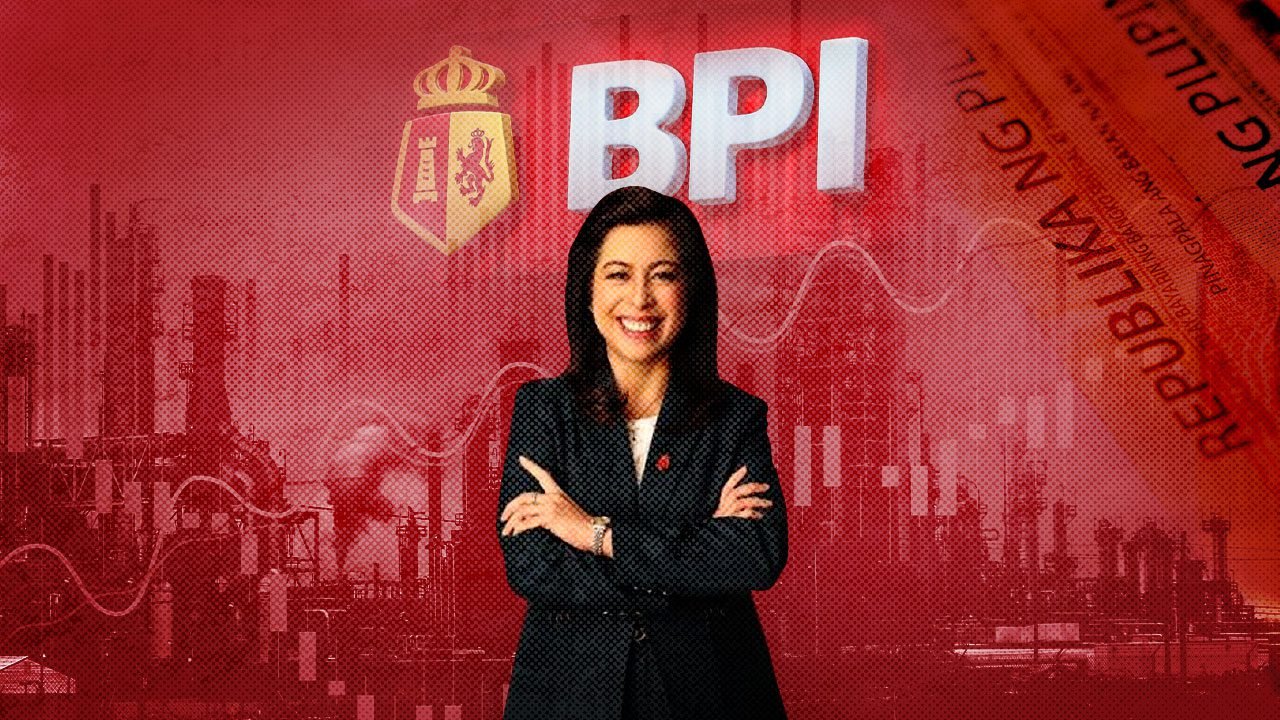
[Vantage Point] The bank Ginbee Go will inherit
On April 26, 2027, Maria Cristina “Ginbee” Go will take charge of a franchise that is both distinctly modernized and in the middle of absorbing the costs of its own rapid ambition.
She will take the helm of the Bank of the Philippine Islands (BPI) from outgoing president Jose Teodoro “TG” Limcaoco, who will leave behind an institution commanding P3.9 trillion in assets, P3 trillion in deposits, and a record P48.9 billion in nine-month net income.
During Limcaoco’s tenure, heavy capital outlays went directly into digital distribution channels, modern core architecture, and an expanding agency banking footprint.
Go is no outsider stepping into the unknown. As head of consumer banking, she helped build the very retail push she will now oversee as president, while Limcaoco remains on the board. But this transition will not be judged by loan volume alone; the real test is how much of that high-yield expansion survives the discipline of collection.
The underlying operating engine has encountered clear friction. While top-line revenue expanded 9.8% across the first nine months, operating expenses rose at a faster clip of 12.5%.
Far more telling was the credit cost: cumulative provisions surged 69.2% to P19.9 billion. A bank booking brisk retail lending while ramping up set-asides by tens of billions inevitably raises questions among investors about whether management is merely exercising prudent foresight or scrambling to erect buffers against visible borrower distress.
Uneven landscape
A closer look at the credit ledger shows an uneven landscape across business lines. The non-performing loan (NPL) ratio for small and medium-sized enterprises (SMEs) climbed to 15.62% in September, jumping more than three percentage points in a single quarter.
Credit card delinquencies edged up to 5.44%, residential mortgages to 4.80%, and auto loans to 4.73%. By contrast, non-performing loans in personal lending retreated to 6.99%, microfinance eased to 13.95%, and institutional exposures stayed pristine at 0.86%.
Because SME credit makes up only a modest slice of the broader balance sheet, its immediate systemic drag is contained. The deeper danger lies in the process: if underwriting flaws or weak collection models are permitted to take root, expanding those loan books will only compound future losses.
Management has sought to assure the market that credit filters have tightened. Limcaoco attributed the strain in small business lending to retail and construction borrowers hit by lags in government disbursements.
Go pointed to aggressive collection campaigns, restructured facilities, and balance write-offs to explain the lower delinquency rates in microfinance and personal credit. But reported improvements in delinquency ratios carry weight only when borrowers resume regular cash payments.
A write-off cleans a ledger without clawing back lost capital, just as loan restructuring can buy time without revitalizing a borrower’s ability to pay. Until the bank discloses the actual cash recovered alongside the volume of debts rewritten or struck off, it remains difficult to verify whether these fixes represent real balance sheet rehabilitation or optical adjustments.
Recent quarterly earnings highlight this delicate balance. Net income for the period nudged up to P16.07 billion from P15.91 billion, but the gain owed its momentum to a decline in quarterly provisions, which fell to P6.54 billion from P7.84 billion.
Operating performance beneath the surface looked softer: pre-provision operating profit slipped to P27.23 billion from P27.96 billion, and net interest margins compressed from 4.70% to 4.56%.
Where scrutiny is needed
A rising bottom line built on curtailed provisioning, against a backdrop of shrinking core margins, cannot easily be mistaken for accelerating business momentum.
The mechanics behind the bank’s provisioning models demand equal scrutiny. Management kept its June macroeconomic assumptions in place through September, carrying a year-to-date expected-credit-loss overlay of P2.7 billion.
Staging adjustments were attributed to regulatory feedback from the central bank suggesting certain loans had been shifted prematurely into Stage 3 rather than Stage 2. This remains management’s characterization, and holding broader economic inputs steady does not answer how provisions should evolve as individual credit exposures deteriorate.
Reserve adequacy presents its own puzzles. BPI reports an accounting NPL coverage ratio of 89.57%, which widens to 113.05% under regulatory formulas. While sub-100% accounting coverage is not inherently dangerous when loans are backstopped by solid collateral, the bank’s own investor disclosures contain oddities.
In the personal loan book, reported “total cover” appears lower than the reserve coverage itself, despite being defined as the sum of reserves and pledged collateral. Clarifying that anomaly is an immediate disclosure priority.
To gauge how sensitive BPI’s bottom line is to unexpected credit deterioration, consider an incremental provisioning shock of 1% across the rounded P2.7 trillion loan book.
That single percentage point would generate a pre-tax charge of P27 billion. Even after factoring in a 25% tax shield, the resulting P20.25 billion hit would erase roughly 41% of the bank’s nine-month profit.
This arithmetic is an indicator of earnings vulnerability rather than a forecast of imminent ruin, especially with common equity Tier 1 sitting at 13.9% and total capital adequacy at 14.7%.
Still, earlier first-half marks revealed P13.44 billion in fair-value losses on debt securities taken directly through equity, alongside a P5.53 billion unbooked fair-value shortfall on amortized-cost paper that awaits updated September transparency.
Financing decisions will add another layer of complexity to Go’s tenure. The planned P5 billion SIBOL or Sustainable Impact Building Our Legacy — BPI’s name for its proposed P5 billion sustainability bond offering — issue brings in wholesale borrowed funds rather than equity capital.
Meanwhile, the bank’s role in Citicore’s roughly P35 billion syndicated solar facility requires careful monitoring of retained credit risk, actual funding drawdowns, and project repayment terms.
Limcaoco still has several months to fortify the foundation before the formal handover. He leaves his successor an enviable retail network, deep funding pools, and scale.
But Go’s tenure will be judged on whether the bank’s high-margin expansion delivered lasting enterprise value or merely postponed a reckoning with bad debt.
The coming years will prove whether today’s balance sheet growth can truly be converted into durable cash.
(This is to be continued in my next newsletter. My analysis draws from BPI’s October 21, 2026 leadership and earnings announcements, its October 27 investor presentation and briefing transcript, its June 30 SEC Form 17-Q, and its October 26–27 SIBOL and Citicore financing disclosures. Management’s explanations, including its account of BSP findings, remain attributed statements; the author’s stress test is illustrative, not a bank forecast.)
I welcome your views on these and other issues where decisions made in power shape the country’s economic future. – Rappler.com
Below are some Vantage Point pieces you might have missed:
Click here for other Vantage Point articles.