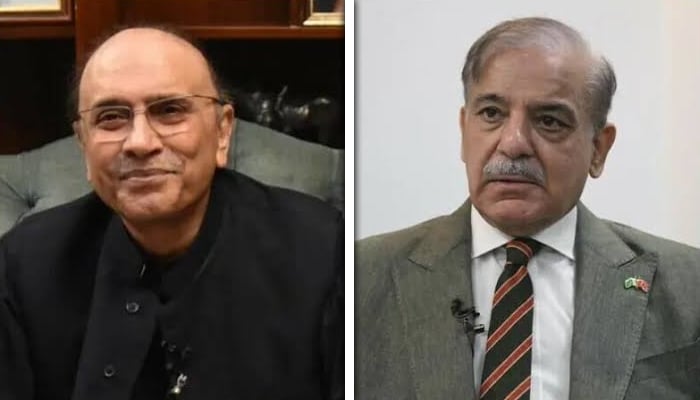
zardari shehbaz hail
| |

Zardari, Shehbaz hail Prophet’s birth as divine …

President Asif Ali Zardari and Prime Minister Shehbaz Sharif have extended greetings to the nation and the Muslim Ummah on the occasion of 12 Rabi-ul-Awwal.

In their separate messages, they said the day of 12 Rabi-ul-Awwal provides an opportunity to remember the great blessing of Allah Almighty and renew the commitment to the guidance brought by the Holy Prophet Muhammad (PBUH).

President Zardari said the birth of the Holy Prophet (PBUH) marked the beginning of a bright era based on faith, knowledge, justice and fairness. He said the Prophet’s exemplary life provides a complete path towards success and salvation.

The president said a righteous and stable society can only be built on the principles of justice, piety and strong moral values.

He added that true love for the Holy Prophet (PBUH) requires Muslims to make his Seerah and Sunnah an integral part of their practical lives. He urged people to reflect the Prophet’s teachings through their character, conduct and dealings with others.

Prime Minister Shehbaz Sharif said the life and teachings of the Holy Prophet Muhammad (PBUH) remain an eternal source of guidance for humanity.

He said the Prophet’s teachings promote compassion, justice, tolerance, unity and service to others. These values, he added, provide a strong foundation for building a peaceful and prosperous society.

The prime minister urged the nation to renew its commitment to shaping individual character and collective behaviour in accordance with the teachings of Seerat-un-Nabi (PBUH).

He called for a collective resolve to work for a peaceful, stable and prosperous Pakistan while promoting unity, brotherhood and mutual respect among citizens.

Both leaders stressed the importance of following the teachings of the Holy Prophet (PBUH) and making them part of everyday life.


Similar Posts

  • |

    Pralhad Joshi appointed India’s Education Mi…

    Pralhad Joshi has been appointed as India’s new education minister following the resignation of Dharmendra Pradhan, who stepped down on Saturday after weeks of youth-led protests over a major exam leak scandal . The 63-year-old Joshi, who already serves as minister of new and renewable energy and consumer affairs, food and public distribution, will now also handle the education portfolio a task political analysts say is likely to prove challenging amid heightened public scrutiny over the country’s education system . Pradhan’s departure was one of the central demands of the student demonstrations that erupted after allegations surfaced that the National Eligibility cum Entrance Test (NEET) medical entrance exam paper had been leaked . Nearly 2.3 million test takers across India, as well as at examination centers in Doha, Dubai, Singapore, and Kathmandu, appeared for the NEET on May 3, competing for fewer than 130,000 spots in medical colleges . After the leak allegations, the Indian government announced on May 12 that the examination was voided and that a new test would be held. The decision left thousands of students disillusioned and frustrated, sparking protests that spread across the country and evolved into a major challenge for Prime Minister Narendra Modi and his Bharatiya Janata Party (BJP) . Joshi, one of the Modi government’s longest-serving ministers, is seen as close to the powerful prime minister . Following his appointment to lead the Ministry of Education, Joshi wrote on social media that he was “grateful” to Modi “for placing his faith” in him and “entrusting” him with responsibility . “I accept it with humility and a deep sense of duty,” he said . On Sunday, Joshi held his first meeting as education minister to assess the situation and implement new schemes aimed at restoring trust in the examination system . The move signals the government’s urgency to address the grievances of students and parents who have demanded greater transparency and accountability . The NEET scandal has exposed broader concerns about the integrity of India’s competitive examination system, which determines access to coveted professional seats. With millions of students’ futures hanging in the balance, Joshi’s appointment represents both a test of his crisis management skills and a pivotal moment for educational reform in the world’s most populous nation .

  • |

    EU to end automatic GSP+ extension from 2027, Pakistan told to submit fresh action plan

    ISLAMABAD: The European Union (EU) is set to introduce a revised mechanism for extending its Generalised Scheme of Preferences Plus (GSP+) trade facility from January 2027, under which beneficiary countries will no longer receive an automatic extension. The Commerce Ministry informed the National Assembly Standing Committee on Commerce on Wednesday that Pakistan would have to formally seek continuation of the GSP+ facility and submit an action plan covering its commitments under 32 United Nations conventions. Commerce Secretary Jawad Paul briefed the committee that the new GSP+ framework would come into force in January 2027, followed by a two-year transition period. During this period, countries benefiting from the scheme will be required to prepare and submit their respective plans, which will subsequently be assessed by the European Union. According to the secretary, the EU’s assessment of Pakistan contains both positive observations and areas of concern. Among the issues highlighted by the European bloc is the human rights situation in Pakistan, along with security and climate-related challenges. The briefing was given during a meeting of the National Assembly Standing Committee on Commerce chaired by Jawad Hanif. Members including Asad Alam Khan Niazi, Khurshid Ahmed Junejo, Shaista Pervaiz, Dr Ramesh Kumar Vankwani, Tahira Aurangzeb, Mir Amir Magsi, Dr Mirza Ikhtiar Baig and Kiran Haider attended the meeting. EU concerns discussed The committee asked the Commerce Ministry to explain the concerns raised by the European Union in its latest assessment of Pakistan and their possible implications for the country’s trade interests. Jawad Paul said the EU report had acknowledged the difficult circumstances Pakistan was facing, particularly in terms of security challenges, economic pressures and climate-related disasters, including floods. These factors, he said, had affected the country’s capacity to fully implement various commitments. He urged members of parliament to present Pakistan’s perspective during their engagements with European Parliamentarians and other EU representatives. The secretary maintained that Pakistan’s circumstances should be taken into account while evaluating the country’s performance under the GSP+ framework. He said the government needed to undertake fundamental measures to address the challenges identified by the EU while also ensuring that Pakistan’s position was effectively communicated to European stakeholders. The committee also expressed concern over the repeated absence of the Commerce Minister from its meetings and conveyed its displeasure over the matter. Tariff reforms aimed at boosting exports The meeting also reviewed the government’s tariff reforms and their impact on industrial competitiveness and exports. Committee members questioned whether exporters would be required to commit to specific export targets in return for government support. The committee chairman clarified that the measures being introduced should not be viewed simply as incentives for exporters, arguing that reductions in duties and taxes were intended to lower production costs and improve Pakistan’s competitiveness in international markets. Officials from the Commerce Ministry said the government had been pursuing a policy of reducing tariff protection and lowering the cost of imported raw materials. The objective, they said, was to enable domestic industries to become more competitive and increase their presence in international markets. As part of the reforms, tariffs on around 2,000 tariff lines were reduced last year to make raw materials and other industrial inputs available at lower prices. The secretary said tariff reforms were being implemented under the National Tariff Policy and that the government had provided an estimated Rs160 billion benefit to industry and exporters during the previous year. For fiscal year 2026-27, another Rs120 billion has been earmarked under the relevant support measures. According to the Commerce Ministry, the previous Rs120 billion package was associated with a $1.27 billion increase in exports during 2025-26. Jawad Paul acknowledged that the tariff changes could initially result in higher imports as industries gained access to cheaper inputs and machinery. However, he argued that the trade imbalance could gradually improve as increased industrial production translated into stronger exports. Committee seeks review of Pakistan-China trade agreement The standing committee also raised concerns over Pakistan’s trade deficit with China and identified the China-Pakistan Free Trade Agreement (CPFTA) as an issue requiring closer examination. Members asked the Commerce Ministry to provide a detailed presentation on the agreement’s impact on Pakistan’s exports, imports and overall trade balance. The committee also sought an update on the latest trade discussions between Pakistan and the United States. The Commerce Secretary assured members that a detailed briefing on the matter would be provided in an in-camera session. Export Development Fund restructuring reviewed The committee separately examined the restructuring of the Export Development Fund (EDF). Officials told the meeting that the management and decision-making structure of the fund had been moved towards greater private-sector participation, with leading exporters being given a more significant role in determining spending priorities. The committee welcomed the shift towards projects that have a direct and measurable connection with export growth rather than conventional infrastructure-focused initiatives. Members also reviewed the allocation of 40% of the Export Finance Scheme (EFS) portfolio for small and medium-sized enterprises (SMEs). They stressed that smaller businesses should have fair and sufficient access to export financing so that they can participate more effectively in international trade. Pakistan Reinsurance Company performance discussed The committee also reviewed the performance and investment strategy of Pakistan Reinsurance Company Limited (PRCL). Members were informed that the company retained nearly 30% of its risk domestically, while approximately 70% was placed in international reinsurance markets, including London, Dubai and Singapore. The committee chairman called for careful management of the company’s financial resources and urged officials to explore opportunities to improve returns without compromising risk-management standards. Proposed amendments for Karachi Chamber examined The committee considered the Trade Organizations (Third Amendment) Bill, 2026, a Private Member’s Bill seeking amendments to the Trade Organizations Act in relation to the Karachi Chamber of Commerce and Industry (KCCI). During the discussion, members examined the special status of KCCI and proposed exemptions from certain district-related provisions. The chairman directed that the proposed amendments be drafted in appropriate legal language in consultation with the Ministry of Commerce and the Ministry of Law and Justice

  • |

    Kuwait introduces new regulations to strengthen e commerce sector

    Kuwait has introduced a comprehensive set of regulations for e commerce platforms aimed at improving consumer protection, increasing transparency and creating a unified legal framework for the country’s rapidly expanding digital marketplace. The new rules were issued by the Ministry of Commerce and Industry under Ministerial Resolution No. 109 of 2026 and came into effect on July 8. They apply to all online platforms involved in selling, ordering and delivering goods and services across Kuwait. Officials said the regulations were introduced to address the rapid growth of online shopping while clearly defining the responsibilities of digital platforms, merchants, delivery companies and consumers. The measures are also intended to encourage investment and promote fair competition within the sector. Under the new framework, companies operating electronic platforms must obtain the required licences and comply with existing commercial laws. They are also required to strengthen cybersecurity measures to protect their digital systems and safeguard customer data from misuse or cyberattacks. The regulations require platforms to display complete pricing information before customers confirm their purchases. This includes product prices, delivery charges, commissions and any additional fees. Platforms must also provide accurate information about merchants, publish clear terms and conditions and ensure that product descriptions are truthful and up to date. Businesses are now required to establish transparent policies for returns, exchanges and refunds. They must also create complaint handling systems that resolve customer issues within specified time limits while protecting consumers’ personal information. In addition, platforms must maintain proper records of electronic transactions and payments. The new rules also place responsibilities on delivery service providers to ensure goods are transported safely and delivered efficiently. Online platforms will be expected to supervise delivery operations and coordinate closely with merchants and delivery companies throughout the process. To prevent excessive charges, the ministry has introduced limits on service commissions. Platforms may charge a maximum commission of 17 percent when they provide delivery services and 10 percent when deliveries are handled directly by merchants. Consumer delivery fees have also been capped at one Kuwaiti dinar per order, with businesses prohibited from charging more than that amount. The Ministry of Commerce and Industry has been given authority to monitor compliance with the regulations. Officials will be able to inspect businesses, request information and impose administrative penalties on companies that fail to follow the new requirements. Existing licensed platform operators must also update their registered business activity to reflect the category of managing delivery services through electronic platforms. The ministry said an implementation guide will be issued to help businesses, delivery companies and consumers understand the new compliance requirements. According to the explanatory memorandum accompanying the regulations, the reforms are designed to address problems that emerged with the rapid expansion of e commerce, including inconsistent commission rates, high delivery charges and unclear commercial practices. Officials believe the new framework will improve service quality, strengthen consumer confidence and support the continued growth of Kuwait’s digital economy.

  • |

    Canadian carrier resolves cabin crew strike through provisional labor agreement

    The industrial action carried out by WestJet flight attendants concluded following overnight negotiations that yielded a provisional contract between the Canadian airline and the Canadian Union of Public Employees Local 8125. The resolution arrived early Monday morning after a brief strike that disrupted travel plans nationwide over the weekend. Union leadership confirmed that the consensus marks progress regarding operational credit structures, ensuring better recognition and wage distribution for duties performed on the ground prior to takeoff, including passenger boarding and delay management. Management at the carrier expressed satisfaction with the outcome, highlighting the dedication of the workforce. Unofficial terms indicate the proposal includes an immediate pay raise retroactive to the start of the year, alongside adjusted duty allocations. While flight operations are slated to rebuild gradually pending safety verifications and roster adjustments, the negotiated terms remain subject to formal ratification by the union membership.

  • |

    South Korea offers North Korea formal end to war

    South Korea has made a fresh and potentially significant proposal to North Korea, calling for both sides to formally bring an end to the Korean War and move away from decades of hostility. According to officials, Seoul has urged Pyongyang to abandon threats and confrontational policies and instead work toward ending the state of war that has technically remained unresolved since the 1953 armistice. The South Korean government also proposed establishing a coordinated security system along the border to help prevent military tensions and reduce the risk of accidental clashes. The initiative is aimed at creating greater stability on the heavily fortified Korean Peninsula. The proposal comes amid continued tensions between the two Koreas, where military activity and hostile rhetoric have repeatedly raised concerns about a possible escalation. Seoul’s latest offer could open a new diplomatic door if Pyongyang responds positively, although North Korea has historically remained cautious about South Korean-led initiatives. Meanwhile, US President Donald Trump also drew attention to the issue by sharing a memorable photograph on social media showing his meeting with North Korean leader Kim Jong Un. The developments have renewed questions over whether diplomacy could eventually replace confrontation on the Korean Peninsula.

  • |

    CDA launches Rs5.07bn Six-Lane Road project from Faizabad to Koral Chowk

    The Capital Development Authority (CDA) has accelerated plans to construct a new six-lane carriageway along Service Road East, approving a project worth Rs5.072 billion aimed at easing chronic traffic congestion on the Islamabad Expressway and improving connectivity between Faizabad and Koral Chowk. The 9.25-kilometre road will run parallel to the Islamabad Expressway, extending from Faizabad to Koral Chowk near Gulberg Housing Society. Once completed, the new corridor is expected to provide motorists with an alternative route, reducing travel time on one of the capital’s busiest transport arteries while facilitating smoother traffic movement for commuters travelling to Islamabad and Rawalpindi. Officials said the project forms part of the CDA’s broader strategy to upgrade the capital’s road infrastructure in response to increasing traffic volumes and rapid urban expansion in surrounding residential and commercial areas. According to official sources, the new carriageway is expected to improve access to several housing societies and neighbourhoods located along the eastern side of the Islamabad Expressway. Authorities believe the project will not only ease traffic bottlenecks but also stimulate commercial development by increasing the value of properties and attracting new businesses along the corridor. To facilitate construction, the CDA has earmarked approximately Rs500 million for the relocation of critical utility infrastructure. This includes fibre-optic networks operated by the Islamabad Police Safe City Project, the Strategic Plans Division (SPD), Sui Northern Gas Pipelines Limited (SNGPL), and the Islamabad Electric Supply Company (IESCO). Sources said extensive utility shifting will be required before the main construction work can proceed at full pace. The project involves relocating 11kV electricity distribution lines, shifting 242 electricity poles, and relocating 248 graves that fall within the road alignment. Earthwork activities have already begun at selected locations. The road project also incorporates environmental protection measures. Officials said engineers have planned the preservation of 22 underground water channels, natural streams, and stormwater drains located along the proposed route to minimise environmental disruption and maintain the area’s natural drainage system. A breakdown of utility relocation costs shows that around Rs406 million has been allocated for IESCO infrastructure, Rs87.3 million for shifting Safe City fibre-optic networks, and approximately Rs6 million for relocating SPD facilities. Work on these utility relocation components is expected to commence after the completion of technical and administrative formalities. A senior CDA official said the authority has revised the project’s completion timeline, reducing the original target of 12 months to between six and eight months. However, the official acknowledged that the timely relocation of utilities remains the biggest hurdle and will largely determine whether the revised deadline can be achieved.

Leave a Reply

Your email address will not be published. Required fields are marked *