security personnel martyred

15 security personnel martyred, 15 militants killed in Tank suicide attack

DI Khan/TANK: At least 15 security personnel were martyred and more than 20 others injured after terrorists carried out a devastating suicide attack on the Manjhi Khel Joint Check Post in Tank district on Thursday night, followed by a prolonged gun battle with security forces.

According to security and police sources, the attackers rammed an explosives-laden Datsun/Mazda vehicle into the check post at around 9:30 p.m., triggering a massive explosion that caused extensive destruction. The blast was so powerful that several nearby houses were also damaged.

Sources said the suicide bombing was immediately followed by an intense exchange of fire between the attackers and security personnel, which continued for several hours.

The martyred personnel included two police constables, 12 Pakistan Army soldiers, and one Forest Guard. More than 20 personnel sustained injuries, including six police officials and over two dozen security personnel, who were shifted to the District Headquarters Hospital in Tank for treatment.

Police identified the martyred policemen as Constable Bilal Khan and Driver Constable Tala Muhammad. The injured police personnel include Constable Ismatullah Akbari, Constable Jasim Khan, Constable Muhammad Daud, and Constable Pir Ghulam.

The explosion completely destroyed seven to eight rooms of the joint check post, causing severe structural damage. Security forces immediately cordoned off the area and launched a comprehensive search and clearance operation.

According to security sources, all 15 terrorists involved in the attack were killed during the operation. Sources further claimed that two of the attackers were wearing Pakistan Army-style uniforms. Investigators are collecting evidence to determine the planning and execution of the assault.

Initial investigations indicate that the suicide vehicle was carrying approximately 1,500 kilograms of explosives. Sources also revealed that a white Toyota Corolla GLI was allegedly used by the attackers to facilitate movement during the operation.

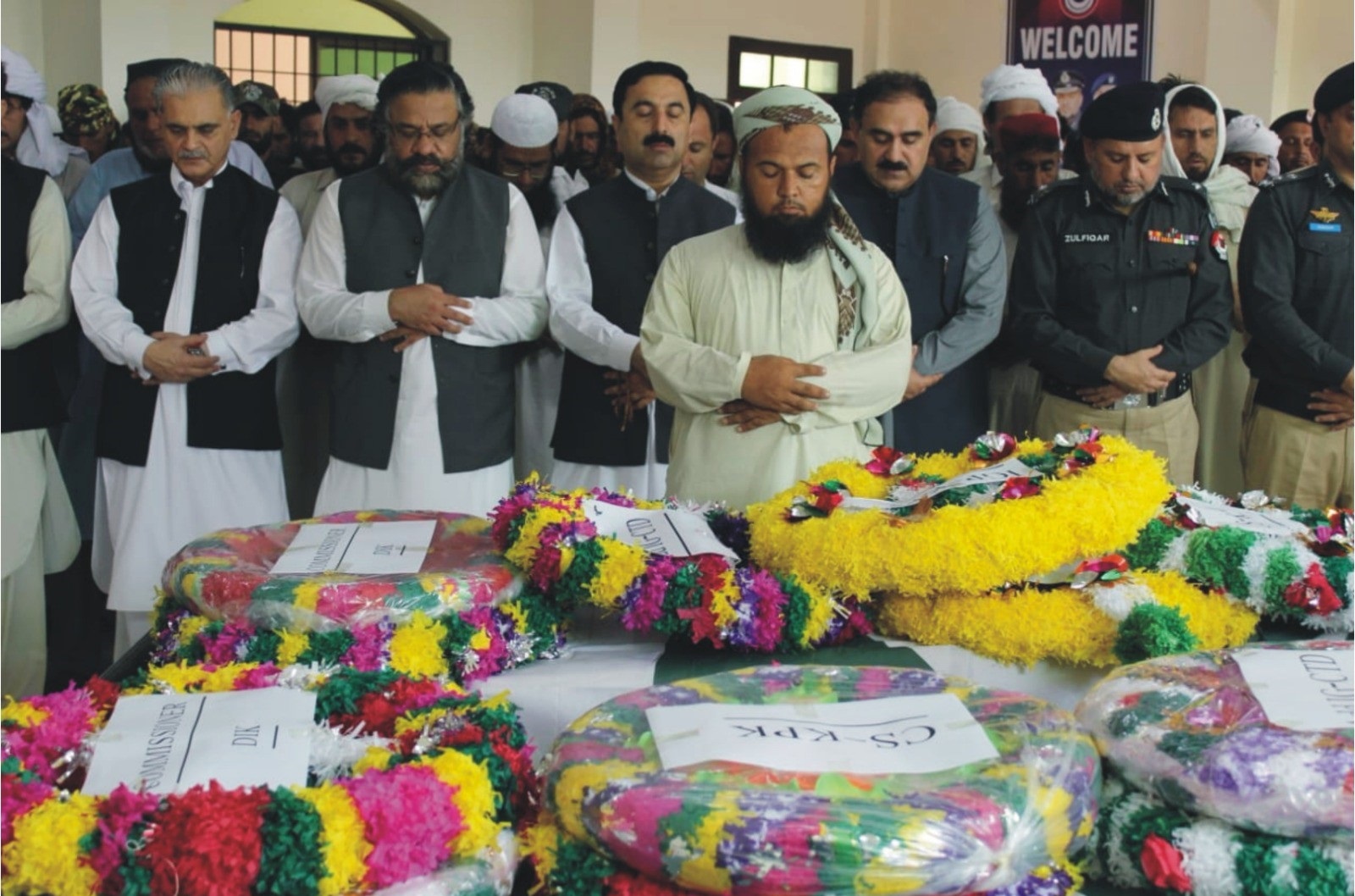
Meanwhile, the funeral prayers of Constable Bilal Khan, Constable Tala Muhammad, and Forest Guard Noor Azam were offered with full state honours at the Tank Police Lines.

The funeral was attended by Inspector General of Police Khyber Pakhtunkhwa Zulfiqar Hameed, Chief Secretary Khyber Pakhtunkhwa Shahab Ali Shah, Special Assistant to the Chief Minister on Home and Tribal Affairs Tariq Saeed Marwat, Additional IG CTD Jawad Qamar, RPO Dera Ismail Khan Ghulam Mubashir Mekan, Commissioner Dera Ismail Khan Daud Khan, DPO Tank Abdul Samad Khan, Deputy Commissioner Tank Jamshed Khan, senior civil and police officials, relatives of the martyrs, and local elders.

Floral wreaths were laid on the coffins, while a smartly turned-out police contingent presented a guard of honour. Special prayers were offered for the departed souls, the speedy recovery of the injured, and lasting peace in the country.

Later, the IGP and Chief Secretary visited the injured police personnel at the hospital, appreciated their bravery, and announced financial assistance for the wounded officers. The officials assured them that their concerns would be addressed on a priority basis.

Following the attack, the district administration imposed curfew across Tank district due to security concerns, with all entry and exit routes remaining closed.

Later, during a joint press conference in Dera Ismail Khan, Special Assistant Tariq Saeed Marwat, Chief Secretary Shahab Ali Shah, and IGP Zulfiqar Hameed stressed that terrorism could only be defeated through close cooperation between the government, security institutions, the media, and the public.

Tariq Saeed Marwat said the provincial government was utilizing all available resources to eliminate terrorism and restore peace across Khyber Pakhtunkhwa, particularly in the southern districts. He stated that anti state elements would never succeed in their objectives and urged citizens to remain united against terrorism.

Chief Secretary Shahab Ali Shah described the recent terrorist incidents in Tank and other southern districts as a serious challenge but reaffirmed that security agencies were conducting coordinated and intelligence based operations. He emphasized that counter-terrorism is a national responsibility and urged the public to report suspicious activities promptly while refraining from providing any form of support or shelter to terrorists.

He also called on the media to practice responsible journalism by avoiding the spread of unverified information and contributing to strengthening the national narrative against terrorism.

Inspector General of Police Zulfiqar Hameed said close coordination existed among the police, security forces, and intelligence agencies, adding that intelligence based operations were being further strengthened. He announced that the police force was being equipped with modern weapons and enhanced capabilities to effectively counter terrorist threats.

The senior officials reiterated their commitment to continue the fight against terrorism until its complete eradication and emphasized that the government, law enforcement agencies, media, and the public must remain united to ensure lasting peace in Khyber Pakhtunkhwa, particularly in the southern districts.

Similar Posts

  • | |

    Karachi watchman shot dead during suspected robber…

    Two people were killed in separate shooting incidents reported within an hour in different areas of Karachi on Thursday, prompting police to launch investigations into both cases. The first incident occurred in the Boat Basin police jurisdiction near Bath Island in Clifton, where a watchman was fatally shot outside a residential bungalow. Rescue officials shifted the victim’s body to Jinnah Postgraduate Medical Centre for legal formalities. According to Chhipa rescue officials, the deceased was identified as 40-year-old Mewa, who sustained a fatal gunshot wound to the chest. Initial information suggested that armed suspects opened fire after encountering resistance during an attempted robbery. However, Boat Basin Station House Officer (SHO) Riaz Niazi said the exact motive behind the killing had not yet been established. He confirmed that the victim originally belonged to the Thar region and was employed as a watchman at the bungalow where the incident occurred. The SHO said police were investigating all possible angles, including personal enmity and robbery, before reaching a final conclusion. Authorities are also attempting to obtain CCTV footage from the surrounding area to identify the suspects and reconstruct the sequence of events. In a separate incident, another man was shot dead near Link Road on the National Highway in the Bin Qasim area. The victim was also taken to Jinnah Hospital for medico-legal procedures. Bin Qasim SHO Faisal Rafiq identified the deceased as 40-year-old Bashir, a truck driver originally from Dera Ismail Khan. According to preliminary findings, Bashir was present at a truck terminal when unidentified assailants, who were allegedly lying in wait, opened fire on him. Police said the victim suffered three bullet wounds, including one to the chest. Investigators recovered three spent 30-bore pistol casings from the crime scene, which have been collected as forensic evidence. Officials believe the second shooting may have been motivated by personal enmity, although they emphasised that the investigation remains ongoing and no suspects have been arrested so far. The two fatal incidents highlight the continuing security challenges in Karachi, where police regularly investigate cases involving violent crime, targeted attacks, and robbery-related shootings. Authorities have appealed to the public to cooperate with investigators and provide any information that may assist in identifying those responsible.

  • |

    Pakistan links JAAC protests to India-funded forei…

    Information Minister Attaullah Tarar has alleged that violent protests by the banned Joint Awami Action Committee (JAAC) in Azad Jammu and Kashmir are being driven by militant elements pursuing a foreign agenda with Indian funding, as the government moves to restore order following the first phase of regional elections. Speaking on Tuesday, Tarar maintained that while the recent elections in the Mirpur division were peaceful and transparent, the banned outfit could not accept the democratic process and resorted to violence. He noted that the people of Kashmir had given a “spectacular response” to the elections, with 600,000 votes cast in Rawalakot alone. Tarar claimed that investigators have uncovered irrefutable evidence linking the JAAC’s social media campaign to India. Security agencies recently arrested a digital marketing services provider whose payment trails were traced to Indian gateways. According to the minister, an entire misinformation network was operating through bot farms to spread anti-state content targeting Pakistan’s sovereignty, government institutions, and armed forces. The investigation also recovered WhatsApp conversations between the arrested suspect and an Indian operator discussing payments and content amplification. “The investigation found that the entire misinformation network was operating through bot farms,” Tarar stated, adding that forensic analysis identified India-based accounts even when VPNs were used. State Minister for Interior Talal Chaudhry emphasized that the government had accepted 37 out of 38 JAAC demands, with only the issue of refugee seats in the AJK Legislative Assembly remaining unresolved due to constitutional complexities. “Thirty-seven out of 38 JAAC demands were accepted, and the government of Pakistan fully cooperated with them,” Chaudhry said. He noted that the movement was not about securing rights but about “snatching” the rights of AJK people. The minister questioned the timing of the protests, noting that JAAC initially tried to stop the election schedule in AJK. “When they failed, JAAC members started long marches, sit-ins, strikes, blocked roads and disrupted activities across the region,” he added. The AJK government has declared JAAC a proscribed organization under the Anti-Terrorism Act, and authorities have announced a Rs10 million reward for information leading to the arrest of four wanted JAAC leaders. Officials allege that armed members of the group have engaged in violence, resulting in injuries to police personnel. The federal government has assured full support to AJK authorities in maintaining law and order.

  • | |

    Sherry Rehman accuses India of using flood situati…

    Pakistan Peoples Party Senator Sherry Rehman has criticised India’s water policies, accusing New Delhi of using the flood situation as a tool of “water aggression” against Pakistan. In a statement, Sherry Rehman said India was adopting a contradictory approach by threatening to suspend the Indus Waters Treaty while also releasing floodwater towards Pakistan. She claimed that India opened the gates of the Salal Dam, putting millions of Pakistanis at risk of flooding. She stressed that river water management should be handled responsibly and should not become a source of conflict between the two countries. The senator said India’s alleged failure to provide timely information about water flows had created uncertainty, particularly regarding the flow of the Chenab River. She warned that sudden changes in the river’s water levels could affect Pakistan’s irrigation system and agriculture. The Chenab River supports millions of acres of farmland in Punjab, and any unexpected increase or decrease in water flow could damage crops and impact farmers’ livelihoods. Sherry Rehman said Pakistan’s agricultural economy depends heavily on the proper management of river systems. She added that uncertain water policies could increase risks for farmers and create challenges for the country’s water security. She urged India to respect existing water agreements and follow international commitments. She said western rivers under the Indus Waters Treaty cannot be diverted, stored, or transferred in a manner that affects Pakistan’s water supply.

  • | | | |

    Three powers, one shield? What the pact means

    Pakistan, Saudi Arabia and Türkiye have formalised their long-standing strategic and defence ties through the newly signed Makkah Joint Defence Agreement, establishing a framework for closer military coordination and collective security. The agreement was signed during a trilateral summit in Makkah attended by Prime Minister Shehbaz Sharif, Saudi Crown Prince Mohammed bin Salman and Turkish President Recep Tayyip Erdogan. The pact has attracted comparisons with established military alliances. However, analysts say its stated purpose is not to create a new military bloc or target any particular country. Instead, it provides an institutional structure for defence cooperation that has developed between the three nations over several decades. A formal structure for longstanding ties Pakistan and Türkiye have maintained close political and military relations for decades, while Islamabad and Riyadh have developed extensive defence, diplomatic and economic cooperation. The new agreement is viewed as an attempt to bring these existing relationships under a formal trilateral framework. It is designed to provide a more structured mechanism for consultations, military coordination and strategic cooperation. Why the agreement was signed now The agreement comes amid growing security challenges across the Middle East and wider region. Analysts say conflicts, changing military technologies and emerging security threats have encouraged countries with shared strategic interests to strengthen their defence coordination. The trilateral arrangement is intended to improve collective preparedness and provide a coordinated response to potential threats while supporting regional stability. What the defence pact provides A central element of the agreement is the principle of collective security. Under the framework, aggression against one member is to be treated as a threat to all three countries. The arrangement is expected to encourage greater military coordination, intelligence cooperation, strategic consultations and defence planning. Closer institutional links could also allow the three countries to coordinate their military capabilities and improve their ability to respond to security challenges. Different strengths, shared security interests Each country brings different capabilities to the partnership. Pakistan contributes a large and experienced military, operational expertise and extensive experience in counterterrorism and conventional defence. Saudi Arabia brings significant economic resources, regional influence and political weight. Türkiye adds its growing defence industry, military technology and manufacturing capabilities. Analysts believe these complementary strengths could make the partnership more effective while allowing the three countries to develop greater strategic self-reliance. Pakistan’s diplomatic role The agreement also comes as Pakistan seeks to strengthen its role as a regional diplomatic actor. Islamabad maintains relations with Saudi Arabia, Türkiye, Iran, China and the United States, giving it channels of communication with several major regional and global powers. Analysts argue that Pakistan’s diplomatic engagement, alongside its military capabilities, could help it contribute to regional crisis management and dialogue. What the pact does not mean Despite comparisons with NATO and other military alliances, analysts stress that the agreement is not described as an offensive alliance. It is also not presented as a pact directed against a particular country, a so-called “Muslim NATO”, a nuclear deterrence arrangement or a religious military bloc. Instead, the three countries have presented it as a defensive framework focused on collective security, deterrence, military cooperation and regional stability. The long-term effectiveness of the agreement will depend on sustained political coordination and the willingness of all three governments to implement its commitments.

  • | |

    Rs120bn PRI subsidy ends as banks take over costs …

    Islamabad: The government has stopped providing the Pakistan Remittance Initiative subsidy, which reached Rs120 billion, saying the country’s financial difficulties make it impossible to continue the support under the current budget. Banks have agreed to absorb the related costs themselves to keep overseas Pakistanis sending money through official channels. The development puts the spotlight on the future of Pakistan’s remittance system, which depends heavily on money sent home by Pakistanis working abroad. The government had previously used subsidies to help banks facilitate these transfers, but curtailed that support last year. The Governor of the State Bank of Pakistan informed the Senate Standing Committee on Finance and Revenue that the government had initially provided subsidies to banks under the Pakistan Remittance Initiative to facilitate remittances from overseas Pakistanis. The total subsidy provided by the government reached Rs120 billion. However, the financial pressure on the government has now made it difficult to continue paying this amount. The subsidy could not be continued in the current budget because of prevailing fiscal constraints. Instead, banks have decided to bear the costs linked to facilitating remittances from their own resources. The decision means that banks will continue providing the service to overseas Pakistanis even though the government can no longer provide the previous level of financial support. The Pakistan Remittance Initiative was discussed by the committee during its meeting at Parliament House in Islamabad on August 25, 2026, under the chairmanship of Senator Saleem Mandviwalla. The committee considered the government’s decision important because remittances sent by Pakistanis living and working abroad are a major source of foreign currency for the country. The State Bank told the committee that banks decided to continue bearing the associated costs so that the flow of remittances would not be disrupted. The committee appreciated the banks’ decision but also decided to examine their actual performance. Selected banks will therefore be invited to the committee’s next meeting to explain their performance and contribution to the remittance sector. The move comes at a time when the government is facing tight financial conditions and has been forced to reduce or reconsider spending commitments. The end of the Rs120 billion subsidy raises an important question about how the remittance system will operate in the longer term if banks continue to carry the costs without government support. For millions of Pakistanis working overseas, remittances are an important way of supporting families at home. These transfers help families pay for everyday needs and also bring foreign currency into Pakistan. The government’s decision does not mean that the remittance service has stopped. Instead, banks have agreed to continue facilitating transfers while paying the related costs themselves. The Senate committee has now moved to check whether banks are fulfilling this responsibility effectively and whether overseas Pakistanis are receiving proper services. The next meeting is expected to provide the committee with a clearer picture of how banks are handling the change after the withdrawal of the government subsidy. The key issue remains whether banks can continue carrying the financial burden while maintaining an efficient and reliable remittance system for overseas Pakistanis. The Rs120 billion figure also shows the scale of government support previously used to encourage and facilitate remittances through the formal banking system.

  • | |

    PPP chairman Bilawal alleges ‘vote theft’ in A…

    Pakistan Peoples Party (PPP) Chairman Bilawal Bhutto Zardari has accused political opponents of “stealing” votes in Azad Jammu and Kashmir, urging the state to decide whether the national interest or the interests of the Pakistan Muslim League-Nawaz (PML-N) should take priority. Addressing a PPP workers’ convention in Muzaffarabad, Bilawal claimed that voters in Mirpur and Kotli had been denied their electoral rights and questioned whether the developments surrounding the AJK elections could genuinely be described as democracy. Bilawal thanked the people of Mirpur, saying they had supported the PPP through their votes. However, he alleged that decisions by state institutions appeared to be favouring the PML-N, warning that such a situation would ultimately hurt Kashmir, Pakistan and ordinary citizens. “National interest must come first,” Bilawal said, according to his party’s account of the speech. He maintained that the PPP would stand with the state of Pakistan when it comes to national interests, but not when, in his view, those interests were being confused with the interests of a political party. He also criticised what he described as restrictions on political activity and internet connectivity, saying such measures could undermine the democratic character of AJK. Bilawal argued that shutting down internet services would create an impression inconsistent with the idea of an “Azad Kashmir”. His remarks came after the first phase of the AJK elections in the Mirpur division was marked by clashes, violence and allegations of electoral manipulation. Polling was held across 13 constituencies in Mirpur, Kotli and Bhimber, with rival PPP and PML-N supporters accusing each other of irregularities. The election environment also turned violent in Kotli, where one person was killed and others were injured during clashes. The PPP alleged rigging and ballot stuffing in several constituencies, while the wider electoral process remained under scrutiny. Bilawal questioned how attacks could occur at multiple polling stations despite extensive security arrangements. He alleged that the elections were being conducted in phases in a manner that could facilitate manipulation. The PPP chairman further vowed to pursue what he called the rights of party workers and said his party would not accept the denial of its supporters’ mandate. With more phases of polling still to come, demands for free, fair and transparent elections are likely to remain at the centre of political debate in AJK. Bilawal said the PPP’s reconciliation-based political approach should be considered to protect democratic institutions and what he described as the broader Kashmir cause.

Leave a Reply

Your email address will not be published. Required fields are marked *