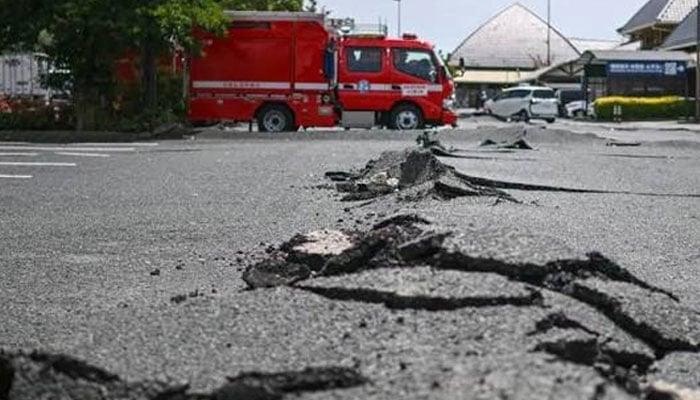
58magnitude earthquake hits
|

5.8-magnitude earthquake hits Japan

A 5.8-magnitude earthquake struck Japan’s main island of Honshu, sending tremors through parts of the eastern coastal region and causing minor injuries and temporary disruptions to train services.

According to the German Research Centre for Geosciences (GFZ), the earthquake occurred at a depth of around 78 kilometres near the eastern coast of Honshu. The relatively deep location of the quake helped limit the severity of its impact, although residents in several areas reported feeling strong shaking.

Japanese authorities said several people suffered minor injuries following the tremors. Some railway services were also temporarily suspended as officials carried out safety checks on tracks and infrastructure. Authorities continued to assess whether the earthquake caused any structural damage or other disruptions.

The Japan Meteorological Agency urged residents to remain cautious and stay alert for further seismic activity. The agency said another earthquake measuring below magnitude 5 could occur in the region during the following week.

Japan lies along the Pacific Ring of Fire, one of the world’s most seismically active zones, and experiences frequent earthquakes of varying intensity. Authorities regularly advise residents to keep emergency supplies ready and follow official instructions during and after seismic events.

Officials have not reported any major damage from the latest earthquake, but monitoring of the affected areas remains underway.

Similar Posts

  • |

    DR Congo bans copper and cobalt concentrate exports to boost domestic smelting

    The Democratic Republic of Congo has banned the export of copper and cobalt concentrates, accelerating national efforts to enforce in-country mineral processing and retain greater economic value from its natural resources. The ministerial decree, signed by Mines Minister Louis Kabamba Watum, Foreign Trade Minister Julien Paluku Kahongya, and Economy Minister Daniel Mukoko Samba, takes effect immediately. The regulation revokes a previous 2023 framework and its associated exemptions, replacing them with a comprehensive structure governing mineral exports alongside a new tax regime on mining by-products. Following news of the export ban, benchmark three-month copper on the London Metal Exchange rose by up to 1.8 per cent to $14,369.50 per metric ton, approaching historic record highs. While the prohibition is absolute, the decree allows for temporary one-year waivers under specific strategic circumstances. Major mining operators, including Ivanhoe Mines, which runs the Kamoa-Kakula copper complex in partnership with Zijin Mining,indicated that domestic processing facilities, such as the on-site smelter and the Lualaba copper smelter in Kolwezi, process the majority of local yields. Analysts note that because the vast majority of Congolese copper and cobalt is already refined locally into cathodes and hydroxides prior to shipment, the new policy primarily aims to eliminate remaining concentrate exports while standardising royalty collections across trace mineral by-products.

  • |

    US fuel opens a capitalist crack in Cuba

    HAVANA: Gasoline selling for as much as $38 a gallon, diesel advertised on social media and fuel stored inside cramped apartments are offering an unusual glimpse of private enterprise in communist Cuba, where the energy sector has long remained firmly under state control. A US policy allowing American companies to export fuel to private Cuban businesses has triggered an unexpected transformation. As Cuba struggles with shortages, blackouts and a weakened public transport system, imported fuel is creating a growing private market — while also exposing a sharp divide between those who can afford it and millions who cannot. The change follows the collapse of Cuba’s traditional fuel supplies from Venezuela and Mexico after the United States removed Venezuelan President Nicolas Maduro in January. With sanctions discouraging tankers from sailing toward the island, fuel shortages have increasingly affected transport, hospitals, schools and other essential services. Under an exception to Washington’s oil restrictions, however, private Cuban restaurants, retailers, taxi operators and other businesses have been allowed to import fuel. The impact has been striking. Between February and May, around 900,000 barrels of US fuel entered Cuba — enough to meet only about nine days of the country’s energy requirements. Yet those relatively small shipments have helped create a new network of legal wholesalers, private buyers and illegal resellers. Gasoline becomes a luxury For ordinary Cubans, the new fuel market has often brought frustration rather than relief. On a July afternoon in Havana, 53-year-old Amarilis Sanchez waited for hours at a bus stop after attending her daughter’s birthday celebration. Public buses, which normally cost only two pesos, were unreliable. Nearby, taxi drivers offered rides in vintage cars, but one driver quoted Sanchez 1,000 pesos for the journey — roughly 500 times the price of a bus ride. Unable to afford it, Sanchez considered spending the night at her daughter’s home and trying again for a bus the following day. Her experience illustrates how Cuba’s fuel crisis is creating two very different realities: one for people with access to private vehicles and imported fuel, and another for those dependent on the country’s struggling public transport network. Black-market gasoline prices reportedly reached $10 per litre, or about $38 per gallon, during the spring before falling as imports increased. Social media fuels a new market The emerging trade is increasingly visible online. WhatsApp groups and Facebook pages advertise gasoline and diesel, while some sellers store fuel in apartments and small shops despite the dangers posed by fire, explosions and toxic fumes. At one Havana convenience store, a shopkeeper reportedly kept around a dozen 20-litre fuel containers in a backroom, selling gasoline for approximately $5 per litre. Private companies are also moving into the newly emerging legal wholesale market. By late July, almost 200 Cuban businesses had received permission to distribute fuel wholesale to other private companies. One company, A Granel, advertises diesel through social media and charges $2.50 per litre for a 940-litre tank. The promotion reportedly features a model walking through a warehouse of diesel containers while Daddy Yankee’s famous song Gasolina plays in the background — an unusually flashy image for a country where the energy industry has historically been dominated by the state. Are Cuban gas stations next? The transformation could go further. Cuban lawmakers approved a broad package of economic reforms in June aimed at opening the energy sector to private and foreign investment. Prime Minister Manuel Marrero Cruz later announced that Cuba had approved its first foreign investment project focused on importing and selling fuel, although he did not name the company. The reforms have raised the possibility that private operators could eventually take control of some of Cuba’s familiar state-run Cupet petrol stations. For now, however, retail fuel sales remain largely under state control. Some state-owned stations are storing imported fuel but can distribute it only to vehicles belonging to authorised private businesses. Cuban authorities have defended the reforms while rejecting the idea that they represent a move toward large-scale privatisation. President Miguel Diaz-Canel has accused Washington of imposing a “genocidal siege” on Cuba and said economic changes were not being introduced to satisfy the United States. A lifeline with a heavy price The new fuel market has helped prevent some businesses from shutting down completely. During recent power outages, restaurants and shops with generators powered by imported fuel remained illuminated while much of Havana was plunged into darkness. But experts warn that the emerging system could deepen inequality. With the average government salary reportedly around $10 a month, imported gasoline remains unaffordable for most of Cuba’s roughly nine million residents. Cuban sociologist Mayra Espina said the limited fuel supplies had helped prevent “complete paralysis” but warned that the benefits were overwhelmingly concentrated among those able to pay. The result is an extraordinary contradiction: a small opening toward private enterprise is helping Cuba keep parts of its economy running, while simultaneously making access to basic mobility and energy increasingly dependent on wealth. For a country that has spent decades keeping fuel firmly within the state system, Cuba’s new gasoline economy may therefore prove to be more than a temporary response to shortage. It could become an early test of how far Havana is prepared to let capitalism into one of its most tightly controlled sectors.

  • |

    Israeli banks plan to end services for Palestinian banks raising fears of financial crisis

    Israeli banks have informed Palestinian financial institutions that they plan to end key banking services within the coming weeks, a move that has sparked concerns about serious economic disruption in the occupied West Bank. Officials on both sides say the decision could affect trade, salaries, and the daily financial operations that rely on cooperation between the two banking systems. The banking relationship allows Palestinian institutions to process transactions in Israeli shekels, the currency widely used in the Palestinian territories. These services are essential for paying for electricity, water, fuel, food imports, and other goods purchased from Israel. They also help transfer wages earned by thousands of Palestinians employed in Israel. According to Palestinian banking officials, five local banks that depend on Israel’s Bank Hapoalim for correspondent banking services have been told those arrangements will end on August 13. Other Palestinian banks that work through Discount Bank have reportedly been informed that their services will stop on September 1 unless a solution is reached. Israel’s Finance Ministry confirmed that both banks had announced plans to discontinue their correspondent banking services. The ministry said the decision reflects increasing legal and financial risks faced by Israeli banks while handling transactions for Palestinian institutions. In a statement, the ministry said it is holding discussions with the banks to find a way to continue these services while protecting Israel’s economic and security interests. Officials are exploring options that would allow financial cooperation to continue under conditions that reduce legal exposure for the banks involved. The banking arrangements have long depended on a government backed legal guarantee that shields Israeli banks from liability related to transactions carried out on behalf of Palestinian financial institutions. This protection is renewed every six months by the Israeli government. However, banking officials say commercial lenders no longer believe the existing guarantees provide enough protection. They argue that the risks of possible money laundering claims or allegations linked to terrorist financing have increased over time. According to one Israeli banking official, the banks believe the responsibility should now be taken over directly by the government instead of remaining with private financial institutions. Discount Bank confirmed that it had informed Israeli authorities of its concerns regarding the growing risks associated with these services. The bank said it has a responsibility to protect its depositors and shareholders while operating within an increasingly complex legal environment. Bank Hapoalim said the issue remains under review and did not provide further details. Economic experts warn that ending these banking links could have serious consequences for the Palestinian economy. Without access to correspondent banking services, businesses and individuals may be forced to rely more heavily on cash transactions. That shift could weaken the formal banking sector, reduce financial transparency, and encourage the growth of an informal economy. The decision could also place additional pressure on the Palestinian Authority, which already faces severe financial difficulties. The Authority depends heavily on local banks to finance public sector salaries and cover budget shortfalls. Financial analysts warn that if banks lose access to essential payment systems, the government’s ability to meet its financial obligations could be significantly weakened. A Palestinian businessman with close connections to the banking sector said the stability of local banks is closely tied to the stability of the Palestinian Authority. He warned that serious disruption to the banking system could have wider political and economic consequences across the West Bank. The latest development comes as the Palestinian Authority continues to struggle with reduced revenues after Israel suspended the transfer of customs and tax funds collected on its behalf. Those funds account for around two thirds of the Authority’s income, leaving its finances under increasing strain. Unless an agreement is reached soon, officials fear the planned banking cutoff could deepen the economic challenges already facing Palestinians in the occupied territory.

  • |

    Fifty UK police chiefs urge prime minister to halt early release of PC Harper’s killers

    Fifty police chiefs from across the United Kingdom have sent a joint letter to Prime Minister Andy Burnham, urging the government to exhaust every legal avenue to prevent the early release of the teenagers convicted in the 2019 death of PC Andrew Harper. PC Harper, a 28-year-old Thames Valley Police officer, died after being dragged behind a getaway car following a quad bike theft in Berkshire. Two of the men convicted of his manslaughter, Jessie Cole and Albert Bowers, were sentenced to 13 years in 2020. Under recent legislative changes to manage severe prison overcrowding, both men are due to become eligible for release in January after serving half their sentences. The intervention by police chiefs across England, Scotland, Wales, and Northern Ireland supports Burnham’s recent declaration that he is confident a legal resolution can be found to halt their discharge. In Downing Street, officials reiterated that the government intends to do everything within its power to block the early release. Beyond the specific case, the letter highlights broader concerns regarding public safety, victim impact, and officer morale. The police chiefs argued that reducing sentences for individuals involved in the deaths of emergency service personnel undermines the perceived sacrifice of officers who put themselves in harm’s way to protect the public. The police leaders called on the government to mandate explicit public protection reviews before amending release terms for offenders convicted of serious violence or causing death, while also ensuring bereaved families are formally consulted whenever significant sentencing changes are implemented.

  • |

    Chances of US-Iran agreement remain uncertain 

      Despite US President Donald Trump’s confident claim that a deal with Iran has effectively been finalized, senior Gulf officials have indicated that the prospects of reaching an agreement this Friday remain uncertain. These officials estimated the likelihood of a successful agreement at only “fifty-fifty,” suggesting that significant obstacles still stand in the way of a final breakthrough. According to the sources, one of the major concerns is the composition of the Iranian delegation currently involved in discussions. They revealed that representatives of Iran’s Islamic Revolutionary Guard Corps (IRGC) are not part of the negotiating team. This absence is viewed as highly significant because the IRGC is widely regarded as the most influential military and political institution in Iran and is expected to have the final authority in approving any interim or broader agreement. Without its backing, even a negotiated framework may struggle to gain official approval in Tehran. President Trump has repeatedly expressed confidence in the ongoing diplomatic efforts between Washington and Tehran. Earlier, he stated that American officials were holding “very good talks” with their Iranian counterparts and suggested that negotiations were progressing positively. However, he also issued a stern warning, saying that if Iran were to back away from a potential agreement as it had in previous rounds of negotiations, the United States would respond with decisive and severe measures. His remarks reflected a combination of optimism about diplomacy and a willingness to adopt a tougher stance should talks collapse. Trump also hinted that an agreement concerning the Strait of Hormuz could be reached as early as today. The Strait of Hormuz is one of the world’s most strategically important maritime routes, carrying a significant portion of global oil exports. Any understanding aimed at ensuring safe navigation through the waterway would be welcomed by international markets and regional governments, given the repeated tensions and security incidents that have threatened shipping in recent years. Despite the optimistic statements coming from Washington, Iran has continued to deny that it is engaged in direct negotiations with the United States. Iranian officials maintain that their current discussions are exclusively with Oman and are focused on resolving issues related to maritime navigation and shipping through the Strait of Hormuz. Tehran has consistently rejected claims that formal talks with Washington are underway, emphasizing that its engagement is limited to regional diplomatic channels. Political analysts believe, however, that the ongoing dialogue between Iran and Oman could serve as an important bridge toward eventual negotiations between Tehran and Washington. Oman has long played the role of a trusted intermediary between the two countries, facilitating discreet diplomatic contacts during previous periods of heightened tension. Analysts argue that if discussions between Iran and Oman produce positive outcomes, they could help build confidence, reduce mistrust, and create the conditions necessary for broader US-Iran negotiations in the near future. For now, uncertainty continues to dominate the diplomatic landscape. While President Trump projects confidence that a breakthrough is close, regional officials remain cautious, pointing to unresolved political and military considerations that could still prevent a final agreement. The coming days are expected to determine whether diplomatic efforts can translate into a meaningful deal or whether tensions between the United States and Iran will persist.

  • | |

    Newcastle complete signing of goalkeeper Lukas Hornicek from Braga

    Newcastle, currently without a permanent manager, announced Monday that they have signed Czech Republic goalkeeper Lukas Hornicek from Portuguese club Braga. Hornicek has agreed to a five year contract after Newcastle triggered his 30 million euro release clause, a fee equivalent to roughly 25.7 million pounds or 34.6 million dollars. He becomes the club’s fifth signing of the summer transfer window. The 24 year old, who is expected to challenge Nick Pope for the starting goalkeeper role, described the past few days as an emotional experience since first learning of the move, and said he is thrilled to have completed the transfer. He said he is aware of Newcastle’s reputation as a major football city, pointing to the roughly 52,000 fans who fill St James’ Park and create an atmosphere he said pushes the team in every match, adding that he is eager to play in front of them. Newcastle sporting director Ross Wilson said Hornicek has firmly established himself as one of the top young goalkeepers in Europe. The signing comes during a turbulent period for the club. Eddie Howe stepped down as Newcastle manager last week after five years in charge, following a difficult campaign that saw the team finish 12th in the Premier League. The club has also faced a challenging summer transfer window on other fronts. Italy midfielder Sandro Tonali has completed a move to Tottenham, while England forward Anthony Gordon has departed for Barcelona. Captain Bruno Guimaraes has also been strongly linked with a switch to Premier League champions Arsenal. Newcastle will open their Premier League season at home against Liverpool on August 23.

Leave a Reply

Your email address will not be published. Required fields are marked *