unmaking wife identity

The Unmaking of a Wife: Identity, Myth, and Rebirt…

By Mudassar Javed Baryar

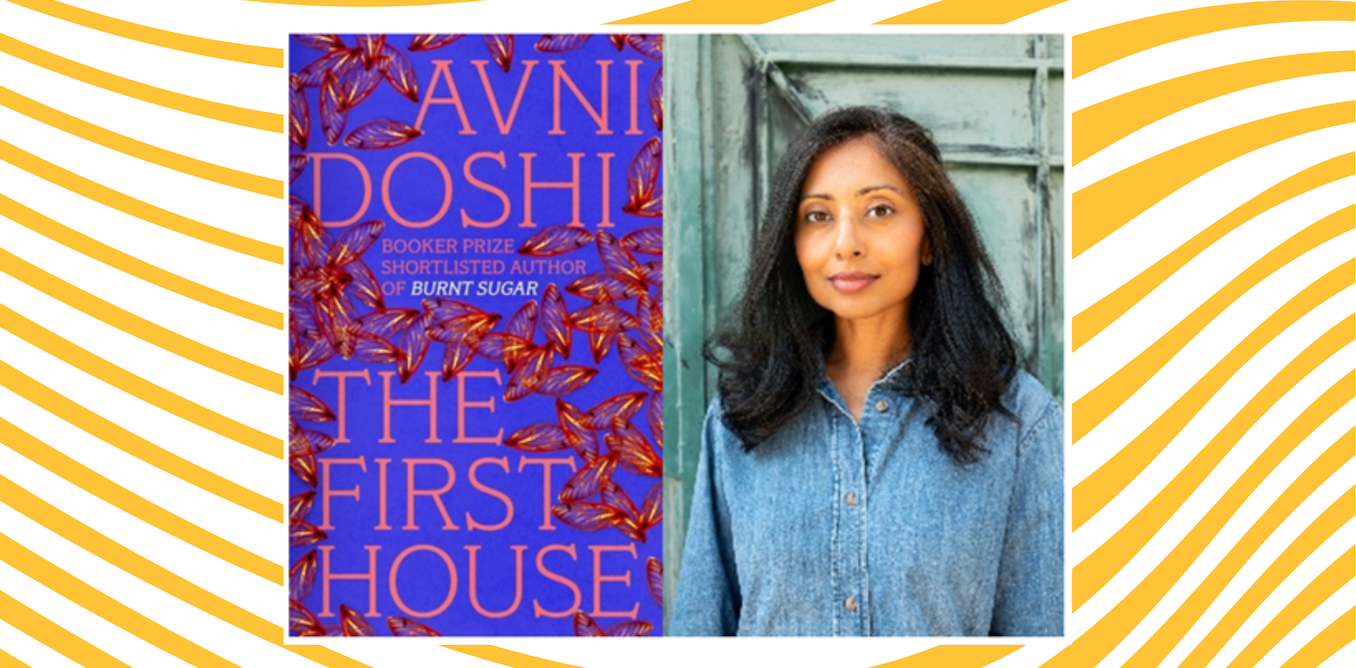
Avni Doshi, the Booker Prize-shortlisted author of Burnt Sugar, returns with her second novel, The First House, a work that solidifies her reputation as one of the most compelling literary voices of her generation. Doshi, born in New Jersey in 1982, has established herself as a writer who fearlessly dissects the complexities of human relationships, particularly those between mothers and daughters, husbands and wives. Her debut was lauded for its unflinching honesty and lyrical prose, and The First House continues this tradition, offering readers a psychologically penetrating exploration of marriage, identity, and the slow, agonizing process of self-reclamation.

The novel centres on an unnamed narrator whose thirteen-year marriage unexpectedly collapses, forcing her to confront not only the immediate devastation of her husband’s departure but also the deeper, more unsettling questions about her past, her family, and the very nature of love and sacrifice. It is a story that is as mythologically rich as it is emotionally devastating, weaving together ancient goddesses, astrological charts, and the relentless cycle of nature to create a profound meditation on what it means to lose everything and find oneself in the process.

The First House is a domestic drama steeped in psychological intensity and mythological symbolism, unfolding through the intimate, raw perspective of its unnamed narrator. The story begins with a moment of shattering clarity: her husband enters their bedroom and calmly announces he no longer wishes to be married. From this single, devastating event, the narrative spirals outward, exploring the aftermath of abandonment and the slow, painful process of learning to exist without the structures that once defined her. The plot is not driven by a series of dramatic external events but rather by the protagonist’s internal journey as she grapples with her grief, anger, and profound disorientation.

As the narrator struggles to maintain her composure for the sake of her two young daughters, she retreats into the world of astrology, studying birth charts in search of answers or perhaps just patterns that might explain the chaos of her life. She becomes fixated on the figure of Diana, the Roman goddess of the hunt, whose statue stands in her neighbour’s yard—a constant, silent observer of her unravelling. The statue, originally commissioned as a weathervane, becomes a powerful symbol of her own perceived powerlessness and the indignity of being turned by forces beyond one’s control. The novel also weaves in the emergence of periodical cicadas, whose seventeen-year life cycles of subterranean dormancy and explosive, noisy mating serve as a metaphor for hidden growth, suppressed desire, and the inevitable transformations that drive all living things.

The setting, a seemingly placid suburban landscape, contrasts sharply with the internal turmoil of the protagonist. Her world shrinks to the confines of her home, her fraught relationships with her parents, and her complicated, long-estranged relationship with her sister, Didi. The central conflict is her struggle to maintain a sense of self—to keep her head, as it were, while her life is dismantled piece by piece.

As she navigates financial instability, the practical challenges of single parenthood, and the humiliation of being left, she is forced to confront uncomfortable truths about her marriage and herself. The novel is ultimately a story about the stories we tell ourselves to survive, and what happens when those narratives collapse. Doshi uses the themes of loss, betrayal, and self-reclamation to explore how we construct our identities through relationships and what remains when those structures are removed.

The true power of The First House lies in Doshi’s extraordinary prose and the depth of her protagonist’s consciousness. The author crafts a narrative that is brutally honest, often uncomfortable, and deeply insightful into the psychology of a woman in crisis. The writing itself is a masterclass in showing, not telling; the reader feels the protagonist’s disorientation, her rising panic, and her eventual, hard-won clarity through the rhythm of the language and the accumulation of powerful, visceral details. Doshi has a remarkable ability to render complex emotional states with precision and economy, making the reader feel as though they are living inside the narrator’s mind. The novel’s structure, which moves between present-day events and memories of the past, creates a rich, layered portrait of a life that feels both specific and universal.

One of the most compelling characters is the narrator herself. Her voice is raw, intelligent, and often unflattering, yet it is this very honesty that makes her so resonant. She is not a passive victim; she is a woman capable of sharp observation and deep self-criticism, which makes her journey of self-discovery all the more moving.

For instance, her admission that she sometimes resented the intrusion of her family on her writing time, or her complex feelings of love and resentment towards her children, are depicted with a startling authenticity that challenges romanticized notions of motherhood. A specific example of her compelling development is her relationship with the act of writing itself. Initially a source of guilt and a symbol of what she has lost, writing gradually becomes a tool for her reclamation, a way for her to”re-collect”herself and her story. Her growing awareness of her own complicity in the failure of her marriage, and her willingness to examine her own flaws, makes her a deeply sympathetic and profoundly human character.

Another exceptionally compelling aspect of the novel is the storyline involving the Diana statue and the cicadas. Doshi masterfully uses these elements not as mere decorative motifs, but as integral parts of the narrative’s thematic architecture. The statue of Diana, a representation of a powerful, self-possessed female deity, becomes a haunting presence throughout the novel, a mirror for the narrator’s own lost power and a link to her past self. The story of Diana’s commissioning as a weathervane, a great goddess forced to turn at the whim of the wind, becomes a potent symbol for the diminishment the protagonist feels in her marriage and society at large. The revelation of the architect’s violent death at the foot of the statue adds another layer, suggesting that power, even divine power, is always contested.

Simultaneously, the cicadas, with their long, subterranean dormancy and explosive emergence to mate and die, parallel the narrator’s own hidden life, her suppressed desires, and the inevitable, often painful, transformations that drive her forward. The way Doshi intertwines these natural and mythological cycles with the protagonist’s personal crisis elevates the novel from a simple story of divorce to a profound exploration of life, death, and rebirth. The meticulous research that underpins these elements—the history of the statue, the biology of the insects, the details of Hindu mythology—lends the novel a weight and richness that rewards careful reading.

It is a testament to the novel’s quality that finding genuine fault with it is a challenging task. Doshi has crafted a work that is so tight, so fully realized in its vision and execution, that its”flaws”feel more like deliberate, provocative choices. For instance, the protagonist’s family, particularly her mother and father, are portrayed as almost caricatures of narrow-minded, self-absorbed immigrants, with the mother obsessing over food and appearances and the father wielding his authority with casual cruelty.

Their dialogue is often sharp, funny, and painfully recognizable, but their motivations can feel somewhat one-dimensional. They serve as foils to the narrator’s introspection, representing the world of tradition, judgment, and surface appearances from which she is trying to break free. While this makes them effective as obstacles, it also means they lack the psychological depth of the central character. This choice, however, might be intentional, reflecting how the protagonist herself, in her own distress, reduces her family to the roles they have always played in her life.

The only other potential point of critique is the novel’s unrelenting intensity. The protagonist’s emotional state is so vividly rendered that the reader is plunged into her anxiety, grief, and confusion without much respite. This immersive quality is, in fact, a strength, as it forces the reader to sit with the uncomfortable feelings of the character, creating a visceral reading experience that is rare in contemporary fiction. Some might find the pacing, which mirrors the protagonist’s cyclical thoughts and slow progress, to be a challenge, but this is a stylistic choice that serves the story’s thematic core.

The novel is not meant to be an easy, escapist read; it is meant to be a deep, sometimes claustrophobic, dive into a mind in the process of breaking down and rebuilding. Therefore, what might be perceived as a flaw in another book—the dense, interior focus and the lack of conventional plot—is, in The First House, a hallmark of its exceptional quality. It demonstrates Doshi’s complete control over her narrative and a remarkable commitment to her protagonist’s truth. The ending, too, feels earned, not a tidy resolution but a quiet, powerful moment of emergence, mirroring the cicadas’ own breaking of the surface. This is a novel that trusts its readers to find meaning in its depths.

The First House is a literary masterpiece that will resonate most deeply with readers who appreciate sophisticated, character-driven fiction. Fans of authors like Rachel Cusk, Sheila Heti, and Elena Ferrante will find a kindred spirit in Doshi’s unflinching examination of female interiority and the complicated dynamics of family and marriage. This is not a book for those seeking a fast-paced plot or a tidy, redemptive ending; rather, it is for those who find pleasure in complex prose, rich symbolism, and a story that is both intellectually stimulating and emotionally devastating.

It is a novel for anyone who has ever questioned their own identity within a relationship, struggled with the weight of family expectations, or sought to rebuild themselves from the ground up after a profound loss. Due to its mature themes and psychological complexity, it is best suited for an adult audience, particularly readers who appreciate literary fiction that challenges and rewards in equal measure. The First House is a book that will linger in the mind long after the final page, a testament to Avni Doshi’s extraordinary talent.

Similar Posts

  • Can Pakistan live on a Borrowed Revolution?

    The most pitiable creature I know is not the beggar who asks for bread but the gentleman who must borrow a personality. He dresses in another man’s taste, speaks in another man’s phrases and mistakes imitation for refinement. He is everywhere respectable and nowhere original. Nations occasionally acquire the same unfortunate habit. Their politics become echoes, their ideals reflections, and their revolutions little more than borrowed costumes. There was a time when borrowing was the necessity of poverty. We borrowed machines because we had no factories, medicines because we had no laboratories, and books because we had no presses. Such borrowing was neither shameful nor unusual; indeed, civilisation itself advances through exchange. The Greeks borrowed from Egypt, the Arabs preserved and enlarged the inheritance of Greece, Europe rediscovered Aristotle through Muslim Spain, and Japan modernised by learning from the West without surrendering its soul. Borrowing knowledge is the beginning of wisdom. Borrowing identity is the beginning of decline. There is another form of borrowing that no customs official can intercept and no tariff can discourage. It enters silently through the imagination. A society begins by borrowing opinions, then aspirations, then indignation. Before long, it borrows its heroes, its villains, its vocabulary and, eventually, its revolutions. It ceases to ask, “What does our history require?” and instead asks, “Whose history should we imitate?” That, I fear, is the predicament into which much of Pakistan’s public discourse has drifted. During the past several weeks, social media has been flooded with admiration for the recent political resistance witnessed across the border in India. Video clips have travelled faster than thoughtful analysis. Slogans have crossed the Wagah frontier with greater ease than ideas. Among countless young Pakistanis one question has become almost fashionable, Why can’t Pakistan have a movement like this? The question is understandable. It is also profoundly revealing. Hidden within it is an assumption that our political future must resemble somebody else’s present; that history unfolds according to a universal script; that every nation matures by repeating the experience of another. It is an assumption born not of confidence but of intellectual dependency. The tragedy, therefore, is not that Pakistanis admire another people’s courage. Every decent society can appreciate courage wherever it appears. The tragedy is that many have become convinced that courage itself must now be imported. We seem increasingly unable to recognise our own political inheritance unless it first receives foreign approval. This habit is hardly confined to politics. It has become the defining condition of our intellectual life. We borrow theories from European universities before examining our own social realities. We borrow ideological fashions from America before asking whether they illuminate Pakistani society. We borrow debates from social media and mistake them for scholarship. We consume outrage manufactured elsewhere and wear it as though it were tailored for our own circumstances. We have become, in the deepest sense of the phrase, tenants in the house of our own imagination. The irony is painful. No civilisation lacking confidence in itself has ever become creative. Creation begins where imitation ends. Shakespeare borrowed stories but produced Hamlet. Iqbal studied Nietzsche and Bergson yet remained unmistakably Iqbal. Muhammad Ali Jinnah mastered the constitutional traditions of Britain but transformed them into a political movement rooted in the aspirations of Indian Muslims. Great minds borrow raw material; they do not borrow finished identities. The same principle governs nations. Civilisations borrow in order to create. Declining societies borrow in order to imitate. Perhaps nowhere is this confusion more visible than in our understanding of resistance. Resistance has become one of the most romantic words in modern political vocabulary. It evokes images of heroic crowds, defiant slogans, dramatic confrontations and triumphant victories. Social media, with its appetite for spectacle, has transformed resistance into a global performance. Every protest becomes a cinematic narrative; every confrontation seeks an audience; every slogan aspires to immortality through a hashtag. But history is not written in hashtags. Nor are nations transformed by theatrical moments alone. The anthropologist Leila Abu-Lughod offered an important warning nearly three decades ago in her influential essay The Romance of Resistance. She argued that scholars often romanticise resistance as though every act of opposition were inherently emancipatory. Such a view, she suggested, ignores the complex relationships of power, culture and history within which resistance acquires meaning. Acts of dissent cannot be detached from the societies that produce them. They are rooted in particular institutions, historical memories and cultural conditions. Her insight deserves careful attention today. To ask why Pakistan does not produce resistance identical to India’s is rather like asking why the Indus refuses to flow like the Ganges. Rivers obey their own geography. Nations obey their own history. Every meaningful political movement is shaped by its unique historical circumstances. The French Revolution emerged from fiscal collapse and aristocratic privilege. The American Revolution arose from disputes over representation and imperial authority. South Africa’s democratic transition was forged in the struggle against apartheid. None of these experiences can simply be photocopied for another society. History does not distribute identical examinations to different nations. Each country answers its own questions. Yet we continue searching for borrowed answers. Perhaps this is because borrowed revolutions are emotionally satisfying. They spare us the difficult labour of self-examination. It is always easier to admire another nation’s struggle than to confront the unfinished responsibilities of our own. Admiration demands nothing. Citizenship demands everything. That distinction has become blurred in contemporary Pakistan. Our public imagination has fallen in love with the romance of beginning anew. Every few years another movement captures our attention. We invest it with almost mythical expectations. We hope it will accomplish what institutions, constitutions and patient political reform have failed to achieve. We long for redemption through spectacle. But mature nations are not built upon permanent excitement. They are built upon permanent institutions. Hannah Arendt observed in On Revolution that the enduring achievement of successful revolutions lies not in the destruction of an old order but in the establishment of a

  • Debtocracy & bankruptcy of ideas   

    Pakistan’s debt problem has entered a new phase. The headline figure is alarming: total debt and liabilities reached Rs. 99.59 trillion by the end of fiscal year (FY) 2025-26. The deeper concern, however, lies in the composition of this debt, the burden of servicing it and the channels through which public borrowing now affects every productive sector of the economy. According to the latest State Bank of Pakistan data, total debt stood at Rs. 97.88 trillion. Gross government domestic debt reached Rs. 59.44 trillion, while external debt amounted to Rs. 36.20 trillion. Central government debt increased by 7.39% over the preceding year to Rs. 83.64 trillion. External debt and liabilities stood at US$138.85 billion. These numbers confirm the central argument developed in the a ten-part series published in these columns [‘Bankruptcy of ideas—X: Debt, Taxes & Democracy’, Minute Mirror, June 21, 2026]. Pakistan has not merely borrowed against its future. It has increasingly borrowed to service earlier borrowing, while failing to create sufficient productive capacity from the accumulated debt.   ‏The external debt-servicing profile for FY2026 makes this particularly clear. Pakistan serviced US$21.59 billion of external debt during the year. An extraordinary US$10.14 billion—nearly half of the annual amount—fell in the final quarter alone. Quarterly servicing was 2.63 times the amount paid in the preceding quarter, mainly because principal repayments jumped from US$2.70 billion in the third quarter to US$8.81 billion in the fourth. This concentration of repayments is as important as the overall debt stock. A country may carry a large debt if its economy generates sufficient revenue, exports and foreign exchange to service it. Pakistan’s difficulty is that debt obligations have expanded much faster than the productive and export capacities needed to meet them. The debt accumulated over decades cannot be attributed to one government or one fiscal year. Persistent fiscal deficits, a narrow and inequitable tax base, losses of state-owned enterprises, the energy-sector circular debt, excessive recurrent expenditure, exchange-rate depreciation and repeated balance-of-payments crises have all contributed to it. Borrowing became the preferred substitute for reform.  Governments borrowed because they could not tax influential sectors, restructure loss-making enterprises, reduce wasteful expenditure or build a competitive export economy. External lenders financed temporary stability, while domestic banks financed the fiscal deficit. Each arrangement postponed difficult decisions without removing the causes of the crisis. The Ministry of Finance reported public debt at 70.7% of GDP by June 2025. The ratio may improve when nominal GDP grows faster than debt, especially during periods of inflation, fiscal consolidation and lower interest rates. A declining debt-to-GDP ratio, however, does not necessarily mean that the debt burden has become harmless. Pakistan’s debt stock is still increasing. What has improved is the immediate cost of servicing parts of it. Total debt and liabilities servicing declined from Rs. 13.16 trillion in FY2025 to Rs. 11.97 trillion in FY2026. Interest payments on debt fell by more than 23%, from Rs. 9.47 trillion to Rs. 7.27 trillion, largely because lower policy rates reduced the cost of servicing domestic government debt. Interest payments on gross government domestic debt consequently fell from Rs. 8.08 trillion to Rs5.99 trillion. This is welcome relief. It should not be presented as the end of the debt crisis. Lower interest rates reduce the flow cost of debt; they do not extinguish the stock. Principal repayments on external debt and liabilities increased from Rs. 3.47 trillion to Rs. 4.47 trillion during FY2026. Pakistan therefore obtained relief on domestic interest payments while facing a substantially heavier external repayment burden. The distinction is between debt management and economic transformation. Pakistan may be moving from an acute debt-accumulation crisis towards a more manageable financing position. It has not escaped debtocracy—the system in which fiscal policy, taxation, banking, foreign relations and development priorities become subordinate to the requirements of borrowing and repayment. Debtocracy does not remain confined to the accounts of the Ministry of Finance. It is transmitted throughout the economy. The first channel is the banking system. Government securities offer banks sovereign backing, liquidity and attractive risk-adjusted returns. Lending to the government is easier than evaluating businesses, financing innovation or supporting small and medium enterprises. A large domestic borrowing requirement therefore creates continuous competition for available liquidity. The result is crowding out. The State obtains the funds it requires, banks earn relatively secure returns and the private sector bears the adjustment. Productive businesses face limited access to credit, higher risk premiums and shorter financing horizons. Smaller enterprises suffer the most because they cannot compete with the sovereign for bank liquidity. This creates a financial system that can remain profitable while the productive economy remains weak. Deposits are mobilised from citizens and businesses, channelled into government securities, and then used substantially to meet recurrent expenditure and service earlier debt. Banking expands without an equivalent expansion in productive capacity. The second channel operates through foreign exchange. External debt repayment creates demand for dollars. That demand places pressure on reserves and the current account. Any resulting exchange-rate depreciation increases the rupee value of external liabilities and raises the domestic price of imported fuel, machinery, raw materials and intermediate goods.  The chain is direct: External repayment creates foreign-exchange demand; reserve pressure increases exchange-rate sensitivity; depreciation generates imported inflation; and inflation raises working-capital requirements and production costs. Debt consequently becomes a corporate balance-sheet issue. An industrial enterprise may have no external loan, yet still bear the effects of sovereign external debt through a weaker rupee, costlier imports, higher energy prices and restricted access to domestic credit. Consumers ultimately pay through inflation, reduced employment and lower real incomes. The third channel is fiscal. Every rupee allocated to debt servicing is a rupee unavailable for education, health, water, climate resilience and productive infrastructure—unless the State raises additional revenue or borrows again. Pakistan then enters a circular arrangement: borrowing creates servicing obligations, servicing compresses development expenditure, weak development limits growth and revenue, and insufficient revenue necessitates further borrowing. This is why a primary surplus, though necessary, is not sufficient. It can stabilise debt dynamics, but

  • Fundamental Right No. 10A: Right to Fair Trial in …

    By Muhammad Imran, Staff Member, SAHSOL-LUMS and Asma Rahmat, Final Year Law Student, SLC, Superior University and Muhammad Ameer Hamza, Final Year Law Student, SLC, Superior University    Historical Evolution and Constitutional Recognition: The right to a fair trial and due process is expressly guaranteed under Article 10A of the Constitution of the Islamic Republic of Pakistan, 1973, which was inserted through the Constitution (Eighteenth Amendment) Act, 2010. The Eighteenth Amendment was passed by the National Assembly on 8 April 2010, approved by the Senate on 15 April 2010, and received the assent of the President on 19 April 2010, whereupon it came into force. The insertion of Article 10A marked one of the most significant constitutional reforms introduced by the Eighteenth Amendment by expressly recognizing the right to a fair trial and due process as enforceable fundamental rights. Before the insertion of Article 10A, the Constitution did not contain an explicit guarantee of the right to a fair trial. Nevertheless, the superior judiciary consistently interpreted Articles 4, 9, and 25 of the Constitution as implicitly incorporating the principles of natural justice, procedural fairness, and due process. Article 4 guarantees the right of every individual to be dealt with in accordance with law, Article 9 protects the security of person, and Article 25 guarantees equality before the law and equal protection of the law. Through an evolving body of constitutional jurisprudence, the Supreme Court of Pakistan acknowledged that fairness in legal proceedings constituted an indispensable component of the rule of law and the protection of fundamental rights. However, the absence of an express constitutional guarantee often created uncertainty regarding the precise scope and enforceability of these procedural protections. The insertion of Article 10A fundamentally transformed Pakistan’s constitutional framework by elevating the right to a fair trial and due process into an independent and directly enforceable fundamental right. It converted principles previously implied through judicial interpretation into an explicit constitutional mandate, thereby strengthening the protection of individual liberties, reinforcing constitutional supremacy, and enhancing judicial oversight. Moreover, the amendment reflects Pakistan’s commitment to internationally recognized human rights standards, particularly Article 14 of the International Covenant on Civil and Political Rights (ICCPR), which guarantees the right to a fair and public hearing by an independent and impartial tribunal. Scope and Nature of Article 10A: Article 10A provides that: “For the determination of his civil rights and obligations or in any criminal charge against him, a person shall be entitled to a fair trial and due process.” The language of Article 10A demonstrates that its protection is not confined to criminal prosecutions. Rather, it extends equally to civil proceedings and all judicial, quasi-judicial, and administrative proceedings in which legal rights and obligations are determined. Consequently, the constitutional guarantee encompasses the entire continuum of justice, including investigation, arrest, detention, prosecution, adjudication, sentencing, appeal, and review. The constitutional requirement of “due process” ensures that every stage of legal proceedings must be conducted in accordance with established legal procedures, free from arbitrariness, discrimination, mala fide exercise of power, or abuse of authority. Essential Components of the Right to Fair Trial: The right to a fair trial under Article 10A embodies a comprehensive set of procedural safeguards that are indispensable for the administration of justice. These include the presumption of innocence until guilt is proved beyond reasonable doubt, the right to be informed promptly and clearly of the accusations, the right to adequate time and facilities to prepare a defence, the right to legal representation by counsel of one’s own choosing, the opportunity to examine and cross-examine witnesses, the right to produce evidence in defence, and the entitlement to a public hearing before an independent, impartial, and competent tribunal established by law. Equally important is the obligation that judicial decisions be reasoned, evidence-based, and transparent. The requirement to provide reasoned judgments promotes accountability, facilitates appellate review, enhances public confidence in the administration of justice, and ensures that justice is not only done but is also manifestly seen to be done. Relationship with Other Constitutional Guarantees: Article 10A does not operate in isolation but forms part of a broader constitutional framework safeguarding individual liberty and procedural justice. Article 4 guarantees that every individual shall be treated strictly in accordance with law, while Article 9 protects the fundamental rights to life and liberty. Article 10 provides specific procedural safeguards relating to arrest and detention, including the right to be informed of the grounds of arrest, the right to consult legal counsel, and the right to be produced before a magistrate within twenty-four hours. Article 25 further guarantees equality before the law and equal protection of the law. Read harmoniously, these constitutional provisions establish an integrated framework designed to prevent arbitrary state action, ensure accountability of public authorities, and uphold fairness throughout the legal process. Judicial Interpretation of Article 10A: The superior judiciary has consistently interpreted Article 10A as embodying both procedural and substantive dimensions of justice. The Supreme Court of Pakistan has repeatedly emphasized that compliance with Article 10A requires more than mere adherence to technical procedural formalities; rather, fairness must permeate every stage of legal proceedings. Investigations, collection of evidence, prosecution, trial, sentencing, and appellate review must all satisfy constitutional standards of due process. The courts have further held that statutory provisions or executive actions inconsistent with Article 10A are subject to constitutional scrutiny and may be declared unconstitutional where they undermine the fundamental right to a fair trial. Consequently, Article 10A has become a cornerstone of Pakistan’s constitutional jurisprudence, guiding judicial review in criminal justice, administrative law, disciplinary proceedings, and civil litigation. Constitutional Significance: The constitutional recognition of the right to a fair trial has significantly strengthened Pakistan’s legal system by providing an effective safeguard against arbitrary exercise of state power. It protects individuals against unlawful convictions, promotes judicial accountability, enhances public confidence in legal institutions, and reinforces the supremacy of the rule of law. Simultaneously, it serves as an important constitutional mechanism for balancing society’s interest in the effective prosecution of crime with the fundamental rights

  • Pakistan deserves better, Call for responsible gov…

    By Mehak Ali Pakistan is a country united by diverse cultures, languages, and provinces. Sindh, Punjab, Balochistan, Khyber Pakhtunkhwa, Gilgit-Baltistan, and Azad Jammu and Kashmir together form a nation blessed with breathtaking mountains, mighty rivers, vast deserts, fertile plains, and a strategically significant location. These natural blessings make Pakistan one of the most important countries in South Asia. ‎Yet, despite these advantages, millions of citizens continue to struggle with basic issues. Every day, news headlines report murders, sexual violence, malnutrition, unemployment, floods, illiteracy, inflation, gas shortages, electricity outages, and rising fuel prices. These are not isolated incidents; they are challenges that affect the daily lives of ordinary Pakistanis. ‎Citizens pay taxes with the expectation that the government will provide quality education, healthcare, infrastructure, security, and economic opportunities. When these expectations remain unfulfilled, frustration naturally grows. Good governance is not measured by speeches or publicity but by improvements in the lives of the people. ‎The condition of Sindh, particularly in many rural areas, reflects these concerns. Damaged roads, overflowing garbage, poor sanitation, and inadequate public services make everyday life difficult. Similar concerns are voiced by people in Balochistan, Khyber Pakhtunkhwa, and other regions, where many continue to demand better facilities, development, and equal opportunities. ‎Farmers work tirelessly under the scorching sun to feed the nation. Employees spend long hours in offices to support their families. Students invest years in education, yet many remain unemployed even highly qualified graduates and researchers struggle to find suitable jobs. Meanwhile, poverty, heat-related illnesses, and malnutrition continue to claim innocent lives. ‎In a democratic society, peaceful protest is a constitutional right. When citizens raise their voices for justice, development, or equal treatment, they deserve to be heard with dialogue rather than confrontation. The unrest in Azad Jammu and Kashmir reminds us that citizens’ grievances whether related to economic hardships, political representation, or governance must be addressed through dialogue, accountability, and peaceful solutions rather than allowing frustration to turn into violence. Listening to the concerns of the people strengthens democracy and builds trust between the government and its citizens. ‎Despite these challenges, Pakistan remains our home, and we are proud to be Pakistanis. Criticizing shortcomings does not mean we love our country any less. On the contrary, it reflects our hope for a better future. We dream of a Pakistan where every citizen enjoys equal rights, where public resources are used responsibly, where justice prevails, and where no one is left behind because of their province, ethnicity, or economic status. ‎Pakistan has immense potential. What it needs is sincere leadership, transparent governance, and policies that place the welfare of the people above all else. Only then will every citizen be able to say with confidence and pride: Yes, we are Pakistanis, and we are truly united.

  • A Soldier, a Mechanic, and the Cold Arithmetic of …

    By General Ghulam Mustafa (Served in different staff and command assignments, commanded a Corps, raised and commanded Army Strategic Force Command) & Engineer Arshad H Abbasi, Co-founder, Energy Excellence Centres at NUST and Engineering University Peshawar, International Transboundary Water Expert We are not screenwriters, and this is not the plot of some Hollywood picture about killer robots. We write this together as two men who came to the same conclusion from two different directions — one of us a soldier who has stood post and commanded troops, the other a mechanic and engineer who has spent his life with his hands inside machines, the kind who can tell you what’s wrong with an engine by the sound it makes before it ever fails. Between us, we have spent the last two years doing the same thing every serious military professional on earth has been doing: watching. Watching Russia and Ukraine grind through the third year of a war that has quietly buried the twentieth century. Watching the United States and Israel fight Iran through the spring and summer of 2026 in a conflict that opened with a strike on a supreme leader and closed, for now, with tankers stacked outside a blockaded Strait of Hormuz. We have not been watching for drama. We have been watching for the future, because the future is what these two wars have been showing us, in plain daylight, for anyone willing to look. In these two wars, our role has not been that of commentators cheering for one flag or another. It has been closer to that of historians standing over wreckage — the unglamorous, unsleeping work of the crash investigator rather than the war correspondent. Every video of an intercepted missile over the Gulf, every geolocated frame of a naval drone striking a Russian hull, every leaked spec sheet of a downed quadcopter over the Black Sea or a jammed loitering munition over the Iranian coast, has to be logged, timestamped, and cross-checked against the next one. That is what wreckage analysis actually is: not excitement, but discipline — recording what a piece of equipment was asked to do, and what it actually did, until the pattern becomes undeniable. Two years of that discipline, applied to two very different wars fought six thousand kilometres apart, keeps returning the same verdict. Here is what we have seen. The age of the tank column, the massed infantry advance, the fighter squadron duel, and even the aircraft carrier as the ultimate expression of national power — that age is closing. Not because these machines have become useless overnight, but because a battlefield now watched by satellites, saturated with cheap sensors, and swarmed by thousands of low-cost drones has no room left for anything large, slow, or expensive to hide in. Ukraine, a country with no serious blue-water navy, used naval drones costing a fraction of a warship to cripple roughly 40 percent of Russia’s Black Sea Fleet and force the rest to retreat from Crimea’s shores. In the Iran war, American carrier strike groups sat further offshore than doctrine once assumed necessary, and the campaign’s real damage was done by long-range strike, electronic warfare, and a naval blockade — not by tank divisions crossing a border, because there was no border to cross. The lesson repeats itself in both theatres: mass a large, valuable, human-crewed asset in the open, and you have built an expensive target. The war has moved to the phone in a soldier’s hand and the joystick on a folding table a hundred kilometres from the front. That is the second thing the two of us keep coming back to, and we believe it is right: future wars will be fought on mobile phones, controlling drones and robots. A robotic aircraft or ground vehicle can turn harder, dive faster, and sit still for longer than any pilot or driver, because it carries no pulse, no fear, no fatigue, and no family waiting at home. It needs no food. It needs no rest. It bleeds nothing when it dies except budget. Robots are already taking on the jobs that used to cost human lives — clearing minefields, hauling ammunition across exposed ground, flying reconnaissance into airspace too dangerous for a manned cockpit, making split-second targeting decisions with artificial intelligence faster than any human crew ever could. Armed drones and robotic ground vehicles now engage targets without risking a single pilot or driver. And because production, not stockpiling, decides who wins a prolonged war, the country that can build the most machines the fastest — not the country with the largest inherited arsenal — will hold the advantage. That is why the truest weapon in this new age is not a missile or a jet. It is the strength of a nation’s economy: its factories, its chip supply, its ability to iterate a drone design in weeks instead of years. Nowhere is this arithmetic more urgent than on the roof of the world, along the disputed frontier between India and China. China is not merely testing drones there; it is one of the most important production engines in the world for both, and it has been pouring resources into robotic ground systems, sensors, and autonomous platforms specifically postured along the Line of Actual Control, at altitudes where a human soldier struggles simply to breathe, let alone fight. Every one of those machines can be commanded from a warm room in Beijing, thousands of kilometres from the mountain. It needs no oxygen tent, no field ration, no medical evacuation. It can occupy a ridge and simply wait there, indefinitely, with a precision no human sentry can match, and it costs Beijing nothing but electricity and silicon when it is destroyed. Against that, India fields one of the largest land armies on the planet — an active strength of roughly 1.25 million soldiers, organized into seven operational commands and fourteen corps of holding and strike formations, built on a tradition of sacrifice, discipline, and sheer human

  • A Continent on Fire: What Central Asia Can Teach t…

    By Engineer Arshad H Abbasi, ahabasi@gmail.com, edited by Engineer Musa Arshad H Abbasi I write this from Islamabad, not as a diplomat or a historian, but as someone who spends his working life measuring rivers, glaciers, and energy systems — and who has spent the last year watching the instruments of my own profession become instruments of geopolitics instead. I am a water, energy and climate professional, not an expert in international relations. But you do not need a doctorate in strategic studies to feel what it means to live in a capital that sits within reach of two active fronts at once, and to watch a third, farther away, threaten the fuel that keeps my own country’s lights on. To the east, the Indus itself has become a weapon in a dispute I once only studied on paper. Since April 23, 2025, one day after the Pahalgam attack killed 26 people in Jammu and Kashmir, India has held the 1960 Indus Waters Treaty in abeyance, and as recently as July 3, 2026, New Delhi reaffirmed the suspension will continue until Pakistan “credibly and irrevocably” ends cross-border terrorism. Pakistan calls any interruption of that water an act of war. I measure river flows for a living, and I can tell you that a treaty which survived two wars and decades of hostility between 1960 and 2025 was never really about engineering — it was about restraint. Watching that restraint erode between two nuclear-armed neighbors, over a river that irrigates the fields I grew up walking beside, is not an abstraction to me. It is personal. To the west, the war that began on February 28, 2026 between the United States, Israel, and Iran has turned the Strait of Hormuz — the channel that once carried roughly a quarter of the world’s seaborne oil and a fifth of its LNG — into a contested chokepoint. Iranian forces have mined and attacked shipping there on and off for months; a ceasefire and a June memorandum of understanding collapsed in July when Iran resumed strikes on vessels it deemed noncompliant. Even now, in mid-August, Tehran and Oman are still negotiating the terms under which the strait might fully reopen. Every Pakistani household that has watched fuel prices swing this year has felt that war, even though it is being fought a thousand miles from here. And Pakistan’s own western border is no longer a metaphor for instability — it is an active one. Since February 2026, Pakistan and Afghanistan have fought what both sides’ own defense ministries have called open war along the 1893 Durand Line, with Pakistani airstrikes on Nangarhar and Kabul, an Afghan cross-border offensive, and casualty claims running into the hundreds on each side before Qatar- and Turkey-mediated pauses briefly held. I know these are not the only fires burning on this continent, and an honest accounting has to look past South Asia. In Southeast Asia, a century-old dispute between Thailand and Cambodia over the ancient temples of Preah Vihear and Ta Muen Thom erupted twice in 2025 — first in July, then again in December — leaving at least 101 people dead and forcing more than half a million civilians from their homes before a fragile ceasefire, signed December 27, brought an uneasy calm. In East Asia, the map is a thicket of overlapping claims: China and Taiwan over the island’s sovereignty itself; China and Japan over the Senkaku/Diaoyu islands in the East China Sea; China and the Philippines over Scarborough Shoal and reefs across the South China Sea; and Japan and its neighbors over a scattering of other contested waters that keep regional navies on constant alert. Indonesia and Malaysia, too, carry an unresolved history — the armed 1960s Konfrontasi and a maritime boundary dispute over the oil-rich Ambalat block in the Sulawesi Sea that periodically flares even between otherwise friendly neighbors. And running beneath all of it is the oldest fault line of all: the decades-long conflict between Israel and its Arab neighbors, still reshaping alliances and battlefields from Gaza to Lebanon to Yemen, where Houthi strikes on Saudi infrastructure continue even this month. Set against all of that, look at Central Asia — building transit corridors instead of trench lines, settling water and border disputes through negotiation rather than force, and courting the same investors that war has driven away from South Asia, the Gulf, and the South China Sea. Even the Armenia-Azerbaijan peace process next door, however unfinished — initialed in Washington in August 2025, still unsigned a year later over Armenia’s constitutional language — has produced something rarer than victory: an actual framework both sides keep returning to, rather than abandoning for the battlefield. While I want to avoid romanticizing Central Asia to those who know the region far better than I do, it stands as a compelling model for peace. The region offers a practical demonstration that Asian states can prioritize economic integration over territorial reflexes—a choice that others, from Islamabad to Phnom Penh to Manila, have yet to make. The Ledger of Conflict: A Continent Still at War With Itself It is worth setting all of this down in one place, because scattered across a dozen news cycles it is easy to lose the scale of it. India–Pakistan, Kashmir and the Indus Waters Treaty. Held in abeyance since April 23, 2025; reaffirmed as of July 2026 to remain suspended until Pakistan “irrevocably” ends cross-border terrorism, in a dispute that touches the water security of more than 300 million people and involves two nuclear-armed states that have already fought a war in 2025. Iran, Israel, and the United States. War since February 28, 2026, with Iranian attacks on shipping through the Strait of Hormuz — a corridor carrying roughly a quarter of the world’s seaborne oil and a fifth of its LNG — still unresolved as Tehran and Oman negotiate terms for reopening it, even this month. Pakistan–Afghanistan, the Durand Line. Open war since February 2026 between two governments that have never

Leave a Reply

Your email address will not be published. Required fields are marked *