
debtocracy 038 bankruptcy

Debtocracy & bankruptcy of ideas   

Pakistan’s debt problem has entered a new phase. The headline figure is alarming: total debt and liabilities reached Rs. 99.59 trillion by the end of fiscal year (FY) 2025-26. The deeper concern, however, lies in the composition of this debt, the burden of servicing it and the channels through which public borrowing now affects every productive sector of the economy.

According to the latest State Bank of Pakistan data, total debt stood at Rs. 97.88 trillion. Gross government domestic debt reached Rs. 59.44 trillion, while external debt amounted to Rs. 36.20 trillion. Central government debt increased by 7.39% over the preceding year to Rs. 83.64 trillion. External debt and liabilities stood at US$138.85 billion.

These numbers confirm the central argument developed in the a ten-part series published in these columns [‘Bankruptcy of ideas—X: Debt, Taxes & Democracy, Minute Mirror, June 21, 2026]. Pakistan has not merely borrowed against its future. It has increasingly borrowed to service earlier borrowing, while failing to create sufficient productive capacity from the accumulated debt.


‏The external debt-servicing profile for FY2026 makes this particularly clear. Pakistan serviced US$21.59 billion of external debt during the year. An extraordinary US$10.14 billion—nearly half of the annual amount—fell in the final quarter alone. Quarterly servicing was 2.63 times the amount paid in the preceding quarter, mainly because principal repayments jumped from US$2.70 billion in the third quarter to US$8.81 billion in the fourth.

This concentration of repayments is as important as the overall debt stock. A country may carry a large debt if its economy generates sufficient revenue, exports and foreign exchange to service it. Pakistan’s difficulty is that debt obligations have expanded much faster than the productive and export capacities needed to meet them.

The debt accumulated over decades cannot be attributed to one government or one fiscal year. Persistent fiscal deficits, a narrow and inequitable tax base, losses of state-owned enterprises, the energy-sector circular debt, excessive recurrent expenditure, exchange-rate depreciation and repeated balance-of-payments crises have all contributed to it. Borrowing became the preferred substitute for reform

Governments borrowed because they could not tax influential sectors, restructure loss-making enterprises, reduce wasteful expenditure or build a competitive export economy. External lenders financed temporary stability, while domestic banks financed the fiscal deficit. Each arrangement postponed difficult decisions without removing the causes of the crisis.

The Ministry of Finance reported public debt at 70.7% of GDP by June 2025. The ratio may improve when nominal GDP grows faster than debt, especially during periods of inflation, fiscal consolidation and lower interest rates. A declining debt-to-GDP ratio, however, does not necessarily mean that the debt burden has become harmless.

Pakistan’s debt stock is still increasing. What has improved is the immediate cost of servicing parts of it.

Total debt and liabilities servicing declined from Rs. 13.16 trillion in FY2025 to Rs. 11.97 trillion in FY2026. Interest payments on debt fell by more than 23%, from Rs. 9.47 trillion to Rs. 7.27 trillion, largely because lower policy rates reduced the cost of servicing domestic government debt. Interest payments on gross government domestic debt consequently fell from Rs. 8.08 trillion to Rs5.99 trillion. This is welcome relief. It should not be presented as the end of the debt crisis.

Lower interest rates reduce the flow cost of debt; they do not extinguish the stock. Principal repayments on external debt and liabilities increased from Rs. 3.47 trillion to Rs. 4.47 trillion during FY2026. Pakistan therefore obtained relief on domestic interest payments while facing a substantially heavier external repayment burden.

The distinction is between debt management and economic transformation. Pakistan may be moving from an acute debt-accumulation crisis towards a more manageable financing position. It has not escaped debtocracy—the system in which fiscal policy, taxation, banking, foreign relations and development priorities become subordinate to the requirements of borrowing and repayment.

Debtocracy does not remain confined to the accounts of the Ministry of Finance. It is transmitted throughout the economy. The first channel is the banking system. Government securities offer banks sovereign backing, liquidity and attractive risk-adjusted returns. Lending to the government is easier than evaluating businesses, financing innovation or supporting small and medium enterprises. A large domestic borrowing requirement therefore creates continuous competition for available liquidity.

The result is crowding out. The State obtains the funds it requires, banks earn relatively secure returns and the private sector bears the adjustment. Productive businesses face limited access to credit, higher risk premiums and shorter financing horizons. Smaller enterprises suffer the most because they cannot compete with the sovereign for bank liquidity.

This creates a financial system that can remain profitable while the productive economy remains weak. Deposits are mobilised from citizens and businesses, channelled into government securities, and then used substantially to meet recurrent expenditure and service earlier debt. Banking expands without an equivalent expansion in productive capacity.

The second channel operates through foreign exchange. External debt repayment creates demand for dollars. That demand places pressure on reserves and the current account. Any resulting exchange-rate depreciation increases the rupee value of external liabilities and raises the domestic price of imported fuel, machinery, raw materials and intermediate goods. 

The chain is direct: External repayment creates foreign-exchange demand; reserve pressure increases exchange-rate sensitivity; depreciation generates imported inflation; and inflation raises working-capital requirements and production costs.

Debt consequently becomes a corporate balance-sheet issue. An industrial enterprise may have no external loan, yet still bear the effects of sovereign external debt through a weaker rupee, costlier imports, higher energy prices and restricted access to domestic credit. Consumers ultimately pay through inflation, reduced employment and lower real incomes.

The third channel is fiscal. Every rupee allocated to debt servicing is a rupee unavailable for education, health, water, climate resilience and productive infrastructure—unless the State raises additional revenue or borrows again. Pakistan then enters a circular arrangement: borrowing creates servicing obligations, servicing compresses development expenditure, weak development limits growth and revenue, and insufficient revenue necessitates further borrowing.

This is why a primary surplus, though necessary, is not sufficient. It can stabilise debt dynamics, but it cannot by itself transform the economy. Stability becomes sustainable only when fiscal consolidation is accompanied by higher productivity, diversified exports, improved human capital and greater domestic revenue raised according to the ability-to-pay principle.

The relevant question is not whether Pakistan can continue borrowing. It probably can, provided external refinancing remains available, nominal GDP growth exceeds the effective cost of debt and the government maintains sufficient fiscal discipline.

The real question is what the borrowing finances. Debt used for efficient infrastructure, export capacity, energy security, technological development and human capital can enlarge the economy’s repayment capacity. Debt used to finance current consumption, untargeted privileges, inefficient enterprises and recurring fiscal gaps merely transfers the cost of present political choices to future taxpayers.

Pakistan therefore needs a binding distinction between productive and unproductive borrowing. Every major loan should identify the asset or capacity it will create, its expected economic return, its foreign-exchange implications and the source from which it will ultimately be repaid. Parliament and the public should be able to examine these claims before liabilities are contracted, not after the money has been spent.

Domestic borrowing must also be linked to financial-sector reform. Banks cannot remain primarily intermediaries between depositors and the government. Regulatory and fiscal incentives should encourage longer-term lending to agriculture, industry, technology, exports and small enterprises without compromising credit discipline.

External borrowing requires an even stricter test. Foreign-currency debt should preferably finance activities capable of earning or saving foreign exchange. Borrowing dollars to meet rupee-based recurrent expenditure is one of the surest ways of converting a fiscal weakness into a balance-of-payments crisis.

The decline in interest payments during FY2026 provides breathing space. It does not provide an escape. That space can either be used to restructure the economy or consumed until the next interest-rate, exchange-rate or refinancing shock arrives.

Pakistan will emerge from debtocracy only when borrowing ceases to substitute for taxation, governance and productive investment. The Rs.100 trillion headline is not merely a record of what Pakistan owes. It is a measure of opportunities already consumed and a warning about choices still to be made.

Debt becomes manageable when it creates the capacity to repay itself. Without that transformation, improved ratios and lower interest payments will amount to another interval of stabilisation—while the underlying bankruptcy of ideas continues.

___________________________________________________________

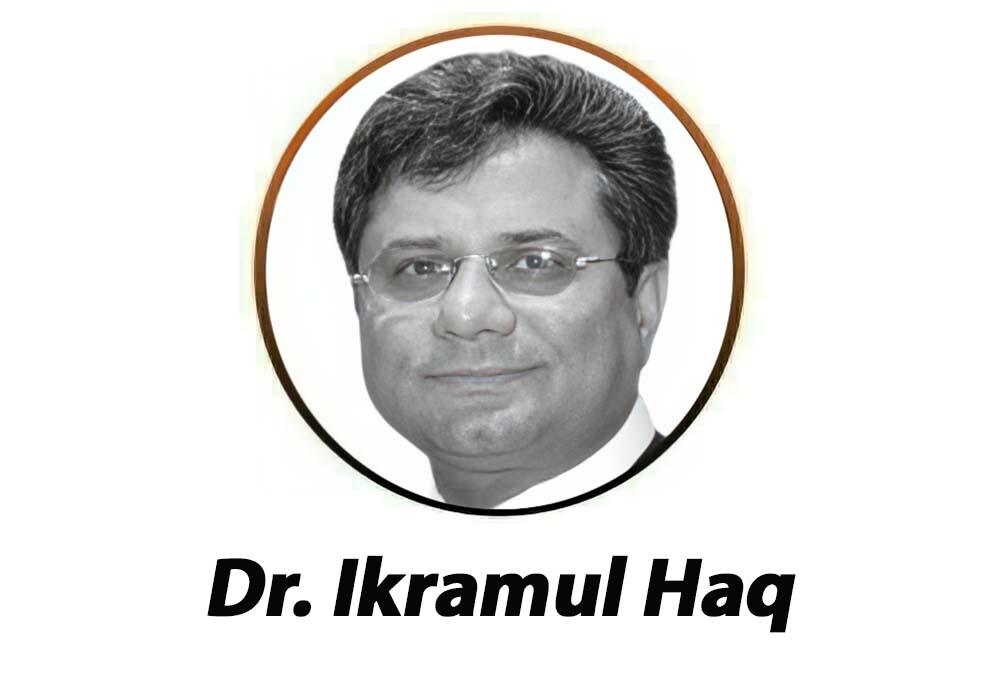
Dr. Ikramul Haq, Advocate Supreme Court, specializes in constitutional, corporate, media, environment, ML/CFT related laws, IT, intellectual property, arbitration and international tax laws. He holds an LLD in tax laws with specialization in transfer pricing. He was full-time journalist from 1979 to 1984 with Viewpoint and Dawn. He served Civil Services of Pakistan from 1984 to 1996. 

Similar Posts

  • The AJK Crisis 

    Azad Jammu and Kashmir has recorded at least 40 deaths since early June in clashes tied to the Joint Awami Action Committee’s campaign against the region’s twelve refugee assembly seats, a toll that predates the events of July 27-28, when JAAC and AJK police gave conflicting counts of 14 to 21 more killed in Rawalakot. The combined total since June likely sits in the high 40s to high 50s, though no independent body has confirmed a single figure; every clash in this sequence has produced a JAAC count and a police count that don’t match, and neither has been verified from outside. The July violence fell during the first phase of a legislative election that AJK’s election commission split into three stages because of the unrest, a break from the territory’s usual practice of voting in a single day. Mirpur division cast ballots on July 27. Rawalakot, in Poonch division, was deliberately held back for the third phase because it has been the epicenter of the agitation. The clashes there on July 27-28 came as JAAC’s long march tried to push through the city toward Muzaffarabad, not on a day its own constituents were voting. That the state felt it necessary to stagger an election by geography to manage a protest movement is itself a measure of how far the crisis had already gone. Law enforcement personnel have been repeatedly targeted through the unrest. Police say an armed JAAC contingent opened fire on officers near Combined Military Hospital Rawalakot in a planned attack, which the region’s police chief called outright terrorism. JAAC disputes this, as it has disputed nearly every account of nearly every clash, saying its own people came under fire after power was cut to the area. Neither version has been independently verified, and the Human Rights Commission of Pakistan has called for an impartial probe into the Rawalakot deaths for that reason. What is not contested is that a movement now banned under anti-terrorism law has been in near-continuous confrontation with police for eight weeks, and that officers have died in it. The dispute traces back to a structural question the state has already answered through the proper channel. Six of the twelve seats go to refugees from the Jammu division, numbering around 434,000; six more go to refugees from the Kashmir Valley, numbering around 30,000. JAAC calls this disproportionate and argues the seats let people who do not live in AJK shape its politics from outside. The AJK Supreme Court ruled on June 7 that the seats are constitutionally protected and can only be altered through a formal amendment, not by administrative order or by protest. The government’s proscription of JAAC under anti-terrorism law came two days earlier, on June 5, ahead of a planned June 9 protest; the worst of the killing followed the ban rather than preceding it. Both sides of that sequence can be argued. What can’t be argued is that the state waited for a body count before invoking the law , it acted first, and the deaths followed. On the demands themselves, the government reports 24 of JAAC’s 44 total demands fully implemented and 16 more partially complete or in process, with 4 at an impasse. That record is substantial, larger than most governments manage against a protest charter. But it does not settle the argument on its own, because none of the 24 completed demands is the refugee-seat question. That one sits among the 16 still unresolved, and it is the demand driving the current violence. A compliance rate built mostly from other line items ; subsidies, cabinet size, judicial commissions, demonstrates the state’s good faith in general. It does not demonstrate its handling of the one issue JAAC is dying and killing over, and that distinction should not be blurred. Even so, the seat question has been settled by the only body with authority to settle it. Abolishing the seats to appease pressure tactics would be unconstitutional on its face, and it would tell any future movement in Pakistan that enough disruption can override a court and a negotiated settlement alike. A state that has followed its own constitutional process, implemented most of an agreed reform charter, and still faces an intensifying campaign of blockades and attacks on security personnel has grounds to hold its position; grounds that rest on the process it followed, not on an implementation statistic that doesn’t reach the actual grievance. The state’s strongest move now is to negotiate from the position it has already earned, not concede from a position of weakness. Reweighting the seats toward Jammu’s larger population, pursued through the amendment process the Supreme Court has itself outlined, would resolve the proportionality complaint on the state’s own terms and timeline, not JAAC’s. Offered now, immediately after a disputed mass-casualty event, it would read as capitulation. Offered once the group’s remaining leadership either accepts the court’s authority or is dealt with through the law, it becomes a demonstration of a functioning constitutional order rather than a retreat from one. The state does not owe JAAC a seat at the table it has spent eight weeks helping to blow up. It owes AJK’s residents a government that can enforce the law, account honestly for its own role in how this got this bloody, and eventually fix what is fair within the constitution , in that order.

  • The hands that clean Karachi

    KARACHI: Before the city wakes up, thousands of sanitation workers are already at work. They sweep roads, collect household waste, clean neighbourhoods and, in some cases, enter sewer lines and manholes to clear blockages. Among them are many workers from Christian and Hindu communities who perform some of Karachi’s most difficult and hazardous jobs. On August 11, Pakistan observes National Minorities Day. The occasion is usually marked with messages about equality, tolerance and the contribution of minority communities to the country. But for many minority sanitation workers in Karachi, the day will be no different from any other: they will be out cleaning the city, often while facing low wages, insecure employment, inadequate safety equipment and social discrimination. Their problems extend beyond poverty. They include workplace safety, access to healthcare, employment benefits and the stigma attached to the occupation itself. There is no reliable and up-to-date official figure showing exactly how many Christian and Hindu sanitation workers are currently employed in Karachi. A World Bank-linked environmental and social assessment, however, recorded around 11,400 sweepers and sanitary workers employed by the city’s district authorities. It also noted additional workers employed through SSWMB contractors and a large informal workforce involved in door-to-door waste collection and material recovery. The 11,400 figure therefore does not represent Karachi’s entire sanitation workforce. The actual number is considerably broader once outsourced, daily-wage and informal workers are included. Sanitation work in Pakistan has for decades been disproportionately associated with religious minorities. Research by Amnesty International has documented the concentration of Christians and Hindus in sanitation work and found evidence of discrimination in recruitment, employment and working conditions. The issue therefore begins well before a worker picks up a broom. It is also about whether people from particular religious and social backgrounds are being denied opportunities to enter other occupations. The question of wages is equally important. The Sindh government has announced a minimum monthly wage of Rs43,000 with effect from July 1, 2026. While the announcement is significant for low-paid workers, the more important question for sanitation workers is whether the amount actually reaches them. A substantial part of Karachi’s sanitation work is performed through contractors, outsourcing arrangements and daily-wage employment. Previous reporting has documented workers employed through SSWMB contractors receiving wages below the applicable minimum wage. In one reported case, a minor working for an SSWMB contractor was receiving Rs15,000 a month when the minimum wage for unskilled workers was Rs32,000. The new Rs43,000 minimum wage therefore requires more than a government notification. It requires effective enforcement and monitoring, particularly where public sanitation services are outsourced. If a worker performs essential public work through a contractor, there must be clarity about who is responsible for ensuring that he receives the legally prescribed wage and other employment rights. For sanitation workers, however, low wages are not the only concern. The nature of the work itself can be fatal. In September 2025, three sanitation workers died in Karachi’s Usmanabad area after inhaling toxic gases while cleaning a manhole. The victims were identified as 22-year-old Vishal, 19-year-old Shahir and 42-year-old George. A fourth worker survived after being rescued. The deaths were followed by further fatalities. In October 2025, The Express Tribune reported that six sanitation workers had died from suffocation while cleaning sewers in Karachi in just over a month. The deaths occurred in Sohrab Goth, Garden and Landhi. According to the report, the victims were privately hired daily-wage workers who lacked adequate safety equipment and training. On April 17, 2026, three private sanitation workers died in Surjani Town after inhaling toxic fumes while cleaning a choked sewerage line. Police identified the deceased as Wilson, Waqas and Nazeer and said all three belonged to the Christian community. Such incidents follow a familiar pattern. A worker enters a sewer to clear a blockage. Toxic gases overcome him. Another worker may enter in an attempt to rescue him and can suffer the same fate. Without proper protective equipment, gas detection devices, training and rescue arrangements, a routine cleaning operation can quickly turn into multiple deaths. The exact number of sanitation workers who have died in Karachi is difficult to establish because there is no comprehensive publicly available official database covering municipal, private, contracted and informal workers. In October 2025, activist Naeem Sadiq told Arab News that approximately 100 manual scavengers die every year in Pakistan, including around 30 in Karachi. He also warned that the actual number could be higher because of underreporting. The figure is an activist estimate rather than an official government statistic, but it illustrates the scale of the concern. At the national level, Amnesty International documented 80 sanitation workers who died in 50 manhole incidents between 2011 and 2023. Of these, 40 were Christians, 22 Muslims and 18 Hindus. Most of the deaths were associated with poisonous gases and asphyxiation. The figures highlight a wider concern: minority workers are disproportionately represented in some of the most hazardous sanitation jobs, while also facing social and economic disadvantages. A survey by the National Commission for Human Rights of 42 sanitation workers in Karachi provides further evidence of poor working conditions. Thirty-three workers, or 78.6 per cent, said they had never been provided personal protective equipment. Twenty-four, or 57.1 per cent, reported workplace injuries. The same number reported verbal or physical abuse, threats, non-payment or other forms of discrimination. These findings raise a basic question about Karachi’s sanitation system: the issue is not only who will clean the city, but under what conditions the people cleaning it are expected to work. Another study involving 400 sewerage and sanitary workers in Karachi found that 228, or 57 per cent, were sweepers and 172, or 43 per cent, were sewerage workers. The study found that 96.5 per cent had not been immunised against typhoid, hepatitis and tetanus, while 91 per cent were not using safety equipment at work. For workers exposed daily to sewage, waste and potentially toxic environments, protective clothing, gloves, boots, masks, vaccination, health examinations and emergency support should not

  • Nelson Mandela: The Statesman Who Transformed the …

    By Ali Hamza Alvi, Final Year Law Student, SLC, Superior University and Muhammad Imran, Staff Member, SAHSOL-LUMS Some individuals attain prominence because they occupy positions of authority; others earn an enduring place in history because they transform the destiny of humanity. Nelson Rolihlahla Mandela unquestionably belongs to the latter category. His greatness did not arise merely from his election as the first democratically elected President of South Africa; rather, it was forged through his unwavering commitment to justice, equality, human dignity, and reconciliation. Even during the darkest chapters of his life, Mandela remained steadfast in his conviction that freedom and human rights were worth every sacrifice. Nelson Mandela was born on 18 July 1918 in the rural village of Mvezo in South Africa’s Eastern Cape. He was raised in a society deeply scarred by racial discrimination, where the colour of one’s skin determined virtually every aspect of life. Under the oppressive system of apartheid, Black South Africans were systematically deprived of their political, social, and economic rights. They were denied equal access to education, employment, healthcare, and public services, while racial segregation was enforced through an elaborate framework of discriminatory laws. Witnessing these profound injustices from an early age inspired Mandela to dedicate his life to dismantling institutionalised racial oppression and establishing a society founded upon equality and human dignity. Recognising the transformative power of law, Mandela pursued legal studies with the conviction that the law should function as an instrument of justice rather than a mechanism of oppression. As a practising lawyer, he represented countless individuals who had been denied their fundamental rights solely because of their race. These experiences reinforced his belief that genuine justice could exist only where every individual stood equal before the law, irrespective of race, ethnicity, religion, or social background. His legal career became not merely a profession but a platform for challenging systemic injustice and advocating constitutional equality. Mandela’s opposition to apartheid inevitably brought him into direct conflict with the South African government. His relentless campaign against racial discrimination and political repression led the authorities to regard him as a dangerous opponent of the existing order. In 1962, he was arrested, and following the historic Rivonia Trial, he was sentenced to life imprisonment. Confined for twenty-seven years, much of that time on Robben Island under exceptionally harsh conditions, Mandela endured one of the longest incarcerations of any political prisoner in modern history. Yet imprisonment neither diminished his resolve nor extinguished his hope. Instead, it strengthened his moral character and reinforced his unwavering belief that justice would ultimately prevail. Life behind prison walls subjected Mandela to severe physical hardship and profound emotional suffering. He was compelled to perform exhausting manual labour, endured restrictive prison conditions, and remained separated from his family and loved ones for decades. Despite these immense personal sacrifices, he refused to succumb to bitterness or hatred. Mandela understood that resentment imprisons the human spirit just as effectively as physical confinement. Instead, he embraced forgiveness as a transformative force capable of healing divided societies. His profound insight that reconciliation, rather than revenge, offers the surest path to lasting peace would later become the defining philosophy of his public life. Following sustained international pressure, widespread domestic resistance, and growing recognition that apartheid was morally and politically indefensible, Nelson Mandela was released from prison in 1990. His liberation marked not merely the end of his personal imprisonment but the beginning of a new era for South Africa. Across the world, millions celebrated his release as a triumph of justice over oppression. Many anticipated that Mandela would seek retribution against those responsible for his decades of imprisonment. Instead, he astonished the international community by advocating reconciliation, peaceful dialogue, and national unity. He firmly believed that South Africa could achieve genuine freedom only by replacing hatred with mutual respect and by building a future founded upon forgiveness rather than vengeance. In 1994, South Africa conducted its first democratic elections based on universal adult suffrage, culminating in Nelson Mandela’s election as the nation’s first Black President. His inauguration represented far more than a political transition; it symbolised the moral triumph of democracy over racial tyranny and the realisation of aspirations long denied to millions of South Africans. As President, Mandela dedicated himself to fostering national reconciliation, strengthening democratic institutions, and promoting equality before the law. His administration sought to heal the wounds of the past by encouraging cooperation among citizens of every race, culture, and community, thereby laying the foundations for a constitutional democracy committed to human rights and the rule of law. Among Mandela’s most remarkable qualities was his extraordinary humility. Despite occupying the highest office in the nation, he remained approachable, gracious, and deeply respectful of others. He believed that authentic leadership is measured not by personal power or privilege but by one’s willingness to serve humanity with integrity and compassion. His conduct demonstrated that strength need not be accompanied by arrogance and that true authority is exercised through wisdom, empathy, and moral example rather than coercion. Today, Nelson Mandela stands as one of the most revered figures in modern history. His legacy transcends the geographical boundaries of South Africa and continues to inspire people across every continent. He demonstrated that courage is not the absence of fear but the determination to uphold justice despite fear; that forgiveness is not a sign of weakness but the highest expression of moral strength; and that enduring social transformation is achieved not through hatred or violence but through reconciliation, equality, and respect for human dignity. His life remains compelling evidence that a single individual, guided by unwavering principles, extraordinary perseverance, and profound compassion, possesses the power to alter the course of history and leave an indelible legacy for generations to come. Nelson Mandela’s life demonstrates that while another individual may one day attain comparable moral stature and global influence, becoming another Nelson Mandela in the truest sense is extraordinarily difficult. His greatness did not stem merely from his imprisonment for twenty-seven years or his election as the

  • The Illusion of Governance and the Structural Cris…

    When the highest echelons of a state pronounce that the apparatus of governance has completely collapsed, it ceases to be merely the remark of a federal minister. Instead, it becomes a stark, involuntary confession of the internal decay inherent in a post-colonial state structure—a testament that indelibly seals the collective and systemic failure of the ruling class. To any conscious citizen, political worker, or student of history, this acknowledgment contains little novelty; the populace has long been ground to dust by the gears of this obsolete machinery, experiencing its failure as an everyday reality. The true astonishment lies in hearing this unvarnished truth uttered from the very center of power. One is compelled to ask: what intellectual evolution prompts the masters of the state to confess to their own institutional bankruptcy? Is this an enlightened realization paving the way for genuine reform, or is it merely the prelude to a new political experiment—a fresh authoritarian corset designed to tighten the controls of a shifting state arrangement? History stands as a grim witness that whenever the crisis of the state is magnified by its custodians, the ultimate objective is invariably to sabotage constitutional continuity and clear the path for elite capture or adventurous political engineering. Time and again, this tragedy has been inflicted upon the nation’s destiny. The nation has repeatedly witnessed the rise of self-proclaimed saviors who concentrated all fountainheads of power within their own persons, only to leave behind a hollow illusion of stability that dissolved like a house of sand upon their departure, plunging the country into irreparable geographic, economic, and political trauma. Today, ominous signals point toward the resurrection of this very same discredited formula. The echoes of a renewed stranglehold and a controlled democracy emanating from the rhetoric of the interior ministry betray an elite class fundamentally terrified of true popular sovereignty and constitutional supremacy. For the past seventy years, this nation has been systematically denied a genuine democratic evolution because dominant power centers have persistently sought to subordinate all state organs to their exclusive writ. To dismiss this systemic trauma merely as a functional glitch in administration is to indulge in a deliberate evasion of reality. The truth is that this is not the collapse of a mere administrative mechanism, but rather the manifestation of Hamza Alavi’s classic thesis of the over-developed state—a persistent structural crisis dominated by entrenched elite capture. Within this post-colonial framework, the coercive control mechanisms of the British Raj have been preserved intact, where the primary objective of the state remains the extraction of resources and the concentration of power rather than public welfare. When political expression is stifled, electoral outcomes are systematically engineered, and parliament is reduced to a rubber stamp, the resulting paralysis is entirely inevitable. The crisis of governance is, at its core, a profound crisis of legitimacy. No administrative superstructure can endure without the genuine, uncoerced mandate of the people. When state policy-makers declare that the system has collapsed, they are essentially confessing to their own fiscal insolvency and administrative bankruptcy. Yet, the tragedy of this confession lies in its utility: rather than diagnosing the foundational causes, they weaponize this failure as a pretext to tighten their grip on power. History teaches us that whenever economic or administrative pressures mount, the centers of power invariably bypass the spirit of the constitution to erode it further. The dangerous concentration of authority in a few hands, the freefall of economic indicators, and the formulation of policies under the duress of international financial institutions—all while excluding the citizenry from meaningful participation—constitute the real malignancy eating away at the state. Democracy is far more than casting a ballot once every few years; it is an active architecture built on inclusive policymaking, freedom of expression, the rule of law, and the uncompromising protection of fundamental human rights. When these values are systematically strangled, the collapse of governance is not an accident, but a natural law. The priorities of the ruling elite have never accommodated the welfare of the common citizen. State resources are routinely sacrificed at the altar of corporate privileges, elite exemptions, and inflated administrative expenditures, while foundational human rights—education, health, and justice—are systematically withheld from the masses. History offers a relentless warning: states are not experimental laboratories where arbitrary political models can be tested on a whim. From Ayub Khan’s Basic Democracies to Zia-ul-Haq’s Majlis-e-Shoora, and Pervez Musharraf’s devolution experiments, every single top-down engineering project ended exclusively in national fragmentation and internal turmoil. Each time, a new savior arrives claiming to smash the system, only to leave the country deeper in the mire before exiting the stage. Should the interior minister’s declaration be used this time to midwife yet another hybrid experiment or authoritarian arrangement, it will prove fatal to the nation’s remaining political existence. Escaping this vicious cycle of institutional decay demands moving beyond raw emotion and tired conspiracy theories to embrace a rigorous, actionable roadmap for structural reform that must unfold with absolute urgency. First and foremost, political will must be harnessed to draft a comprehensive framework of constitutional and legal reforms that restores parliament to its rightful position of supremacy, ensuring that executive interference in legislation is thoroughly eliminated and parliamentary committees are empowered to reflect genuine public representation. In tandem with this, a revolutionary structural overhaul of the civil and military bureaucracies remains non-negotiable, requiring the archaic and paternalistic colonial-era administrative model to be dismantled and replaced with a modern public service framework rooted entirely in direct public accountability. Furthermore, fiscal autonomy and equitable resource distribution must be granted to the federal units as an imperative measure, systematically redirecting national wealth away from elite extravagance toward foundational public infrastructure, education, and healthcare for the marginalized segments of society. Finally, the judicial system must be thoroughly reformed to guarantee the common citizen swift and affordable access to justice, effectively resolving systemic contradictions through transparent legal recourse rather than arbitrary administrative fiat. The federal interior minister’s warning that the system has collapsed must therefore serve as an

  • Fundamental Right No. 12: Protection Against Retro…

    By Muhammad Imran, Staff Member, SAHSOL-LUMS and Asma Rahmat, Final Year Law Student, SLC, Superior University and Muhammad Ameer Hamza, Final Year Law Student, SLC, Superior University Article 12 of the Constitution of the Islamic Republic of Pakistan, 1973, enshrines one of the oldest and most celebrated principles of criminal jurisprudence, namely nullum crimen, nulla poena sine lege, which means there can be neither a crime nor a punishment without prior law. This constitutional guarantee embodies the rule of law by prohibiting retrospective criminal legislation and protecting every individual from arbitrary prosecution or punishment. It ensures that a person may be held criminally liable only for conduct that constituted an offence under the law at the time it was committed, and that no punishment more severe than that then prescribed may subsequently be imposed. The first part of Article 12 prohibits the retrospective creation of criminal offences. A person cannot be convicted for an act or omission which was lawful when committed merely because the legislature subsequently criminalises that conduct. The second part prohibits the retrospective enhancement of punishment. Accordingly, where the law prescribes a maximum sentence of six months’ imprisonment or two years’ imprisonment at the time of the offence, neither the judiciary nor the legislature may subsequently impose or authorise a more severe penalty for that completed act. The constitutional guarantee thus preserves legal certainty, protects legitimate expectations, and prevents arbitrary exercises of legislative and executive power. Article 12 is founded upon the universally accepted doctrine of legal certainty, which requires that criminal laws be clear, prospective, and predictable. Individuals must be capable of regulating their conduct according to existing law without fear that future legislation will retrospectively criminalise their past actions or increase their punishment. The principle therefore operates as an indispensable safeguard against governmental arbitrariness and political persecution and constitutes a cornerstone of every constitutional democracy governed by the rule of law. The constitutional philosophy embodied in Article 12 is consistent with internationally recognised human rights norms. Article 11(2) of the Universal Declaration of Human Rights, 1948, provides that no person shall be held guilty of any penal offence on account of any act or omission that did not constitute a penal offence under national or international law at the time it was committed, nor shall a heavier penalty be imposed than that applicable at the time of the commission of the offence. Likewise, Article 15 of the International Covenant on Civil and Political Rights (ICCPR), to which Pakistan is a State Party, reiterates the same prohibition against retrospective criminal liability while recognising only the limited exception relating to offences recognised under the general principles of international law. Comparable constitutional protection is also found in the United States Constitution, where Article I, Sections 9 and 10 expressly prohibit Congress and the States from enacting ex post facto laws. This prohibition has long been regarded as a fundamental limitation upon legislative authority and reflects a universal constitutional commitment to fairness in criminal justice. The superior courts of Pakistan have consistently treated Article 12 as an indispensable constitutional safeguard. In Mian Muhammad Nawaz Sharif v. The State, the Supreme Court reaffirmed that Article 12 embodies the constitutional prohibition against retrospective penal legislation and protects individuals from being subjected to criminal liability or enhanced punishment under laws enacted after the commission of the alleged offence. The Court emphasised that retrospective penal laws offend the rule of law because criminal consequences must always be determined according to the law in force at the relevant time. Similarly, in Benazir Bhutto v. Federation of Pakistan, the Supreme Court underscored that fundamental rights must receive a liberal and purposive interpretation so as to prevent arbitrary governmental action and preserve constitutional liberties. Although that case did not directly concern Article 12, its interpretative philosophy has significantly influenced the constitutional protection afforded to penal safeguards. A significant constitutional question concerns the offence of high treason under Article 6 of the Constitution. High treason, comprising the abrogation, subversion, suspension, or holding in abeyance of the Constitution, represents the gravest constitutional offence. Through the Constitution (Eighteenth Amendment) Act, 2010, Parliament expanded Article 6 to include persons who aid, abet, collaborate with, or validate such unconstitutional acts. Nevertheless, Article 12 continues to apply with full constitutional force. Even in prosecutions for high treason, criminal liability and punishment cannot be imposed retrospectively. Any legislative amendment increasing punishment or enlarging criminal liability can operate only prospectively and cannot constitutionally affect acts committed before its enactment. The historical experience of constitutional development further demonstrates the importance of this principle. Following the restoration of the English monarchy, the remains of Oliver Cromwell were exhumed in 1661 upon the orders of Charles II, symbolically hanged, beheaded, and publicly displayed. Although this episode belonged to a different constitutional era, it illustrates the dangers of political vengeance unconstrained by constitutional guarantees. Modern constitutional democracies reject such practices and instead insist that criminal justice must always be governed by legality, due process, and prospective application of penal laws. Article 12, therefore, is not merely a procedural safeguard but a substantive manifestation of constitutionalism itself. It preserves the supremacy of law over arbitrary power, protects individual liberty against retrospective criminal legislation, and strengthens public confidence in the fairness and integrity of the criminal justice system. Together with Articles 4, 9, and 10A of the Constitution, it forms an integral part of Pakistan’s constitutional architecture for the protection of human dignity, legal certainty, and the rule of law. Article 12 of the Constitution of the Islamic Republic of Pakistan, 1973, is a cornerstone of constitutionalism and the rule of law. By prohibiting retrospective criminal legislation and the retrospective enhancement of punishment, it embodies the fundamental principle of nullum crimen, nulla poena sine lege, ensuring that no person is punished except in accordance with the law in force at the time of the alleged offence. In conjunction with Articles 4, 9, and 10A, Article 12 protects legal certainty, due process, and individual liberty while preventing arbitrary or politically

  • Jalalpur Canal and Sindh’s Water Rights

    The Indus river, long considered the jugular vein of the people of Sindh, is under assault. The construction of the Jalalpur irrigation canal — and its trial commencement — has gone ahead despite Sindh’s stiff opposition last year, voiced through a peaceful protest movement that carried the province’s strong resentment and anger to the federation. Sindh’s political forces have raised serious concerns and reservations over Punjab’s decision to commence trial operations of the Jalalpur canal, even as the constitutional dispute over new canal projects and Sindh’s water rights remains unresolved. Sindh is already grappling with acute water shortages, the destruction of the Indus Delta, and the collapse of its agricultural economy. To proceed with new upstream canal projects under these conditions is unacceptable to the people of Sindh and amounts to an assault on the rights of the lower riparian province. There is no denying that agriculture is the livelihood of the majority of Sindh’s people, and that this agriculture depends entirely on river water — the Indus being its only source. The crops, fruits, vegetables, and sweet drinking water that sustain Sindh all owe their existence to this one river. Without the Indus, there would have been neither Sindh nor its thousands-year-old civilization. The Sindh government must record its protest before the federal government and urge it to immediately convene a meeting of the Council of Common Interests, taking every constitutional measure available to halt the project. Sadly, we have learnt nothing from our past mistakes and blunders. Why do we remain wedded to narrow-mindedness and shortsighted thinking bound to destroy our very existence? Will this policy bring us success and standing in the comity of nations? Why are our so-called champions of democracy and constitutional supremacy more inclined toward injustice than fair treatment? Will this serve the cause of our unity? The constitution obliges the federal government to convene a meeting of the Council of Common Interests at least once every three months. Yet the federation seems more preoccupied with resolving international conflicts than with addressing the issues confronting the country and defusing tensions between its federating units — even though the latter bear more directly on national stability. Our government strongly condemns India’s aggressive weaponisation of water under Modi. Yet it shows no equal readiness to ensure the judicious and fair distribution of water among its own federating units, as mandated by the Indus River System Authority (IRSA). The construction of the Jalalpur canal in Punjab, in flagrant breach of the decisions taken at last year’s CCI meeting — decisions reached only after massive protests and a strong outcry across Sindh — amounts to diverting Sindh’s water to irrigate the barren lands of its “big brother,” at Sindh’s expense. Unless decisions reached by consensus are implemented in letter and spirit, for the good of the country as a whole, the differences between the federation and the provinces will only widen rather than ease. The Indus, the very source of survival for the people of Sindh, should never be pushed to the wall. Depriving Sindh of its legitimate right to the river, again and again, risks shattering the very foundations of the state. No government has the authority to compromise Azhar Azad crisis and further erode confidence in the federation.

Leave a Reply

Your email address will not be published. Required fields are marked *