pakistani team wins

Pakistani team wins 1 gold, 2 silver medals at Nuclear Olympiad

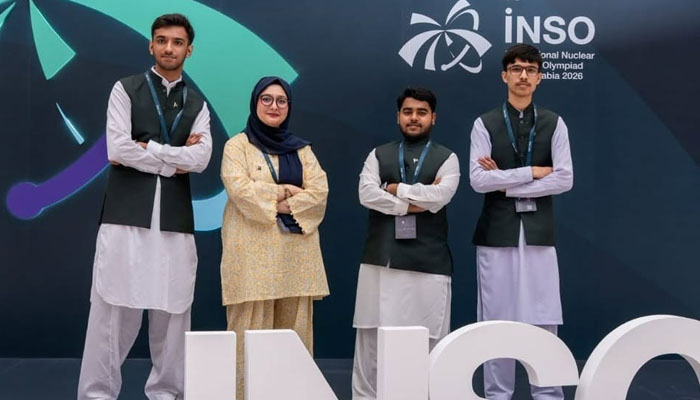
The Pakistani team has won one gold and two silver medals at the International Nuclear Science Olympiad.

The International Nuclear Science Olympiad was held in Jeddah from August 2 to 8 with 120 students and experts from 19 countries participating in the competition. Students from China, Japan, Russia, Türkiye, Malaysia, Indonesia and Saudi Arabia also took part.

The Pakistan Atomic Energy Commission team won one gold and two silver medals. Muhammad Ali from Government College University Lahore won the gold medal while Muhammad Usman from FG Sir Syed College Rawalpindi won a silver medal.

Seerat Fatima Bhatti from Nixor College Karachi also won a silver medal. According to a statement issued by the Pakistan Atomic Energy Commission, Pakistan will host the 4th International Nuclear Science Olympiad in 2027.

Similar Posts

  • | | |

    Ishaq Dar offers special prayers for Pakistan in M…

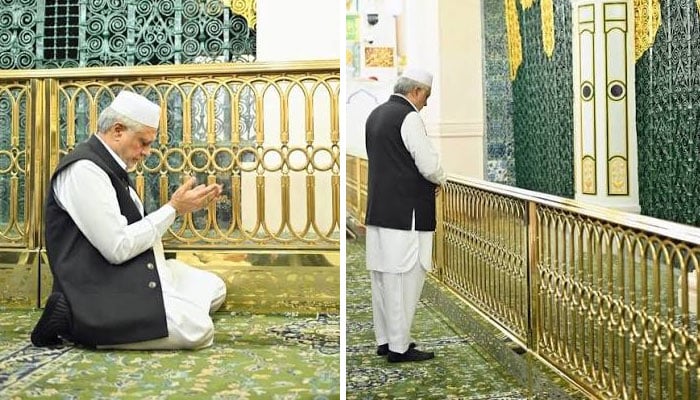
    Medina: Pakistan’s Deputy Prime Minister and Foreign Minister Ishaq Dar visited the Prophet’s Mosque (Masjid an-Nabawi ﷺ) in Madinah, where he offered prayers and prayed for Pakistan’s peace, prosperity and continued progress during his official visit to Saudi Arabia. According to Pakistan’s Foreign Office, the deputy prime minister paid his respects at the Roza-e-Rasool ﷺ and offered Salam. He also performed voluntary (Nafl) prayers at the Prophet’s Mosque, one of Islam’s holiest sites, where millions of Muslims from around the world gather every year to worship and seek spiritual blessings. The Foreign Office said Dar made special prayers for Pakistan’s economic development, national stability and the well-being of its people. He also prayed for unity, peace and prosperity across the Muslim world, expressing hope for harmony and progress among Islamic nations. As part of his visit to Madinah, Dar also travelled to Jabal Uhud, a site of immense historical and religious significance in Islamic history. He visited the resting place of Hazrat Ameer Hamza (RA), the beloved uncle of Prophet Muhammad ﷺ and one of the most revered martyrs of the Battle of Uhud, where he offered prayers and paid his respects. The visit reflects the spiritual aspect of Dar’s Saudi Arabia trip while highlighting Pakistan’s longstanding religious and diplomatic ties with the Kingdom. Senior Pakistani officials traditionally visit Islam’s holy sites during official engagements in Saudi Arabia, where they offer prayers for the country and the wider Muslim Ummah. The Foreign Office noted that Dar’s prayers focused on Pakistan’s future, asking for sustained peace, economic growth and national prosperity. His visit to the Prophet’s Mosque and other sacred sites also underscored the importance of faith and spiritual reflection alongside official diplomatic engagements. The visit comes at a time when Pakistan continues to seek economic stability and stronger cooperation with friendly countries, while reaffirming its commitment to unity and the welfare of the Muslim Ummah.

  • | |

    LHC acquits man sentenced to life for wife’s…

    LAHORE: The Lahore High Court ( LHC) has overturned the life imprisonment sentence of a man convicted of murdering his wife, ruling that the prosecution failed to establish his guilt beyond reasonable doubt. Justice Tariq Saleem Sheikh issued a detailed 19-page written judgment, allowing the appeal filed by the convict, Tanveer, and ordering his immediate release. According to the verdict, Tanveer maintained that he was on duty at a petrol station at the time of the incident and denied any involvement in the killing of his wife. The court observed that the prosecution had failed to produce reliable and convincing evidence to support the allegations against him. The judgment concluded that the available evidence was insufficient to sustain the conviction, leading the court to set aside the trial court’s decision and acquit the appellant. Tanveer had been sentenced to life imprisonment in 2022 by a trial court after being found guilty of his wife’s murder. In addition to the prison term, he was fined Rs400,000. He later challenged the conviction before the Lahore High Court, which has now ruled in his favor.

  • | |

    IHC reserves verdict on judges’ appointments ple…

    The Islamabad High Court (IHC) on Thursday reserved its verdict on the maintainability of a petition challenging the delay in the approval of judicial appointments for high courts across the country. Justice Arbab Muhammad Tahir heard the petition filed by advocate Luqman Zafar Chaudhary through his counsel Zahid Asif Chaudhry. The petitioner requested the court to direct President Asif Ali Zardari to approve a summary forwarded by the prime minister for the appointment of 19 additional judges and the confirmation of five judges in the Islamabad, Lahore, Sindh, Balochistan and Peshawar high courts. During the hearing, the petitioner’s lawyer argued that the Judicial Commission of Pakistan (JCP) had recommended the appointments during its meetings held on July 20 and 21. He said the summary was later sent to the president for approval, but no decision has been made despite the passage of more than two weeks. The counsel maintained that the delay is affecting the functioning of the superior judiciary. He informed the court that the tenure of an additional judge of the Sindh High Court has already expired, while the terms of four additional judges of the Peshawar High Court are expected to end within the coming days. The lawyer also told the court that reports suggest the government may issue notifications regarding the appointments within the next 48 hours. Justice Tahir repeatedly questioned whether a constitutional petition could legally be maintained against the president. He asked the petitioner’s counsel to cite any previous court ruling in which a writ had been issued against the president regarding the exercise of constitutional powers. The court observed that the judgments presented by the petitioner did not support the argument that courts could direct the president in matters governed by Article 48 of the Constitution. Justice Tahir asked whether any legal precedent existed requiring the president to act on such matters through a judicial order. The petitioner’s counsel argued that Article 48 requires the president to act on the advice of the prime minister or the cabinet. He maintained that the president has no independent authority to indefinitely delay judicial appointments once the Judicial Commission has completed its recommendations. The lawyer further argued that the Ministry of Law is the competent authority to issue appointment notifications after the completion of the constitutional process. He claimed that the president’s role in the appointment process is largely formal and that unnecessary delays should not hinder the functioning of the judiciary. The petitioner requested the court to seek responses from the federal government, the Prime Minister’s Office and the Ministry of Law regarding the status of the pending summary. However, the court declined to issue notices at this stage.

  • | |

    Islamabad High Court extends stay on 50% additiona…

      The Islamabad High Court (IHC) has extended its earlier interim order preventing the collection of an additional 50 percent toll tax from vehicles that do not have an M-Tag installed. The relief will remain in effect until the next hearing of the case, providing temporary protection to motorists while the legal proceedings continue. During the hearing, the National Highway Authority (NHA) submitted its written response before the court, outlining its position regarding the policy of imposing an additional toll charge on vehicles that are not registered under the M-Tag system. The response is expected to form the basis of further arguments in the case. The petitioner’s counsel requested additional time to carefully review the written reply submitted by the NHA before presenting a detailed response. Accepting the request, the court adjourned the proceedings to a later date, allowing both parties sufficient time to prepare their arguments. While postponing the hearing, the Islamabad High Court announced that its previous order would continue to remain in force until the next hearing. As a result, authorities have been restrained from collecting the additional 50 percent toll tax from vehicles that either do not have an M-Tag installed or have insufficient balance in their M-Tag accounts. The interim relief means that motorists falling into these categories cannot be charged the extra amount until the court issues further directions. However, the regular toll charges applicable under existing rules may still be collected. The dispute centers on the National Highway Authority’s policy requiring motorists to register their vehicles with the M-Tag electronic toll collection system. Under the authority’s regulations, vehicles that are not registered with M-Tag are subject to a 50 percent higher toll fee when using motorways and designated highways. Similarly, vehicles with an M-Tag account that does not have sufficient balance may also be charged the additional amount under the same policy. The NHA introduced the M-Tag system to modernize toll collection, reduce congestion at toll plazas, promote cashless payments, and improve the efficiency of traffic management on Pakistan’s motorway network. The electronic system enables vehicles to pass through toll plazas more quickly, minimizing delays and reducing manual cash transactions. Despite these objectives, the policy of imposing an additional 50 percent toll charge has faced criticism from some motorists and legal experts. Opponents argue that the surcharge is excessive and places an unnecessary financial burden on drivers, particularly those who have not yet registered for the M-Tag system or encounter technical issues with their accounts. They also contend that such a financial penalty should have a clear legal basis and should not be enforced without proper safeguards. The NHA’s decision has therefore been challenged before the Islamabad High Court, where the petitioner seeks to have the additional toll charge declared unlawful. The court will examine the legal validity of the policy after considering the arguments of both parties, including the authority’s written response and the petitioner’s objections. Until the next hearing, the High Court’s interim order will continue to provide temporary relief to affected motorists by preventing the collection of the disputed 50 percent additional toll tax. The outcome of the case is expected to determine whether the National Highway Authority can lawfully enforce the surcharge in the future or whether changes to the policy will be required.

  • | | |

    Narathiwat Province in Thailand’s Deep South Escalates Martial Law Powers After Deadly Attack Kills Five Border Rangers

    NARATHIWAT, Thailand Security forces in Thailand’s southern border province of Narathiwat have intensified the application of martial law powers following a deadly assault on a checkpoint that left five paramilitary rangers dead and several civilians injured. On the evening of July 22nd, 2026, at approximately 6:45 p.m., a group of about six attackers dressed in […]

  • | |

    Khawaja Asif says Mir Raza case exposes compromise…

    Defence Minister Khawaja Asif has criticised the Sindh government over the investigation into the Mir Raza case. He said the developments emerging from the case suggest that the entire system had been compromised. In a social media post, Asif said continued attention was needed to ensure that the matter was investigated properly. He warned that any previous attempts to settle or cover up the issue should not be repeated. The defence minister also called for those who allegedly tried to conceal facts in the case to be exposed. His remarks came as questions continued to be raised over the handling of the Mir Raza case. The case has attracted attention because of conflicting information and concerns about the progress of the investigation. Meanwhile, the Sindh government has decided to establish a judicial commission to investigate the Mir Raza murder case. Sindh Home Minister Zia Lanjar said the provincial government wanted justice for Mir Raza’s family. He said a new committee had also been formed to examine the matter. Lanjar said the authorities would allow the judicial commission or the court to determine how conflicting reports should be dealt with. The government’s decision to form a judicial commission is expected to provide another forum for examining the circumstances surrounding the case. It may also help clarify conflicting accounts and determine responsibility based on the available evidence.

Leave a Reply

Your email address will not be published. Required fields are marked *