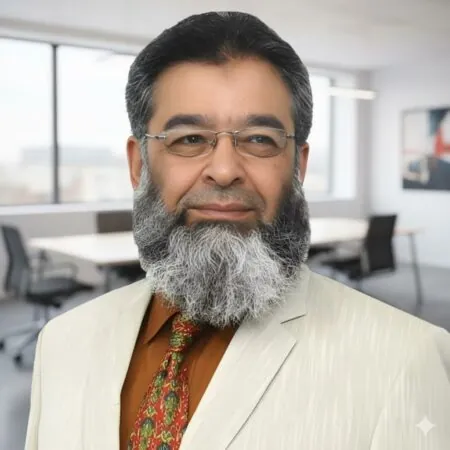
architect conscience arif

The Architect of Conscience: Arif Ali Mir and the …

Reflecting upon the profound vastness of the cosmos and the acute, unyielding solitude of the human condition, the French philosopher and writer Albert Camus once observed that if even a single lamp were to be kindled within the dark, tempestuous ocean of history, the entire fabric of the universe would transform, tearing asunder the merciless veil of night. The annals of history stand as an unshakeable testament to the truth that whenever the fierce gales of material greed, political expediency, and moral decay have threatened to engulf human societies, certain dervish-souled, deeply conscientious, and granite-willed individuals have emerged from the crowd. Swimming resolutely against the powerful, destructive current of their era, these rare souls have stood guard over the invaluable civilizational trusts bequeathed by antiquity.


The fertile, history-drenched soil of Gujrat—where the ancient, meandering waves of the Chenab and Jhelum rivers have whispered civilizational sagas for centuries—has long served as the intellectual cradle and practical domain of precisely such a man of extraordinary mettle. Brushing aside the rigidities of legal codes, the demanding, iron-willed disciplinary training of police service, and the glittering, lucrative allure of high-ranking international postings, he made the monumental choice to dedicate his entire terrestrial existence to books, the retrieval of forgotten history, and uncompromised moral dignity. This towering, unyielding personality is none other than Arif Ali Mir, Advocate, whose entire life has stood like an unshakable monolith against the self-serving, shifting winds of his time.
Born on December 28, 1949—corresponding precisely to the 8th of Rabi’ al-Awwal, 1369 AH, on a Wednesday—within the historic, time-honored confines of “Mir Manzil” in Mohalla Khyber, nestled deep in the heart of Gujrat’s historic town of Jalalpur Jattan, Arif Ali Mir’s life is far more than a conventional biographical sketch. It is a profound, sweeping narrative capturing the complex post-colonial socio-political contradictions of the Indian subcontinent, an unwavering, almost sacred custodianship of noble familial heritage, and an extraordinary odyssey of letters where every single chapter serves as a luminous metaphor for absolute sincerity, purity of intellectual purpose, and complete self-sufficiency.


His esteemed father, Ghazanfar Hussain Mir, was a legendary, fiercely principled, and seasoned lawyer of his generation. His uncommon nobility, profound legal acumen, and distinguished, intellectual circle of acquaintances infused the deepest foundational layers of Arif Ali Mir’s character with a forged-steel morality that would remain his greatest, most unassailable asset throughout his life. Standing gracefully beside him was his mother, Ruqaiya Begum, an affectionate, deeply dignified woman who silently imprinted the enduring values of selfless sacrifice, patience, and unbreakable resilience upon the rearing of her children. Within this vibrant, intellectually charged household comprising four sisters and three brothers, Arif Ali Mir occupies a unique middle vantage: two elder sisters precede him in age, while all other siblings are younger.
Driven eventually by the professional demands and expanding horizons of his father’s legal practice, the family made the permanent transition from Jalalpur Jattan to the bustling city of Gujrat, establishing their permanent domestic and intellectual anchor at “Mir Street” on Bhimber Road—a historic domicile that would organically evolve into a cherished sanctuary for scholars, jurists, and discerning bibliophiles alike. A deep, discerning psychological and biographical study of Mr. Arif Ali Mir’s versatile and multifaceted personality reveals that his arrival on December 28, 1949, was far from a mere statistical coincidence. According to the timeless principles of astrological configuration and character alignment, his zodiac sign, Capricorn, functions as a clear mirror to his intrinsic nature. Ruled by Saturn—the planetary archetype of profound gravity, timeless perseverance, and unyielding adherence to principle—these exact traits form the unmistakable, defining hallmark of Mr. Arif’s entire life. While Capricorns are universally recognized across traditions as grounded earth signs marked by relentless, grinding toil, Arif Sahib uniquely channeled this raw elemental energy into cultivating a veritable forest of arts, letters, and historical preservation upon the plains of Gujrat.
The crowning virtue of his astrological archetype is structural discipline combined with penetrating foresight—qualities that naturally laid the bedrock of his early success in the legal arena, where he learned to dissect truth from falsehood with microscopic precision. Yet, the most captivating, transcendent facet of his persona is how he decisively transcended the traditional, narrow materialism often associated with his sign through a profound inner spiritual inclination. Operating as a fiercely devoted bibliophile and patron of learning, he redirected the formidable organizational capacity of the Capricorn psyche away from worldly accumulation and entirely toward the preservation of rare texts and the wide propagation of knowledge. Operating with the quiet, unostentatious efficiency characteristic of his sign, his personal dignity, fierce institutional loyalty, and immense intellectual depth render him a towering, sheltering tree on Gujrat’s literary horizon—its roots gripping ancient tradition, its uppermost branches illuminated by the clear light of universal wisdom.
Mr. Arif Ali Mir’s educational journey is a rugged, continuous path strewn with dramatic twists, historical upheavals, and personal sacrifices that ultimately refined his character like crucible-tested gold. At the time of his earliest schooling, his father was stationed as the Chief Sanitary Inspector for the Sialkot Municipality, prompting Arif’s first three formative, sensory years of childhood to unfold within the disciplined, historic halls of the Convent of Jesus and Mary in Sialkot. Upon the family’s return to Jalalpur Jattan, he successfully completed his fifth and sixth grades at Islamia Primary School, subsequently transitioning to Islamia High School.
When domestic circumstances necessitated a move to Gujrat, where the family initially settled in a rented house near Mohalla Gyanpura / Muslim Abad , he pursued his seventh and eighth grades at Muslim High School on Court Road. This institution was then under the stellar administrative helm of the eminent headmaster Master Ghulam Abbas. For his matriculation, he moved to Public High School No. 1 in Gujrat—administered with strict discipline by Headmaster Mirza Shaukat Ali and school owner Sheikh Shafqatullah—where he successfully passed his Matriculation examination in the watershed year of 1964.
Following this, he completed his intermediate education at Sir Syed College on Railway Road, Gujrat, in 1966, before earning his Bachelor of Arts degree in 1969 from the historic Zamindar College, Gujrat, operating under the distinguished principalship of Professor Farman Ali. Driven by an innate pull toward jurisprudence, Arif then pursued legal education at the highest level, securing his Bachelor of Laws degree in 1972 from the prestigious Punjab University Law College in Lahore, studying under the esteemed principalship of Sheikh Imtiaz Ali.
Eager to expand his intellectual horizons internationally, he set his sights on Germany with the clear intention of pursuing a Master of Laws degree at the Free University of Berlin. However, to carefully navigate the complex foundational stages of the German language and ensure economic self-sufficiency abroad, he initially enrolled at the Technical University of Berlin. This promising academic trajectory was abruptly and permanently halted when urgent news of his father’s severe illness reached him. Without a moment’s hesitation, he chose to abandon his overseas academic dreams, catching the first flight back to his homeland. In doing so, he placed absolute filial devotion, family honor, and moral duty far above personal academic credentials and foreign degrees—a defining choice that laid bare the core of his character.
During his youth, his expansive literary appetite gravitated naturally toward world history, with a special emphasis on Islamic and Mughal epochs. Within the vast corpus of jurisprudence, the Evidence Act, the Law of Torts, the Code of Criminal Procedure, and the Pakistan Penal Code remained his absolute favorites, while the intricacies of Land Revenue law held virtually no appeal for his temperament.
His intellect was consciously forged under the direct mentorship of great academic luminaries: figures like Chaudhry Abdul Majid during his school days, Chaudhry Muhammad Altaf and Sheikh Inamullah at Sir Syed College, and Professor Muhammad Yaqoob alongside Professor Hamid Hassan Syed at Zamindar College served as his true intellectual guiding lights, waking the sensitive writer buried deep within him. This rich mentorship bore its first literary fruit in 1969 with the publication of his maiden youth composition, Pachaas Aurtain (“Fifty Women”), beautifully printed by the Pakistan Printing Press in Lahore.
Having absorbed the subtle philosophies of law from towering legal figures at Lahore Law College—such as the eminent jurist Aijaz Hussain Batalvi, former Senate Chairman Wasim Sajjad, and Justice Aftab Farrukh—he completed a rigorous legal apprenticeship under Gujrat’s celebrated advocate Sheikh Ehsan Elahi from 1972 to 1974. Seeking a structured administrative path, he joined the police service in 1976 as a Prosecuting Sub-Inspector. Enduring the famously punishing physical and mental training regimen at the Police Training College in Sehala, he graduated with top honors, securing the coveted “All-Round Good Turnout” distinction and rising rapidly to the rank of Prosecuting Inspector, serving with distinction from 1973 to 1979.
During a professional visit to the United Arab Emirates, a fateful encounter with Mr. Kamal Hamza, Director of the Dubai Municipality, left the latter deeply impressed by Arif’s formidable command of the English language, crisp articulation, and exceptional administrative acumen. This chance meeting paved the way for a formal, high-stakes interview before an elite executive board presided over by Dubai Police Chief Brigadier Dahi Khalfan. Consequently, from 1980 to 1989, Arif Ali Mir held the highly sensitive, prestigious, and demanding office of Chief Security Officer for the Dubai Municipality.
Yet, the most astonishing chapter of this period is not his professional ascent abroad, but his radical departure from it. Walking away completely from the affluent, materially secure, and comfortable stability of Dubai in 1989 to return permanently to Pakistan stands as the defining moral choice of his existence. The sole catalyst for this monumental renunciation was his deep-seated desire to live beside, comfort, and personally care for his aging, ailing father—a living testament to the immutable truth that, for Arif Mir, familial honor, filial piety, and moral obligation outweighed all the combined material wealth of the Arabian Gulf.
Wed in 1984, Arif Ali Mir is blessed with two exceptional sons and a remarkable daughter—Rustam Abbas Mir, Ghulam Mustafa Mir, and Subah Mir. Though born during the family’s years in Dubai, they were deliberately nurtured under a rigorous, uncompromising academic ethos. Rustam pursued his higher education in Germany, Ghulam Mustafa secured his advanced studies from Australia via competitive foreign Higher Education Commission scholarships, and Subah achieved her crowning academic milestone by earning her Doctorate (Ph.D.) from the United States under the prestigious Fulbright Program. Today, all three siblings proudly serve as esteemed academicians and educators at GCU Lahore, the University of Gujrat, and FC College Lahore, respectively, carrying forward the family’s torch of enlightenment.
Following the peaceful passing of his beloved father, Advocate Ghazanfar Ali Mir, in 1996, close friends of the family—most notably Professor Hamid Hassan Syed and Professor Sharif Kunjahi, who demonstrated their loyalty by visiting his residence daily for forty consecutive days of mourning—approached him with a proposal for memorialization. Instead of yielding to convention by organizing a traditional, ostentatious congregational Chelum (the fortieth-day memorial feast), Arif Ali Mir chose a path entirely resonant with his true identity as an uncompromising custodian of letters. Demonstrating radical sincerity, he sold his sole personal automobile to lay the financial and moral foundation of the “Al-Mir Trust Library and Centre for Research and Compilation, Gujrat,” embarking on an extraordinary, lifelong journey as an uncompensated ambassador of knowledge.
The foundational bylaws and governing tenets of the Al-Mir institution are fierce, pure, and uncompromising: absolute free membership for all seekers, the complete absence of printed retail price tags on any publication, permanently unlocked bookshelves inviting open access, a strict, unbending refusal to accept financial donations, state grants, or public charity, and an unwavering non-partisan stance completely divorced from political or sectarian affiliations. The high, dignified office of its Patron-in-Chief has been successively graced over the decades by intellectual giants such as Professor Hamid Hassan Syed, Professor Sharif Kunjahi, Dr. Muzaffar Hasan Malik, Dr. Pir Naseer-ud-Daula, Professor Waseem Baig Mirza, and currently, Professor Kaleem Ehsan Butt.
Mr. Arif Ali Mir’s lifelong dedication to books and scholarship has never been a mere personal hobby, casual pastime, or vehicle for intellectual vanity; rather, he successfully transformed it into a dedicated missionary movement. Through the publishing arm of the Al-Mir Trust, he has profoundly enriched the cultural and educational landscape of the entire region by publishing over 80 books, volumes spanning critical literature, regional history, philosophy, and scholarly research—an astonishing, almost miraculous achievement for a purely private, unassisted entity. This literary fountainhead continually echoes the authentic, unvarnished voices of local history while engaging fearlessly with the highest tiers of critical intellectual discourse.
The most astonishing, unique, and deeply heartwarming dimension of this entire intellectual odyssey is its total, radical detachment from material profit. Not a single volume published under the trust bears the customary mark of a commercial price. Where ordinary commercial texts display cold digits of retail trade, Al-Mir Trust publications proudly carry the timeless, spiritual inscription: “A prayer for the forgiveness of parents and a supplication for divine grace and blessings.” This singular, beautiful practice underscores the profound reality that Arif Mir never commercialized knowledge or turned the printed word into a commodity; instead, he transformed his personal intellectual thirst and boundless filial love into an eternal, flowing charity—a true Sadaqah Jariyah that continues to enrich souls.
As a practicing advocate throughout his professional life, Mr. Arif Ali Mir has consistently prioritized the strict supremacy of law, the ethical conduct of the courts, and the unwavering defense of the marginalized and vulnerable. His professional legal life is fundamentally intertwined with his scholarly background; he approaches the meticulous preparation of legal briefs and constitutional arguments with the exact same investigative, microscopic rigor that defines his lifelong bibliophilia. Within the legal fraternity and academic circles of Gujrat, he commands immense, universal reverence for steadfastly refusing to compromise his core ethical principles for expediency. For generations of emerging researchers, young university students, and aspiring writers, he serves as an affectionate, open-door mentor whose physical and intellectual sanctuary remains perpetually accessible to all true seekers of truth.
Arif Ali Mir’s sweeping trajectory across Gujrat’s literary, legal, and cultural landscape is that of an epoch-making, tireless researcher who has dedicated his entire physical and intellectual energy to reclaiming the region’s lost history, forgotten jurisprudence, and obscured literary luminaries. His expansive literary journey commenced brightly on the threshold of youth with the publication of Pachaas Aurtain in 1969, steadily evolving toward profound philosophical and religious reflections such as his monumental theological and intellectual work, Sayqal-e-Aaina, Quran aur Insan (“The Polishing of the Mirror: The Quran and Man,” 1995).
His agile pen consistently refused to remain confined within the narrow boundaries of fictional aesthetics, donning instead the heavy, demanding mantle of the historian to systematically illuminate the darkest, most neglected corners of regional history. Landmark historical and biographical works followed in rapid succession, cementing his status as a master chronicler: Tarikh-e-Jalalpur Jattan (2003), Gujrat Bar se Supreme Court Bar Tak (2010), Tehreek-e-Azadi aur Gujrat (2014), Mashahir-e-Gujrat aur Mirza Waseem Baig (2018), Gujrat aur Sahafat (2024), and Gujrat ka Jiyala Column Nigar: Iftikhar Bhutta (2025). Furthermore, his peerless editorial and curatorial acumen shines brilliantly through his meticulous curation and republication of classical texts, including Qalam-e-Haq… Al-Hiyat (1997), Fazal Shah Nawankoti’s classical romance Sohni Mahiwal (2003), Mulla Ghawasi’s epic Saiful Muluk (2006), Malik Ram’s critical study Zikr-e-Ghalib (2020), and the deeply insightful Sarkar Abdul Ali Heravi Tehrani aur Allama Muhammad Iqbal (2023).
As a resonant verse captures his lifelong devotion:
کتابوں سے تو رشتہ اس طرح جوڑا ہے عارف نے
کہ جیسے زندگی کا اک ضروری کام ہوتا ہے

Arif has woven his bond with books, so profound,As though it were life’s most vital, daily ground.
His artistic, aesthetic, and auditory palate is as thoroughly refined as his intellectual horizon is vast and sweeping. While he remains utterly intoxicated by the timeless, revolutionary poetry of Mirza Ghalib and Allama Iqbal, he simultaneously admires the mesmerizing screen presence and tragic, graceful performances of the legendary Madhubala. In the realm of classical and semi-classical music, he derives deep, meditative solace from the immortal vocal melodies of Muhammad Rafi, Mehdi Hassan, and Lata Mangeshkar; on the grand cinematic canvas, the majestic historical scale of Mughal-e-Azam and the sobering, stark human tragedy documented in Chernobyl deeply resonate with his highly developed artistic consciousness.
A quiet connoisseur of simple, traditional, and wholesome cuisine—savoring authentic mutton broth, traditional paaye, and simple dal chawal—Arif Ali Mir effortlessly commands professional fluency in Punjabi, Urdu, and English, alongside a strong working command of both German and Arabic.
Though his extraordinary life carries certain tender, unfulfilled personal yearnings—such as the lingering, quiet regret of never securing a face-to-face meeting with his great spiritual and intellectual mentor Mr. Aijaz Hussain Mir, the mild ache of not completing formal post-graduate degrees in history, and a wish for even deeper scholarly command over the Persian language—this very intellectual thirst has consistently served as the eternal, burning fuel for his pen. Across the high-pressure chambers of law, the corporate towers of Dubai, and the sacred, book-lined sanctuary of his library upon his return home, every single step taken by Arif Ali Mir testifies to a singular, undeniable truth: when a human being fiercely kindles the flame of self-awareness and intellectual integrity within, all temporal shadows yield, leaving behind a luminous coronet that guides future generations toward truth, civic integrity, and enduring light.
In his early boyhood days, a curious collector of rare postage stamps and historic coins; in his vigorous youth, an insatiable, deep reader of world autobiographies, this remarkable scholar now inhabits the mature, contemplative zenith of his life. In this serene phase, the profound, unhurried comprehension of the Holy Quran, coupled with the rigorous, investigative, and historical contextualization of its sacred verses, has become his ultimate intellectual vocation and daily spiritual nourishment. This deep Quranic contemplation now forms the sum total of his legacy and the absolute center of his remaining thought.
The entire life, character, and monumental institutional services of Advocate Arif Ali Mir stand as an incandescent, living proof that when an individual possesses iron resolve, an uncompromising commitment to family honor, an unshakeable sense of civic duty, and a completely selfless affection for humanity, he alone embodies the true magnitude of an entire, waking institution. From the solemn halls of judicial justice to the executive administrative offices of Dubai, and thence back to the tranquil, book-filled sanctuary of the Al-Mir Trust Library established in eternal memory of his father, every step he has taken affirms that the true, high purpose of human existence is not merely to accumulate worldly gains, but to endlessly bestow—to carve clear pathways of learning and dignity for generations yet unborn.
Upon Gujrat’s rich literary, historical, and cultural horizon, the proud name of Arif Ali Mir shall forever shine brightly as a dervish-souled researcher, pioneering historian, and noble benefactor who steadfastly refused to let the sacred tradition of kindling lamps in the dark ever grow dim. He remains, without a shadow of a doubt, a radiant, guiding star in Gujrat’s intellectual firmament—one whose precious light history will forever guard safely within the innermost sanctuary of its heart.

روشنی بانٹنا جن کا مقدر ہے ضیا دیتے ہیں
وہ تو چپ چاپ اندھیروں کو مٹا دیتے ہیں

Those whose destiny is to scatter light, bestow a brilliant grace,With quiet steps, they sweep away the darkness from its place

Similar Posts

  • Debtocracy & bankruptcy of ideas   

    Pakistan’s debt problem has entered a new phase. The headline figure is alarming: total debt and liabilities reached Rs. 99.59 trillion by the end of fiscal year (FY) 2025-26. The deeper concern, however, lies in the composition of this debt, the burden of servicing it and the channels through which public borrowing now affects every productive sector of the economy. According to the latest State Bank of Pakistan data, total debt stood at Rs. 97.88 trillion. Gross government domestic debt reached Rs. 59.44 trillion, while external debt amounted to Rs. 36.20 trillion. Central government debt increased by 7.39% over the preceding year to Rs. 83.64 trillion. External debt and liabilities stood at US$138.85 billion. These numbers confirm the central argument developed in the a ten-part series published in these columns [‘Bankruptcy of ideas—X: Debt, Taxes & Democracy’, Minute Mirror, June 21, 2026]. Pakistan has not merely borrowed against its future. It has increasingly borrowed to service earlier borrowing, while failing to create sufficient productive capacity from the accumulated debt.   ‏The external debt-servicing profile for FY2026 makes this particularly clear. Pakistan serviced US$21.59 billion of external debt during the year. An extraordinary US$10.14 billion—nearly half of the annual amount—fell in the final quarter alone. Quarterly servicing was 2.63 times the amount paid in the preceding quarter, mainly because principal repayments jumped from US$2.70 billion in the third quarter to US$8.81 billion in the fourth. This concentration of repayments is as important as the overall debt stock. A country may carry a large debt if its economy generates sufficient revenue, exports and foreign exchange to service it. Pakistan’s difficulty is that debt obligations have expanded much faster than the productive and export capacities needed to meet them. The debt accumulated over decades cannot be attributed to one government or one fiscal year. Persistent fiscal deficits, a narrow and inequitable tax base, losses of state-owned enterprises, the energy-sector circular debt, excessive recurrent expenditure, exchange-rate depreciation and repeated balance-of-payments crises have all contributed to it. Borrowing became the preferred substitute for reform.  Governments borrowed because they could not tax influential sectors, restructure loss-making enterprises, reduce wasteful expenditure or build a competitive export economy. External lenders financed temporary stability, while domestic banks financed the fiscal deficit. Each arrangement postponed difficult decisions without removing the causes of the crisis. The Ministry of Finance reported public debt at 70.7% of GDP by June 2025. The ratio may improve when nominal GDP grows faster than debt, especially during periods of inflation, fiscal consolidation and lower interest rates. A declining debt-to-GDP ratio, however, does not necessarily mean that the debt burden has become harmless. Pakistan’s debt stock is still increasing. What has improved is the immediate cost of servicing parts of it. Total debt and liabilities servicing declined from Rs. 13.16 trillion in FY2025 to Rs. 11.97 trillion in FY2026. Interest payments on debt fell by more than 23%, from Rs. 9.47 trillion to Rs. 7.27 trillion, largely because lower policy rates reduced the cost of servicing domestic government debt. Interest payments on gross government domestic debt consequently fell from Rs. 8.08 trillion to Rs5.99 trillion. This is welcome relief. It should not be presented as the end of the debt crisis. Lower interest rates reduce the flow cost of debt; they do not extinguish the stock. Principal repayments on external debt and liabilities increased from Rs. 3.47 trillion to Rs. 4.47 trillion during FY2026. Pakistan therefore obtained relief on domestic interest payments while facing a substantially heavier external repayment burden. The distinction is between debt management and economic transformation. Pakistan may be moving from an acute debt-accumulation crisis towards a more manageable financing position. It has not escaped debtocracy—the system in which fiscal policy, taxation, banking, foreign relations and development priorities become subordinate to the requirements of borrowing and repayment. Debtocracy does not remain confined to the accounts of the Ministry of Finance. It is transmitted throughout the economy. The first channel is the banking system. Government securities offer banks sovereign backing, liquidity and attractive risk-adjusted returns. Lending to the government is easier than evaluating businesses, financing innovation or supporting small and medium enterprises. A large domestic borrowing requirement therefore creates continuous competition for available liquidity. The result is crowding out. The State obtains the funds it requires, banks earn relatively secure returns and the private sector bears the adjustment. Productive businesses face limited access to credit, higher risk premiums and shorter financing horizons. Smaller enterprises suffer the most because they cannot compete with the sovereign for bank liquidity. This creates a financial system that can remain profitable while the productive economy remains weak. Deposits are mobilised from citizens and businesses, channelled into government securities, and then used substantially to meet recurrent expenditure and service earlier debt. Banking expands without an equivalent expansion in productive capacity. The second channel operates through foreign exchange. External debt repayment creates demand for dollars. That demand places pressure on reserves and the current account. Any resulting exchange-rate depreciation increases the rupee value of external liabilities and raises the domestic price of imported fuel, machinery, raw materials and intermediate goods.  The chain is direct: External repayment creates foreign-exchange demand; reserve pressure increases exchange-rate sensitivity; depreciation generates imported inflation; and inflation raises working-capital requirements and production costs. Debt consequently becomes a corporate balance-sheet issue. An industrial enterprise may have no external loan, yet still bear the effects of sovereign external debt through a weaker rupee, costlier imports, higher energy prices and restricted access to domestic credit. Consumers ultimately pay through inflation, reduced employment and lower real incomes. The third channel is fiscal. Every rupee allocated to debt servicing is a rupee unavailable for education, health, water, climate resilience and productive infrastructure—unless the State raises additional revenue or borrows again. Pakistan then enters a circular arrangement: borrowing creates servicing obligations, servicing compresses development expenditure, weak development limits growth and revenue, and insufficient revenue necessitates further borrowing. This is why a primary surplus, though necessary, is not sufficient. It can stabilise debt dynamics, but

  • A new wave of youth activism in Asia

    By : Amir Ismaiel ( London based pakistani student )  A new youth-led protest movement in India, known as the Cockroach Janata Party has become the focus of global attention. In recent days students associated with the movement attempted to march towards Parliament, but police used baton charges and force to stop them. The movement’s founder, Abhijeet Dabke, is currently studying in the United States while several of its other leaders are enrolled at leading universities in India and the United Kingdom. The movement is primarily driven by young students. The movement began after the Chief Justice of India reportedly referred to young people as “cockroaches.” Students adopted the term as a symbol of resistance and established the Cockroach Janata Party. According to its leaders, the recent examination paper leak scandal has exposed deep weaknesses and corruption within India’s education system. They argue that corruption in examinations and the erosion of merit are allowing unqualified individuals to enter key institutions, ultimately damaging the country’s future. Protesters are therefore demanding the resignation of the Education Minister, whom they hold responsible for the crisis. Thousands of students continue to demonstrate across different cities while pressing for a wider set of demands. Opposition leader Rahul Gandhi has expressed solidarity with the protesting students. Meanwhile, allegations of police mistreatment of both protesters and opposition leaders have sparked a nationwide debate. Several Indian actors, artists, and public figures have also condemned the use of force against students, adding to the growing political and public pressure on Prime Minister Narendra Modi’s government. India often presents itself as the world’s largest democracy and a champion of democratic values. While its large youth population is one of its greatest strengths, it can also become a significant challenge. Because of its distinctive identity and objectives, this movement has attracted the attention of young people not only across India but throughout Asia and beyond. Its growing popularity on social media has encouraged increasing numbers of young Indians to join. If the protests spread further and gain broader public support, they could become a serious political challenge for the government. In response to the latest developments, Prime Minister Narendra Modi released a late-night video message appealing to young people for patience. He stated that investigations into the paper leak scandal were already underway and assured the public that those responsible would be held accountable. However, student leaders insisted that their sit-in would continue until the Education Minister resigned. Some observers believe that the Prime Minister’s body language during the address reflected political pressure and unease. A government that has previously responded firmly to numerous protests now appears to be facing unprecedented pressure from a youth-led movement. Over the past few decades, Asian politics has undergone significant change, with young people emerging as an increasingly influential political force. Even before the current protests in India, youth movements in Bangladesh, Sri Lanka, and Nepal had already played decisive roles in shaping political developments. In March 2022, Sri Lanka was engulfed by mass protests triggered by a severe economic crisis. Young people stood at the forefront of the demonstrations and led protests that continued for weeks. The government imposed a state of emergency, enforced curfews, and attempted to restrict access to social media, but these measures failed to weaken the protesters’ determination. Eventually, demonstrators surrounded the Presidential Palace, forcing the President to resign. Similarly, Bangladesh witnessed a student-led protest movement that fundamentally reshaped the country’s political landscape. As demonstrations intensified, then Prime Minister Sheikh Hasina left office and departed the country. Security forces attempted to suppress the protests, resulting in the deaths of numerous young demonstrators. Despite this, the movement expanded across the country. Student activism ultimately dominated national politics, the government collapsed, and Nobel Peace Prize laureate Dr. Muhammad Yunusassumed leadership of the interim administration. The intensity of public anger was evident in the actions of some protesters, who set fire to a statue of Bangladesh’s founding leader Sheikh Mujibur Rahman, burned his residence, and removed his image from banknotes. Many young protesters viewed these acts as a response to what they considered years of political repression and believed that every sacrifice was necessary to achieve their objectives. Nepal also witnessed strong youth mobilization against corruption, weak governance, and restrictions on social media. As a generation raised in the digital era, young activists relied heavily on social media to organize, coordinate, and build public support. Issues were first highlighted online, public consensus was gradually developed, and protest calls were then issued. The same strategy transformed local demonstrations into a nationwide movement. The protests became so significant that the country’s political leadership resigned, with Prime Minister K. P. Sharma Oli and his cabinet stepping down. The new interim administration subsequently accepted several of the protesters’ demands. Young people have likewise organized movements in countries such as Indonesia and the Philippines to demand political, social, and economic reforms. Together, these examples demonstrate that the youth of Asia are no longer passive observers but have become powerful and influential agents of political change. Pakistani media is currently giving extensive coverage to the student protests in India. Reports highlight the Indian government’s use of force against students and the growing political pressure facing the Modi administration. This naturally raises an important question: if young people in Pakistan were to launch a similar peaceful movement for their rights, would our own government respond with the same level of restraint? Would protesters avoid police violence, criminal charges, house raids, blocked identity cards, or accusations of disloyalty? The reality is that as a society, we have yet to build a strong culture of tolerance for dissent. Too often, we are more accustomed to silencing critical voices than listening to them. Pakistani youth face not only unemployment and economic uncertainty but also an environment shaped by fear. Even those who have jobs frequently hesitate to raise legitimate concerns, fearing that doing so could cost them their employment, personal freedom, or future opportunities. For this reason, before commenting on developments elsewhere,

  • Shocks and Aftershocks

    In the autumn of 2005, the earth rose in wrath against the ancient hills of Kashmir. On the eighth day of October, a violent convulsion of 7.6 magnitude tore through the region, its epicentre lying a mere 19 kms northeast of Muzaffarabad. The tremor was felt far beyond Pakistan’s borders, reverberating through Afghanistan and Tajikistan, across the valleys of India, and even into the remote expanses of Xinjiang. It proved one of the deadliest natural disasters of that decade, claiming thousands of lives and reducing entire villages to rubble. For months the ground refused to rest; careful records later counted no fewer than 497 aftershocks between October and the following March. During such uncertainty a sobering lesson emerged; buildings erected with care and strength stood firm against the repeated tremors, while those raised hastily or without conscience crumbled into dust and despair. A parallel drama of sudden upheaval and lingering aftershocks has unfolded more recently, though this time the forces at work have been those of human conflict rather than nature’s blind fury. Late in February 2026, long-simmering tensions between Iran and USA erupted into open warfare, with Israel joining the fray in decisive fashion. Large-scale aerial and missile assaults struck hundreds of targets across Iran, homing in upon military bases, nuclear facilities, and centres of leadership. The loss of Iran’s Supreme Leader, Ayatollah Ali Khamenei, in the opening strikes sent shockwaves through the region and beyond. Tehran responded with barrages of missiles and swarms of drones that lit the night skies and struck at targets across several countries. For several weeks in March and April the fighting intensified, leaving thousands dead—most of them in Iran and Lebanon—and threatening to engulf wider circles of involvement involving Hezbollah and other actors. Shipping in the Strait of Hormuz, that vital artery of global energy, faced grave peril, and the world watched anxiously as oil supplies trembled on the edge of disruption. A measure of relief arrived around the middle of June when a MOU was concluded between the United States and Iran. The accord promised a halt to major combat operations, the reopening of the strait to peaceful navigation, and the beginning of serious negotiations concerning Iran’s nuclear program. For a brief season hope flickered that reason might yet prevail. Yet by the seventh and eighth of July the ceasefire had fractured. Iranian forces struck at merchant vessels in the Hormuz passage; the United States answered with fresh waves of airstrikes and the reimposition of a naval blockade. Iran, in turn, launched retaliatory attacks upon American and coalition positions in Bahrain, Kuwait, Jordan, and elsewhere. As July draws toward its close, the pattern of nocturnal American strikes and Iranian counterblows continues, holding the Gulf in a state of restless tension. Though the principal theatre of war lies distant from our frontiers, its aftershocks have travelled with merciless swiftness to the streets and bazaars of Pakistan. The initial convulsion in global oil markets followed hard upon the early phase of hostilities. Petrol prices in Pakistan surged to an unprecedented four hundred and fifty-eight rupees and forty-one paise per litre on the third of April—a record born of disrupted supplies and fevered speculation. Diesel climbed still higher, touching five hundred and twenty rupees and thirty-five paise. The consequences touched every corner of national life; transporters raised their fares, farmers faced higher costs for machinery and transport, and ordinary households tightened their belts as inflation rippled outward. For a time, as diplomatic channels—including Pakistan’s own quiet mediation efforts—bore fruit and the strait began to function once more, prices eased and a measure of stability returned. Yet the renewed outbreak of fighting in July has shattered that fragile calm. Oil prices have again become uncontrollable, climbing under the pressure of uncertainty and fresh speculation. The government, its options narrowed by heavy reliance on international loans and a vulnerable economy, has found itself compelled to adjust domestic fuel rates almost daily, basing decisions as much upon forecasts of future trouble as upon present realities. Thus, the nation has endured a great initial shock followed by persistent aftershocks, much like the Kashmir earthquake two decades earlier. Each fresh tremor in the Gulf sends another wave through our foreign exchange reserves, our transport sector, and the fragile purchasing power of the common citizen. Industries dependent upon steady fuel supplies have curtailed operations; the cost of everyday commodities has risen in sympathy; and the burden has fallen most heavily upon those least able to bear it. Pakistan’s economy, long accustomed to navigating external storms while standing upon borrowed foundations, feels these disturbances with particular acuity. Even in these challenging times, the dry wit of everyday Pakistanis remains unshaken. One recalls an incident from the days when the Daily Pakistan newspaper was under the ownership of Akbar Bhatti. A reporter rushed into the newsroom one afternoon declaring that Bhatti Sahib’s car had met with an accident. Before concern could fully form, another veteran journalist remarked with a knowing smile that this surely meant salaries would not arrive on time that month. The quip, though light, spoke volumes about the precariousness of life and livelihood when those at the helm encounter misfortune. Pakistan has passed through many such seasons of trial—political upheavals, economic tempests, and natural calamities alike. Each time the nation has gathered its scattered strength, mended what could be mended, and pressed onward. The present difficulties arising from the conflict in the Gulf, with their daily toll upon fuel prices and economic confidence, constitute yet another test of our collective endurance. The strong institutions and resilient spirit of the people have served as anchors in the past; they remain our surest hope today. God willing, this too shall pass, and Pakistan shall emerge from these aftershocks steadier and more united, its foundations reinforced by hardship and its future secured by the unyielding will of its citizens.

  • Four provinces can no longer govern 240m people

    Regions with structural problems need structural fixes, not more funding formulas. Pakistan’s administrative map was drawn for a country that no longer exists. We have four provinces today, the same number we had 55 years ago, while East Pakistan, which used to be one province, now has eight administrative units and 64 subdivisions or districts. Since then Pakistan’s population has multiplied several times over, but the map has not moved an inch. That mismatch is the primary reason why resources never reach the people who need them. Pakistan’s approach when it comes to managing resources is wrong for a country this size. The population crossed 241 million in 2023, with density around 260 people per square kilometre. On its own, this is a sign of a healthy, growing country, just until we look at how that population is actually distributed. In the last six years alone, the country has added roughly 35 million people, which is a 16 percent increase. Sixty-one percent of that population lives in rural areas, 39 percent in cities like Islamabad, Lahore and Karachi. The alarmingly undeniable fact is that the trend keeps moving one direction, in which young people keep leaving villages for urban areas because those are the only places where jobs, universities and hospitals reliably exist. This migration is certainly not a lifestyle choice. This is bound to happen when four provincial governments are asked to administer a population that is five times larger than the one they were built for. Punjab alone holds 59 percent of the country’s population. It is administered as a single unit, but its population is more than most countries on earth. No provincial government, no matter however competent it is, can deliver electricity, healthcare and education evenly across a population that size from a single provincial capital. The same problem exists in reverse in Balochistan, which covers 48 percent of Pakistan’s landmass but accommodates only 11 to 12 percent of the population, and has absorbed six of the last six years’ 16 points of national population growth despite having the country’s thinnest infrastructure. These two provinces tell the story of two completely different failures. The cause, however, is common: the administrative unit is the wrong size for the job. The numbers underneath this are national rather than regional. Eighty-two percent of Pakistanis have electricity, but that average hides the gap between urban grids and rural darkness; hence urbanisation. The list of problems does not stop here. Take Balochistan, where one doctor serves 10,000 to 10,500 people. Sixty percent of the province lacks clean water, and filtration plants are scarcer still. Moreover, 70 percent of rural communities nationwide lack adequate education, and 44 to 45 percent of people in those communities never reach middle school. The human cost of that distance is specific and repeats itself in province after province. Young doctors trained in these regions leave for Punjab, Sindh and Islamabad. The biggest reason is safety, since their lives can be at risk in remote postings. The second is that a health facility 30 kilometres from the nearest paved road, unable to stock full equipment, offers nothing to build a career on. Vocational training institutes exist in these areas but sit locked, not for lack of funding but because there is no administrative capacity to operate them. These are not Balochistan’s problems alone. They can happen anywhere a provincial government is too large, too centralised, or too distant to reach its own population. Balochistan simply shows the extreme case. If it were split into three or four provinces, governments could actually reach people there. Then there is this issue of financial distribution, and this is where the case for new provinces stops being administrative and becomes constitutional. Pakistan’s own constitution ties resource revenue to the province that produces it. Sindh generates around 70 percent of national revenue and receives back only 24 to 25 percent. Similarly, Balochistan sits on gas fields and mineral wealth that fund the federation, while its own communities remain unconnected to piped gas or reliable power. Calling this a technical funding gap would be wrong because the problem is structural. Provinces too large to manage internally are also too large to track what they are owed, let alone claim it. Regions with structural problems need structural fixes, which again brings us to the dire need for carving out more provinces instead of introducing more funding formulas layered onto the same four units. How many provinces should there be is debatable. There are four now, and making that six or eight is better than staying at four. That would certainly put administration close enough to reach a village 30 kilometres off the highway, and close enough that Punjab’s 59 percent isn’t governed as a single bloc or Balochistan’s 48 percent of the map isn’t governed as an afterthought. Balochistan’s neglect, Punjab’s congestion, Sindh’s revenue grievance, the pressure on Karachi and Lahore are not four different crises but one. And this crisis will not be solved by anyone currently governing under the old map.

  • Privatization of DICSOs. Why Pakistan Should Hand …

    Pakistan is about to privatise three of its distribution companies — FESCO, GEPCO and IESCO — and call it reform. It is not reform. It is triage, dressed up by three institutions that have run out of the credibility to call it anything else. The government picked these three not because they are the future of Pakistan’s grid, but because they are the only ones healthy enough to survive being sold. Their transmission and distribution losses sit around 9–10 percent, low by Pakistani standards, and their books are clean enough to attract a buyer. That is not a privatisation strategy. That is a garage sale of the family’s least broken furniture while the roof still leaks — supervised by the very carpenters who let the roof rot. And look who is showing up to bid. Expressions of interest have come from a handful of Pakistani business houses — conglomerates looking for a new asset class. Not one of them has run a national distribution network at scale, with the theft, the political interference, and the feeder-level rot that defines an ex-WAPDA DISCO. We have seen this film before. It was called K-Electric. At the time of its 2005 privatisation, KE was drawing a subsidy of roughly Rs 8 billion. Two decades later, it needed a Rs163 billion tariff differential subsidy in the FY2026–27 federal budget just to keep its consumers’ bills from reflecting its own inefficiency. Twenty-fold growth in the subsidy bill is not what privatisation was sold as. If that is what “successful” privatisation looks like, Pakistan should be terrified of doing it two, or eleven, more times. The rot is institutional, and it has three addresses. NEPRA has spent years rubber-stamping tariff hikes, capitulating to circular debt, and failing to enforce performance standards on the DISCOs it already regulates — a ceremonial regulator that confuses notifying a tariff with governing a sector. CPPA-G, sitting at the centre of the power purchase and settlement system, has presided over a circular debt mountain that keeps climbing regardless of who is nominally in charge, and has never been made to answer for it. And the Ministry of Power itself has spent a decade approving capacity contracts, rejecting cheaper foreign offers, and rotating leadership through the same small circle of appointees who preside over one crisis and then the next. None of these three institutions has the standing left to supervise a privatisation of this scale. Handing FESCO, GEPCO and IESCO to private buyers while NEPRA still writes the tariff rules, CPPA-G still runs settlement, and the Ministry still calls the shots is not privatisation — it is a death sentence dressed in a share-purchase agreement, executed slowly, one quarterly tariff adjustment at a time, on the very consumers this reform claims to protect. A regulator that could not discipline a state-owned utility is not going to discipline a private one with dollar-indexed tariff protections and lawyers on retainer. Investors bidding for FESCO, GEPCO and IESCO are already demanding exactly that: payment guarantees in US dollars, contractual protection against future renegotiation, and freedom to slash staff. Pakistan is not privatising its grid. It is handing three of its most valuable state assets to whoever negotiates the toughest exit clause, under a regulator, a market operator, and a ministry with no track record of holding anyone to account. There was a better road, and Pakistan turned it down. In 2016, Chinese Smart Grid firms — brought to the table personally (Engineer Arshad H Abbasi) in that effort — offered to bring smart grid technology into Pakistan’s distribution network, the same technology that helped State Grid Corporation of China push national transmission and distribution losses down to roughly the mid-single digits in recent years. The proposal on the table was a shared-risk model: China would modernise the DISCOs into smart grids over a decade, splitting recovered losses fifty-fifty with the state. It would have cost Pakistan almost nothing upfront and aligned China’s incentives directly with reducing theft and technical loss — the two diseases actually killing Pakistan’s grid. The Ministry of Power and the Planning Commission rejected it. A parallel 2015 pitch to interconnect Pakistan’s grid with China’s has sat on the drawing board for over a decade. Meanwhile Pakistan built its way into the LNG and imported-coal trap that now drives the very capacity payments crushing consumers and taxpayers alike — a trap Chinese engineers, who have spent thirty years wiring one of the largest and most loss-efficient grids on earth, would likely have steered Pakistan away from. Compare the region. India already exports power to Nepal, Bhutan and Bangladesh and is deepening links with Sri Lanka and Myanmar. Bhutan alone hosts roughly 3,156 MW of Indian-financed hydropower capacity across five major projects — a model of a regional power partner investing in generation rather than merely trading finished electricity. Pakistan, by contrast, cannot even get its own national grid properly connected into Gilgit-Baltistan or Gwadar, a port city that still runs short of reliable power despite sitting at the centre of a multi-billion-dollar Chinese economic corridor. China already has more than 5,000 MW of committed CPEC power capacity inside Pakistan, selected and negotiated by the Planning Commission, and a demonstrated willingness to build hydropower in difficult terrain. It is time to stop pretending Pakistan can manage this alone. Invite China to finance and build the hydropower across GB, AJK and KPK the way India financed Bhutan, and let Pakistan’s surplus eventually be wheeled toward Afghanistan, toward India, even toward China itself — which still needs to retire coal capacity and would gladly take clean power off a friend’s grid. Because that is what China has been, in a relationship most Pakistanis do not need convincing about: a friend when the ledger was empty, a builder when nobody else would build, a partner sweeter than honey and, on the balance sheet of sixty years of cooperation, standing taller than Everest over every other option on the table. NEPRA and CPPA-G have failed

  • Pakistan’s Economy: Challenges and Opportuni…

    A country’s economy is the foundation of its development, sovereignty and national security. A strong economy not only improves the quality of life of its citizens but also strengthens a nation’s standing in the international community. Pakistan’s economy today stands at a critical juncture. While there are encouraging signs of stability, many structural challenges continue to hold back sustainable growth. As a result, the economy has become a central concern for citizens, businesses, investors and policymakers alike. Over the past few years, Pakistan has endured one of its most difficult economic periods. High inflation significantly reduced people’s purchasing power, while repeated increases in electricity and gas tariffs drove up production costs for industries. At the same time, the depreciation of the Pakistani rupee made imports more expensive, placing additional pressure on businesses and households. The burden fell most heavily on middle and low-income families, many of whom struggled to meet even their basic daily needs. Despite these hardships, recent economic indicators offer cautious optimism. Inflation has eased compared to previous highs, foreign exchange reserves have shown improvement, remittances have remained resilient, and efforts to increase exports are beginning to produce positive results. However, stronger macroeconomic indicators alone do not automatically translate into better living standards. Sustainable progress can only be achieved when economic growth creates employment opportunities, revitalises industries and leads to meaningful increases in household incomes. One of Pakistan’s most persistent economic challenges is the lack of policy continuity. Successive governments often replace or abandon the initiatives of their predecessors in favour of new priorities. This inconsistency weakens investor confidence and undermines long-term economic planning. Many successful economies have demonstrated that sustained growth depends on stable national policies that remain consistent regardless of political transitions. Tax reform is another area that demands urgent attention. The country’s tax base remains disproportionately small compared to its population, placing an unfair burden on compliant taxpayers while a significant portion of the economy continues to operate outside the formal tax system. Broadening the tax net, simplifying tax procedures, enhancing transparency and effectively addressing tax evasion would provide the government with greater fiscal space to invest in infrastructure, education and public services. Agriculture continues to be the backbone of Pakistan’s economy, yet the sector faces numerous challenges. Water scarcity, limited adoption of modern farming techniques, rising input costs and the growing impact of climate change have reduced agricultural productivity and increased the hardships faced by farmers. Investing in modern agricultural technologies, improving water management and providing farmers with better financial and technical support could substantially enhance production and boost agricultural exports. Pakistan’s information technology sector also presents remarkable opportunities. With a large and increasingly skilled young population, expanding freelance services and growing participation in the digital economy, the country has significant potential to earn valuable foreign exchange. Realising this potential requires greater investment in digital education, reliable internet infrastructure, research, innovation and an environment that supports entrepreneurship. The energy sector remains equally important to economic growth. High electricity and gas prices continue to increase industrial production costs, reducing the competitiveness of Pakistani products in international markets. Greater investment in renewable energy, reducing transmission losses and improving energy management could help lower costs and strengthen industrial productivity. Foreign direct investment is another key driver of sustainable economic development. Investors are naturally attracted to countries that offer political stability, transparent regulations, an efficient judicial system and a business-friendly environment. Pakistan can significantly improve its investment climate by reducing bureaucratic hurdles, strengthening institutions and implementing investor-friendly policies that encourage long-term confidence. Economic progress, however, is not solely the responsibility of governments. Citizens also have an essential role to play by paying taxes honestly, using energy responsibly, supporting local industries and respecting the rule of law. A resilient economy is built through shared responsibility between the state, businesses and the public. Pakistan is not short of resources or potential. What it needs is better governance, prudent management of available resources, policy consistency and broad national consensus on economic priorities. Continued investment in education, industry, agriculture, exports and human capital can enable the country not only to overcome its economic challenges but also to emerge as a stronger and more competitive economy in the region. The need of the hour is to place long-term economic interests above short-term political considerations. A strong economy is the cornerstone of a strong state. By making informed and consistent policy choices today, Pakistan can lay the foundations for lasting prosperity, economic resilience and a better future for generations to come.

Leave a Reply

Your email address will not be published. Required fields are marked *