gunmen target ppp
| |

Gunmen target PPP MNA Qadir Patel’s office in Ka…

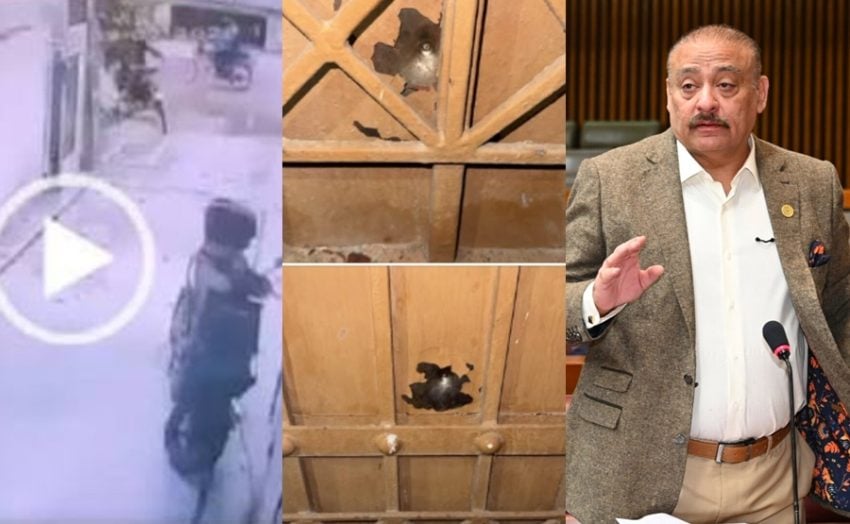
KARACHI: Unidentified gunmen opened fire at the office of Pakistan Peoples Party (PPP) MNA and former federal minister Qadir Patel in Karachi’s Boat Basin area, prompting a police investigation and tighter security around the premises.

According to police, the attackers fired several shots at the office entrance late at night before fleeing the scene. No one was injured in the incident, while the main gate sustained bullet marks.

Investigators recovered five spent 9mm pistol casings from the site and secured them as evidence. Police teams also began examining CCTV recordings from the surrounding area to trace the attackers and determine the vehicle used in the shooting.

Following the incident, security was increased around Patel’s office and nearby areas of Clifton. Police said efforts were underway to identify the suspects and establish the motive behind the attack.

Similar Posts

  • LESCO fails to give relief as power fluctuations hit major areas

    LAHORE: The Lahore Electric Supply Company (LESCO) has so far failed to bring any visible relief as frequent and increasingly severe power fluctuations have hit several areas of the provincial capital, leaving residents and commercial consumers complaining of damage to refrigerators, washing machines, air-conditioners, energy savers and other electrical appliances. The problem has reportedly become a growing concern in several localities, including Shah Jamal, Shadman, Mozang, Band Road, Mall Road, Gawalmandi and Krishan Nagar, where residents and shopkeepers say sudden voltage fluctuations and unstable power supply have become a routine problem. Consumers complain that fluctuations occur repeatedly, sometimes several times a day, putting expensive electrical and electronic equipment at risk. They say that while power supply interruptions are already a major inconvenience, sudden variations in voltage are causing additional financial losses to households, businesses and small shopkeepers. Shopkeepers at Shadman Market expressed serious concern over the situation, saying commercial consumers were particularly vulnerable because their businesses depend on refrigerators, air-conditioners, washing machines, energy savers and other electrical equipment. Zeeshan and Khaqan Hussain said repeated fluctuations had become a source of anxiety for traders, who fear that costly appliances may be damaged without warning. Similar complaints have emerged from Shah Jamal, where residents and traders have also raised concerns over unstable voltage. Fida Chishti and Ahsan Qadri said consumers were already struggling with rising electricity costs and could not afford additional expenses on repairing or replacing appliances allegedly damaged by fluctuations. Residents in other parts of Lahore, including Mozang, Band Road, Mall Road, Gawalmandi and Krishan Nagar, have also complained about the worsening power situation. They said the issue appeared to be affecting a wider area of the city and required immediate attention from the power utility. Consumers said the problem was particularly serious during periods of high electricity demand and extreme weather, when fluctuations and interruptions could become more frequent. They urged LESCO to inspect the affected feeders, transformers and distribution network to determine the causes of unstable voltage and take corrective measures. The Daily Minute Mirror office has also reportedly faced appliance-related problems amid repeated power fluctuations. According to staff, incidents involving electrical equipment have occurred several times, raising concerns about the impact of unstable voltage on office operations and costly appliances. Residents and traders said they had repeatedly submitted complaints to LESCO offices regarding power fluctuations but claimed that no significant improvement had been witnessed. They said the continued problem had created frustration among consumers, who wanted the power utility to take practical measures instead of merely registering complaints. The consumers demanded that LESCO conduct a technical assessment of areas facing frequent fluctuations and check the condition of transformers, feeders and other components of the distribution system. They also called for an effective complaint mechanism through which consumers could promptly report voltage-related problems. The Daily Minute Mirror contacted relevant LESCO offices to seek their response regarding the complaints, the reported appliance damage and the measures being taken to control power fluctuations, but no response was received until the filing of this report. Consumers have appealed to LESCO authorities to take immediate notice of the situation and ensure a stable and reliable power supply across Lahore, saying that continued fluctuations were not only disrupting daily life but also placing an additional financial burden on households, businesses and commercial consumers.

  • | |

    Italy’s fourth summer heat wave peaks as rec…

    Italy’s fourth heat wave of the summer reached its most intense point on Monday, with a record 25 cities placed under red heat alerts as temperatures climbed above 40 degrees Celsius in parts of the country, according to local media reports. Italy’s Health Ministry raised the number of cities under its highest heat risk warning from 23 on Sunday to 25 on Monday, marking the highest total recorded so far this summer. Only Reggio Calabria and Messina avoided the red alert designation, though both remained under yellow level warnings. The Po Valley and central regions of the country are experiencing the harshest conditions, while inland areas and Sardinia could also see temperatures exceed 40 degrees Celsius. In parts of central and northern Italy, overnight temperatures are expected to stay above 25 degrees Celsius, a pattern meteorologists have described as super tropical nights. The central province of Terni recorded a temperature of 41 degrees Celsius on Sunday. Experts have linked the extreme heat to a persistent African anticyclone combined with continued warming of the Mediterranean Sea, where surface temperatures have reached or surpassed 30 degrees Celsius across much of the basin. Meteorologist Lorenzo Tedici of iLMeteo.it said the accumulated heat is expected to fuel atmospheric instability, warning of strong afternoon thunderstorms forming over the Alps and Apennines. Italy’s Civil Protection Department has issued yellow alerts for heavy rainfall along the Apennine mountain range stretching from Umbria to Calabria, as well as in inland areas of Sicily. Tedici said a genuine shift away from the hottest phase of summer 2026 is unlikely before at least mid August. Authorities have also flagged an elevated risk of wildfires, placing Sicily and Emilia Romagna under orange alerts as the heat wave continues to grip the country. The extreme temperatures fit a broader pattern of intensifying summer heat across southern Europe in recent years, as scientists have repeatedly linked rising Mediterranean sea temperatures and more frequent heat waves to long term climate trends affecting the region’s weather systems.

  • |

    Huma Qureshi and Saqib Saleem join students at Delhi protest

    Actors Huma Qureshi and Saqib Saleem visited the ongoing student protest at Jantar Mantar in New Delhi during the early hours of Thursday, expressing support for demonstrators calling for accountability over alleged irregularities in the country’s education system. The sibling duo was accompanied by actor Rachit Singh as they walked alongside students who have been camping at the protest site for weeks. The demonstrators are demanding the resignation of Education Minister Dharmendra Pradhan, alleging misconduct and irregularities linked to the NEET examination process. Videos circulating on social media showed the actors arriving at the protest around 2:13 a.m. Huma, dressed casually in a black top and blue jeans, was seen interacting with protesters and walking through the gathering with a smile. Rachit Singh, wearing a white shirt, stayed close to her, while Saqib Saleem was also spotted joining the march and speaking with students. The visit quickly drew attention online, with many social media users praising the actors for showing solidarity with the students during the late-night demonstration. Others viewed their presence as a significant show of support from members of the film industry for a movement that has continued to gain momentum across the country. Huma and Rachit recently collaborated on the film Baby Do Die Do, which was produced by Huma Qureshi and Saqib Saleem under their production banner. Their appearance together at the protest marked an unexpected reunion, this time in support of a public cause rather than a film project. The student demonstrations, reportedly led by the Cockroach Janta Party (CJP), have expanded to several cities in recent weeks. Protesters have continued to demand greater transparency and accountability regarding the alleged examination irregularities, while urging authorities to address their concerns. Organisers have maintained that the movement will continue until their demands are met. In a statement shared on social media, representatives of the protest said they would remain united in their campaign and continue pressing for action. The protests have witnessed moments of heightened tension. Earlier this week, clashes reportedly broke out after police attempted to disperse demonstrators using batons and tear gas. Several protesters were removed from protest sites during security operations, while opposition leaders participating in demonstrations outside Prime Minister Narendra Modi’s residence were also detained during a separate sit-in. Despite the tense atmosphere, student groups have continued their demonstrations, attracting support from activists, public figures and members of the entertainment industry. The appearance of Huma Qureshi and Saqib Saleem adds to the growing list of Bollywood personalities who have publicly voiced solidarity with the students and their demands. As the protests continue, attention remains focused on the government’s response and whether officials will address the concerns raised by demonstrators. With public support growing and demonstrations showing no signs of slowing down, the movement has become one of the country’s most closely watched developments in recent weeks.

  • |

    Houthis strike Saudi Aramco refinery following historic defence pact with Pakistan and Turkey

    Yemen’s Iran-aligned Houthis launched a drone strike against Saudi Aramco’s Jazan refinery, just two days after Saudi Arabia signed a tripartite defence pact with Turkey and Pakistan to bolster regional deterrence. The Saudi Energy Ministry confirmed that emergency crews extinguished a fire resulting from the drone strike at the 400,000-barrel-per-day facility, reporting no casualties or disruptions to operations. The Houthis also executed combined missile and drone strikes against the Yemeni Red Sea port city of Mocha, killing seven people and damaging critical maritime infrastructure near the Bab-el-Mandeb strait. The newly forged Saudi alliance with Pakistan and Turkey specifies that an armed aggression against one signatory constitutes an attack on all, though member states have not yet detailed any operational military response. Houthi military spokesperson Yahya Saree stated that the Red Sea strikes targeted Saudi military assets and ammunition stores, framing the operations as part of an ongoing naval blockade against the kingdom. The escalating attacks in the Red Sea further complicate global energy transport, depriving Saudi Arabia of key alternative routes while regional access through the Strait of Hormuz remains constrained.

  • |

    PIA-style model proposed for DISCO privatisation

    ISLAMABAD: The government has proposed a new financial structure for the privatisation of three major power distribution companies. The plan covers Faisalabad Electric Supply Company (FESCO), Gujranwala Electric Power Company (GEPCO) and Islamabad Electric Supply Company (IESCO).The proposal is based on the restructuring model used during the privatisation process of Pakistan International Airlines (PIA). Under the proposed plan, selected assets and liabilities of the three companies will be separated from their balance sheets.The government plans to establish a Special Purpose Vehicle (SPV) for this purpose. The SPV will be owned by the government. It will hold specific assets and liabilities removed from the DISCOs. The restructuring is aimed at making the companies more attractive to private investors. The government wants to offer financially stronger entities to potential buyers.Land assets are among the items expected to be separated from the DISCO balance sheets. Liabilities related to retired employees and pension benefits will also be shifted to the SPV.These pension-related liabilities were worth around Rs312 billion for the three companies as of June 2025. The final amount could change after the companies’ balance sheets are restructured. The government plans to use audited financial results for March 2026 as the basis for the final calculation.The three DISCOs had combined assets of around Rs1.2 trillion in June 2025. Their combined liabilities stood at approximately Rs1.05 trillion.The companies together reported net positive equity of around Rs145 billion. However, the financial position of the three companies varies considerably.GEPCO had negative equity of around Rs14.4 billion as of June 2025. The final figures may be different because the government is using March 2026 audited accounts for the restructuring process. The Privatisation Commission board has recommended that the Cabinet Committee on Privatisation approve the restructuring plans. The plans cover the first group of DISCOs selected for privatisation.The proposed arrangements have been prepared using audited financial statements for the period ending March 31, 2026. Officials believe the new structure could increase the value of the companies for the government.It is also intended to make the transactions commercially viable for private-sector investors. The government hopes the approach will attract stronger interest from domestic and international buyers.The strategy closely resembles the model adopted for PIA. During the airline’s privatisation process, the government separated more than Rs650 billion in liabilities from PIA’s balance sheet.The move was designed to leave the airline in a stronger financial position before its transfer to new owners. A similar approach is now being considered for the three DISCOs.The Privatisation Commission has been informed that both local and foreign investors have shown interest in the companies. The government has already announced deadlines for Expressions of Interest.Investors interested in FESCO must submit their Expressions of Interest by August 7, 2026. The deadline for GEPCO is August 21, 2026.For IESCO, the deadline has been set for September 7, 2026. FESCO has a relatively stronger financial position among the three companies.Its assets stood at around Rs410.3 billion as of June 2025. Its liabilities were approximately Rs347 billion.The company reported positive equity of around Rs63 billion. The equity position was supported by deposits for shares and gains from asset revaluation.FESCO also recorded a profit after tax of around Rs9.4 billion. Its non-current liabilities stood at approximately Rs217.6 billion.Staff retirement benefits accounted for around Rs123 billion of these liabilities. The company’s current liabilities were estimated at about Rs130 billion.Trade payables made up around Rs118 billion of the current liabilities. GEPCO reported a profit after tax of around Rs13.7 billion.Its total assets stood at approximately Rs238 billion. However, its equity remained negative at around Rs14.4 billion.The company’s total liabilities were around Rs252.5 billion. Staff retirement benefits accounted for approximately Rs79 billion.IESCO reported a loss after tax of around Rs1.42 billion during the same period. The company had total assets of approximately Rs547 billion.Its liabilities stood at around Rs450 billion. Despite recording a loss, IESCO had positive equity of around Rs97 billion. The company’s equity position was supported by a share deposit of approximately Rs67 billion. It also benefited from a surplus revaluation of around Rs158 billion.IESCO’s liabilities included staff retirement benefits worth around Rs110 billion. The company also carried deferred tax liabilities.The proposed privatisation is part of Pakistan’s wider power-sector reform programme. It is also linked to commitments made under Pakistan’s agreement with the International Monetary Fund (IMF).Pakistan has repeatedly pledged to reduce government involvement in the power distribution sector. The commitment to privatise at least three DISCOs has been made several times since 2013.Previous attempts, however, failed to reach completion. The IMF has urged Pakistan to implement structural reforms in the power sector.The broader objective is to reduce electricity costs for households and businesses. The reforms also aim to improve the operational efficiency of power distribution companies.The IMF has previously noted delays in the private-sector participation process for DISCOs. The first group, consisting of FESCO, GEPCO and IESCO, faced delays after potential investors raised concerns about the proposed transaction structure.The government has now said that those concerns have been addressed. Officials expect the privatisation process to move forward.The government is targeting completion of the first phase by early 2027. The proposed SPV will be an important part of the process.It is intended to separate selected financial burdens from the three companies before they are offered to private investors. The government hopes the restructuring will improve investor confidence and make the DISCO transactions more commercially attractive.

  • | |

    Senate health subcommittee discusses A-Level, FSc …

    Pakistan’s Senate Health Subcommittee held an important meeting to discuss concerns surrounding the Medical and Dental College Admission Test (MDCAT), the country’s medical education policies, and the increasing number of students pursuing medical education abroad. The session was chaired by Senator Samina Zehri, the convener of the subcommittee, and attended by Federal Health Minister Mustafa Kamal, Senator Anusha Rahman, Senator Shahzaib, and officials from the Pakistan Medical and Dental Council (PMDC). During the meeting, Senator Samina Zehri highlighted the significant differences between Pakistan’s FSc (Faculty of Science) education system and the internationally recognized A-Level qualification. She remarked that Pakistan’s education system is well known for its challenges and that the disparity between the two academic streams should not be overlooked when formulating admission policies for medical colleges. Responding to these concerns, Federal Health Minister Mustafa Kamal stated that the MDCAT examination is designed in a way that does not favor either A-Level or FSc students. He explained that the test includes questions that can be answered by candidates from both educational backgrounds, ensuring fairness in the admission process. According to the minister, the examination aims to assess students’ knowledge and aptitude rather than the curriculum they have studied. Mustafa Kamal further suggested that a detailed analysis should be conducted to determine how students from different educational backgrounds perform in the MDCAT. He pointed out that approximately 95,000 students had passed the examination and proposed collecting data from the past five years to determine how many successful candidates came from A-Level and FSc backgrounds. Such data, he said, would provide evidence-based insights for future policy decisions. The minister also assured members of the committee that the details of the assessment committee responsible for the MDCAT would be submitted within 24 hours. In response, Senator Anusha Rahman stated that the Senate committee was currently assisting the ministry in reviewing the admission process and therefore required complete information about the committee members involved in preparing and evaluating the examination. Following the discussion, Federal Health Minister Mustafa Kamal formally assured the committee that all requested information regarding the assessment committee would be provided within the promised timeframe. During the meeting, Senator Anusha Rahman also called for a review of the Pakistan Medical and Dental Council’s (PMDC) current policies. She emphasized the need to reassess regulations to ensure they effectively address the concerns of students and maintain the credibility of Pakistan’s medical education system. Senator Shahzaib raised another important issue regarding Pakistani students who intend to pursue higher medical education abroad. He questioned why graduates of Pakistani universities who plan to enroll in medical institutions overseas are still required to take the MDCAT. Referring to a recently issued advertisement, he noted that the existing policy appears to require these students to pass the admission test even if they have no intention of studying medicine within Pakistan. In response, Health Minister Mustafa Kamal acknowledged the concern and assured the committee that the policy would be reviewed. Senator Anusha Rahman added that while reviewing the policy, authorities should also ensure that students planning to study abroad avoid enrolling in institutions that have been identified as “red-flag” universities or those lacking proper accreditation. The Chairman of the PMDC Reforms Committee informed the meeting that students intending to study medicine overseas are required to register with the PMDC before leaving the country. This registration process, he explained, helps the regulatory body monitor students and maintain standards for foreign medical qualifications. Highlighting another major concern, Health Minister Mustafa Kamal stated that around 40,000 Pakistani students travel abroad each year for medical education, taking an estimated US$800 million out of the country. He stressed that this represents a significant financial outflow and underlined the importance of strengthening Pakistan’s own medical education system. However, Senator Anusha Rahman offered a different perspective, arguing that many of these students eventually return to Pakistan after completing their education and contribute to the country’s economy through their professional earnings. She suggested that while the government should improve local opportunities, it should also recognize the long-term benefits that internationally educated professionals can bring back to Pakistan.

Leave a Reply

Your email address will not be published. Required fields are marked *