man breaks fish

Man breaks fish finger record

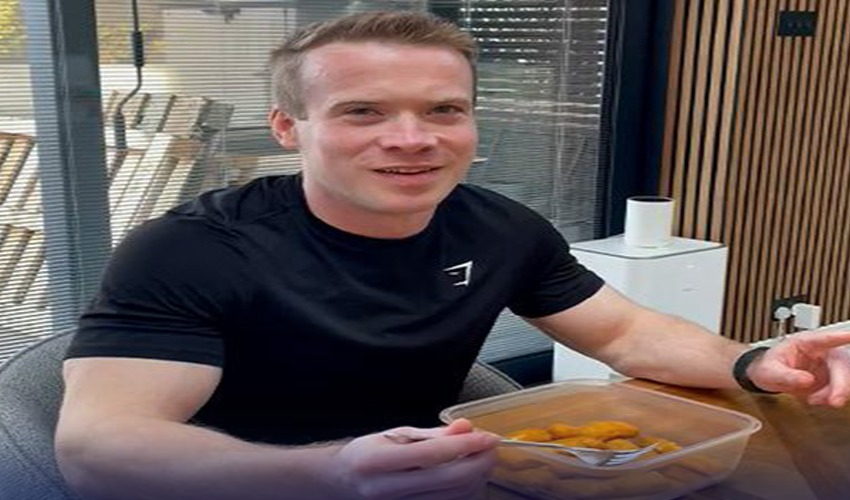
A 32 year old man from the UK has earned a Guinness World Records title after eating 15 fish fingers in just one minute.

Nathan Davis decided to chase a world record after recently winning more than $130,000 on a TV game show.

He said he chose fish fingers because he had already taken part in several informal eating challenges and felt confident with the food.

After setting the record Davis said he was happy to become a Guinness World Record holder even if it was for eating fish fingers.

He added that if the fish fingers had been allowed to cool a little more he believed he could have eaten even more. Still he said he was pleased with his achievement.

Similar Posts

  • Get natural brown hair with henna

    Chemical hair dyes and salon coloring treatments are becoming increasingly common.  While they can give hair an attractive color frequent use may leave hair dry weak and damaged. For people who want a more natural option homemade henna can be a simple alternative.  It can add a warm brown shade while helping hair look soft and shiny. How chemical dyes can affect hair Many chemical hair dyes contain ingredients such as ammonia and hydrogen peroxide.  These chemicals can affect the hair’s outer layer and may weaken its structure over time. Repeated coloring can make hair dry and brittle leading to more breakage.  Some people may also experience scalp problems such as itching irritation or small bumps. Why choose natural henna? Many women use henna but later return to chemical dyes because they do not get the brown shade they want.  Adding a few natural ingredients to henna can help create a deeper brown color. Ingredients you need 1 cup dry henna 2 cups water 1 tablespoon tea leaves 1 tablespoon coffee 1 egg 2 tablespoons coconut mustard or olive oil How to prepare the mixture Boil two cups of water with one tablespoon each of tea leaves and coffee. Continue boiling until about one and a quarter cups of water remain. In a bowl add one cup of dry henna one egg and two tablespoons of your preferred oil.  Add the prepared tea and coffee water and mix everything well. Cover the mixture and let it rest for about 30 minutes. How to apply henna Wash your hair properly with shampoo one day before applying the henna. The next day apply the prepared mixture evenly from the roots to the ends. Leave it on for around three to four hours. Once the henna has dried rinse your hair with plain water. For the next step mix about half a teaspoon of lemon juice with a small amount of your regular hair oil.  Apply it to damp hair and let your hair dry. Shampoo your hair normally the following day. Use it regularly Using this henna method around twice a month may gradually give the hair a natural brown tone. It can also help hair look smoother and shinier. However natural does not always mean risk free. It is best to do a small patch test before using henna or any new ingredient especially if you have sensitive skin or a history of allergies.

  • China tests giant fusion magnet

    China has successfully tested the world’s largest fusion magnet weighing 582 tons marking a major step toward developing an “artificial sun.” The technology aims to produce clean safe and nearly unlimited energy through nuclear fusion in the future. The giant D-shaped superconducting magnet was developed by the Institute of Plasma Physics under the Chinese Academy of Sciences. It is designed to control extremely hot plasma using powerful magnetic fields which is one of the most important parts of the nuclear fusion process. The magnet measures 21 meters long and 12 meters wide and has been built for the world’s largest fusion reactor. Reports say it is about 1.3 times larger than a similar magnet used in an international fusion project and can store three times more energy. It is capable of containing plasma at temperatures of up to 100 million degrees Celsius allowing scientists to recreate the same fusion process that powers the Sun. Chinese officials said most of the materials and manufacturing were completed within China reducing the country’s reliance on foreign technology and supplies. China hopes to generate electricity from fusion energy by around 2030. Scientists say an “artificial sun” is a nuclear fusion reactor that copies the natural process used by the Sun to produce energy. If successful this technology could provide the world with a reliable source of clean and almost unlimited electricity in the future.

  • Japan launches cooling shirt with built in fans

    Japan is finding a new way to deal with extreme summer heat.  A Japanese clothing company has introduced a formal looking shirt with built in fans that can help keep people cool while they are outside. The company, Yofuku no Aoyama has launched a short sleeved shirt fitted with two small fans. The fans circulate air inside the shirt helping cool the wearer while walking or traveling. At first glance the shirt looks like a normal office shirt. However it has a small cooling system hidden inside. The fans are placed near the lower back and push air through the shirt to reduce heat and discomfort. Cooling clothes with built in fans have become popular in Japan over the past few years. They were mainly used by construction workers garbage collectors, security staff and other outdoor workers.  Most of these products looked like jackets or work vests rather than regular office clothing. With summers becoming hotter demand for cooling clothes is now growing among office workers and other people who spend time outdoors. To meet this demand Yofuku no Aoyama developed the shirt in partnership with FZN a company that specializes in fan powered clothing. The shirt comes with two fans and a rechargeable battery. The company has tried to keep the cooling system as light as possible. Each fan weighs around 95 grams, while the battery pack weighs about 165 grams. The fans are visible from the back but the designers have kept the rest of the system as discreet as possible so the shirt still looks suitable for an office environment. The company has not provided specific information about how loud the fans are so they may not be  completely silent. The shirt is mainly designed for traveling rather than meetings. Most offices and meeting rooms already have air conditioning so there is little need to use the fans indoors. However the cooling system can be useful when employees walk between meetings travel by public transport or spend time outside in hot weather. It may also help workers arrive at their destination without becoming heavily sweaty reducing the need to change clothes before continuing their work. Price and Availability The Coochowear Short Sleeve Shirt is being sold as a complete cooling package for 17,490 Japanese yen. The package includes the shirt two fans a rechargeable battery pack and a charging cable. The shirt is available in blue and gray with medium large and extra large sizes. The product is now available through the company’s stores and online shop.

  • |

    The limits and depth of human consciousness

    For millions of years, the survival of living species depended almost entirely on practical adaptations. The core of living was finding food, securing shelter, avoiding predators, and reproducing. Yet, at a crucial juncture in evolutionary history, Homo sapiens began engaging in a behavior that offered no immediate physical utility like making art. From red ocher hand stencils on cave walls in Sulawesi and Western Europe to intricate bone flutes and sculpted figurines, early humans devoted valuable time and energy to symbolic creation. Today, neuroscientists, cognitive psychologists, and evolutionary anthropologists increasingly view art not as a secondary cultural luxury, but as a foundational hallmark of human consciousness. The Evolutionary Emergence of Symbolic Thought The birth of artistic expression marks a profound cognitive transition. While many animals exhibit complex behaviors, these actions are largely instinctual and functional. Human art, by contrast, relies on abstract symbolic thinking. The capacity to let one object, shape, or sound represent an idea, emotion, or absent reality. When an early human carved a figure or painted a thundering herd of bison onto rock, they were not merely copying their surroundings. They were projecting an internal mental world onto an external physical canvas. This ability to externalize subjective experience required a sophisticated architecture of consciousness, including robust working memory, metacognition (thinking about one’s own thinking), and a developed theory of mind. It’s the understanding that others possess distinct mental states and can interpret shared symbols. The Neurobiology of Aesthetic Experience Modern neuroimaging reveals that creating and contemplating art engages large-scale, interconnected brain networks. When a person immerses themselves in a painting, music, or literature, the Default Mode Network (DMN) works with sensory and emotional circuits. Artistic engagement triggers a dynamic dialogue between the visual or auditory cortex, the limbic system (which processes emotion), and executive regions in the prefrontal cortex. This complex cross-talk allows humans to experience qualia. The subjective, qualitative feel of conscious experiences. A visual composition does not simply register as light wavelengths in the brain; it evokes nostalgia, awe, melancholy, or inspiration. This capacity to synthesize raw sensory inputs with deep emotional resonance and reflective thought is a unique feature of high-level conscious awareness. Lived Experience versus Machine Patterning In an era dominated by artificial intelligence algorithms capable of generating hyper-realistic images and musical compositions in seconds, the relationship between art and consciousness has taken on renewed urgency. While generative models analyze billions of data points to predict and replicate aesthetic patterns, they operate entirely without subjective awareness, intent, or emotional feeling. Human art originates from a grounded biological reality: the lived experience of mortality, joy, heartbreak, bodily sensation, and social existence. The power of a masterpiece lies not merely in its formal technique, but in the implicit bridge it constructs between the inner world of the artist and that of the observer. Art is fundamentally a dialogue of consciousnesses. It is a mechanism through which one conscious entity communicates what it feels like to exist. A Mirror to Human Identity Ultimately, art serves as both a product and a mirror of conscious awareness. It enables individuals to simulate hypothetical scenarios, process complex social dynamics, and navigate existential questions about purpose and mortality. By translating internal emotional states into tangible forms, humans construct shared cultural meaning and foster deep social cohesion.   As science continues to explore the mystery of how physical brain matter generates subjective experience, art remains our most visible and enduring cognitive fingerprint. It stands as compelling proof that human consciousness is defined not just by how we perceive the objective world, but by our infinite capacity to imagine and construct new ones.

  • Lettuce linked to U.S. parasite outbreak

    A recent outbreak of cyclosporiasis, a parasitic illness has spread to more parts of the United States. Health officials say the number of affected states has now increased to nine making it the largest known outbreak of its kind in the country. According to the latest update from U.S. health authorities the outbreak was first reported in Indiana Kentucky, Michigan Ohio and West Virginia. It has now also been confirmed in Illinois Kansas, Oklahoma and Pennsylvania. Investigators believe most of the cases are linked to contaminated iceberg lettuce imported from central Mexico. The lettuce is believed to have been contaminated with the Cyclospora parasite. Although cyclosporiasis is usually not life threatening experts say it can cause severe symptoms.  These include frequent watery diarrhea vomiting stomach cramps nausea and extreme tiredness. Officials say people in the newly affected states became sick around the same time as earlier patients suggesting they may have been exposed to the same shipment of contaminated lettuce. Health authorities are urging anyone who develops these symptoms after eating contaminated food to seek medical care as soon as possible. The investigation into the source of the outbreak is still ongoing.

  • Suzi’s monument keeps Lahore Zoo’s beloved elephant alive in memory

    By Sahr Sarfraz A visit to Lahore Zoo recently brought back memories of one of its most beloved residents, Suzi, whose monument continues to preserve the legacy of an elephant that remained close to the hearts of visitors for nearly three decades. Founded in 1872, Lahore Zoo is among Pakistan’s oldest zoological institutions and has witnessed generations of animals becoming part of the city’s collective memory. However, few managed to capture public affection quite like Suzi. The African elephant arrived at Lahore Zoo in 1988 and soon became one of its most popular attractions. Families, schoolchildren and tourists regularly gathered around her enclosure, fascinated by her gentle nature and calm presence. Suzi was more than an animal on display. Over the years, she developed a special relationship with her keepers, who cared for her and became familiar faces in her daily life. Visitors also grew accustomed to seeing her during school trips, holidays and weekend outings. Her popularity was reflected in the affection with which people remembered her. At times, her name was painted on her forehead alongside Pakistan’s crescent and star, a gesture that reflected the special place she held in the hearts of Lahore’s residents. For thousands of visitors, seeing Suzi became part of growing up in the city. Children who first encountered her during school trips later returned with their own families, creating memories that crossed generations. Suzi died on May 13, 2017, after suffering from leg-related health problems. Her death left many visitors and zoo workers grieving, particularly those who had known her for years. Today, a monument at Lahore Zoo stands as a tribute to the elephant who once occupied the area. Although her former enclosure has since become home to other animals, including a white rhinoceros and a hippopotamus, the sculpture keeps Suzi’s memory alive. Standing before the monument offers a quiet opportunity to reflect on the connection that can develop between people and animals. In a rapidly changing city, the memorial serves as a reminder of a life that brought happiness to countless visitors. Lahore Zoo remains an important destination for recreation, education and family visits. Yet Suzi’s monument adds another dimension to the experience by preserving a piece of the zoo’s history. Her story demonstrates that animals can become much more than exhibits. They can become part of a community’s memories, childhood experiences and emotional history. Suzi may no longer be present at Lahore Zoo, but her legacy continues through the monument that ensures generations of visitors can remember the elephant who once brought quiet joy to one of Lahore’s most familiar landmarks. About the writer Sahr Sarfraz is a doctor by profession who enjoys writing reflective articles in her spare time.

Leave a Reply

Your email address will not be published. Required fields are marked *