long war ahead

A Long War Ahead: Diplomacy, Nerves, and a Region …

The Middle East appears to be entering a prolonged phase of strategic tension—one defined not only by the possibility of conflict, but by a high-stakes battle of nerves accompanied by intense diplomatic maneuvering. The American Centcom has briefed the president about the next phase of attacks that Centcom thinks will decaptilze the Iranian power. They warn that they will target the Iranian power plants and with meeting Israeli pm natanyahu also assured and second the trump decision. In response the Iranian also ready to attack in Israeli power plants and in Gcc American bases. So a long war ahead. At the center of this evolving landscape stands Mohammed bin Salman (MBS), whose regional vision and leadership now face one of their most critical tests.


Over the past decade, the Gulf Cooperation Council (GCC), under Saudi Arabia’s influence, aligned itself closely with the United States. This alignment brought undeniable short-term gains: an influx of multinational corporations, the emergence of technology hubs, ambitious infrastructure projects like NEOM, and a rebranding of the Gulf as a global tourism and investment destination. These developments projected an image of modernity and economic diversification—an intentional shift away from rigid conservatism.


However, beneath this transformation lies a deeper geopolitical calculation. The United States sought not only economic engagement but strategic positioning in the Middle East, particularly in the context of its long-standing rivalry with Iran. By encouraging normalization with Israel through frameworks like the Abraham Accords, Washington aimed to consolidate a regional bloc that could counterbalance Tehran.


This strategy, while effective in shaping alliances, also came at a cost. Iran was increasingly portrayed in Western narratives as rigid, anti-modern, and resistant to democratic values. Whether accurate or exaggerated, this portrayal contributed to its diplomatic isolation. Yet, Iran has not remained passive. Instead, it has adopted a dual-track approach—maintaining a posture of resistance while keeping diplomatic channels open. This calculated balance has allowed Tehran to assert its relevance in any future regional order.


Recent developments suggest that the initial cohesion within the GCC may be more fragile than it appeared. Trust built over decades can erode rapidly under pressure, and shifting geopolitical realities have exposed underlying vulnerabilities. If Iran successfully convinces regional actors that its inclusion is essential for stability, it could reshape the Middle Eastern power structure in its favor.


Meanwhile, other key players—Pakistan, Qatar, and Turkey—have attempted to position themselves as mediators. However, their efforts have been slow and, at times, constrained by their own strategic dependencies. Qatar has shown willingness to facilitate dialogue, but Turkey’s independent stance and Pakistan’s cautious approach—often influenced by its ties with Washington—have limited the effectiveness of a unified diplomatic front.


The question, then, is whether diplomacy can still alter the trajectory. Iran’s willingness to engage, even while projecting strength, indicates that a negotiated outcome remains possible. If Tehran can compel regional actors, including Saudi Arabia, to broaden the dialogue and incorporate Turkey into a more inclusive framework, it may shift the balance away from confrontation.


For the United States, the situation presents no clear path to victory. Military escalation risks triggering a wider, multi-stage conflict that could engulf the entire region, placing GCC states in a precarious position. What may have once been framed as a strategic contest could evolve into a prolonged struggle driven by perceptions of credibility and prestige.


In this volatile environment, the risk is not just war—but a drawn-out cycle of escalation and retaliation. Iran, despite sustained pressure, appears increasingly resilient, with its strategic resolve hardening over time. Conversely, the Gulf states must reassess whether their current alignments serve long-term stability or merely short-term gains.


Ultimately, the region stands at a strong moment. The path forward will depend not only on military power but on the success of diplomacy in bridging deep-seated divides. There remains a possibility—however uncertain—that actors like China and Russia could play a crucial role in de-escalation. But trump also hinted that both assured him their neutrality during Iran war. The drones however allegedly counter thinks a Russian help under the war table. If such efforts succeed, they may prevent the Middle East from sliding into a conflict whose consequences would extend far beyond its borders.

Similar Posts

  • Drunk Driver Who Ran Over and Killed 2-Year-Old Claims Poverty

    LAMPANG – The first court mediation for a tragic drunk driving case in Lampang ended without a resolution on Tuesday. A former assistant village headman, known locally as “Uncle Det,” refused to pay financial compensation after causing a fatal crash. The devastating accident took the life of a two-year-old girl named Nong Toem Fan. It also […]

  • | | | |

    Egypt weighs joining Pakistan-Saudi-Türkiye defen…

    CAIRO: Egypt has started a serious review of the possibility of joining the Makkah Joint Defence Agreement between Pakistan, Saudi Arabia and Türkiye. Egyptian Foreign Minister Badr Abdelatty said Cairo has close and strategic relations with all three countries. He said Egypt’s ties with Pakistan, Saudi Arabia and Türkiye extend beyond political cooperation. Abdelatty was asked about Egypt’s possible inclusion in the defence agreement. He said Egypt has been aware of the pact since the beginning. He confirmed that Egyptian state institutions are currently conducting a comprehensive assessment of the agreement. The minister said no final decision has been taken yet. He added that the relevant Egyptian authorities are examining the agreement and its possible implications. Abdelatty stressed that defence agreements involve important commitments. Therefore, Egypt must carefully assess all legal and constitutional aspects before making a decision. He said any possible Egyptian participation would have to comply with the country’s Constitution and existing legal requirements. The review will also consider the responsibilities that could arise from joining the agreement. The development comes days after Pakistan, Saudi Arabia and Türkiye signed the Makkah Joint Defence Agreement. The pact seeks to strengthen defence cooperation among the three countries and enhance their collective security. Under the agreement, an attack against any one of the three countries would be considered an attack against all three. The arrangement has been described as a major step towards closer defence and strategic cooperation.

  • | |

    Anti-corruption probe flags HMC appointment irregu…

    The Anti-Corruption Department has conducted an inquiry into alleged irregularities and appointments to key positions at Hayatabad Medical Complex (HMC), raising questions over the appointment procedures and eligibility of several candidates. The inquiry report identified alleged violations of rules and regulations in appointments to important positions, including Director Finance, Chief Internal Auditor, Director Supply Chain, and Director Research and Clinical Audit. According to the report, a person was appointed as Director Finance despite allegedly failing to meet the prescribed eligibility criteria. The inquiry also found that the candidate who secured the top position on merit for the post of Chief Internal Auditor was allegedly overlooked. The report further stated that the appointment of the Director Supply Chain was made despite the candidate allegedly not meeting the required technical expertise criteria. Similarly, the inquiry raised objections to the appointment of the Director Research and Clinical Audit, stating that the appointee allegedly did not meet the required eligibility criteria. The Anti-Corruption Department said the appointments allegedly violated provisions of the Medical Teaching Institutions (MTI) Act and relevant rules and regulations. Based on its findings, the inquiry recommended that the disputed appointments be cancelled. The report also recommended action against the Chairman and members of the Board of Governors, along with other officials allegedly involved in the appointment process. According to the inquiry report, the disputed appointments remained in place for around three years, allegedly causing a financial loss of approximately Rs150 million to the public exchequer. The inquiry recommended recovering the alleged financial loss from the individuals responsible. The Anti-Corruption Department has also recommended verification of the educational qualifications, professional experience and certificates of the officials concerned. The verification is aimed at determining whether the documents submitted by the candidates at the time of their appointments met the prescribed criteria and were in accordance with the relevant rules. The matter has already been under investigation by the Anti-Corruption Department. A petition challenging appointments to key posts, including Director Finance, Chief Internal Auditor and Director Supply Chain, is also pending before the Peshawar High Court.

  • | |

    Punjab Governor ends 19-year UAF research officers…

    FAISALABAD: In a landmark decision expected to reshape the service structure of the University of Agriculture Faisalabad (UAF), Punjab Governor and UAF Chancellor Sardar Saleem Haider Khan has ordered the upgradation of the post of Research Officer with retrospective effect from April 25, 2007, bringing an end to what many describe as nearly two decades of discrimination against the university’s research cadre. The decision came after the Chancellor accepted a representation filed by Muzaffar Hussain Salik, a Research Officer at the Office of University Books and Magazines (OUBM). Besides approving the upgradation, the Chancellor declared the post of Research Officer a “Teacher of the University,” making its holders eligible for all related service, financial, seniority and pensionary benefits in accordance with the law. The dispute dates back to the implementation of the UAF Amended Service Statutes, 2007, introduced after the federal government’s policy to upgrade university teachers and teaching-equivalent positions with the concurrence of the Higher Education Commission (HEC). While several teaching and equivalent posts received the approved benefits, Research Officers and Senior Research Officers were allegedly left out despite performing comparable academic and research responsibilities. According to the representation, the exclusion created a longstanding disparity, depriving the affected employees of promotions, financial benefits, and equal treatment under the approved statutory framework. It argued that the selective implementation of the service statutes resulted in years of professional and financial disadvantage for members of the research cadre. After reviewing the legal and administrative record, the Chancellor ruled that the benefit of upgradation should be extended to Research Officers from the same effective date as Lecturers — April 25, 2007. The order effectively places the research cadre on par with other teaching-equivalent positions that had already been upgraded under the 2007 amendments. University officials and academic observers believe the decision will benefit around 66 Research Officers, Senior Research Officers and other teaching-equivalent employees, providing them with long-awaited financial relief, revised seniority, pensionary benefits and formal recognition within the university’s teaching community. The ruling has been widely welcomed by researchers, academics and legal experts, who describe it as one of the most significant service-related decisions in UAF’s recent history. They say the order reinforces the principles of equality, transparency and uniform implementation of statutory rights while setting an important precedent for public sector universities across Pakistan. For petitioner Muzaffar Hussain Salik, the decision marks the successful conclusion of a long legal and constitutional struggle. Beneficiaries have hailed the ruling as a collective victory for justice, merit and the rule of law, expressing hope that similar disparities in higher education institutions will now be addressed through fair and consistent implementation of service statutes.

  • | | |

    Weekly inflation rises 0.15%, annual rate reaches …

    ISLAMABAD: Weekly inflation in Pakistan increased by 0.15% during the latest week, taking the overall annual inflation rate to 9.11%, according to data released by the Pakistan Bureau of Statistics (PBS). The statistics agency issued its weekly inflation report, showing mixed price trends for essential commodities. According to the report, prices of 20 essential items increased during the week, while nine items became cheaper. Prices of 22 commodities remained unchanged. Onion recorded the sharpest increase, with its price rising by 24.68% in one week. The price of gram lentils also increased by 3.35%. Chicken became 2.45% more expensive during the week. Prices of several other household essentials, including yogurt, garlic and tea, also recorded increases. The report showed that some major commodities became cheaper. Tomato prices declined by 1.26% during the week. Petroleum prices also decreased. Petrol became 2.35% cheaper, while diesel prices fell by 0.29%. The prices of sugar, eggs and potatoes also recorded declines during the week. The latest figures indicate continued fluctuations in the prices of essential commodities. While several food items became more expensive, reductions in petroleum prices and some food products provided some relief to consumers. The weekly inflation figures are closely monitored as they reflect short-term changes in the prices of goods commonly purchased by households. The annual inflation rate, meanwhile, provides a broader picture of price increases across the economy.

  • | | | |

    Gen Aamer Raza honoured with Nishan-i-Imtiaz

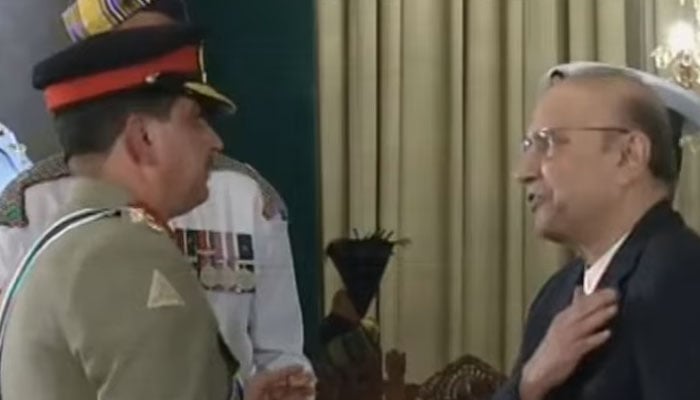
    Commander National Strategic Command General Syed Aamer Raza has been conferred the Nishan-i-Imtiaz (Military), one of Pakistan’s highest military honours. President Asif Ali Zardari conferred the prestigious award on General Syed Aamer Raza during a ceremony held at Aiwan-e-Sadr in Islamabad. President Zardari, Prime Minister Shehbaz Sharif, Field Marshal Syed Asim Munir and the chiefs of the armed services attended the ceremony. Deputy Prime Minister and Foreign Minister Ishaq Dar, the chairman of the Senate, federal ministers and other senior government officials were also present. The ceremony was held to recognise General Aamer Raza’s services and contributions in his capacity as Commander National Strategic Command. General Raza has previously received two major military honours, the Hilal-i-Imtiaz (Military) and the Sitara-i-Basalat. Before his latest appointment, he was serving as Chief of General Staff. The position is considered one of the Pakistan Army’s key operational assignments. During his tenure, he was involved in implementing organisational changes following the 27th Constitutional Amendment. He also oversaw restructuring within the military after last year’s conflict with India. The changes included the creation of the Army Rocket Force Command, as part of efforts to strengthen the army’s organisational and operational capabilities. General Raza began his military career as a cavalry officer. He trained at the Officers Training School and was commissioned into the 6th Lancers in 1988. Over the course of his career, he held several important command positions. These included command of an armoured regiment and an armoured brigade. He also commanded an infantry brigade in South Waziristan. Later, he served as the commander of an infantry division. His senior field appointments included command of Lahore-based IV Corps, one of the Pakistan Army’s major corps formations. General Raza has also held a number of important institutional and staff positions. He headed Heavy Industries Taxila, a major defence production organisation. He also served as Director General of Weapons and Equipment. In another senior assignment, he worked as Chief of Staff at II Corps. His professional background has largely focused on conventional military operations, command responsibilities and force development. Unlike some senior officers associated with Pakistan’s strategic institutions, General Raza has not served in the Strategic Plans Division or the Army Strategic Forces Command. He has also not held an appointment directly linked to the country’s strategic missile programme.

Leave a Reply

Your email address will not be published. Required fields are marked *