trump8217s board peace
|

Trump’s Board of Peace plan draws global attention and criticism

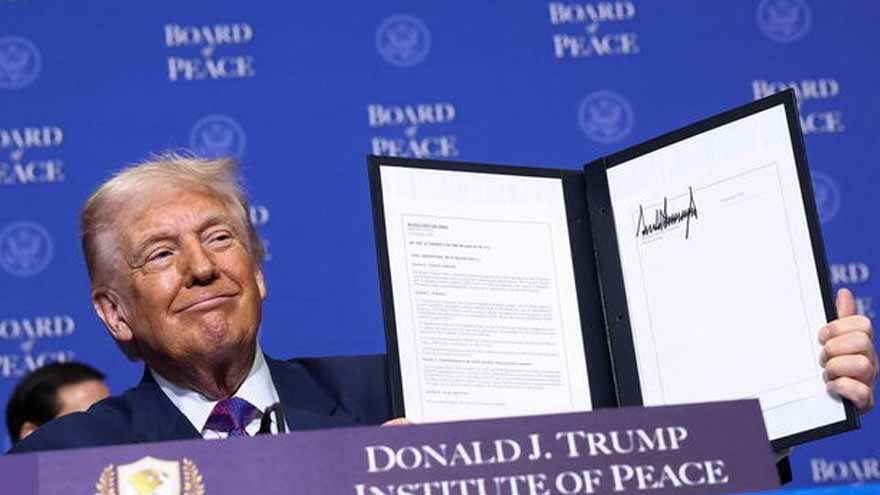
United States President Donald Trump has announced that his Board of Peace has secured an agreement aimed at the complete disarmament of Hamas and other armed groups in Gaza, along with the gradual withdrawal of Israeli forces from the territory. Trump described the agreement as a historic breakthrough and said it would be carried out in stages, with Israeli troops leaving Gaza as disarmament progresses.

The Board of Peace was first proposed by Trump in September last year as part of his plan to end the war in Gaza. He later expanded the initiative, saying it would also work to address conflicts in other parts of the world. The board is intended to coordinate peace efforts and oversee reconstruction projects, a role that has traditionally been led by the United Nations.

According to its charter, countries joining the board normally serve three year terms. However, nations that contribute one billion dollars toward its activities are eligible for permanent membership. Trump serves as chairman of the initiative and has broad executive authority, including the power to veto decisions and remove members under certain conditions.

The White House named Secretary of State Marco Rubio, special envoy Steve Witkoff, former British Prime Minister Tony Blair and presidential adviser Jared Kushner as members of the board’s founding executive team.

More than two dozen countries have joined the initiative. Alongside the United States, members include Israel, Saudi Arabia, Egypt and Qatar, all of which have played important roles in recent Middle East diplomacy. Other participating countries include Bahrain, Jordan, Kuwait, Morocco, Turkey and the United Arab Emirates. Outside the region, Albania, Argentina, Armenia, Azerbaijan, Belarus, Bulgaria, Cambodia, El Salvador, Hungary, Indonesia, Kazakhstan, Kosovo, Mongolia, Pakistan, Paraguay, Uzbekistan and Vietnam have also joined.

Several major countries and international partners have declined to participate. Britain, France, Germany, Norway, Sweden and the European Union have all decided not to join the initiative. Brazil, Mexico, India and South Africa have also remained outside the board, while China and Russia have chosen not to participate. The Vatican has argued that responsibility for handling international conflicts should remain with the United Nations. Canada also lost its invitation after a diplomatic disagreement between Trump and Prime Minister Mark Carney earlier this year.

The Board of Peace received international recognition after the United Nations Security Council approved a United States drafted resolution acknowledging its temporary role in Gaza. Under the resolution, the board will coordinate funding for reconstruction and oversee a temporary international stabilisation force in Gaza through 2027. It must also report its progress to the Security Council every six months. China and Russia abstained from the vote, saying the resolution did not clearly define the United Nations’ role in Gaza’s future administration.

Despite official backing, the initiative has attracted widespread criticism from human rights organisations and political observers. Critics argue that the board resembles a colonial style governing structure because it is designed to supervise Gaza without including Palestinian representatives. They have also questioned the inclusion of Tony Blair because of his role in the Iraq war and criticised the participation of countries with poor human rights records.

The decision to include Israel on a body responsible for overseeing Gaza has generated additional controversy. Opponents argue that Israel’s ongoing military campaign has left much of Gaza destroyed and displaced its population. Israel maintains that its military actions were carried out in self defence following the Hamas attack in 2023 that killed around 1,200 people and resulted in more than 250 hostages being taken.

Since its launch, the Board of Peace has focused mainly on plans for rebuilding Gaza. Trump said member countries have already pledged around seven billion dollars toward reconstruction, although experts estimate that restoring the territory after more than two years of conflict could cost as much as 70 billion dollars. The board has also reportedly held discussions with international companies on future infrastructure and supply chain projects as planning for Gaza’s recovery continues.

Similar Posts

  • |

    25 US states challenge Trump’s new tariffs in court

    NEW YORK: A coalition of 25 US states has filed a lawsuit against the administration of President Donald Trump, seeking to block a new round of tariffs imposed on imports from dozens of countries. The legal challenge was submitted to the US Court of International Trade in New York, where the states asked the court to suspend the tariffs, declare them unlawful and order the federal government to refund businesses that have already paid the import duties. The coalition argued that the administration exceeded its legal authority by introducing sweeping tariffs under Section 301 of the Trade Act of 1974. According to the lawsuit, the investigations cited by the administration as justification for the tariffs were used as a pretext to impose broad trade restrictions. The disputed tariffs, ranging from 10% to 12.5%, were introduced last month and apply to imports from 60 trading partners, covering a significant share of goods entering the United States. The Trump administration has defended the measures, saying they are intended to address concerns related to forced labour in international supply chains and to protect American trade interests. The White House maintains that the tariffs were imposed within the government’s legal authority and remain an important tool for securing fair trade practices. A White House spokesperson said the administration is using powers granted under US trade law to respond to what it considers unfair policies and practices affecting American commerce. Officials also argued that Section 301 tariffs have previously withstood legal scrutiny and continue to be a lawful instrument of trade policy. The lawsuit follows earlier legal disputes over President Trump’s tariff policies. Previous tariffs introduced under emergency economic powers were struck down by the US Supreme Court earlier this year, prompting the administration to replace them with the current Section 301 measures after a temporary global tariff expired in July. The states involved in the case contend that the latest tariffs are arbitrary and unlawful, arguing that while they support efforts to combat forced labour worldwide, such concerns cannot be used to justify what they describe as an illegal expansion of presidential tariff powers.

  • | |

    50,000 cusecs surge through Ravi River

    A low-level flood has been recorded in the Ravi River near Kamalia after water levels increased at the Mil Fatyana point. Authorities have stepped up monitoring and emergency preparations as floodwater continues to move downstream. According to the Sub-Divisional Officer (SDO) Irrigation, around 50,000 cusecs of water is flowing through the Mil Fatyana section of the Ravi River. Officials are closely monitoring the river to assess any further rise in water levels and to ensure timely action if conditions worsen. The district administration has established flood relief camps in several vulnerable areas. The camps have been set up in Mil Fatyana, Kot Pathana, Adda Kalaira, Mauza Tara, Haveli Mai Safuran, Kot Karam Shah and Dedi. These facilities are intended to provide temporary shelter, food and emergency assistance to residents if evacuations become necessary. As part of efforts to improve disaster preparedness, Punjab has launched drone-based flood monitoring for the first time. The technology is being used to monitor river conditions, identify vulnerable locations and issue early warnings before floodwaters reach populated areas. Officials believe the system will help improve response times and reduce the impact of flooding. The rising water has already affected nearby agricultural land. Standing crops in Mil Fatyana, Khan Da Chak, Jhalar Sigla, Shahabal Shah, Basti Peepal Wala and Mauza Darsana have been submerged, raising concerns about crop losses and the financial impact on local farmers. The Irrigation Department has urged people living along the river belt to remain alert and cooperate with local authorities. Residents in low-lying areas have been advised to move to safer locations as a precaution against any further increase in water levels. Officials said surveillance of the Ravi River will continue around the clock. Rescue teams and local administration remain on standby to respond quickly if the flood situation intensifies. Authorities have also appealed to the public to follow official advisories and avoid unnecessary movement near the river until conditions become safe.

  • |

    FIFA’s $20bn plan shakes football power balance

    FIFA’s plan to bring private equity investment into global football is opening a new chapter in its long-running struggle with Europe over the sport’s power, finances and commercial control. The world football governing body, led by President Gianni Infantino, is considering the creation of a subsidiary valued at around $20 billion. The proposed company would manage the World Cup and other major FIFA events. Under the plan, outside investors could acquire stakes of up to 20% in the new entity. The proposal has already triggered strong opposition from European football authorities. UEFA has criticised the idea and accused FIFA of putting the “soul” of football at risk by allowing private investors greater access to the sport’s most valuable competitions. Infantino has defended the proposal as an effort to make football’s financial system more inclusive. He has described the initiative as a form of “democratisation” that could allow more football nations to benefit from the sport’s growing commercial revenues. The plan could also provide financial incentives to FIFA’s 211 member associations. Under the proposal, each association could receive up to $20 million in immediate funding for special projects. Further grants of $20 million or more could be provided during subsequent four-year cycles. Such funding could prove particularly attractive to smaller and emerging football nations that depend heavily on FIFA for financial support. FIFA already generates billions of dollars through broadcasting rights, sponsorships and other commercial agreements. The organisation had set a revenue target of $13 billion for its previous four-year cycle, which included the latest World Cup and the Club World Cup. However, FIFA’s financial strength remains smaller than the overall commercial value of European football. UEFA reported that Europe’s top club competitions generated around €4.4 billion during the 2024-25 season alone. Football competitions across Europe generated more than €40 billion during the same period, according to Deloitte’s annual football finance review. The continent’s five major domestic leagues — the Premier League, Bundesliga, LaLiga, Serie A and Ligue 1 — accounted for more than half of that revenue. FIFA has spent decades trying to reduce Europe’s dominance over the global game. The organisation’s leadership has repeatedly sought to give greater influence to football associations in Africa, Asia and Latin America. Former FIFA president João Havelange was a major figure in that effort. He expanded the World Cup and built political support among smaller football nations, helping shift the balance of influence within FIFA. Successive FIFA presidents continued that approach. Infantino has expanded the World Cup from 32 teams to 48, increasing opportunities for countries outside Europe’s traditional football powers. The FIFA president has also suggested that a 64-team World Cup could be considered for the 2030 centenary tournament. The idea followed calls from South American football’s governing body CONMEBOL for an expanded competition. The proposal has faced criticism from European football officials. LaLiga president Javier Tebas has accused FIFA of damaging the sport. His criticism reflects wider concerns in Europe about the growing number of international competitions and the commercial expansion of FIFA. FIFA has previously attempted to attract external investment into its competitions. A proposed expansion of the Club World Cup backed by a consortium led by SoftBank in 2018 failed to materialise after strong resistance from UEFA. The latest private equity proposal could face a similar challenge. However, Infantino has a major advantage within FIFA’s political structure. The organisation’s decisions are determined by its global membership rather than European football alone. FIFA has 211 member associations, meaning support from Africa, Asia, Latin America and other regions could allow Infantino to advance the plan despite European opposition. Experts believe the financial incentives could make the proposal attractive to developing football nations. Eric Windholz, an associate professor at Monash University’s law faculty, said countries in the Global South could find the plan appealing because their domestic football competitions generate far less commercial income than major European leagues. The regional football authorities have also reacted cautiously

  • | |

    Ghazi University, Chinese academy sign MoU for agr…

    By MIR HUNBAL BIRMANI DG Khan: Ghazi University has formally signed a Memorandum of Understanding (MoU) with the Chinese Academy of Agricultural Sciences (CAAS), China, establishing a strategic partnership aimed at advancing agricultural research and academic excellence.The agreement was officially signed by Dr. Muhammad Asif (Registrar, Ghazi University) and Dr. Zahoor Hussain on behalf of Ghazi University, alongside Prof. Dr. Xiaohui Zhang and Prof. Dr. Haiping Wang representing CAAS According to details , Department of Horticulture at Ghazi University, Dera Ghazi Khan, successfully organized a comprehensive one-day international workshop attended by scientists from china titled “Sustainable Vegetables Production Under Changing Climate” to address the growing challenges posed by global climate fluctuations on agricultural security. Registrar of Ghazi University, Dr. Muhammad Asif, who underscored the immense value of the event in enhancing the technical capacity and research aptitude of the university’s faculty members and senior students in attendance. The workshop’s core highlight featured keynote addresses delivered by a delegation of distinguished international agricultural scientists from the Chinese Academy of Agricultural Sciences (CAAS) in Beijing, China. The visiting panel included Prof. Dr. Xiaohui Zhang, Prof. Dr. Haiping Wang—Director, Chief Scientist of the Department of Vegetable Germplasm, and Curator of the National Vegetable Germplasm Resources Bank—and Dr. Jiangping Song, also a scientist and curator at the institution. During the technical sessions, these experts presented advanced, climate-resilient strategies tailored to modern horticultural demands, focusing on improved cultural practices, vegetable forcing techniques to optimize growth cycles, and controlled greenhouse production systems designed to maintain high yield quality despite extreme weather conditions. An interactive question-and-answer session was also part of the workshop, providing attendees with a valuable opportunity to engage directly with the keynote speakers and clarify complex concepts. The event concluded with a vote of thanks from Dr. Zahoor Hussain, Chairperson of the Department of Horticulture, who expressed deep gratitude to the honorable international guests, administration, and participants for contributing to the event’s success. Ultimately, the workshop served as a vital academic platform for knowledge transfer and scientific exchange, strengthening bilateral ties between Pakistani and Chinese agricultural researchers while setting a clear path forward for sustainable vegetable cultivation in the region. Ghazi University has formally signed a Memorandum of Understanding (MoU) with the Chinese Academy of Agricultural Sciences (CAAS), China, establishing a strategic partnership aimed at advancing agricultural research and academic excellence. The agreement was officially signed by Dr. Muhammad Asif (Registrar, Ghazi University) and Dr. Zahoor Hussain on behalf of Ghazi University, alongside Prof. Dr. Xiaohui Zhang and Prof. Dr. Haiping Wang representing CAAS. This bilateral agreement lays the groundwork for joint research initiatives, faculty and student exchange programs, and the provision of specialized scholarships. Additionally, the collaboration will focus on hosting joint workshops, technical training sessions, and capacity development programs designed to build expertise and strengthen global academic cooperation in agricultural sciences.

  • | |

    UK heatwave breaks 1995 record as fifth heatwave h…

    London: Britain is facing another spell of intense summer heat, with the country’s fifth heatwave of the year pushing the number of days above 30°C beyond a record set more than three decades ago. According to media reports, temperatures have exceeded 30°C across several parts of the UK, adding to growing concerns over the health and environmental impact of prolonged hot weather. The UK has now recorded 35 days with temperatures above 30°C this year, surpassing the 1995 total of 34 such days. The development highlights the unusual persistence of hot weather this summer. The Met Office is forecasting further rises in temperatures, with East Anglia and southeast England expected to experience particularly hot conditions on Thursday. Temperatures in some areas could climb to around 36°C. The prolonged heat has also prompted health authorities to issue warnings. The UK Health Security Agency has placed heat-health alerts across several regions, including London, the East Midlands, West Midlands, Yorkshire and the Humber, urging people to take precautions during the hottest periods. The heat is not the only concern. Britain is also dealing with increasingly dry conditions, putting additional pressure on water supplies, agriculture and natural habitats. Government assessments have previously warned that repeated heatwaves and low rainfall are increasing drought risks, while wildfires have affected several parts of the country. Dry grass, parched fields and shrinking water resources have become visible signs of the changing conditions. Authorities are urging residents to stay hydrated, avoid unnecessary exposure to extreme heat and remain cautious in areas vulnerable to fires. With another hot spell approaching, attention is now focused on how long the latest heatwave will last — and whether Britain is heading toward another summer of unprecedented weather extremes.

  • |

    Jeff Bezos throws weight behind $2.6B AI startup fixing the chip material crunch

    Jeff Bezos has placed his bet on CuspAI, an artificial intelligence startup working to discover and design advanced materials for the next generation of computer chips. The investment aims squarely at the material shortage behind the ongoing chip crisis that has rattled the tech industry over the past several months. This is not  CuspAI’s first big funding win. Back in July, the company closed a $450 million Series B round, pushing its valuation to $2.6 billion. That round pulled in heavyweight backers, including Bezos Expeditions, AMD Ventures, Nvidia, and Meta. CuspAI was founded in 2024 with a much narrower focus. Originally, the company built AI tools to identify and test materials for water purification and carbon capture projects. Since then, its mission has grown considerably. By expanding into AI infrastructure and chip materials, the startup now positions itself as a possible fix during a period of serious supply chain strain. One of CuspAI’s key advantages lies in finding substitutes. The company’s AI can search for alternative materials that mimic the properties of scarce elements like tantalum, gallium, and iridium. These elements are becoming harder to source as demand climbs, particularly with the explosion of AI infrastructure worldwide. The International Energy Agency has already flagged concerns that data centre demand for gallium could outpace supply within the next few years. Adding to the pressure, rising geopolitical tension between the US and China over rare earth minerals continues to complicate global supply chains. Analysts have pointed to this rift as a growing risk factor for tech manufacturers everywhere. Beyond securing fresh funding, CuspAI has also launched something bigger: the AI Materials Foundry. This initiative brings together more than 45 major industry players under one coalition, including tech giants like Nvidia, Samsung, Meta, and Hyundai Motor Group. The goal is to pool resources and expertise as the industry races to solve its materials bottleneck. With Bezos now backing the effort directly, CuspAI’s profile in the AI and semiconductor space is only expected to grow. As chip shortages continue to challenge manufacturers worldwide, the company’s approach of using AI to hunt for alternative materials could prove critical in keeping production on track.

Leave a Reply

Your email address will not be published. Required fields are marked *