terrorists killed balochistan
| |

18 terrorists killed in Balochistan operation: ISP…

Eighteen suspected terrorists were killed in Balochistan’s Surab district after an explosives-laden vehicle detonated prematurely, followed by a security operation against fleeing militants, the military’s media wing said on Wednesday.

According to the Inter-Services Public Relations (ISPR), the incident occurred on the morning of August 12 while the militants were preparing a vehicle-borne improvised explosive device (VBIED).

The premature explosion killed eight militants at the site, while several others were reportedly injured.

ISPR said additional explosives stored by the militants also detonated. The blast reportedly caused the deaths of three civilians living or working near the area.

Following the explosion, security forces and Balochistan Police launched a joint clearance operation. The objective was to identify those involved in the incident and locate other militants and their facilitators.

During the operation, security personnel detected several militants attempting to flee the area. Ten more militants were subsequently killed in an exchange of fire, according to ISPR.

The military said the combined death toll among the militants involved in the incident had reached 18.

Two security personnel were also injured during the operation.

Security forces have continued sanitisation activities in the area to search for any remaining militants and clear possible threats.

The military said counter-terrorism operations would continue under the government’s broader Azm-e-Istehkam framework.

It said security and law-enforcement agencies remained committed to preventing terrorist groups from establishing a foothold in the country.

The latest operation comes a day after security forces reported killing five militants during an intelligence-based operation in Balochistan’s Panjgur district.

Balochistan has remained one of Pakistan’s key security challenges, with militant groups repeatedly targeting security personnel, civilians and government installations.

The province has witnessed several major attacks in recent months, prompting increased coordination between the Pakistan Army, Frontier Corps and Balochistan Police.

Security officials say operations are being conducted to disrupt militant networks, identify facilitators and prevent further attacks.

The authorities have also repeatedly warned that militant groups operating in Balochistan pose a threat to both civilian life and national security.

Similar Posts

  • | |

    ‘I will not apologize’: Maulana Fazlur…

    A political controversy surrounding Jamiat Ulema-e-Islam (F) chief Maulana Fazlur Rehman has intensified after the veteran politician refused to apologize for remarks he made earlier this month regarding security issues and the role of state institutions. The comments have drawn criticism from government officials and prompted legal proceedings. Addressing lawyers affiliated with his party on Sunday, Maulana Fazlur Rehman stated that he would not withdraw or apologize for his remarks. Instead, he argued that those who, in his view, launched a propaganda campaign against him should offer an apology. The controversy stems from a speech delivered during a party rally in Kasur, where the JUI-F leader spoke about the deteriorating security situation in Khyber Pakhtunkhwa and Balochistan. During the address, he questioned calls for political workers to take up arms against militant groups, saying he would not form a private force or militia. In the same speech, Maulana Fazlur Rehman also criticized the involvement of individuals in politics while serving in uniform, suggesting that anyone wishing to participate in politics should first leave official service and contest elections as civilians. The remarks quickly became the subject of nationwide political debate. The speech also led to legal action. On July 15, a local court in Gujranwala issued a notice to the National Cyber Crime Investigation Agency (NCCIA) in response to a petition filed over the remarks. The court has sought a reply from the agency by August 17 as the matter proceeds through legal channels. Senior members of the federal government strongly criticized the JUI-F chief’s comments. Defence Minister Khawaja Asif said linking the sacrifices of Pakistan’s armed forces to their salaries was unfair and disrespectful to military personnel, particularly the families of fallen soldiers. He maintained that while political leaders have the right to criticize policies or procedures, they should avoid statements that undermine the sacrifices of security forces. The controversy has sparked wider debate across Pakistan’s political landscape, with supporters arguing that Maulana Fazlur Rehman was expressing a political opinion on national security, while critics believe his remarks crossed acceptable boundaries. As political reactions continue, the legal process is expected to determine whether any further action will be taken. The issue remains a prominent topic in national politics, highlighting ongoing tensions between opposition leaders and the government over security, governance, and political accountability.

  • Bhumjaithai Secures Dominant Win, Anutin Poised to Continue as PM

    BANGKOK — The Bhumjaithai Party, led by incumbent Prime Minister Anutin Charnvirakul, has secured a commanding victory in Thailand’s general election, winning 194 parliamentary seats according to the latest unofficial tally released early Thursday. Bhumjaithai Projected as Leading Party With 92% of votes counted nationwide by 4:08 a.m. on February 9, preliminary results from the […]

  • | |

    Public projects are people’s right, not a gift: …

    ISLAMABAD, July 26: Pakistan Peoples Party (PPP) Chairman Bilawal Bhutto Zardari has said that facilities and development projects built for the public should not be described as gifts. He said these projects are the people’s right. In a video statement, Bilawal said people were being told about promises involving buses, roads and airports. He welcomed every project aimed at improving public facilities. He said he would welcome every new bus service. He would also welcome every road, hospital and airport built for the people. However, Bilawal stressed that such facilities should not be presented as gifts to the public. He said the people have a right to better transport, healthcare, roads and other basic services. The PPP chairman said his party had also taken practical steps instead of making only promises. He claimed that around 3,000 new employment opportunities had been created through PPP initiatives. Bilawal also spoke about Mirpur Airport. He said he had personally worked to secure funds for the airport in the previous budget. He said the allocation was made during the budget process to support the airport project. He presented the initiative as part of efforts to improve facilities for the people of the region. Bilawal also criticised his political opponents while discussing development work in Azad Jammu and Kashmir. He said it appeared that Pakistan Muslim League-Nawaz leaders Nawaz Sharif and Maryam Nawaz were standing with their minister. The PPP chairman also referred to a stadium where his political opponents had recently addressed a gathering. He said the stadium was constructed during a previous PPP government. Bilawal said his focus was not limited to development projects. He said he wanted the people of Kashmir to receive their fundamental political and economic rights. He specifically mentioned the right to governance, ownership and employment. According to Bilawal, providing these rights to the people would be more important than announcing development projects as gifts. He said people should have ownership over the resources and development of their region. They should also have access to employment opportunities. Bilawal maintained that governments must fulfil their responsibilities towards citizens. Public infrastructure, he said, should be viewed as an entitlement. He added that roads, hospitals, transport services and airports are built using public resources. Therefore, they should not be used as political gifts.

  • |

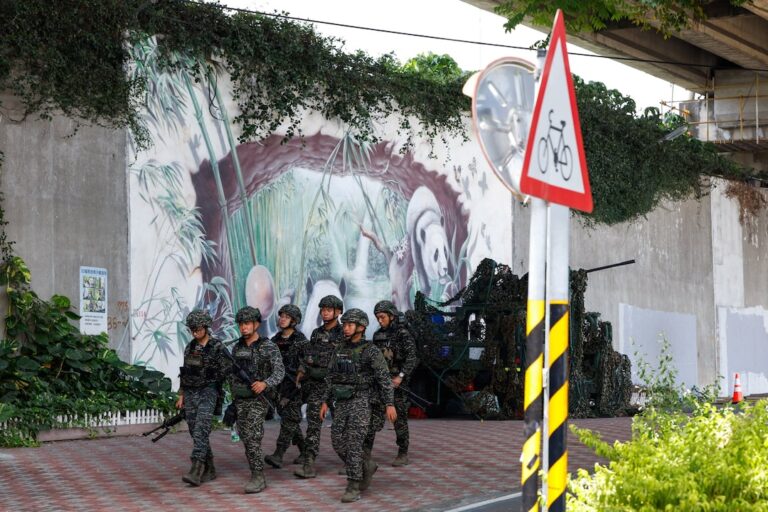
    Taiwan president joins wartime evacuation drill

    Taiwan has intensified its annual military exercises by rehearsing the wartime evacuation of President Lai Ching-te, testing how the government would continue operating if the island came under attack. During the overnight exercise, President Lai, wearing body armour and a helmet, was transported in an armoured personnel carrier to a secure command centre. Senior government officials also participated in the drill, which focused on maintaining leadership, coordinating emergency responses and ensuring the continuity of government during a national crisis. The evacuation formed part of Taiwan’s 10-day Han Kuang military exercises, the country’s largest annual defence drill. The exercises are designed to strengthen military readiness amid growing tensions with China, which claims Taiwan as its territory and has repeatedly vowed to bring the self-governed island under its control, by force if necessary. The wartime evacuation plan has its roots in the Cold War era and was created to protect Taiwan’s leadership in the event of an invasion. Taiwanese authorities have long expressed concern that China could attempt a “decapitation strike” targeting the president and other senior officials during a conflict. As part of this year’s drills, President Lai also observed coast guard vessels being equipped with missile launchers, highlighting efforts to improve Taiwan’s coastal defence capabilities. Military units have deployed advanced air defence systems and other equipment across key locations as they practise responding to realistic combat scenarios. The exercises also include training for counter-blockade operations, coastal defence, protection of strategic infrastructure and broader civilian support during wartime. Next week, authorities will test emergency communication systems by deliberately reducing mobile internet speeds to evaluate how people would communicate if networks became disrupted during a crisis. Meanwhile, Taiwan’s defence ministry reported continued Chinese military activity near the island, saying multiple Chinese aircraft and naval vessels were detected operating around Taiwan during the exercises. Beijing has not officially commented on the ongoing drills but continues to increase military pressure on the island while rejecting President Lai’s calls for dialogue.

  • |

    At least 18 migrants die as thousands cross into Spain’s Ceuta enclave

    At least 18 migrants have died while attempting to reach the Spanish enclave of Ceuta after thousands crossed the border from Morocco in one of the largest migration surges seen in the region in recent years. The humanitarian situation continued to worsen on Friday as migrants kept arriving by sea while clashes broke out between Moroccan security forces and groups gathered near the border. Hundreds of migrants were seen on hills overlooking Ceuta as Moroccan authorities used tear gas to disperse crowds trying to move toward the Spanish territory. Despite the security operation, many people continued to swim across the narrow stretch of water separating Morocco from Ceuta. At the same time, large numbers of migrants who had already entered the enclave chose to return to Morocco on foot. Rachid Sbihi, who heads a local association representing Spain’s Civil Guard officers, described the situation as a serious humanitarian emergency. He said thousands of migrants, including many unaccompanied children, were sleeping in parks, streets and public spaces because reception centres had reached capacity. Emergency teams and military personnel sent to the area have mainly focused on treating the injured and providing humanitarian assistance as authorities struggle to manage the crisis. According to local officials, many of the 18 victims drowned while trying to swim into Ceuta. Others reportedly died during a stampede near the breakwater at Tarajal beach as large crowds rushed toward the border. Rescue teams continued searching the coastline while personal belongings including shoes, clothing and flotation devices were scattered along the shore. Many migrants said they left Morocco in search of better economic opportunities in Europe. One migrant, 33 year old Ahmed Karim, said unemployment and limited prospects at home had driven many people to take the dangerous journey. He explained that many dream of reaching Europe or the United States but see few legal opportunities to do so. Moroccan authorities strengthened security along the border by deploying additional police officers, using water cannons and firing warning shots into the air to stop more crossings. Human rights groups said migrants who were detained near the border were transported further into Morocco, although many others continued arriving in the area hoping to enter Ceuta. Morocco’s ambassador to Spain, Karima Benyaich, expressed hope that those who had crossed into Ceuta would voluntarily return. She said Morocco supports safe and orderly migration but did not comment on what had triggered the sudden movement of thousands of people toward the Spanish territory. Officials in Spain linked the surge to a recent Supreme Court ruling stating that migrants who reach Spain by swimming cannot automatically be returned, unlike those who cross by land or climb the border fence. The Spanish government argued that people smuggling networks had exploited public misunderstanding of the ruling to encourage migrants to attempt the dangerous crossing. Some Moroccan rights activists questioned that explanation, saying many migrants were unlikely to have known about the legal decision. Spanish Prime Minister Pedro Sánchez was expected to visit Ceuta after local authorities requested military assistance. His government’s migration policies have come under criticism from opposition politicians, who argue that recent measures granting residency and work permits to certain undocumented migrants have encouraged more people to head for Spain. The government rejected those claims, insisting the current crisis is unrelated to its immigration reforms. The unrest also spread to Melilla, Spain’s other North African enclave, where groups of migrants attempted to cross the border and clashed with Moroccan police. Rights groups reported injuries among security personnel and dozens of arrests. Spanish officials have not yet confirmed how many migrants entered Ceuta, although media reports estimate that between 30,000 and 49,000 people crossed into the territory within a single day, placing enormous pressure on a city with a population of about 84,000.

  • | | |

    One missed bill enough for Lesco to pull the plug?…

    The month of July brings heat and humidity to Lahore. It also brings frequent power cuts, mainly from weather related issues. When it rains, and the atmosphere is muggy, power breakdown occurs and people expect that power will return soon after it goes. But there is a different kind of fear. This fear grows when a house sits dark while every other house on the street still has light. This means the power meter has been disconnected. Recent reports say that field staff of the Lahore Electric Supply Company (LESCO), have been harassing consumers. These reports say that officials are disconnecting power for people who have missed just one month of bill payment. This goes against the normal rule. Under the normal rule, a meter can only be disconnected after two months of non-payment. LESCO spokesperson Rabia Qadir has denied these reports. She said the company has not received any complaint about this issue. She said that rules made by the National Electric Power Regulatory Authority (Nepra), protect the rights and safety of consumers. Under these rules, a meter cannot be disconnected simply because one month of bill payment was missed. She also said that Lesco has not received any formal complaint against any sub-divisional officer, executive engineer, or lineman of any of its circle regarding such incidents. However, she said that some linemen may try to scare or pressure consumers. These linemen may threaten to disconnect a meter if the consumer does not pay the outstanding bill right away. She said this could happen in some cases and this was not the company’s policy. But she stressed that Lesco has a consumer complaint cell. All complaints are recorded there. She said that according to these records, no such complaint has come in. The situation on the ground appears more complicated. This reporter visited the consumer cell at the office of the Lesco chief officer. Several consumers were present there. Their complaints were about different issues. Some wanted correction of industrial bills. Others reported broken meters. When asked about the reports of meters being cut for a single month of default, one officer gave an important detail. They said this practice usually happens in June or July. They said the ministry gives instructions during these months to speed up bill recovery. The goal is to reduce financial losses. Staff at the office suggested that a proper response should come from Lesco Chief Executive Officer Ramzan Butt or his public relations office. However, the public relations office said that Ramzan Butt was in Islamabad for a meeting at the time. This problem is not limited to LESCO areas. Similar reports have come from areas covered by the Multan Electric Power Company. In Muzaffargarh, consumers who missed one month of payment received strict warnings from field staff. These staff members told consumers to avoid another default. If they defaulted again, they were told, their meters would be disconnected. According to the rules, a power connection cannot be cut through meter removal unless bills for both the current and the previous month remain unpaid. Yet for several months now, Lesco teams have continued cutting connections even when only one month of payment was missing. Other than power severe threats, the other main issue people face is take notice of a major problem in the new electricity bill format. The Pakistan Hosiery Manufacturers and Exporters Association in a letter to the prime minister said the revised bill has removed a lot of information that consumers used to see. He said this makes it hard for people to check their meter readings, units consumed, tariff calculations and other charges on their own. They say the changes seem to have been made without following the proper process set by the National Electric Power Regulatory Authority, known as NEPRA. No formal request for changing the bill format was filed with NEPRA and that consumers were never asked for their objections, nor were they given a chance to take part in a public hearing before the change was made. They say that bills are supposed to show the date when the connection or meter was installed, but this information is now missing. The removal of the meter reading snapshot is a serious problem, because consumers can no longer check if the reading used for their bill matches the actual reading at their home. Also, information about the meter reader, along with the date and time of the reading, has also disappeared. They say that when a meter is changed, the bill should show a snapshot of the final reading from the old meter, but distribution companies are not properly doing this. The new bills carry a QR code instead, but this cannot replace information that should be clearly printed on the bill itself. Many senior citizens, people living in rural areas, and low income households may not have smartphones or the internet access needed to scan a QR code. Economist and corporate lawyer Dr Ikramul Haq commented on this situation. He said that the conduct of power distribution companies is not simply a small technical mistake. He called it as a form of pressure against ordinary citizens. These citizens are already struggling with rising prices, high electricity rates, and falling purchasing power. He said that reports of field teams arriving at homes, treating consumers badly, and threatening immediate disconnection show the real human cost of this careless approach. He added that in some cases, meters were removed without any prior notice being given. Dr said explained that the legal position on this matter is very clear. Under the revised Consumer Service Manual issued by Nepra, electricity cannot be disconnected only because the bill for the current or previous month remains unpaid. A notice of seven days must be given along with the bill for the second month of default. Only after this notice period passes, and the default continues, can disconnection take place. He said that removing a meter involves even more safeguards under the rules. He

Leave a Reply

Your email address will not be published. Required fields are marked *