taiwan president joins
|

Taiwan president joins wartime evacuation drill

Taiwan has intensified its annual military exercises by rehearsing the wartime evacuation of President Lai Ching-te, testing how the government would continue operating if the island came under attack.

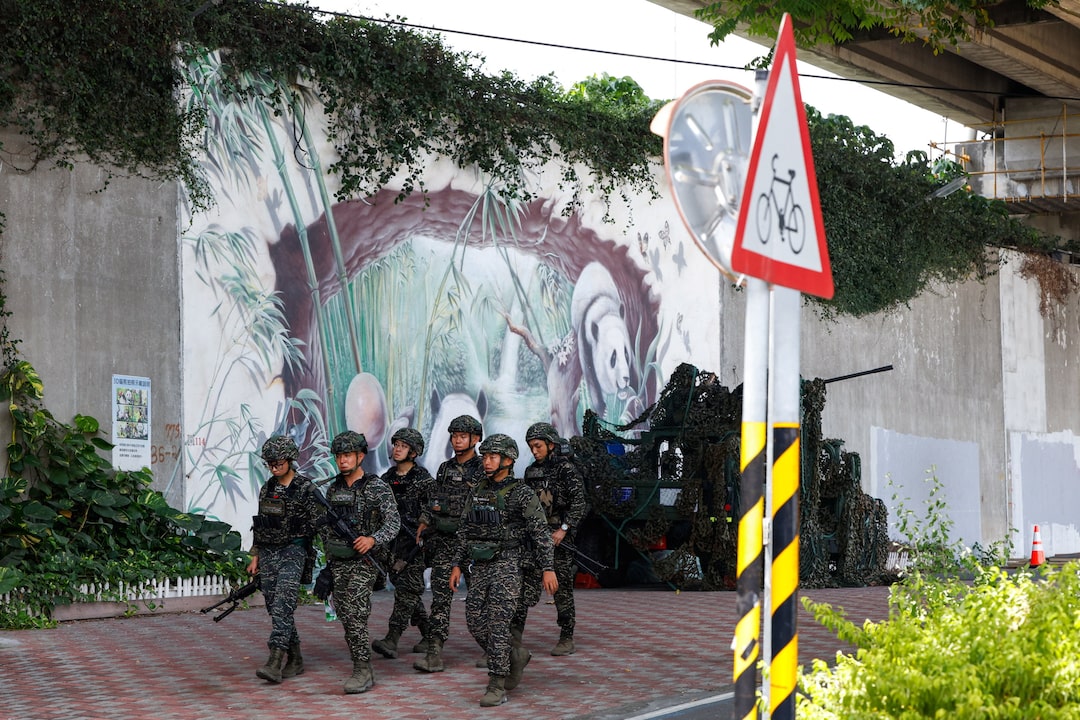
During the overnight exercise, President Lai, wearing body armour and a helmet, was transported in an armoured personnel carrier to a secure command centre. Senior government officials also participated in the drill, which focused on maintaining leadership, coordinating emergency responses and ensuring the continuity of government during a national crisis.

The evacuation formed part of Taiwan’s 10-day Han Kuang military exercises, the country’s largest annual defence drill. The exercises are designed to strengthen military readiness amid growing tensions with China, which claims Taiwan as its territory and has repeatedly vowed to bring the self-governed island under its control, by force if necessary.

The wartime evacuation plan has its roots in the Cold War era and was created to protect Taiwan’s leadership in the event of an invasion. Taiwanese authorities have long expressed concern that China could attempt a “decapitation strike” targeting the president and other senior officials during a conflict.

As part of this year’s drills, President Lai also observed coast guard vessels being equipped with missile launchers, highlighting efforts to improve Taiwan’s coastal defence capabilities. Military units have deployed advanced air defence systems and other equipment across key locations as they practise responding to realistic combat scenarios.

The exercises also include training for counter-blockade operations, coastal defence, protection of strategic infrastructure and broader civilian support during wartime. Next week, authorities will test emergency communication systems by deliberately reducing mobile internet speeds to evaluate how people would communicate if networks became disrupted during a crisis.

Meanwhile, Taiwan’s defence ministry reported continued Chinese military activity near the island, saying multiple Chinese aircraft and naval vessels were detected operating around Taiwan during the exercises. Beijing has not officially commented on the ongoing drills but continues to increase military pressure on the island while rejecting President Lai’s calls for dialogue.
Similar Posts

  • | |

    PTI vows no compromise over Imran Khan’s health …

    PESHAWAR: Khyber-Pakhtunkhwa Information Minister Shafi Jan has strongly criticised restrictions on meetings with former prime minister and PTI founder Imran Khan, saying the party will continue its legal, constitutional and political efforts to protect his health and fundamental rights. Speaking on Tuesday, Jan said the presence of a large number of PTI parliamentarians outside the Supreme Court reflected the party’s determination to ensure that Imran Khan receives proper medical care and access to his family and doctors. He described reports about the former prime minister’s health as deeply concerning and said denying him his constitutional and legal rights was unacceptable. Jan alleged that Imran Khan had been kept in detention through what the PTI considers politically motivated cases. The minister said PTI would not remain silent and would continue pressing for appropriate medical treatment, access to personal physicians and meetings with family members. He particularly criticised the reported denial of permission for Imran Khan’s sisters to meet him, calling the restrictions a violation of constitutional and legal rights as well as court directives. Jan said KP Chief Minister Sohail Afridi had already warned that PTI lawmakers would gather outside Adiala Jail on Thursday if Imran Khan’s sisters were again prevented from meeting him. Meanwhile, speaking to a private television channel on Monday, Afridi said the party had been left with little choice but to protest after its concerns were allegedly ignored by authorities. He rejected accusations that PTI was deliberately promoting unrest, arguing that protests would not have been necessary if the party’s grievances had been addressed. Afridi claimed that Imran Khan was being held unlawfully and was being denied access to his family, lawyers and personal doctors. He said PTI had exhausted available constitutional and legal avenues and would therefore continue with peaceful demonstrations. The chief minister maintained that peaceful protest was a constitutional right and urged authorities to listen to the party’s concerns.

  • |

    Aubrey Plaza and Christopher Abbott welcome baby girl together

    Aubrey Plaza and Christopher Abbott have entered an exciting new chapter as parents, welcoming their first child together. The couple has reportedly welcomed a baby girl, marking a major milestone in their relationship. The happy news came to light after Plaza was spotted in New York City on Sunday, August 9, carrying her newborn in a baby sling. The actress was seen in a relaxed casual look as she stepped out wearing a black tank top, jeans and her hair pulled into a high ponytail. She appeared to be carrying the newborn after attending Christopher Abbott’s final performance in the Broadway production Death of a Salesman. According to reports, Plaza gave birth to the couple’s daughter during the final week of July 2026. The arrival comes just months after the couple publicly confirmed that they were expecting their first child. Plaza’s pregnancy was officially revealed in April, when her representative confirmed the news. At the time, an insider described the pregnancy as a “beautiful surprise” following an emotional year for the actress and said that Plaza and Abbott felt extremely blessed about starting a family together. The couple later made their red carpet debut as an expecting pair at the 2026 Tony Awards on June 7. The event, held at Radio City Music Hall in New York City, gave fans their first major public glimpse of Plaza’s growing baby bump. Although Plaza and Abbott have kept much of their relationship away from the spotlight, their romance reportedly began after years of professional connections. The two previously worked together on the 2020 film Black Bear and later reunited for the 2023 Broadway revival of Danny and the Deep Blue Sea. Their relationship reportedly became public in 2025, with the pair gradually stepping out together before announcing their pregnancy the following year. For Plaza, the birth of her daughter represents an important new beginning after a difficult period in her personal life. Before her relationship with Abbott, the Parks and Recreation star was married to filmmaker Jeff Baena. The former couple separated in 2024 after several years together. Baena died in 2025. Since then, Plaza has largely maintained a private approach to her personal life while continuing to focus on her acting career. Abbott, meanwhile, has remained busy with his professional commitments, including his Broadway role in Death of a Salesman. His final performance in the production appears to have coincided with a particularly memorable moment for the couple, as Plaza was photographed carrying their newborn shortly afterward. The arrival of their baby girl adds another special milestone to Plaza and Abbott’s evolving relationship. While neither star has publicly shared extensive details about their daughter, fans are celebrating the couple’s reported new journey into parenthood.

  • |

    Google DeepMind exec admits AI extinction risk is “not zero

    Lila Ibrahim, Google DeepMind’s Chief AI Readiness Officer, will not put a number on the odds of AI wiping out humanity. She is not dismissing the possibility either. Speaking to Fortune, she said the risk is “not zero,” admitting that anything more specific would just be guesswork on her part. Ibrahim was among those who signed the Center for AI Safety’s 2023 statement, alongside co-founders of Anthropic and OpenAI. That statement argued AI extinction risk deserves the same global priority as nuclear war and pandemics. Three years on, she still believes staying silent on existential risk would be irresponsible. She feels this way especially now, given how far the technology has advanced since then. Some of her peers sound even more alarmed. Geoffrey Hinton, often called the “godfather of AI,” estimates a 10% to 20% chance of extinction within the next three decades. Anthropic’s Dario Amodei has gone further, putting the odds of things going “really, really badly” at around 25%. These warnings are not new either. Physicist Stephen Hawking, who used AI tools himself, raised similar concerns long before ChatGPT even existed. Ibrahim compares the situation to the pandemic, pointing out that the worst risks rarely arrive the way people expect. She noted that entire industries failed to properly weigh risk during earlier tech shifts, including the rise of the internet and social media. She is just as sceptical of the optimistic predictions floating around. Elon Musk recently told The Economist that money will stop mattering by 2036, imagining a future of cheap abundance and universal high income once robots take over most jobs. Jeff Bezos has predicted millions of people living in space by 2045. Sam Altman, meanwhile, envisions new job opportunities specifically for graduates working in space. Ibrahim isn’t convinced by either scenario, arguing that AI simply is not developing fast enough to make these predictions realistic anytime soon. Rather than debating far-off futures, Ibrahim says she is more focused on using AI to tackle problems happening right now. She pointed to climate change and industrial pollution as areas where the technology could make a real difference. She was also clear that AI’s benefits should not be limited to a handful of powerful companies. For her, that is just as important as managing the risks.

  • | |

    Bessent says Hormuz shipping deal with Iran could …

    US Treasury Secretary Scott Bessent said on Tuesday that a deal to reopen the Strait of Hormuz to normal shipping traffic could be reached within a day or two, as diplomatic activity intensified across the Gulf region. Speaking in a television interview, Bessent said American officials are in active discussions with Iranian counterparts and expressed optimism about a near term breakthrough. “There is a chance we may have a deal today or tomorrow,” he said, adding that the goal is to move toward a more normalized posture in the conflict. Asked whether any agreement would let Iran charge ships a toll for using the waterway, Bessent said he expects the outcome to guarantee freedom of movement rather than a fee based system. He noted that vessel traffic through the strait has picked up in recent days despite lingering danger, and predicted that energy prices would ease once a deal takes hold. His comments followed a report from The New York Times saying Iran and Oman have moved close to an arrangement that would restore commercial shipping through the strait. Under the terms described in that report, inbound vessels would travel through a corridor close to the Iranian coast while outbound ships would use a route nearer Oman. Iranian officials told the newspaper that no formal tolls would apply, though they said a service charge tied to environmental protection, cargo security and staffing costs would be split evenly between Tehran and Muscat. A US official pushed back on that characterization, calling the Iranian version inaccurate and insisting any temporary shipping lanes would not need Iranian sign off or involve fees. The report also noted that some Pentagon officials worry the arrangement could look like a concession to Tehran, while some Iranian officials privately questioned whether it would actually stop further American strikes. Qatar’s Foreign Ministry said Tuesday that mediators including Doha, Pakistan and Oman continue to coordinate closely to bridge the gap between Washington and Tehran, exchanging draft proposals between the two sides. Ministry spokesperson Majed Al Ansari said there is still no clear timeline for a final agreement, and Qatar separately called for a return to normal conditions in the strait while diplomacy continues. Tension over the waterway remained visible even as talks progressed. A dry bulk carrier called the Minoan Pioneer, sailing under the Liberian flag, was struck by an unidentified projectile near Oman’s coast on Tuesday, according to maritime security sources. The strike reportedly hit the engine room and sparked a fire in the crew’s living quarters, forcing the entire crew to abandon ship. One crew member, the vessel’s third engineer, was reported missing. The ship’s Greece based operator did not immediately respond to requests for comment. The incident followed an earlier report from the UK Maritime Trade Operations center, which said a separate cargo vessel had broadcast that it was hit by an unknown projectile about 20 nautical miles northeast of Khasab, Oman. No group has claimed responsibility for either strike, and authorities have opened an investigation. In Tehran, President Masoud Pezeshkian used a televised address to reject reports that he had offered his resignation amid the ongoing standoff with Washington. “If I were going to resign, I would announce it publicly,” he said, denying any rift with Supreme Leader Ali Khamenei or the armed forces and insisting the leadership is working in full coordination. He separately said Iran intends to defend its territorial integrity but has no interest in expanding the conflict, while claiming Iranian missile and drone strikes had disrupted US military goals during a recent 17 day period of fighting. The regional picture grew more complicated elsewhere. Yemen’s Houthi movement claimed responsibility for a drone strike on Najran Airport in southern Saudi Arabia, with military spokesman Yahya Saree saying the attack struck its target accurately. He described the strike as retaliation for alleged Saudi drone incursions over Yemen’s Saada and Hajjah provinces and warned that further violations would draw a response. Saudi authorities had not commented on the claim as of Tuesday. In Lebanon, a seventh round of direct negotiations with Israel opened in Rome under American sponsorship, continuing talks tied to a framework agreement the two sides signed in June covering a phased Israeli withdrawal from Lebanese territory in exchange for Lebanese army deployment and the disarming of armed factions, a clear reference to Hezbollah. Hezbollah Secretary General Naim Qassem used a speech at an Arbaeen commemoration in Baalbek to criticize the talks, saying they have delivered only “shame, humiliation, despair and repeated concessions” for Lebanon. He accused Lebanese President Joseph Aoun of acting with bias rather than serving as a unifying figure and argued that only the earlier US brokered truce between Washington and Tehran had kept Israeli strikes at bay. Financial markets showed relief at the signs of diplomatic movement. Brent crude futures fell about 7 percent to near $83.77 a barrel on Monday, while the Dow Jones Industrial Average closed at a record high. Asian stocks and oil prices ticked higher again on Tuesday. In a Truth Social post, Trump described Iran’s leadership as “unbelievably duplicitous” while claiming more talks were scheduled for the near future. He also reasserted that the US Navy maintains full control over the strait, writing that nothing passes through unless Washington allows it. The exchange fits a broader pattern that has defined the conflict since it began roughly five months ago under the codename Operation Epic Fury. Trump has repeatedly threatened major military escalation only to step back and cite diplomatic openings, while Iran has publicly refused direct talks with Washington since a memorandum of understanding both sides signed collapsed in early July. Washington maintains that June’s memorandum obligated Iran to open the Strait of Hormuz to shipping, while Tehran insists the agreement preserved its authority over traffic through the waterway, a disagreement that continues to sit at the center of the standoff.

  • | |

    Achakzai urges PM to appoint new chief election co…

      ISLAMABAD: National Assembly Opposition Leader Mahmood Khan Achakzai has urged Prime Minister Shehbaz Sharif to initiate the process of appointing a new Chief Election Commissioner (CEC) and fill the vacant positions of two Election Commission of Pakistan (ECP) members from Sindh and Balochistan. Achakzai made the request in a letter addressed to Prime Minister Shehbaz Sharif on August 10. The opposition leader, who also heads the Tehreek Tahafuz Ayeen-i-Pakistan (TTAP) and serves as chairman of the Pakhtunkhwa Milli Awami Party, asked the premier to give immediate attention to what he described as an important constitutional responsibility concerning the composition of the country’s electoral watchdog. According to Achakzai, the official terms of the Chief Election Commissioner and the ECP members representing Sindh and Balochistan expired on January 26, 2025. He stressed that the vacant positions should be filled without further delay to ensure the commission continues to function effectively. The opposition leader argued that the timely appointment of officials to these constitutional positions was essential for maintaining the ECP’s operational continuity, institutional independence and credibility. In his communication, Achakzai referred to relevant provisions of the Constitution that outline the procedure for appointing the Chief Election Commissioner and members of the Election Commission. He cited Article 213(2A) under which the prime minister is required to consult the leader of the opposition in the National Assembly before forwarding three candidates for the post of CEC to a parliamentary committee. The committee then considers the proposed names before making the appointment through the constitutional process. Achakzai also referred to Article 218(2)(b), arguing that the appointment of ECP members from the provinces is subject to the same constitutional principle of consultation between the prime minister and the opposition leader. The opposition leader consequently called on Prime Minister Shehbaz to hold a formal meeting with him so that both sides could consult and agree on suitable candidates for the vacant constitutional positions. The demand comes against the backdrop of a prolonged delay in completing the composition of the electoral body. It is worth recalling that Prime Minister Shehbaz Sharif had previously invited former National Assembly Opposition Leader Omar Ayub for consultations regarding the appointment of a new Chief Election Commissioner. The invitation was extended in June last year as part of the constitutional process for filling the position. However, the parliamentary situation subsequently changed after the National Assembly removed Omar Ayub and several other Pakistan Tehreek-e-Insaf (PTI)-backed leaders from important parliamentary positions. The move followed their disqualification by the Election Commission of Pakistan in connection with the May 9 cases in August last year. As a result, the consultation process concerning appointments to key positions within the ECP remained stalled. Achakzai’s latest letter has brought renewed attention to the issue, with the opposition leader emphasising that the vacant positions should be filled through the constitutional procedure and without further delay. The appointment of a CEC and provincial ECP members is considered crucial for ensuring the electoral watchdog remains fully functional and retains public confidence. Achakzai has therefore sought an immediate consultation process with the prime minister to resolve the matter and complete the appointments in accordance with the Constitution.

  • | |

    Lahore declares August 4 public holiday

    The Lahore district administration has declared Tuesday, August 4, as a public holiday across the district to facilitate devotees attending the annual Urs celebrations of the revered Sufi saint Hazrat Data Ganj Bakhsh. According to an official notification, the holiday will remain effective only within the limits of Lahore district, allowing worshippers to participate in the religious events without disruption. The 983rd annual Urs officially commenced with a traditional chadar-laying ceremony and the inauguration of a milk sabeel at the shrine. The opening ceremony was attended by Deputy Prime Minister Senator Ishaq Dar, who paid tribute to the great Sufi saint and highlighted his enduring message of peace, tolerance, and unity. The Urs is observed over three days and attracts thousands of devotees from across Pakistan. Religious scholars, spiritual leaders, and followers gather at the shrine to offer prayers, recite the Holy Quran, and take part in various religious and spiritual activities held throughout the celebrations. Hazrat Data Ganj Bakhsh, also known as Hazrat Ali Hajveri, was an 11th-century Persian Sufi scholar born in Ghazni. He later settled in Lahore, where he dedicated his life to spreading the teachings of Islam, compassion, and brotherhood through Sufism. His shrine has since become one of the most significant spiritual landmarks in the region. Data Darbar is widely regarded as South Asia’s largest Sufi shrine and receives millions of visitors every year.

Leave a Reply

Your email address will not be published. Required fields are marked *