trump8217s board peace
|

Trump’s Board of Peace plan draws global attention and criticism

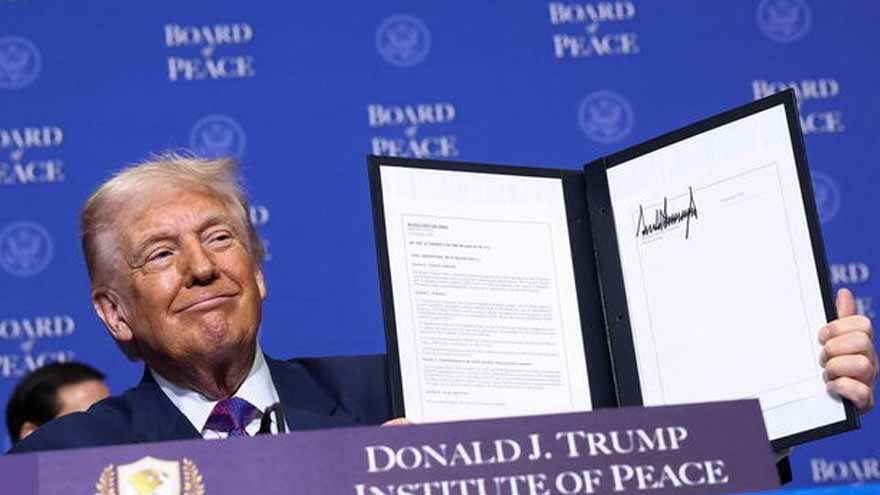
United States President Donald Trump has announced that his Board of Peace has secured an agreement aimed at the complete disarmament of Hamas and other armed groups in Gaza, along with the gradual withdrawal of Israeli forces from the territory. Trump described the agreement as a historic breakthrough and said it would be carried out in stages, with Israeli troops leaving Gaza as disarmament progresses.

The Board of Peace was first proposed by Trump in September last year as part of his plan to end the war in Gaza. He later expanded the initiative, saying it would also work to address conflicts in other parts of the world. The board is intended to coordinate peace efforts and oversee reconstruction projects, a role that has traditionally been led by the United Nations.

According to its charter, countries joining the board normally serve three year terms. However, nations that contribute one billion dollars toward its activities are eligible for permanent membership. Trump serves as chairman of the initiative and has broad executive authority, including the power to veto decisions and remove members under certain conditions.

The White House named Secretary of State Marco Rubio, special envoy Steve Witkoff, former British Prime Minister Tony Blair and presidential adviser Jared Kushner as members of the board’s founding executive team.

More than two dozen countries have joined the initiative. Alongside the United States, members include Israel, Saudi Arabia, Egypt and Qatar, all of which have played important roles in recent Middle East diplomacy. Other participating countries include Bahrain, Jordan, Kuwait, Morocco, Turkey and the United Arab Emirates. Outside the region, Albania, Argentina, Armenia, Azerbaijan, Belarus, Bulgaria, Cambodia, El Salvador, Hungary, Indonesia, Kazakhstan, Kosovo, Mongolia, Pakistan, Paraguay, Uzbekistan and Vietnam have also joined.

Several major countries and international partners have declined to participate. Britain, France, Germany, Norway, Sweden and the European Union have all decided not to join the initiative. Brazil, Mexico, India and South Africa have also remained outside the board, while China and Russia have chosen not to participate. The Vatican has argued that responsibility for handling international conflicts should remain with the United Nations. Canada also lost its invitation after a diplomatic disagreement between Trump and Prime Minister Mark Carney earlier this year.

The Board of Peace received international recognition after the United Nations Security Council approved a United States drafted resolution acknowledging its temporary role in Gaza. Under the resolution, the board will coordinate funding for reconstruction and oversee a temporary international stabilisation force in Gaza through 2027. It must also report its progress to the Security Council every six months. China and Russia abstained from the vote, saying the resolution did not clearly define the United Nations’ role in Gaza’s future administration.

Despite official backing, the initiative has attracted widespread criticism from human rights organisations and political observers. Critics argue that the board resembles a colonial style governing structure because it is designed to supervise Gaza without including Palestinian representatives. They have also questioned the inclusion of Tony Blair because of his role in the Iraq war and criticised the participation of countries with poor human rights records.

The decision to include Israel on a body responsible for overseeing Gaza has generated additional controversy. Opponents argue that Israel’s ongoing military campaign has left much of Gaza destroyed and displaced its population. Israel maintains that its military actions were carried out in self defence following the Hamas attack in 2023 that killed around 1,200 people and resulted in more than 250 hostages being taken.

Since its launch, the Board of Peace has focused mainly on plans for rebuilding Gaza. Trump said member countries have already pledged around seven billion dollars toward reconstruction, although experts estimate that restoring the territory after more than two years of conflict could cost as much as 70 billion dollars. The board has also reportedly held discussions with international companies on future infrastructure and supply chain projects as planning for Gaza’s recovery continues.

Similar Posts

  • | | |

    Army captain martyred, seven militants killed in H…

    Army captain martyred, seven militants killed in Hangu operation A Pakistan Army captain was martyred during an intelligence-based operation in Hangu district of Khyber Pakhtunkhwa, while security forces killed seven militants, according to the military’s media wing. The operation was carried out on August 7 after security agencies received information about the presence of militants in the area. Security forces launched the raid after confirming the reported militant presence. Troops engaged the militants at their hideout. Seven militants were killed during the exchange of fire. Captain Hamza Akram, 27, was also martyred during the operation. He belonged to Narowal district. According to the Inter-Services Public Relations (ISPR), Captain Hamza was leading his troops from the front. He continued pursuing the militants during the firefight and lost his life while performing his duty. Security forces recovered weapons and ammunition from the militants’ possession. The military said the killed militants were involved in attacks against security personnel and law enforcement agencies. They were also linked to attacks targeting civilians. A clearance operation was launched after the main engagement. Security personnel searched the surrounding area to ensure that no militants remained there. Three militants killed in Mastung operation In a separate operation in Balochistan, security forces killed three militants in Mastung district. The operation was conducted in the Kambela and Asimabad areas as part of Operation Rad-ul-Fitna-3. Security forces carried out an extensive search and clearance operation across an area of around 68 square kilometres. Three militants were killed during the operation. The bodies of two of the militants were recovered. Four other militants were injured, including a key commander identified as Shaukat Mama, according to security sources. Security personnel also detained 12 suspects for questioning during the operation. Militant hideouts were dismantled during the clearance activity. Security forces also removed flags associated with the militant group from the cleared areas. The latest operations come amid continued security challenges in Khyber Pakhtunkhwa and Balochistan. Both provinces have witnessed a significant number of militant attacks in recent years. Security forces have intensified intelligence-based operations to target militant networks, their hideouts and support structures.

  • | |

    PIMS denies CT Scan failure after Imran Khan’s h…

    ISLAMABAD: The Pakistan Institute of Medical Sciences (PIMS) has rejected reports that its CT scanning facility was unavailable after former prime minister and PTI founder Imran Khan was unable to undergo a recommended heart scan during his recent visit to the hospital. In a statement issued on Tuesday, the hospital administration said the CT machine installed in 2022 “remains functional” and continues to provide diagnostic services. Imran, who is currently incarcerated at Adiala Jail, was taken to Pims last week for an eye-related procedure and other medical examinations. Doctors had reportedly recommended a CT coronary angiography (CTA), a diagnostic test used to examine the coronary arteries and identify possible blockages. However, the test was not performed before he was returned to jail. The development prompted Prime Minister Shehbaz Sharif to order an inquiry into reports that the required facility at Pims was not operational. An inquiry committee was subsequently constituted to establish the facts surrounding the missed examination. Pims clarified that medical imaging procedures are carried out according to clinical assessments, specialist recommendations, patient-safety requirements and established medical protocols. The administration also cautioned against interpreting the use or non-use of a particular imaging procedure outside its medical context. A senior Pims doctor, speaking on condition of anonymity, said approximately a dozen CT coronary angiographies had been performed at the hospital before the latest statement was issued. The controversy has also intensified demands from PTI leaders for Imran to be transferred to Shifa International Hospital in Islamabad. The Supreme Court had directed on August 18 that he be shifted to the facility. PTI Information Secretary Sheikh Waqas Akram has questioned why the recommended examination was not carried out. He said a government-appointed medical board examined Imran on August 10, while a Pims cardiologist had recommended the cardiac scan earlier due to reported fluctuations in blood pressure, palpitations, headaches and restlessness, along with concerns related to his age and prolonged incarceration. Akram alleged that the test was considered medically necessary but was not conducted when Imran was brought to Pims. He further claimed that hospital officials cited the unavailability of the facility despite the presence of a functioning CT scanner. The conflicting accounts have placed renewed attention on Imran’s medical care and the circumstances surrounding the recommended cardiac examination, with the government-ordered inquiry expected to clarify whether the test was withheld for medical reasons or because of an operational issue.

  • |

    New Delhi distances itself from scheduled online talk by ousted Bangladeshi leader Sheikh Hasina

    The Ministry of External Affairs in New Delhi has formally clarified that the Indian government maintains no connection to or responsibility for an upcoming online address by former Bangladeshi Prime Minister Sheikh Hasina. Officials confirmed that the press gathering is an entirely independent initiative arranged by a private press entity. The official statement came following direct enquiries from diplomatic authorities in Dhaka seeking clarity regarding New Delhi’s position. Sheikh Hasina, the ousted head of the Bangladesh Awami League, is scheduled to deliver a remote address on 5 August during an international media event hosted by the Foreign Correspondents’ Club of South Asia in New Delhi. The date coincides with the second anniversary of the mass student-led demonstrations that brought an end to her administration in 2024. Addressing the matter during a press briefing, an official spokesperson for the Indian foreign ministry emphasized that the gathering is strictly a private affair organised by the media body, adding that the state framework remains wholly unassociated with its coordination or proceedings.

  • Sarah Ferguson, the former Duchess of York, is said to be pushing back against feelings of isolation from the royal family. Insiders  claim that she is now seeking a direct audience with King Charles and Queen Camilla. The details were shared with Heat World by a source close to the situation. According to the confidant, Ferguson has no intention of quietly fading from public life. She is reportedly determined to make her case directly to the King and Queen, hoping to secure some form of leniency regarding her standing within the family. The source quoted Ferguson as saying she refuses to be discarded simply because it would make things easier for Charles and Camilla. She reportedly believes she deserves far better treatment than that, and is prepared to keep pressing until she gets it. Despite her resolve, the insider noted that Ferguson is not approaching this without apprehension. Returning to England reportedly fills her with nerves, but that anxiety is not enough to make her back down from pursuing the meeting. What seems to be driving her most, according to the source, is the pain of feeling disconnected from her daughters and grandchildren. That separation is reportedly the hardest part of her current situation, more so than any concerns about her public image. The renewed push comes after months of Ferguson keeping an unusually low profile, a shift that followed fresh revelations in January regarding her past association with Jeffrey Epstein. It is worth noting that being named in related documents does not, on its own, suggest any wrongdoing on her part. Ferguson has largely stayed out of the public eye since then. Reports from The Sun suggest she’s been staying with her former partner, Formula 1 businessman Paddy McNally, at his Swiss chalet in Verbier, a property reportedly worth around £15 million known as “Les Gais Lutins.” Her stay there followed her reported eviction from Royal Lodge, the residence she once shared with Prince Andrew. The situation marks a notable shift for Ferguson, who has spent recent months largely removed from royal circles and public appearances. Whether her reported appeal to Charles and Camilla will result in an actual meeting remains unclear, but insiders suggest she has no plans to retreat quietly, even as she navigates both personal anxiety and the complicated dynamics of her relationship with the royal family.

  • | | |

    ISPR calls India’s ‘Operation Sindoor&…

    Pakistan has strongly rejected what it described as India’s attempt to reshape the history of the 2025 military confrontation through a recently produced documentary on “Operation Sindoor,” calling the production a highly dramatized and factually distorted portrayal of events. In a statement, Pakistan said the documentary relied on selectively edited interviews, emotional narration and cinematic reconstructions to present a version of the conflict designed primarily for domestic political consumption. It argued that the production failed to provide an objective account of the military engagements and instead sought to portray a disputed outcome as an unequivocal Indian victory. Pakistan also questioned the documentary’s chronology surrounding the Pahalgam incident of April 22, 2025. It said India had subsequently claimed that the alleged perpetrators of the incident were identified and eliminated on July 28, nearly three months after Operation Sindoor. Islamabad argued that this timeline raised questions about India’s assertion that the May 7 operation was specifically intended to punish those responsible for the Pahalgam attack. The statement further rejected India’s claim of “100 percent mission success,” maintaining that Pakistani forces had effectively responded to the Indian offensive during what Pakistan refers to as Marka-e-Haq. Islamabad claimed that eight Indian military aircraft were shot down during the confrontation and said Pakistan later launched Operation Bunyanum Marsoos, targeting military installations with precision-guided rockets and missiles, precision air-launched munitions, loitering munitions and artillery. Pakistan said the documentary itself contained admissions that undermined its portrayal of decisive Indian dominance. According to Islamabad, references by Indian military officials to Pakistani missile and drone activity, prolonged engagements along the Line of Control and the activation of Indian air-defence systems demonstrated that the confrontation involved significant military exchanges on both sides. The Pakistani statement also challenged New Delhi’s account of how hostilities ended. It noted that the documentary acknowledged communication between the two countries’ Directors General of Military Operations and an agreed cessation of military activity. Islamabad said this account was inconsistent with portraying the conclusion of the conflict as an unconditional Indian military victory, particularly given the role of international diplomatic engagement in facilitating the ceasefire. Pakistan further accused the documentary of presenting contradictory explanations for India’s approach to escalation. While the production reportedly emphasised surprise attacks, precision strikes and escalation dominance, it simultaneously portrayed India as deliberately restricting the scope of the conflict and offering Pakistan an opportunity to withdraw. Islamabad described the documentary as an attempt to create a politically convenient narrative rather than an impartial military assessment. It maintained that cinematic reconstructions and official claims could not alter the chronology of events, the military engagements or the losses suffered during the confrontation. Pakistan said it had no need to construct an alternative narrative around Marka-e-Haq, arguing that battlefield developments, diplomatic interactions and subsequent statements by Indian officials provided sufficient material for assessing the conflict. Reaffirming its stated commitment to regional peace and stability, Pakistan said its armed forces remained prepared to protect the country’s sovereignty and territorial integrity. It warned that any future military escalation would receive a strong response, while asserting that no subsequent narrative or media production could change the actual course of events on the battlefield.

  • | |

    Overseas Pakistanis welcome proposal for creation …

      Overseas Pakistanis have welcomed the proposal to create new provinces in the country, describing it as a positive step toward improving administrative efficiency, strengthening governance and bringing public institutions closer to citizens. Rajah Nasir Hussain, a representative of overseas Pakistanis and a prominent businessman from Gujar Khan, expressed his support for the proposal . He said the idea of creating seven provinces should be considered alongside the establishment of an eighth province comprising Islamabad and the Potohar region. According to Hussain, the creation of new provinces could help address administrative challenges and improve the delivery of public services. He stressed, however, that any decision regarding the creation of new provinces should be made through constitutional amendments and broad political consensus. He said the issue should not be treated as a matter of political rivalry or regional competition. Instead, it should be viewed as an administrative reform aimed at improving governance and ensuring that citizens in different parts of the country receive better access to state institutions and public services. Hussain also highlighted the important role played by overseas Pakistanis in the national economy. He said millions of Pakistanis living and working abroad contribute significantly to the country through remittances. The funds sent by overseas Pakistanis provide vital support to Pakistan’s economy and help strengthen the country’s financial system. He noted that overseas Pakistanis continue to make economic contributions despite living outside the country. Their remittances support families, increase foreign exchange inflows and contribute to economic stability. In his view, their role should therefore be recognised not only in economic terms but also through greater representation in the country’s administrative and political framework. Hussain argued that the government and political leadership should explore new mechanisms through which overseas Pakistanis can participate more effectively in national affairs. He said their experience of living and working in different countries gives them exposure to modern administrative systems, business practices and governance models that could potentially benefit Pakistan. He further suggested that overseas Pakistanis should have greater opportunities to contribute to policy discussions concerning economic development, investment, governance and administrative reforms. Their participation, he said, could help policymakers understand international practices and identify approaches that may be adapted to Pakistan’s circumstances. Regarding the proposed new provinces, Hussain emphasised the importance of consultation among all stakeholders. He said political parties, provincial governments, civil society, constitutional experts and representatives of the affected regions should be involved in the discussion before any final decision is taken. He maintained that the creation of provinces should be based on administrative requirements, population, geographical considerations, economic viability and the interests of local communities rather than short-term political objectives. The proposal to consider Islamabad and Potohar as an eighth province, he said, should also be examined within this broader framework. Such a move, if supported by constitutional and political consensus, could potentially improve administrative management and representation in the region. Hussain reiterated that overseas Pakistanis support reforms aimed at strengthening the country’s administrative structure. He said the debate over new provinces provides an opportunity to consider broader governance reforms while ensuring constitutional procedures and national consensus. He concluded that overseas Pakistanis should be regarded as important stakeholders in Pakistan’s future. Given their economic contributions and national role, developing effective mechanisms for their political and administrative representation should be considered a priority alongside wider institutional reforms.

Leave a Reply

Your email address will not be published. Required fields are marked *