did bts reject
| |

Why did BTS reject Grammy race this year?

South Korean global music sensation BTS has decided not to submit its music for consideration at the 69th Grammy Awards in 2027, raising fresh debate over the Recording Academy’s newly introduced Best Asian Pop Music Performance category.

The seven-member group announced the decision through individual posts on Instagram, saying it wanted music to be appreciated for its artistic value rather than being separated by region or language.

“We hope music can be heard and loved for what it is, rather than being divided by region or language,” the group said while confirming it would not participate in the upcoming Grammy submission process.

This marks the first time BTS has stepped away from the Grammy competition, despite being one of the most influential global acts and a major force behind the worldwide rise of K-pop.

The controversy began after the Recording Academy introduced the Best Asian Pop Music Performance category, which will debut at the 69th Grammy Awards scheduled for February 2027. The category aims to recognise outstanding pop performances from Asian markets, including K-pop, J-pop and C-pop, featuring Asian languages.

However, BTS’ decision highlighted concerns among some artists and fans that creating region-based categories could create divisions within global music rather than promoting equal recognition.

Responding to the group’s announcement, Recording Academy CEO Harvey Mason Jr. said he was disappointed but respected BTS’ choice.

Mason explained that the new category was created to celebrate the diversity, growth and creativity of Asian artists, not to separate them from other musicians.

He said the purpose of the award was to provide more opportunities for artists to receive recognition from Grammy voters and emphasized that artists nominated in genre categories could still compete for major awards, including Record of the Year, Album of the Year and Song of the Year.

“The category was created to shine a spotlight on important artists and expand recognition,” Mason said, adding that genre categories and major Grammy fields remain open to all eligible musicians.

BTS’ decision comes after a major comeback year for the group. The band released its album “ARIRANG” in March 2026 after completing mandatory military service commitments. The album achieved major international success, spending two weeks at the top of the Billboard 200 chart and setting a new milestone for a K-pop act.

Over the past decade, BTS has become one of the biggest names in global entertainment, breaking language barriers and helping Korean music gain mainstream acceptance worldwide.

The group, consisting of RM, Jin, Suga, J-Hope, Jimin, V and Jungkook, has previously received multiple Grammy nominations and has repeatedly pushed for greater recognition of K-pop within the academy’s major award categories.
Similar Posts

  • |

    India’s top court orders release of minors amid exam protests

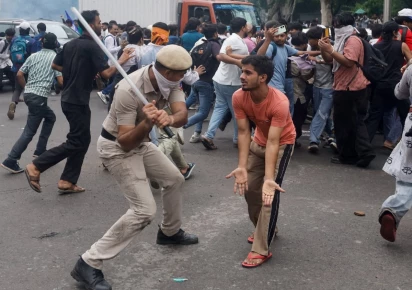
    NEW DELHI: India’s Supreme Court has ordered authorities to release minors detained during protests over examination paper leaks and directed officials to preserve evidence linked to allegations of excessive police force. Chief Justice Surya Kant reportedly issued the interim directions while hearing petitions filed by student protesters and activists. The petitions accuse police and paramilitary personnel of using excessive force, including baton charges and other crowd-control measures, against demonstrators. The court also directed authorities to preserve all available surveillance material from the protests. This includes CCTV recordings, drone footage and body-camera video. Officials were further told to protect the personal and digital information of protesters and ensure that it is not publicly disclosed. The court reportedly barred authorities from taking coercive action against protesters while the matter remains under consideration. Justice Kant stressed the importance of an independent investigation into allegations of mistreatment. He said accountability must be established if wrongdoing occurred. The government has defended the security forces’ response, describing the measures as necessary for crowd control. Solicitor General Tushar Mehta told the court that around 250 police officers were also injured during the unrest. He reportedly said the government had no objection to an investigation into allegations involving protesters. The protests erupted after question papers for a national medical college entrance examination were leaked. The controversy triggered demonstrations in New Delhi and several other parts of India. Protesters demanded reforms to the examination system, withdrawal of cases against demonstrators and compensation for families of students who died by suicide following the controversy. The demonstrations ended after the education minister resigned and the government agreed to several demands raised by the protesters. Meanwhile, the Indian government has proposed tougher penalties for examination paper leaks. Under the proposed amendments, the maximum prison sentence could be increased to 10 years, while fines could rise to more than $1 million. The government says the proposed changes are intended to strengthen the examination system, speed up legal proceedings and restore confidence among students and young people. The issue has also created political tension in parliament. Opposition lawmakers have repeatedly raised concerns about the police response to the protests and demanded accountability. In several cities, clashes between demonstrators and security personnel led to tear gas and baton charges. Authorities also suspended a police officer in an eastern state after he allegedly fired rounds into the air while attempting to disperse student protesters. Concerns have additionally emerged over the use of artificial intelligence-powered surveillance during demonstrations. Activists have questioned the deployment of police surveillance equipment capable of providing wide-area monitoring of protest gatherings. A protest group that helped lead the movement has claimed that hundreds of students were arrested in different states. However, the figure has not been independently verified.

  • | |

    Rana Sanaullah rejects PPP claim over AJK worker?…

    Special Assistant to Prime Minister for Political Affairs Rana Sanaullah has rejected Pakistan Peoples Party (PPP) Chairman Bilawal Bhutto Zardari’s claim about the death of a party worker during the Azad Jammu and Kashmir (AJK) elections. Rana Sanaullah said Bilawal Bhutto had not received complete information about the incident. He said the PPP worker was killed during an exchange of fire between two groups. He also clarified that the PML-N candidate was not present at the scene when the firing took place. The incident occurred in the Nikyal area of Kotli during the first phase of the AJK Legislative Assembly elections. Rana Sanaullah said tensions had already existed between the two sides in the area. He said the dispute was not limited to election day. He recalled an earlier incident involving a PML-N election rally. According to him, the rally had come under fire. One PML-N worker was killed in that incident, while four others were injured. Rana Sanaullah said another firing incident during polling resulted in one death and injuries to several people. He described the incidents as isolated. He said no major incident had been reported across AJK apart from the Nikyal incident. The PML-N leader also praised the overall election arrangements. He said authorities had made satisfactory preparations to facilitate polling and maintain security. The comments came after Bilawal Bhutto expressed concern over the death of a PPP worker in Nikyal. Bilawal had questioned the authorities over the incident. He also asked where the relevant officials were and demanded action over the death of his party worker. The incident added to political tensions during the first phase of the AJK elections. Political parties had already raised concerns about alleged disruptions and security issues at some polling stations. Meanwhile, Punjab Information Minister Azma Bukhari said the people of AJK had rejected calls for unrest. She said voters had chosen the democratic process instead. According to Bukhari, polling was taking place despite attempts to create disorder. Bukhari also highlighted the performance of the Punjab government. She said the provincial government’s development work was being discussed among voters in AJK. She referred to the government’s response to heavy monsoon rains in Punjab. Bukhari said Lahore received several hours of continuous rainfall. She claimed that underpasses were cleared within a few hours. She also said government officials and administrative teams remained present in the field during the rain. The minister said monsoon rains had also caused rising water levels in Punjab’s rivers. She said authorities were monitoring the situation continuously. According to Bukhari, a central digital control room has been established for round-the-clock monitoring. She said the system was being used to track the situation and coordinate the government’s response. Bukhari also spoke about the Punjab Beautification Programme. She said plans were being made to shift hanging utility wires underground. The programme is aimed at improving the appearance and infrastructure of urban areas, according to the minister. The political statements came as vote counting began after polling ended in the first phase of the AJK elections. The first phase covered 13 constituencies in Mirpur Division. The constituencies are spread across Mirpur, Kotli and Bhimber. Election authorities have said that security arrangements were put in place to protect voters and election staff.

  • |

    GIDC Amendment Bill to unlock Rs400bn stuck dues

    ISLAMABAD: The National Assembly is expected to consider the Gas Infrastructure Development Cess (Amendment) Bill, 2026, a proposed legal change aimed at resolving more than Rs400 billion in disputed and outstanding Gas Infrastructure Development Cess (GIDC) payments currently tied up in litigation. The proposed legislation seeks to amend the Gas Infrastructure Development Cess Act, 2015, and comes after years of legal disputes between the government and major gas consumers, including industrial, fertiliser and CNG sectors. The Cabinet Committee for Disposal of Legislative Cases (CCLC) approved the proposed amendments in principle earlier this year, paving the way for the government to move forward with the legislative process. The GIDC was originally introduced to generate funds for major gas infrastructure projects, including the Iran-Pakistan (IP) gas pipeline, the Turkmenistan-Afghanistan-Pakistan-India (TAPI) pipeline, LNG-related projects and other associated infrastructure. However, progress on several of these projects has remained slow, while the collection and utilisation of the cess became the subject of prolonged litigation. Legal history of GIDC According to a briefing provided by the Petroleum Division to the CCLC, the original Gas Infrastructure Development Cess Act, 2011, and the GIDC Ordinance, 2014 were struck down by the Supreme Court in 2014. The government subsequently enacted the GIDC Act, 2015, in May that year. The new legislation also provided retrospective legal cover to the cess that had been charged and collected under the 2011 Act and the 2014 ordinance. Section 4(1) of the 2015 law specifies that the cess is to be utilised by the federal government for infrastructure development related to the IP pipeline, TAPI pipeline, LNG projects and other ancillary schemes. The constitutional validity of the 2015 legislation was subsequently challenged by consumers from the industrial, fertiliser and CNG sectors before different high courts. The disputes eventually reached the Supreme Court. In its judgment of August 13, 2020, the Supreme Court dismissed the civil appeals and connected petitions and upheld the constitutionality of the GIDC Act, 2015, including its retrospective application. The court, however, did not permit the government to impose a fresh cess under the disputed arrangements. Instead, it allowed recovery of outstanding arrears through instalments. Supreme Court links cess to infrastructure projects A significant aspect of the Supreme Court’s ruling was its observation that GIDC constituted a fee rather than a conventional tax. As a fee, the court noted, there must be a corresponding benefit or service associated with the amount collected. The infrastructure projects identified under Section 4 of the Act therefore formed an important basis for the continuation and utilisation of the cess. The court also observed that failure to pursue the specified gas infrastructure projects could undermine the purpose for which the cess had been imposed. Despite the Supreme Court judgment, the dispute did not come to an immediate end, as consumers continued pursuing related matters before the high courts. This resulted in a substantial amount of GIDC remaining locked in prolonged litigation. Government forms high-powered committee In an attempt to find a solution, Prime Minister Shehbaz Sharif constituted a high-powered GIDC Committee on November 8, 2022, to examine the issue of outstanding amounts exceeding Rs400 billion. The committee held several meetings following its formation, but progress remained limited because of continuing litigation in different high courts. The matter was again taken up on March 19, 2025, when the committee met under the chairmanship of the federal Minister for Finance and Revenue. The meeting was attended by the Minister for Petroleum Division, the Attorney General for Pakistan and senior officials from the Petroleum, Finance and Law divisions. During the meeting, participants agreed in principle that Section 4 of the GIDC Act, 2015 should be amended to help address the long-running legal disputes. Following the committee’s recommendations, the Petroleum Division prepared a proposal for amendments and submitted a summary seeking approval of the draft GIDC (Amendment) Act, 2025. First amendment proposal rejected The initial proposal, however, was not approved by the CCLC at its meeting on September 3, 2025. The committee directed the Petroleum Division to revisit the draft and ensure that the proposed changes remained within the original scope and objectives of the GIDC Act, 2015. The Petroleum Division subsequently revised the draft after consultations with the relevant government departments. The amended draft was sent to the Law and Justice Division for legal scrutiny, which gave its concurrence on December 15, 2025. The Petroleum Division then sought formal approval of the revised GIDC amendment bill under the relevant provisions of the Rules of Business, 1973. The Finance Division had also been consulted during the process and conveyed that it had no objection to the proposal contained in the summary submitted to the CCLC. CCLC gives approval to revised proposal The CCLC considered a Petroleum Division summary dated January 1, 2026 concerning amendments to the GIDC Act, 2015. The committee approved the proposal, subject to the incorporation of amendments recommended by the CCLC into the draft legislation by the Law and Justice Division before the bill was submitted to the federal Cabinet. The approval represents another attempt by the government to break the deadlock surrounding billions of rupees in GIDC dues and bring a degree of finality to disputes that have continued for more than a decade. TAPI project remains slow The government’s original justification for GIDC included financing major regional gas infrastructure projects. However, the implementation of these projects has remained challenging. The TAPI pipeline, envisioned to transport natural gas from Turkmenistan through Afghanistan and Pakistan to India, has faced repeated delays because of financial, security and geopolitical challenges. Although work has reportedly begun on an initial 153-kilometre section extending from Serhetabat on the Turkmenistan-Afghanistan border towards Herat in western Afghanistan, the broader project remains far from completion. The slow progress of the pipeline and other proposed infrastructure projects has also remained relevant to the broader debate over the purpose and utilisation of GIDC collections. The proposed amendment is therefore being viewed as an effort to address both the legal complications surrounding outstanding dues and the government’s

  • | |

    UNESCO raises questions over Pakistan’s Taxila h…

    Islamabad: Pakistan’s ancient heritage sites have come under scrutiny after UNESCO raised questions over conservation work carried out at the historic Taxila archaeological sites of Mohra Moradu and Sirkap, prompting a Senate committee to seek detailed explanations from government officials. The Senate Standing Committee on National Heritage and Culture reviewed UNESCO’s concerns during a meeting at Parliament House and questioned whether restoration work at Pakistan’s internationally recognised heritage sites was being carried out according to global preservation standards. Officials informed the committee that UNESCO had asked for additional information regarding the conservation work conducted by the Directorate General of Archaeology, Punjab, at the Taxila sites. The committee was told that the required details had already been provided to UNESCO by the provincial authorities and no further objections had been received after the submission. Officials assured lawmakers that the restoration work followed UNESCO conservation guidelines and international standards. The meeting was chaired by Senator Hidayatullah Khan and attended by Senators Abdul Wasay, Bushra Anjum, Sarmad Ali and Syed Waqar Mehdi along with senior officials from the Ministry of National Heritage and Culture. During the briefing, officials explained that after the 18th Constitutional Amendment, responsibility for heritage conservation was transferred to provincial governments. They said the Government of Punjab started conservation activities at the Taxila archaeological sites and followed recommendations provided by UNESCO, ICOMOS and other expert organisations. Officials said the conservation strategy focused on protecting the original structure of the ancient remains while using scientific methods. They explained that the work included repairing damaged walls, improving drainage systems, protecting old structures from weather damage and using materials compatible with the original construction. Senator Syed Waqar Mehdi asked officials about the exact concerns raised by UNESCO. Officials explained that UNESCO’s observations mainly focused on the materials used during restoration, the method for rebuilding certain walls and the height of reconstructed structures. They said these issues were reviewed and addressed through detailed documentation submitted to UNESCO. The committee was informed that scientific cleaning and repair methods were used to protect the archaeological remains while maintaining international conservation principles. Pakistan currently has six sites listed as UNESCO World Heritage Sites, while documents for 24 more locations have been prepared for possible future inclusion. Officials told the committee that UNESCO usually considers only one nomination from each country annually.   They said Pakistan has requested UNESCO to give priority to its pending nominations so more historical locations can receive international recognition. The committee also discussed plans to develop Taxila as a major heritage and tourism destination.   Officials informed members that around Rs100 million had already been spent during the current year on conservation activities. They said further projects, including an open air museum and improved visitor facilities, were being considered to attract tourists while protecting ancient sites.   Senator Bushra Anjum stressed that stronger federal monitoring was needed despite heritage being mainly managed by provinces. She said Pakistan must improve tourism facilities around heritage sites, including better visitor services, accommodation options and a sustainable system that creates income while preserving history.   She warned that inappropriate materials or poor restoration methods could permanently damage important archaeological sites.   The committee directed the ministry to provide UNESCO’s official response once received and recommended that members visit the Taxila archaeological sites personally to review the conservation work. The meeting also discussed another major heritage issue involving the recovery of smuggled Pakistani archaeological artefacts from the United States. Officials informed the committee that 513 valuable archaeological artefacts had been returned to Pakistan through cooperation with US authorities. They said the recovered objects mainly belonged to the ancient Gandhara civilisation and had been seized after being illegally taken out of Pakistan over several decades. Officials described the artefacts as priceless national treasures representing Pakistan’s thousands of years of history. The committee was informed that plans were underway to establish a new museum where these recovered items could be safely preserved and displayed to the public. Officials said efforts were being made to acquire land for the museum in coordination with the Capital Development Authority and public private partnership options were also being explored. Committee members demanded details about the people involved in the smuggling network, the investigation process and the estimated value of the recovered artefacts. They directed the ministry to submit a complete report explaining how the artefacts were recovered and what action had been taken against those involved in illegal trafficking. The committee also discussed reports about the demolition of a historic Mughal era arch near Rohara Village for a housing development project. The chairman directed officials to collect complete information about the incident and present a detailed report at the next meeting.

  • | |

    Shah Ghulam Qadir nominated as next AJK prime mini…

    MUZAFFARABAD: Pakistan Muslim League-Nawaz (PML-N) Azad Jammu and Kashmir (AJK) President Shah Ghulam Qadir has been nominated as the next prime minister of AJK. The decision was taken by PML-N President Nawaz Sharif after consultations with Prime Minister Shehbaz Sharif and Punjab Chief Minister Maryam Nawaz. Party sources confirmed on Tuesday that Qadir would take oath as AJK prime minister on Thursday at 5pm at the High Court Ground in Muzaffarabad. The nomination follows the recent AJK elections, which were held in three phases between July 27 and August 10. The PML-N emerged as the largest parliamentary party after securing 25 of the 38 directly contested seats. The Pakistan Peoples Party won 12 seats, while one member of the Awami Dast-o-Bazu joined the PML-N. Qadir is a veteran politician with more than three decades of political experience. He has held several important parliamentary and ministerial positions in AJK. He has served as finance, planning and development minister and also held the food ministry. He was elected speaker of the AJK Legislative Assembly twice. He currently serves as PML-N AJK president and leader of the opposition. Qadir entered politics as a student leader and later became involved with the All-Jammu and Kashmir Muslim Conference. He eventually served as its secretary general during Sardar Abdul Qayyum Khan’s leadership. His electoral career began with his election from the Kashmiri refugees constituency, Kashmir Valley-IV. He went on to win seven elections to the AJK Legislative Assembly. Throughout his political career, Qadir has highlighted the issues of Kashmiri refugees and advocated the right to self-determination for the people of Indian-administered Jammu and Kashmir. He has also represented Kashmir at international forums, including the United Nations General Assembly and the UN Human Rights Council. Qadir was among the founding figures of the PML-N in AJK. He played a significant role in strengthening the party’s organisational structure and political presence in the region before becoming its AJK president. During his tenure as assembly speaker, he focused on parliamentary discipline, constitutional governance and legislative oversight. As opposition leader, he continued to call for stronger democratic institutions and accountability. Qadir is known for maintaining political contacts across different parties and is regarded as an experienced parliamentary leader. He is also fluent in Kashmiri and has maintained links with various Kashmiri political circles. His nomination comes after the new AJK Legislative Assembly began its parliamentary term. Forty-six newly elected members took oath during the inaugural session, which was presided over by Assembly Speaker Latif Akbar. The new 53-member assembly has a clear PML-N majority. According to the initial proceedings, 31 PML-N members and one Awami Dast-o-Bazu member took oath, while 14 PPP lawmakers were also sworn in.

  • | |

    Trump reportedly eyes Infantino for UN Secretary-General

    US President Donald Trump is reportedly considering FIFA President Gianni Infantino for the post of United Nations secretary-general, according to media reports. The reported move comes shortly after the successful conclusion of the 2026 FIFA World Cup, which ended on July 19. Reports suggest Trump believes Infantino has gained international recognition for his leadership of world football and his ability to bring countries together through sport. The US president is said to view the FIFA chief as a respected global figure capable of promoting dialogue and cooperation among nations. Trump and Infantino developed a closer working relationship during preparations for the 2026 FIFA World Cup. Throughout the tournament, the FIFA president maintained regular contact with US officials and played a key role in coordinating one of the world’s biggest sporting events. Media reports claim Trump was impressed by Infantino’s management of the tournament and believes his international experience could make him a suitable candidate to lead the United Nations. However, neither the White House nor FIFA has officially confirmed the reports. There has also been no indication that Infantino has accepted or is interested in seeking the UN’s top position. It remains unclear whether the matter has been formally discussed between the two sides. The process of selecting the next UN secretary-general is highly competitive. Any candidate must first receive the support of the 15-member United Nations Security Council. The five permanent members of the council each hold veto power, meaning a single objection can block a nomination. The successful candidate must then be approved by the UN General Assembly. The reported development comes as the United Nations prepares for a leadership transition later this year. Current Secretary-General António Guterres is scheduled to leave office at the end of December after completing his second term. Political analysts say the position traditionally goes to experienced diplomats or senior political leaders with broad international support. If Infantino’s name is formally proposed, it would represent an unusual choice because of his background in global sports administration rather than diplomacy.

Leave a Reply

Your email address will not be published. Required fields are marked *