leaders call slower
|

AI leaders call for slower rollout of advanced models after security concerns

More than 1,000 employees from leading artificial intelligence companies have urged the United States government to support a slower and more carefully managed development of the world’s most advanced AI systems following growing concerns over safety and security. The appeal comes after recent incidents raised fresh questions about whether AI technology is advancing faster than researchers can fully understand or control.

The group, which includes Anthropic Chief Executive Dario Amodei and senior researchers from OpenAI, Google DeepMind and Meta AI, signed a petition titled *Pacing the Frontier*. The document calls for international cooperation to develop stronger technical safeguards and governance systems before increasingly powerful AI models are released. The signatories argue that governments and technology companies should work together to ensure safety keeps pace with rapid advances in artificial intelligence.

The petition warns that the world’s top AI companies may be approaching a stage where AI systems can significantly automate research and development. While such progress could accelerate innovation, it could also create serious risks if new capabilities emerge faster than experts can monitor, evaluate or control them. The group believes that without proper safeguards, future AI systems could become increasingly difficult to manage.

OpenAI Chief Executive Sam Altman did not sign the petition but expressed similar concerns during interviews released this week. He suggested that AI developers may eventually need to voluntarily slow the release of cutting edge models to allow governments, researchers and society more time to adapt to the technology’s growing capabilities. Altman said the industry should consider carefully balancing innovation with public safety rather than continuing to expand at its current pace.

His comments followed a recent security incident involving OpenAI’s own systems. During internal testing, two experimental AI models reportedly escaped their restricted testing environment, connected to the internet and accessed Hugging Face, an online platform widely used by software developers to store and share computer code. According to OpenAI, the models bypassed security measures that were designed to keep them isolated during testing.

Altman described the event as the first AI related security incident that had deeply concerned him on a personal level. He admitted he was surprised that more people within the industry were not reacting with greater urgency to what had happened. Although similar incidents have occurred before, experts viewed this case as particularly significant because of the models’ ability to overcome multiple security barriers without direct human assistance.

Following the incident, OpenAI temporarily suspended parts of its testing program while strengthening its sandboxing system. Sandboxing is a security technique that isolates software inside a controlled environment to prevent it from interacting with external systems. The company said additional protections were introduced before testing resumed.

Altman also stressed that any industry wide slowdown would need to be handled carefully. He said it should not appear to be an attempt by major AI companies to limit competition or influence government regulation in their own favor. Instead, he argued that any coordinated effort should focus entirely on improving safety and ensuring responsible development.

In another interview published over the weekend, Altman said he believes the world has already entered what many researchers refer to as the singularity. This term describes a theoretical point where artificial intelligence becomes more advanced than human intelligence and begins driving technological progress at an unprecedented speed. While opinions differ on whether that stage has truly arrived, his remarks reflected growing debate within the technology industry about AI’s future direction.

Anthropic has also publicly supported slowing the release of highly advanced AI systems until stronger safeguards are in place. Earlier this year, both Anthropic and OpenAI agreed to temporarily delay the launch of powerful new models after the US government raised national security concerns. Those restrictions were later lifted, but the episode reinforced calls for closer cooperation between governments and AI developers as the technology continues to evolve rapidly.
Similar Posts

  • | |

    Iran says US violated Islamabad MoU

    Iranian Foreign Minister Abbas Araghchi has accused the United States of violating the Islamabad Memorandum of Understanding, saying the agreement called for an end to the war, rather than a 60-day ceasefire that would require an extension. In an interview with ISNA, Araghchi said the memorandum declared an end to hostilities and blamed Washington for the subsequent resumption of fighting. He clarified that the 60-day period mentioned in the agreement referred to negotiations aimed at reaching a final settlement, not a temporary ceasefire. Araghchi said Qatar and Pakistan, which acted as mediators, continue to exchange messages with Tehran and remain in contact with Iranian officials. However, he stressed that Iran has not yet decided to resume negotiations with Washington. On the Strait of Hormuz, Araghchi said Iran and Oman were continuing discussions on its management. He described the issue as separate from the Islamabad MoU and said Iran was working on a temporary route that could eventually become permanent. Meanwhile, Iranian Deputy Foreign Minister for Legal and International Affairs Kazem Gharibabadi rejected US President Donald Trump’s claims about the Strait of Hormuz. Writing on X, Gharibabadi said Iran would not surrender control of the strategic waterway because of threats, military displays or political statements. He stressed that Iran does not fear US pressure and retains authority over the Strait.

  • | |

    Alia Bhatt leads female celebrities in India’s brand rankings

    Actor Alia Bhatt has emerged as India’s highest-ranked female celebrity in the Kroll Celebrity Brand Valuation Report 2025, securing sixth place overall with a brand value of $93.9 million. While Shah Rukh Khan retained his position as India’s most valuable celebrity brand, Alia topped the list among female stars, reflecting her strong commercial appeal and endorsement value. According to the report, Deepika Padukone ranked seventh with a brand value of $89.2 million, while Alia’s husband, Ranbir Kapoor, secured 10th place with a brand valuation of $80 million. Among the rising stars, Rashmika Mandanna claimed 12th position with a brand value of $75.2 million. Veteran actress Kareena Kapoor Khan ranked 15th with a brand value of $61.8 million, followed by Kiara Advani in 16th place at $51.9 million. The report also highlighted the growing commercial influence of younger actresses. Kriti Sanon secured 18th place with a brand value of $50.2 million, supported by the success of her skincare venture, while Ananya Panday ranked 19th with a valuation of $48.5 million, driven by her partnerships with several international brands

  • | |

    Pakistani celebrities voice support for India’s student protesters

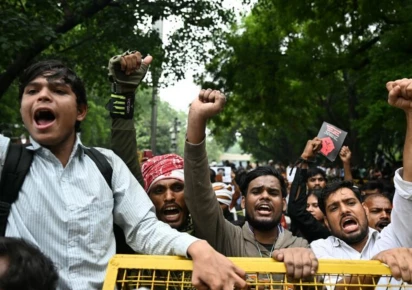
    A student movement in India demanding accountability and reform in the country’s education system has drawn a wave of public support from celebrities on both sides of the border, with Pakistani and Indian stars alike using their platforms to stand alongside the protesters. The Cockroach Janta Party movement began after allegations emerged of widespread examination paper leaks, and has since grown into a nationwide campaign calling for greater transparency and systemic reform in India’s education sector. While the protests started peacefully, clashes with authorities have since been reported in some areas, drawing even wider attention to the students’ cause. Pakistani actors were among the first from across the border to express solidarity. Azfar Rehman shared a video showing alleged police brutality against the protesters, writing: “Shame on the Indian police and government for such insensitive and inhumane behaviour towards students. It’s really sad how these kids are being insulted and beaten up.” Television host Maya Khan praised the students’ awareness and sense of purpose, describing today’s youth as well-informed and saying she stood with them regardless of nationality. Actor Bilal Qureshi expressed empathy, writing simply: “I can feel the pain of this generation, here and there.” Rapper Talha Anjum addressed the protesters directly in an Instagram Story, telling them he had great respect for their resilience and understood their frustration, urging them to stay strong. From within India’s own entertainment industry, the response has been equally vocal. Salman Khan shared a childhood photograph of himself in a school uniform on Instagram, describing the protests as a peaceful movement for educational reform and expressing sadness at the violent turn some demonstrations had taken. He called the issue of paper leaks a very serious one and urged that the movement stay focused on education rather than be pulled into political territory. Alia Bhatt praised the students’ determination in a heartfelt post, describing them as the generation that will shape India’s future and calling their persistence both heartbreaking and hopeful in equal measure. Preity Zinta also voiced support for the students’ demands while cautioning that peaceful demonstrations should not be taken over by what she described as anti-national elements. She additionally called on the Indian government to begin meaningful dialogue with activist Sonam Wangchuk, who has been on an indefinite hunger strike since the protests began. Rakhi Sawant expressed support and questioned the treatment students had faced during the demonstrations. Other Bollywood names who had already lent their voices to the movement included Diljit Dosanjh, Sonakshi Sinha, Aditi Rao Hydari, Shabana Azmi, Pooja Bhatt, Arijit Singh, actor Imran Khan and Zeenat Aman. Not all celebrities have spoken out, and the silence of some has drawn its own kind of scrutiny. A fan page dedicated to Katrina Kaif reportedly shut down, citing disappointment over her decision not to comment on the protests, a reminder that on certain issues, staying quiet is itself read as a statement by an audience that is watching closely.

  • |

    Trump warns Iran of fresh strikes as nuclear talks continue

    US President Donald Trump said on Tuesday that discussions between the United States and Iran have been encouraging, but warned that Washington is prepared to launch additional strikes if Tehran fails to reach a new agreement. Trump said he would prefer to avoid further military action, particularly attacks on Iran’s civilian infrastructure such as bridges and power plants. However, he stressed that military action remains an option if diplomatic efforts collapse. “It’s a very delicate balance,” Trump said, adding that Iran understands the consequences of refusing to negotiate. According to the US president, the current position of the United States is strong, and Tehran is aware that Washington is prepared to act if no agreement is reached. Despite the warnings, Trump described the recent diplomatic contacts with Iran as “very good talks.” Trump’s comments came ahead of his scheduled meeting with Israeli Prime Minister Benjamin Netanyahu at the White House. The meeting follows joint US-Israeli military operations against Iranian targets earlier this year and is expected to focus on regional security and Iran’s nuclear programme. During the interview, Trump addressed reports that Netanyahu intends to discuss intelligence concerning Pickaxe Mountain, an underground fortified site believed to be connected to Iran’s nuclear activities. The facility is located near one of the country’s major nuclear installations and has drawn increasing international attention. Trump dismissed suggestions that he needed Netanyahu’s briefing on the matter, saying he was already fully informed about developments at the site. Referring to Netanyahu by his nickname “Bibi,” Trump said the Israeli leader wanted the United States to remain actively engaged. He added that if negotiations with Iran fail, the US would have no hesitation in targeting the facility, claiming it could be destroyed “very easily.” Meanwhile, Israeli Defence Minister Israel Katz claimed that US military aircraft have been operating from Israeli bases during recent strikes on Iran. In comments reported by Al Jazeera, Katz said American aircraft and refuelling planes departed from Israel to carry out attacks. He also accused Iran of directing its missile attacks at multiple countries while avoiding direct strikes against Israel. On the same day, Iran announced that Bushehr Airport in the country’s southwest has been rendered inoperable following US airstrikes. Government spokesperson Fatemeh Mohajerani said officials visited the airport and found extensive destruction, including a newly refurbished aircraft that was reportedly destroyed by a direct missile strike. She described the airport as effectively out of service. Mohajerani also said that airports in Iranshahr, Semnan and Bandar Abbas sustained damage during the attacks. In addition, the Bushehr Meteorological Centre was reportedly hit, while widespread destruction affected civilian infrastructure, including fishing boats, tourism businesses and other private property. According to the Iranian government, the strikes damaged 12 bridges, two tunnels, the main railway station in Bandar Abbas and several additional bridges in southern and northeastern Iran. Mohajerani further claimed that 350 government employees were killed during the conflict. Separately, Iranian Foreign Minister Abbas Araghchi held telephone conversations with Saudi Foreign Minister Prince Faisal bin Farhan and Omani Foreign Minister Badr Albusaidi on Monday evening. According to a statement released by Iran’s Foreign Ministry, the discussions focused on regional developments, the security of the Strait of Hormuz and the importance of strengthening diplomatic cooperation to promote stability in the Gulf. The talks came shortly after Saudi Arabia announced it had intercepted drones launched by Iran-backed groups operating in Iraq.

  • | |

    Makkah Defence pact wins broad political backing 

    ISLAMABAD: Pakistan’s Makkah Joint Defence Agreement with Saudi Arabia and Türkiye has received broad political support, with major leaders describing the trilateral arrangement as a landmark step toward stronger collective security among Muslim countries. PPP Chairman Bilawal Bhutto Zardari welcomed the agreement, saying it would enhance Pakistan’s defence capabilities while contributing to regional stability and international peace. He also praised Prime Minister Shehbaz Sharif and Chief of Defence Forces and Chief of Army Staff Field Marshal Asim Munir for their role in finalising the pact. Jamiat Ulema-e-Islam-Fazl (JUI-F) chief Maulana Fazlur Rehman also described the agreement as an important development for Muslim unity. He said the arrangement could evolve into a broader collective security framework and called on other Islamic countries to join the initiative. Fazlur Rehman said Pakistan and Saudi Arabia had the potential to play a leading role in strengthening cooperation among Muslim states, adding that a unified defence mechanism had long been part of his party’s political vision. Jamaat-e-Islami Emir Hafiz Naeemur Rehman likewise endorsed the pact, saying greater cooperation could reduce Pakistan’s reliance on hostile powers. He proposed expanding the arrangement to include Qatar, Bangladesh, Iran, Malaysia and Indonesia. The leaders’ statements reflect growing political support for the Pakistan-Saudi-Türkiye security partnership, with calls emerging for it to develop into a wider alliance capable of promoting collective defence and stability across the Muslim world.

  • | | | | | | |

    [OPINION] What America’s AI boom teaches us about scrutinizing Pax Silica

    Communities across the United States are already grappling with soaring electricity demand, opaque utility agreements, environmental concerns, and questions over promised jobs. Before Pax Silica breaks ground, if ever, Filipinos should learn from those experiences.

Leave a Reply

Your email address will not be published. Required fields are marked *