percy bysshe shelleys
|

Percy Bysshe Shelley’s “Mont Blanc”

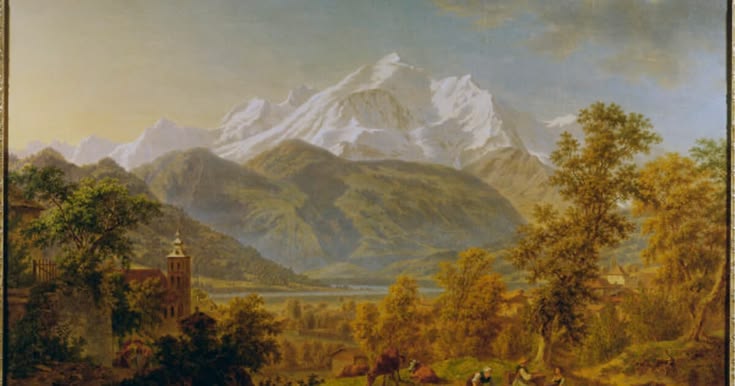
In Romantic-era poetry, Percy Bysshe Shelley’s “Mont Blanc: Lines Written in the Vale of Chamouni” (1816) stands as the ultimate meditation on the romantic sublime. He wrote it during the second generation of English Romanticism alongside Lord Byron and John Keat.  Shelley used the terrifying scale of the Alpine peak to launch questions about perception, human consciousness and the unseen forces governing the cosmos.

While early Romantics like William Wordsworth often found moral harmony and divine comfort in nature, Shelley’s philosophical temperament brought a different energy. For Shelley, nature was not a benevolent mother figure, but an indifferent, boundless, and overwhelming energy. Shelley engages directly with the concept of the Sublime. The sublime is an aesthetic experience where vastness or power induces a feeling of terrifying awe. It makes the human observer feel physically insignificant while mentally elevated. Rather than finding traditional religious comfort in the mountain’s height, Shelley explores his philosophical atheism. He views Mont Blanc as a symbol of Necessity or an impersonal power that governs existence.

Throughout the five-part poem, Shelley constructs a series of striking visual and philosophical wonders. Shelley opens the poem by comparing human thought to a river flowing through a ravine. The “everlasting universe of things” rolls through human perception. Human consciousness is both passive (receiving impressions from the grand landscape) and active (shaping those impressions into meaning).

The everlasting universe of things

Flows through the mind, and rolls its rapid waves…

Looking up at Mont Blanc, Shelley does not describe a peaceful picture-postcard landscape. Rather, he depicts a wild, chaotic realm of ice, rock, and storm. He envisions the mountain as a primordial arena where “the old Earthquake-daemon taught her young / Ruin”. The glaciers are slow-moving “frozen floods” that flatten forests and rocks with silent force. Shelley reflects on what lessons this silent mountain holds for humanity. The mountain possesses a mysterious tongue that teaches a lesson.

To Shelley, Mont Blanc speaks an unspoken truth that can repeal large codes of fraud and woe (i.e., tyrannical dogmas, religious orthodoxies, and political oppression). Nature’s unyielding reality strips away human pretense. The poem reaches its dramatic climax by returning to the relationship between the peak and human thought. Shelley notes that the mountain remains still, snowy, and serene high above human affairs.

He closes with a famous philosophical question:

And what were thou, and earth, and stars, and sea,

If to the human mind’s imaginings

Silence and solitude were vacancy?

 The mountain’s grandeur is real, but its meaning exists because the human imagination is there to perceive it. Without the human mind to process wonder, the immense universe would merely be an empty void.

 

Similar Posts

  • Chickenpox cases rise in Gaza

    The United Nations has warned that chickenpox cases are increasing among displaced children in Gaza. Around 9,300 cases have been reported over the past two weeks with more than half recorded in Khan Younis. According to the UN Office for the Coordination of Humanitarian Affairs (OCHA) overcrowded displacement camps piles of garbage limited access to clean water and damaged sewage systems are creating ideal conditions for infectious diseases to spread. As a result chickenpox is becoming a serious public health concern. The UN said respiratory illnesses and skin diseases remain the most common health problems in Gaza. Waterborne diseases are also increasing especially in the Khan Younis area due to poor sanitation and contaminated water. Last week alone more than 18,000 new cases of skin-related illnesses including chickenpox external parasitic skin infections and impetigo were reported. The report also said Gaza’s healthcare system has been badly damaged by the ongoing war. Many hospitals and medical facilities have been destroyed or damaged while shortages of medicines fuel and medical supplies continue to affect healthcare services. According to the Palestinian Ministry of Health, since the war began more than 73,250 Palestinians have been killed and 173,751 injured. The ministry also said that around 90% of Gaza’s infrastructure has been damaged or completely destroyed.

  • |

    Han Kang transforms trauma into human connection

    In an era often dominated by literary posturing and self-absorbed memoirs, South Korean author Han Kang offers a profound counterweight. Her collection, Light and Thread, serves as an intimate look into the ethical consciousness of a writer shaped by the long shadow of national tragedy. Rather than using her platform to project certainty or celebrate her global acclaim, Han Kang turns writing into a delicate act of witness. An attempt to span the distance between isolated souls using language as a fragile bridge. The Weight of Historical Memory Beneath the intimate and domestic moments captured in Light and Thread lies an undercurrent of history. For readers familiar with Han Kang’s literary canon, the ghostly presence of unresolved national trauma is a constant motif. History is not presented here as a series of dead facts. Instead, it breathes through silence, leaving behind a persistent political and moral residue. A decisive turning point in her artistic journey occurred when she encountered archival photographs of the 1980 Gwangju massacre. She found herself forced to abandon her previous literary trajectory while confronted by the reality of historical violence. The weight of what she witnessed demanded an entirely new vocabulary of remembrance. This epiphany reflects an overarching ethical seriousness. Literature is not viewed as a vehicle for self-promotion or intellectual display. Creation is treated as a solemn, almost spiritual responsibility toward those who have been sisilenced. Her work continually battles with how language can articulate grief without reducing its magnitude. How it can preserve human dignity against historical erasure and honor the memory of the dead. Even in her Nobel Lecture, Han Kang rejects self-congratulation. She transforms the moment into a vulnerable meditation on a writer’s moral duties, choosing quiet reflection over triumph. An Invisible Connection Between Hearts The central motif of the collection traces back to a poem Han Kang wrote as an eight-year-old child. In it, she envisioned an invisible golden thread linking human hearts across space. Decades later, that simple childhood metaphor provides the framework for Light and Thread. For Han Kang, storytelling operates as that very filament: delicate, easily broken, yet surprisingly resilient. It holds the power to link separated lives across loss, time, and geography. Reading and writing become acts of deep empathy. They’re active ways of reaching into another person’s experience without seeking control or mastery. Dissolving the Self to Preserve Humanity Unlike conventional memoirs focused on self-dramatization, Light and Thread presents a porous sense of self. The author’s first-person perspective regularly fades into descriptions of weather, ambient sound, plant life, and lingering pain. Han Kang shifts the focus away from herself and onto the fragile conditions that allow human consciousness to endure. Her fundamental skepticism toward absolute answers becomes her greatest strength. Her writing creates a quiet space where grief can exist without being distorted.  

  • Azad Kashmir Elections: A Pilot Project or a Model for Pakistan’s Next General Elections?

    By Engr. Saqlain Abid Political Commentator and NFPA-Certified Electrical Engineer   Elections are the vital organ of a living democracy. If they are conducted according to the people’s choice, without interference, on equal grounds, and with the consensus of all democratic participants, then the state not only remains in good health but also flourishes with the hope and commitment promised before the elections.   For the first time in the history of Pakistan, the Azad Jammu and Kashmir (AJK) elections are not being held on a single polling day. Instead, the electoral process has been divided into three different phases—27 July, 8 August, and 20 August 2026. This unusual arrangement raises several important questions. Why is the state preparing this electoral model? What are the conditions on the ground that necessitated such a strategy? More importantly, how could this experiment influence Pakistan’s national elections next year?   The political environment surrounding these elections has already become highly contested. The major political force JAAC has been banned by the government, and several of its leaders have been detained. The party has consequently boycotted the elections. PTI, another major opposition force, has also chosen to boycott the electoral process. According to its leadership, the party has been forced to contest only through independent candidates rather than under its official party platform. PTI argues that the government has failed to provide the safety, guarantees, and political environment necessary for free and fair elections. Under such circumstances, the party believes participation would merely legitimize a process it does not trust.   On the other hand, the ruling coalition, led by PML-N and PPP, has entered the campaign with promises of development projects, including new motorways and business initiatives aimed at attracting voters. While development remains an important component of any election campaign, questions regarding electoral credibility continue to overshadow these promises.   In principle, elections should be transparent, efficient, and completed within the shortest possible time. If technological solutions such as secure online systems become feasible in the future, they may further reduce the chances of manipulation. However, extending the polling process over three different days also creates a debate. While supporters argue that it makes election management easier, critics believe that a prolonged process increases opportunities for allegations of interference and weakens public confidence.   The government should have taken all political parties on board before announcing such an unprecedented electoral model. A genuinely inclusive process requires the participation of every major democratic stakeholder. JAAC, which commands significant public support in parts of Azad Kashmir, should have been engaged through political dialogue rather than exclusion. The credibility of elections depends not only on voting day but also on the perception that every political voice has been given an equal opportunity to participate.   Pakistan has previously criticized India for conducting elections in Jammu and Kashmir while sections of the local political leadership remained outside the process. At the time, Islamabad argued that elections held without broad political participation reflected only a procedural exercise rather than the genuine will of the people. The obvious question now is what circumstances have led Pakistan toward a model that some critics argue resembles the same approach.   Some political analysts believe that the AJK elections may serve as a pilot project to test a phased electoral model before its possible application across Pakistan during future general elections. Whether this perception is accurate or not, the debate itself demonstrates the level of public skepticism surrounding the process.   Another factor attracting attention is the role of the Chief Election Commissioner, whose tenure continues to face criticism following the February 2024 general elections. Allegations raised by former Rawalpindi Commissioner Liaquat Ali Chattha regarding manipulation of election results remain part of Pakistan’s political discourse, despite subsequent developments in the case. These controversies have inevitably shaped public perceptions regarding electoral transparency.   If voter turnout remains significantly low because of political boycotts and public distrust, the legitimacy of the exercise may come under further scrutiny. It is therefore the moral responsibility of the government and the Election Commission to create an environment where every democratic force feels secure enough to participate and where no stakeholder can reasonably question the fairness of the process.   The electoral process ultimately determines the political shelf life of a state. When governments emerge through elections widely accepted by the public, trust between the people and the state grows stronger. When that trust weakens, political polarization deepens, frustration increases, and hostile external actors find greater opportunities to exploit internal divisions. With Balochistan already facing serious security challenges and Khyber Pakhtunkhwa confronting persistent instability, any controversy surrounding the AJK electoral process may further strengthen perceptions that democratic space is shrinking rather than expanding.   Ultimately, the success of these elections will not be measured solely by administrative efficiency but by whether the people of Azad Kashmir believe that their voices were freely heard and genuinely counted. A credible electoral process strengthens democracy; a disputed one risks weakening the very foundations upon which democratic legitimacy depends.

  • Unbearable heat in Turbat

    Hani Rasheed Through the columns of your esteemed newspaper, I wish to highlight the unbearable heat in Turbat. Every summer, temperatures rise to dangerous levels, making life extremely difficult for residents. Students, labourers, elderly people, and patients suffer the most. Long hours of load shedding and water shortages make the situation even more unbearable. The authorities should take urgent measures to ensure an uninterrupted electricity supply, improve water availability, and plant more trees to reduce the effects of extreme heat. Public awareness about staying safe during heatwaves should also be promoted. The people of Turbat deserve timely action before this severe weather causes more health problems. I hope the concerned authorities will address this issue without delay

  • |

    The limits and depth of human consciousness

    For millions of years, the survival of living species depended almost entirely on practical adaptations. The core of living was finding food, securing shelter, avoiding predators, and reproducing. Yet, at a crucial juncture in evolutionary history, Homo sapiens began engaging in a behavior that offered no immediate physical utility like making art. From red ocher hand stencils on cave walls in Sulawesi and Western Europe to intricate bone flutes and sculpted figurines, early humans devoted valuable time and energy to symbolic creation. Today, neuroscientists, cognitive psychologists, and evolutionary anthropologists increasingly view art not as a secondary cultural luxury, but as a foundational hallmark of human consciousness. The Evolutionary Emergence of Symbolic Thought The birth of artistic expression marks a profound cognitive transition. While many animals exhibit complex behaviors, these actions are largely instinctual and functional. Human art, by contrast, relies on abstract symbolic thinking. The capacity to let one object, shape, or sound represent an idea, emotion, or absent reality. When an early human carved a figure or painted a thundering herd of bison onto rock, they were not merely copying their surroundings. They were projecting an internal mental world onto an external physical canvas. This ability to externalize subjective experience required a sophisticated architecture of consciousness, including robust working memory, metacognition (thinking about one’s own thinking), and a developed theory of mind. It’s the understanding that others possess distinct mental states and can interpret shared symbols. The Neurobiology of Aesthetic Experience Modern neuroimaging reveals that creating and contemplating art engages large-scale, interconnected brain networks. When a person immerses themselves in a painting, music, or literature, the Default Mode Network (DMN) works with sensory and emotional circuits. Artistic engagement triggers a dynamic dialogue between the visual or auditory cortex, the limbic system (which processes emotion), and executive regions in the prefrontal cortex. This complex cross-talk allows humans to experience qualia. The subjective, qualitative feel of conscious experiences. A visual composition does not simply register as light wavelengths in the brain; it evokes nostalgia, awe, melancholy, or inspiration. This capacity to synthesize raw sensory inputs with deep emotional resonance and reflective thought is a unique feature of high-level conscious awareness. Lived Experience versus Machine Patterning In an era dominated by artificial intelligence algorithms capable of generating hyper-realistic images and musical compositions in seconds, the relationship between art and consciousness has taken on renewed urgency. While generative models analyze billions of data points to predict and replicate aesthetic patterns, they operate entirely without subjective awareness, intent, or emotional feeling. Human art originates from a grounded biological reality: the lived experience of mortality, joy, heartbreak, bodily sensation, and social existence. The power of a masterpiece lies not merely in its formal technique, but in the implicit bridge it constructs between the inner world of the artist and that of the observer. Art is fundamentally a dialogue of consciousnesses. It is a mechanism through which one conscious entity communicates what it feels like to exist. A Mirror to Human Identity Ultimately, art serves as both a product and a mirror of conscious awareness. It enables individuals to simulate hypothetical scenarios, process complex social dynamics, and navigate existential questions about purpose and mortality. By translating internal emotional states into tangible forms, humans construct shared cultural meaning and foster deep social cohesion.   As science continues to explore the mystery of how physical brain matter generates subjective experience, art remains our most visible and enduring cognitive fingerprint. It stands as compelling proof that human consciousness is defined not just by how we perceive the objective world, but by our infinite capacity to imagine and construct new ones.

  • NASA shares breathtaking full moon photo

    People on Earth see a full Moon almost every month but have you ever wondered what it looks like from space? A NASA astronaut living aboard the International Space Station (ISS) has shared a breathtaking photo showing the full Moon from orbit. The image was released on July 29, when July’s full Moon appeared in the night sky. It was shared on social media by NASA astronaut Anil Menon. While people on Earth watched the full Moon rise above the horizon and shine brightly in the sky astronauts on the ISS enjoyed a completely different view. From space the Moon appears to glow brilliantly against the deep black background of the universe. NASA also shared a message encouraging people to take a moment to look up at the night sky. The space agency said that the full Moon remains one of nature’s most beautiful and timeless sights continuing to inspire people around the world with its beauty.

Leave a Reply

Your email address will not be published. Required fields are marked *