pakistan rejects gsp
| | |

Pakistan rejects EU GSP+ report, defends reform re…

Pakistan has expressed disappointment over the European Union’s latest assessment of the country’s performance under the Generalised Scheme of Preferences Plus (GSP+), saying the report does not accurately reflect the scale of reforms implemented over the past several years.

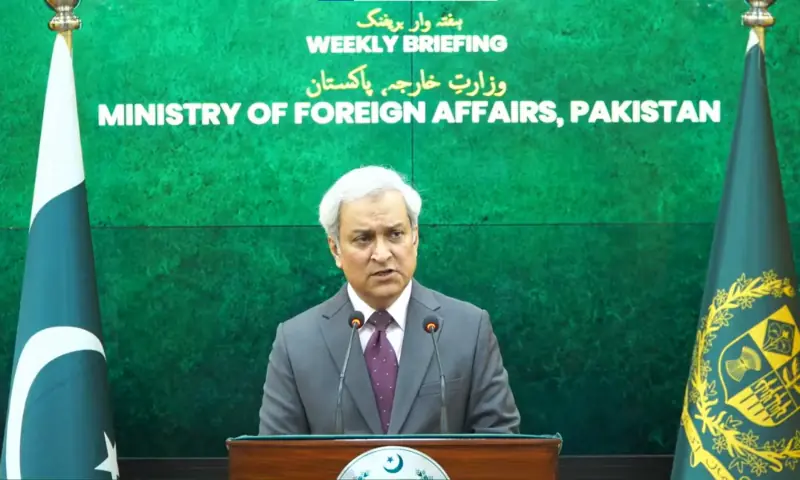
Speaking during the weekly media briefing, Foreign Office spokesperson Tahir Andrabi said Pakistan appreciates that the report acknowledges the country’s legislative progress and continued implementation of the 27 international conventions linked to the GSP+ programme. However, he said the overall assessment presents an unbalanced picture by placing greater emphasis on areas where progress has been slower while overlooking broader reforms.

Andrabi said Pakistan has introduced wide-ranging legal, administrative, and institutional reforms since joining the GSP+ scheme in 2014. He maintained that these reforms have strengthened governance, improved labour protections, promoted human rights, and supported sustainable economic development.

The spokesperson described GSP+ as one of the most important pillars of Pakistan’s economic partnership with the European Union. He said the preferential trade arrangement has played a significant role in boosting exports, creating employment opportunities, increasing women’s participation in the workforce, reducing poverty, and supporting economic growth.

He reaffirmed Pakistan’s commitment to constructive dialogue with the European Commission and other European institutions. According to Andrabi, the government remains fully committed to implementing international conventions and continuing reforms aimed at meeting its obligations under the GSP+ framework.

He also highlighted that Pakistan’s cooperation with the European Union extends beyond trade. Both sides continue to work together in areas including climate resilience, migration, regional security, counterterrorism, development, connectivity, education, and economic cooperation.

During the same briefing, the Foreign Office also rejected allegations made in a recent Amnesty International report regarding Pakistani military strikes in Kabul earlier this year.

Andrabi said Pakistan completely rejects the claims, arguing that the report contains serious allegations without credible evidence. He maintained that any military action taken by Pakistan was carried out solely in self-defence and targeted terrorist hideouts and logistical facilities.

He said the operations were conducted only after other options had been exhausted and fully complied with the principles of necessity, distinction, proportionality, and precaution under international law. He added that Pakistan exercised restraint despite facing repeated cross-border terrorist attacks.

The spokesperson urged the international community to focus greater attention on militant groups operating from Afghan territory. He said organisations such as the Tehreek-i-Taliban Pakistan (TTP), the Baloch Liberation Army (BLA), and other affiliated groups continue to maintain bases and carry out attacks against Pakistan from across the border.

Andrabi called on the Afghan Taliban authorities to fulfil their international commitments by preventing terrorist organisations from using Afghan territory for attacks against neighbouring countries. He said the continued presence of militant groups poses a serious threat to regional peace and security.

The Foreign Office reiterated that Pakistan reserves the right to take all necessary measures to defend its sovereignty, territorial integrity, and the safety of its citizens. Andrabi said no responsible state can ignore repeated attacks on its people and security forces.

Similar Posts

  • |

    Arab and Palestinian groups urge global action to protect Jerusalem and Al Aqsa Mosque

    Fourteen Arab and Palestinian organisations have issued an urgent appeal calling for immediate international action to protect occupied East Jerusalem and the Al Aqsa Mosque, warning that recent Israeli measures are threatening the city’s religious heritage and historic identity. The groups said the situation has reached a critical stage and argued that stronger global intervention is needed to prevent further escalation. In a joint statement released on Wednesday, the organisations expressed concern over what they described as increasing Israeli actions aimed at changing the existing status of Jerusalem and its holy sites. They said recent developments have targeted not only Al Aqsa Mosque but also the Palestinian residents of Jerusalem and the city’s Arab, Islamic, and Christian character. Al Aqsa Mosque is considered Islam’s third holiest site. The same area is also revered by Jews as the Temple Mount, believed to be the location of two ancient Jewish temples. Israel captured East Jerusalem during the 1967 Arab Israeli war and later declared the entire city its capital in 1980, a move that has not been recognised by most of the international community. According to the appeal, Israeli authorities have allowed an increase in visits to the Al Aqsa compound by Jewish groups under police protection. The organisations claimed these actions, along with restrictions placed on Muslim worshippers, are attempts to alter the long standing arrangements governing access to the holy site. The statement also raised concerns about attacks on worshippers, restrictions placed on religious leaders, and measures targeting guards responsible for protecting the mosque. The groups argued that these actions undermine freedom of worship and threaten the historical and legal status of one of Islam’s most important religious landmarks. Beyond the mosque itself, the organisations accused Israel of expanding settlements, demolishing Palestinian homes, revoking residency rights, carrying out excavations around the Old City, and increasing pressure on both Islamic and Christian religious sites. They warned that these policies are changing the city’s demographic and cultural landscape while placing Jerusalem’s diverse religious heritage at risk. The appeal also highlighted concerns over the city’s Christian community. It said restrictions affecting churches, religious institutions, and Christian leaders threaten the long established Christian presence in Jerusalem and weaken the city’s multicultural identity. The organisations argued that international statements of concern are no longer enough to address the situation. They called for coordinated political, legal, and human rights efforts to stop actions they consider violations of international law. They also urged governments and international institutions to ensure accountability and prevent further changes to the city’s status. The statement specifically called on Jordan, which holds custodial responsibilities for Jerusalem’s Islamic and Christian holy sites, to intensify diplomatic efforts and encourage stronger international engagement. The groups said Jordan’s role remains essential in defending the religious and historical significance of the city’s sacred places. Describing Jerusalem as a shared historical, cultural, and religious responsibility, the organisations stressed that protecting the city requires practical measures rather than symbolic declarations. They said preserving the rights of its residents and safeguarding its holy sites should remain an international priority. The appeal was signed by several organisations, including the Popular Conference for Palestinians Abroad, the Al Quds International Institution, the Arab National Congress, the European Palestinian Conference, and the Islamic National Conference. The statement comes as tensions continue to rise across the occupied West Bank, where Israeli military raids and settler related violence have increased since the start of the Gaza conflict in October 2023. Palestinian officials say thousands of people have been injured or arrested during this period, while violence has intensified further following recent deadly clashes near Nablus involving Palestinians, Israeli settlers, and Israeli forces.

  • Body of Missing British Tourist Joshua Kershaw Found in Thailand Hotel

    PATTAYA – The body of 21-year-old British tourist Joshua Kershaw was discovered in a hotel room in Thailand on Wednesday, January 21, 2026, days after he was reported missing. Hotel maids found him in the afternoon and alerted police, who attempted resuscitation before his body was taken from the scene. British Tourist Reported Missing in […]

  • |

    Brasilia reduces diplomatic presence in Buenos Aires following verbal attacks by Argentine leadership

    Brazil has formally downgraded its diplomatic representation in Argentina to the level of chargé d’affaires following renewed verbal insults directed by Argentine President Javier Milei toward Brazilian President Luiz Inácio Lula da Silva. The Ministry of Foreign Affairs confirmed that Brazilian Ambassador Julio Bitelli will not be returning to his post in Buenos Aires. The decision was triggered after Milei referred to the Brazilian head of state using derogatory terms, including calling him corrupt and an ex-convict, during a television interview with Argentine broadcaster LN+. Bitelli had initially been recalled late last month after Milei openly criticized Lula while appearing in São Paulo alongside opposition candidate Flavio Bolsonaro during the formal launch of his presidential campaign. Argentine Ambassador Daniel Raimondi was officially notified of the administrative downgrade in Brasília. The move marks a formal escalation in the deteriorating relations between South America’s two largest economies, whose leaders have not held a formal bilateral summit since Milei assumed office.

  • | | | |

    President Masoud Pezeshkian meets Supreme Leader M…

    TEHRAN: Iranian President Masoud Pezeshkian has held an important meeting with Supreme Leader Ayatollah Mojtaba Khamenei as speculation over the president’s future continues to attract attention amid heightened tensions with the United States and Israel. The meeting reportedly came as Pezeshkian entered the third year of his presidency. It also followed reports suggesting that the Iranian president was considering stepping down, claims he has rejected. Iranian authorities have previously dismissed resignation reports as unfounded, while Pezeshkian has publicly indicated that he intends to continue serving. According to statements attributed to Mojtaba Khamenei on social media, the discussions covered a wide range of economic, military and strategic issues facing Iran. Among the topics were the economic needs of ordinary Iranians, the country’s military situation, access to resources and management of the Iranian rial, foreign currency and energy costs. The two leaders also discussed economic relations with foreign partners and the wider implications of the confrontation with Washington and Israel. The meeting comes at a particularly sensitive moment for Tehran. Iran remains under pressure from the continuing regional conflict and economic difficulties, while efforts to engage Washington have faced repeated obstacles. The reported contact is also notable because Pezeshkian recently said that reaching Mojtaba Khamenei had been difficult, prompting speculation about the supreme leader’s health and whereabouts. Reports in recent days have offered conflicting accounts about how and where senior Iranian officials have been able to meet him. Meanwhile, Iran’s diplomatic efforts with the United States remain uncertain. According to the material cited by Iranian officials, negotiations have been reduced largely to messages exchanged through intermediaries after earlier attempts failed to produce a lasting agreement. The political backdrop has also been complicated by reported tensions between the presidency and powerful military-security institutions. Some reports have suggested disagreements over decision-making and the conduct of Iran’s response to the conflict, although details remain contested. Pezeshkian’s political position has therefore become a subject of renewed attention. He was elected president in July 2024 following the death of former President Ebrahim Raisi in a helicopter crash. Mojtaba Khamenei, meanwhile, became Iran’s supreme leader in March 2026 following the death of his father, Ayatollah Ali Khamenei, during the conflict. Against this backdrop, the latest meeting between the president and supreme leader carries significance beyond routine government business, particularly as Iran confronts economic pressures, military uncertainty and difficult relations with Washington. For now, however, Pezeshkian remains in office, while reports of his resignation have been publicly rejected.

  • |

    North Korea issues fresh warning to US allies

    PYONGYANG: North Korea has accused the United States, Japan and South Korea of creating a new security crisis in the Asia-Pacific, claiming their expanding military cooperation is increasing regional tensions and threatening stability. In a commentary published by the state-run Korean Central News Agency (KCNA), a military commentator alleged that the three allies are strengthening their joint combat capabilities through large-scale military exercises and closer defence coordination. The statement specifically criticized the recently concluded Rim of the Pacific (RIMPAC) naval exercise, describing it as a rehearsal for military aggression rather than a routine multinational drill. According to North Korean officials, the exercise involved more than 30,000 personnel, over 30 warships, five submarines and nearly 190 aircraft. Pyongyang claimed the United States is attempting to strengthen its military influence across the Asia-Pacific with the support of Japan and South Korea. It also objected to recent US-South Korea air force and logistics exercises, plans to expand American military command structures in Japan and the deployment of advanced US missile systems in the region. North Korea warned that it would respond to what it described as growing military threats by further strengthening its own deterrence capabilities. Officials said any increase in external pressure would be met with corresponding defensive measures. Separately, North Korea’s Foreign Ministry rejected recent accusations by the United States and its allies that Pyongyang poses a growing cyber threat. The ministry dismissed the allegations as politically motivated and without evidence. A foreign ministry spokesperson argued that the United States has been expanding military activities in cyberspace through cyber commands, joint cyber exercises and the use of artificial intelligence in defence operations. The spokesperson claimed Washington, rather than Pyongyang, was contributing to rising tensions in the cyber domain. North Korea reaffirmed that it would continue taking measures to safeguard its national security and protect its development interests against what it described as increasing pressure from Western countries.

  • Thailand Ends 60-day Visa-free Scheme For 93 Countries

    BANGKOK, Thailand — Thailand’s Cabinet has approved the cancellation of the pre-travel 60-day visa exemption scheme for citizens of 93 countries, a policy introduced two years ago to stimulate tourism and economic recovery, according to Tourism and Sports Minister Surasak Phancharoenworakul following the Cabinet meeting. Thailand Prepares To Halve Visa-free Stay For Tourists From 60 […]

Leave a Reply

Your email address will not be published. Required fields are marked *