Pakistan rejects EU GSP+ report, defends reform re…
Pakistan has expressed disappointment over the European Union’s latest assessment of the country’s performance under the Generalised Scheme of Preferences Plus (GSP+), saying the report does not accurately reflect the scale of reforms implemented over the past several years.
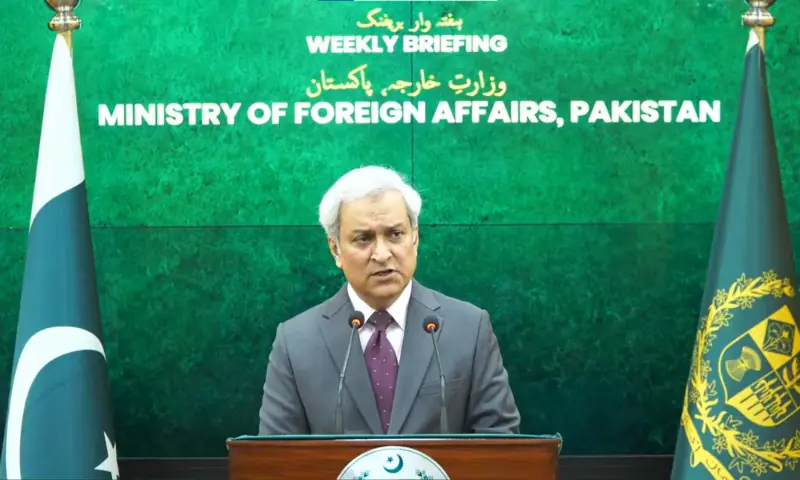
Speaking during the weekly media briefing, Foreign Office spokesperson Tahir Andrabi said Pakistan appreciates that the report acknowledges the country’s legislative progress and continued implementation of the 27 international conventions linked to the GSP+ programme. However, he said the overall assessment presents an unbalanced picture by placing greater emphasis on areas where progress has been slower while overlooking broader reforms.
Andrabi said Pakistan has introduced wide-ranging legal, administrative, and institutional reforms since joining the GSP+ scheme in 2014. He maintained that these reforms have strengthened governance, improved labour protections, promoted human rights, and supported sustainable economic development.
The spokesperson described GSP+ as one of the most important pillars of Pakistan’s economic partnership with the European Union. He said the preferential trade arrangement has played a significant role in boosting exports, creating employment opportunities, increasing women’s participation in the workforce, reducing poverty, and supporting economic growth.
He reaffirmed Pakistan’s commitment to constructive dialogue with the European Commission and other European institutions. According to Andrabi, the government remains fully committed to implementing international conventions and continuing reforms aimed at meeting its obligations under the GSP+ framework.
He also highlighted that Pakistan’s cooperation with the European Union extends beyond trade. Both sides continue to work together in areas including climate resilience, migration, regional security, counterterrorism, development, connectivity, education, and economic cooperation.
During the same briefing, the Foreign Office also rejected allegations made in a recent Amnesty International report regarding Pakistani military strikes in Kabul earlier this year.
Andrabi said Pakistan completely rejects the claims, arguing that the report contains serious allegations without credible evidence. He maintained that any military action taken by Pakistan was carried out solely in self-defence and targeted terrorist hideouts and logistical facilities.
He said the operations were conducted only after other options had been exhausted and fully complied with the principles of necessity, distinction, proportionality, and precaution under international law. He added that Pakistan exercised restraint despite facing repeated cross-border terrorist attacks.
The spokesperson urged the international community to focus greater attention on militant groups operating from Afghan territory. He said organisations such as the Tehreek-i-Taliban Pakistan (TTP), the Baloch Liberation Army (BLA), and other affiliated groups continue to maintain bases and carry out attacks against Pakistan from across the border.
Andrabi called on the Afghan Taliban authorities to fulfil their international commitments by preventing terrorist organisations from using Afghan territory for attacks against neighbouring countries. He said the continued presence of militant groups poses a serious threat to regional peace and security.
The Foreign Office reiterated that Pakistan reserves the right to take all necessary measures to defend its sovereignty, territorial integrity, and the safety of its citizens. Andrabi said no responsible state can ignore repeated attacks on its people and security forces.