
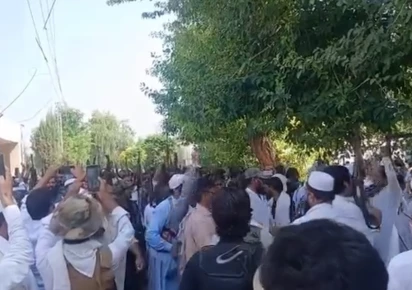
bannu police revolt
| |

Bannu police revolt over seven officials’ transf…

Police personnel in Bannu staged a protest on Tuesday against the transfer of seven Khyber-Pakhtunkhwa police officials to other districts, with the dispute disrupting policing and traffic management in parts of the district.

The protest was organised after the Police Peace Committee called on affected personnel to gather at the police lines and suspend their duties. Similar calls were reportedly made by peace committees in Lakki Marwat and Tank.

The protesters are demanding that the transfer orders be reviewed or withdrawn. They have warned that the protest could be expanded if their demands are not addressed.

Head of the Bannu Peace Committee Hazratullah said the boycott would continue until the transfer orders were cancelled. He said members of the peace committees had worked alongside police to maintain security and restore peace in Bannu, Lakki Marwat and Tank.

The boycott reportedly affected security arrangements at several important government and sensitive locations. The absence of traffic personnel also caused congestion at various points in Bannu and Lakki Marwat, leaving commuters facing delays.

The transfer orders were issued by the Peshawar Central Police Office on the directions of the Additional Inspector General. Seven personnel were moved to different districts and units.

Under the orders, Head Constable Nisar Ali was transferred from Police Lines Lower Dir to PTS Swat. Constable Ghulam Abbas Khan was moved from Elite Force Peshawar to Haripur, while Constable Muhammad Arif was transferred from Elite Force Peshawar to Dera Ismail Khan.

Constable Shafiullah was transferred from Investigation Bannu to Swat. Constable Muhammad Atif Khan was moved from Elite Force Bannu to Upper Chitral.

Meanwhile, Constable Samiullah was transferred from Lakki Marwat to the Counter Terrorism Department in Peshawar, while Constable Khalid Rahman was moved from District Traffic Mobile Lakki Marwat to Shangla.

Police personnel have argued that sudden transfers to distant districts could create difficulties for the affected officials and their families. They have called for the orders to be reconsidered.

Authorities have so far not issued a detailed official response to the reported boycott or confirmed whether disciplinary action will be taken against personnel who stopped performing their duties.

IGP transfer also under review

The protest comes amid uncertainty over the appointment of a new K-P inspector general of police. The proposed transfer of IGP Zulfikar Hameed was put on hold a day earlier as the federal government sought further consultations over the candidates proposed for the post.

Provincial government sources said the list of three senior police officers submitted for consideration could be revised. One name may be removed, while another officer could potentially be added before the appointment process resumes.

A senior police official said the transfer of the current IGP was not being actively pursued for the moment because of the worsening security situation in the southern districts.

The official said the provincial police chief was therefore likely to remain in his position temporarily while consultations between the federal and provincial governments continued.

Similar Posts

  • Tourists Injured in Terrifying 3 Vehicle Crash in Phetchabun, Thailand

    PETCHABUN – A terrifying three-vehicle crash occurred on a steep mountain curve leading up to Phu Thap Boek in Phetchabun province. The heavy collision involved a passenger van, a sedan, and a pickup truck carrying sixteen Thai and foreign tourists. Local emergency workers rushed to the scene shortly after noon to treat the victims and […]

  • Thai Actress Nana Rybena Arrested on Fraud Allegations Involving 190 Million Baht

    BANGKOK – Thai actress Nana Rybena was arrested by cybercrime police at her residence in Bangkok’s Phra Khanong district this morning on charges of public fraud and violations of the Lending Act. She was subsequently taken to the Central Investigation Bureau for questioning. Actress to be questioned by Thai police over her purchase of cyanide […]

  • | |

    Pakistan unveils star-studded civil awards

    The Government of Pakistan has announced its annual list of civil awards as part of the country’s Independence Day celebrations, honouring 372 individuals for their contributions across various fields. The recipients will be formally presented with their awards on Pakistan Day, March 23, next year. According to the announced list, 54 awards have been allocated for services to the arts, while 29 recognise contributions to literature and nine have been awarded in the field of sports. Several prominent names from Pakistan’s entertainment and cultural landscape have been included among this year’s recipients. Actors Sania Saeed, Maria Wasti and Mahmood Aslam, musicians Shiraz Uppal and Zulfiqar Jabbar Khan, better known as Xulfi, and television host Shafat Ali are among the notable awardees. In the arts category, Sultana Siddiqi has been selected for the Hilal-i-Imtiaz for her services to production, while Nisho Begum, Iftikhar Ahmed Thakur, Fasih Uddin Soharwardy, Shakir Hussain, Taranam Naz and several other prominent figures have been named for Sitara-i-Imtiaz and other civil awards. Mahmood Aslam, Sarfraz Hussain Ansari, M Ehtesham Warsi, Ghazala Kaifi, Shazma Haleem, Maria Wasti and Sania Saeed are among those receiving the President’s Award for Pride of Performance for their contributions to acting and direction. The list also recognises artists and musicians from different parts of the country. Classical musicians, singers, painters, sculptors, choreographers, qawwali performers and traditional craftsmen have been honoured for preserving and promoting Pakistan’s cultural heritage. Among the recipients are Xulfi, awarded for music; Aftab Zafar for painting and illustration; Nadeem Salamat for qawwali; Tayyeba Aziz for painting and sculpting; and several artists recognised for traditional crafts including embroidery, block printing, stone carving and regional handicrafts. The literature category features a wide range of writers, poets, playwrights and researchers. Asad Muhammad Khan has been selected for the Nishan-i-Imtiaz for his contributions to playwriting and poetry. Ejaz Rahim and Muhammad Khurshid Ul Hasan Rizvi are among those receiving the Hilal-i-Imtiaz, while writers including Shakeel Adilzada, Waheed Uz Zaman Tariq, Maqsood Hussain Jafri, Hashim Nadeem and other literary figures have been named for the Sitara-i-Imtiaz. The President’s Award for Pride of Performance in literature has also been awarded to several writers and poets, including Dr Shahida Shaheen, Ali Muhammad Farshi, Aslam Javed, Rehman Faris and other contributors to Urdu and regional literature. The government has also recognised contributions to sports. Atta Mohammad Kakar and Dr Waseem A Tai have been selected for the Sitara-i-Imtiaz for their services to boxing coaching and yoga, respectively. The President’s Award for Pride of Performance in sports includes wrest­ler Bashir Bhola, shooter Kishmala Talat, squash player Noor Zaman, ramp-jump performer Sultan Muhammad Golden, boxer Muhammad Waseem and cricketer Sadiq Muhammad. Athlete Faiqa Riaz has been named for the Tamgha-i-Imtiaz. The annual civil awards recognise individuals who have made notable contributions to Pakistan in areas including culture, literature, sports and the arts. The awards ceremony will be held on March 23, when the recipients will officially receive their respective honours.

  • |

    Eggs fly in Kosovo parliament as political crisis …

    PRISTINA: Kosovo’s parliament descended into chaos after opposition lawmaker Time Kadrijaj threw eggs toward acting Prime Minister Albin Kurti during a heated session, highlighting the deep political divisions gripping the country. Kadrijaj, a member of the Alliance for the Future of Kosovo, reportedly threw four eggs in Kurti’s direction while shouting “shame” as lawmakers debated the stalled formation of parliamentary institutions. The dramatic confrontation prompted security personnel and other lawmakers to intervene, and the session was suspended. The incident came after Kurti asked lawmakers for additional time to continue negotiations before proposing a candidate for the speaker of parliament. Kosovo has remained caught in a political deadlock following the June snap elections, with disagreements among political parties preventing the new institutions from being fully established. Kurti’s request for more time has angered opposition parties, which argue that the constitutional deadline has already expired. They have questioned the legality of continuing the parliamentary session under the circumstances. The confrontation inside parliament underscored the increasingly tense political atmosphere in Kosovo, where repeated disagreements have delayed key constitutional and institutional processes. Despite the disruption, Kurti appeared to remain composed. Reports said he indicated that he was willing to face criticism if it helped bring political rivals to the negotiating table. The political impasse follows June’s parliamentary election, in which Kurti’s Vetëvendosje movement emerged as the largest political force but failed to secure enough support to move forward without cooperation from other parties. Kosovo has experienced repeated political instability in recent years, with disagreements over the formation of institutions contributing to uncertainty over the country’s political direction. The egg-throwing incident has now become a striking symbol of that frustration, turning an already tense parliamentary dispute into an extraordinary scene that quickly attracted international attention. For Kosovo, however, the bigger issue remains unresolved: whether political parties can overcome their differences and break the institutional deadlock before the crisis deepens further.

  • |

    Government reviews splitting LESCO, MEPCO before privatisation

    The Ministry of Privatisation has established a high-level Technical Committee to examine the feasibility of dividing the Lahore Electric Supply Company (LESCO) and Multan Electric Power Company (MEPCO) into two or three smaller power distribution companies before their proposed privatisation, according to informed sources. The move is part of the government’s broader strategy to reform Pakistan’s power distribution sector and make state-owned electricity companies more attractive for private investment. LESCO and MEPCO currently serve the largest geographical areas and consumer bases among the country’s distribution companies (DISCOs), prompting officials to assess whether restructuring them into smaller entities could improve operational efficiency and facilitate the privatisation process. Technical Committee Constituted The committee is headed by Sajid Akram, Adviser (Power) at the Privatisation Commission. Other members include Ghulam Rasool, Joint Secretary at the Privatisation Commission; Imran Hafeez, Additional Director Tariff at the National Electric Power Regulatory Authority (NEPRA); and Abid Lodhi, Managing Director of the Power Planning and Monitoring Company (PPMC). The committee has been tasked with conducting a comprehensive review of the proposal and submitting recommendations to the government after evaluating its technical, operational and strategic implications. Weak Performance Raises Concerns Officials familiar with the matter said that both LESCO and MEPCO have consistently faced operational challenges, particularly in controlling electricity theft, reducing transmission and distribution losses, and improving bill recovery. These issues have affected their financial performance and have remained a major concern for policymakers pursuing reforms in the power sector. Recent audit reports for the fiscal year 2024-25 also highlighted unsatisfactory performance by both companies, reinforcing the need for structural reforms before moving ahead with the privatisation programme. MEPCO: Pakistan’s Largest Distribution Company MEPCO was incorporated in 1998 as a public sector company and operates under a permanent electricity distribution licence issued by NEPRA. The company is wholly owned by the Government of Pakistan through the Ministry of Energy. Serving nearly 8.76 million consumers across 13 districts of southern Punjab, MEPCO is the country’s largest electricity distribution company in terms of customer base. Its extensive network includes more than 82,000 kilometres of distribution lines and over 780 grid stations, supplying electricity across a vast region bordering three provinces. The company has initiated several modernisation projects, including the deployment of Advanced Metering Infrastructure (AMI), commonly known as smart metering, and digital billing systems aimed at improving transparency, reducing losses and enhancing customer services. LESCO Serving Over Seven Million Consumers LESCO also began operations in 1998 and supplies electricity to approximately 7.05 million consumers across Lahore, Kasur, Sheikhupura, Nankana Sahib and Okara. Its consumer base includes domestic, commercial, industrial, agricultural and bulk supply customers. The company’s operational network is divided into eight circles supervised by Superintending Engineers and 41 divisions managed by Executive Engineers to oversee field operations. In recent years, LESCO has accelerated efforts to modernise its infrastructure through the installation of smart meters, with plans to convert its entire consumer base to the Advanced Metering Infrastructure by 2029. However, the company continues to face significant operational hurdles, including shortages of transformers and electricity meters, resulting in delays in providing new connections and replacing faulty equipment. These issues have drawn criticism from regulators and consumers alike. Committee’s Terms of Reference According to the approved Terms of Reference (ToRs), the Technical Committee will: Assess the feasibility of splitting LESCO and MEPCO into two or three smaller distribution companies. Examine the potential advantages and disadvantages of such restructuring in line with the National Electricity Plan, the government’s Power Policy and the ongoing privatisation programme. Review whether similar committees were constituted in the past and analyse their findings, recommendations and implementation status. The committee’s recommendations are expected to play an important role in determining whether the government proceeds with restructuring the two major DISCOs before offering them for privatisation.

  • |

    Sophie Cunningham hits back after DiJonai Carrington’s ‘White Privilege’ post

    CHICAGO: A heated Indiana Fever-Chicago Sky matchup has sparked a fresh controversy in the WNBA after Sky guard DiJonai Carrington was ejected for a Flagrant 2 foul on Sophie Cunningham and later posted “WHITE PRIVILEGE” on social media. The incident happened during Saturday’s game in Chicago when Cunningham was driving toward the basket on a fast break. Carrington chased her down and struck Cunningham high around the head and neck, sending the Fever guard to the floor. After a video review, officials upgraded the foul to a Flagrant 2, which carries an automatic ejection. Cunningham immediately confronted Carrington before teammates stepped in to separate the players. Carrington later posted the words “WHITE PRIVILEGE” on Threads while tagging the Indiana Fever, bringing a racial dimension to an already tense incident. Cunningham strongly rejected that interpretation after the game. “I think the league is taking care of that. This has nothing to do with race,” Cunningham said, pointing out that she had previously been ejected for a similar incident and accepted the punishment at the time. She also described Carrington’s foul as unnecessary and said she believed there was intent behind the contact. “I’ve never really spoken to her and have no beef with her,” Cunningham said, adding that she believed Carrington had some pent-up frustration. Despite the confrontation, the Fever guard’s coach offered a more measured assessment of the incident. Indiana coach Stephanie White agreed that the Flagrant 2 call was appropriate but said she did not believe Carrington deliberately targeted Cunningham’s neck. White previously coached Carrington during their time with the Connecticut Sun. Carrington’s own coach, Tyler Marsh, also said he initially believed the play was a legitimate attempt to make a defensive play and had not immediately considered it a Flagrant 2. He said the team would address Carrington’s social media post internally. The controversy comes as Cunningham has already attracted considerable attention away from the basketball court because of her public comments about transgender athletes in women’s sports. Her views have prompted both supporters and protesters to appear around Fever games in recent weeks. The game itself ended in a 90-86 victory for Indiana, while Carrington’s early exit dramatically changed the contest. She had scored eight points in only four minutes before being ejected. Cunningham finished with three points in 17 minutes, with all three points coming from the free throws awarded after the flagrant foul. The latest clash adds another chapter to the increasingly intense rivalry surrounding the Fever, which has attracted enormous national attention. For now, the basketball incident has moved beyond the court, with questions about the foul, Carrington’s social media post and the wider debate surrounding Cunningham continuing to generate discussion across the WNBA.

Leave a Reply

Your email address will not be published. Required fields are marked *