drone attack near
|

Drone attack near Moscow kills 5, injures 6

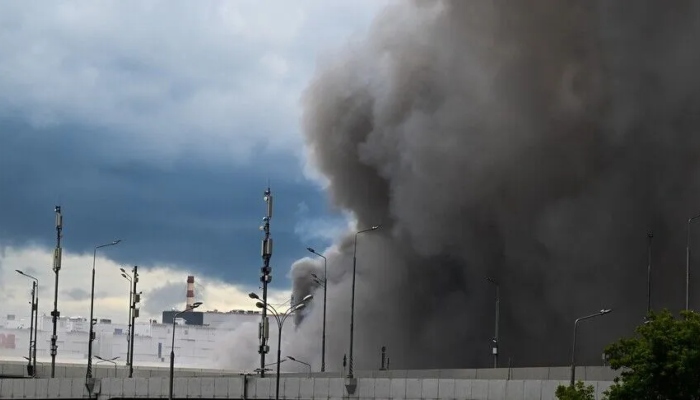
A drone attack in the Moscow region has killed at least five people and left six others critically injured, according to Russian news agencies.

The attack reportedly struck an area near the Russian capital, causing a fire inside a warehouse. The blaze added to the damage caused by the drone strike and prompted emergency responders to move quickly to the scene.

Rescue workers and medical teams are assisting those affected by the incident, while the injured victims have been taken for medical treatment. Officials have described the condition of six injured people as critical, raising concerns that the death toll could increase in the coming hours.

Authorities are assessing the extent of the damage and continuing emergency operations at the site. The exact circumstances surrounding the drone attack, including the origin of the drones and the intended target, have not yet been fully established.

The incident comes amid heightened security concerns in and around Moscow, where drone attacks have periodically targeted the Russian capital and surrounding areas. Such incidents have prompted authorities to strengthen air-defence measures and increase security around key infrastructure and industrial facilities.

Russian officials are expected to provide further details as emergency teams complete their work and investigators examine the scene. The latest attack has once again highlighted the growing security challenges posed by drone warfare and its potential impact on civilian areas and critical facilities.

Similar Posts

  • | |

    Why did Trump share Muhammad Ali’s iconic fi…

    US President Donald Trump has ignited widespread debate on social media after sharing footage of Muhammad Ali’s legendary “Rumble in the Jungle” boxing match against George Foreman, prompting users to speculate about the message behind the post. The iconic 1974 heavyweight title fight is regarded as one of the greatest contests in boxing history. Trump’s decision to post the famous bout quickly attracted attention, with many users questioning whether it carried a political message related to ongoing tensions with Iran or was aimed at domestic American politics. The White House has not issued any statement explaining the context of Trump’s post, leaving room for widespread speculation online. The “Rumble in the Jungle,” held in Kinshasa, then Zaire (now the Democratic Republic of the Congo), remains one of the most memorable moments in sporting history. During the fight, George Foreman appeared dominant in the early rounds, repeatedly landing powerful punches while Ali relied on his now-famous “rope-a-dope” strategy. Instead of engaging aggressively, Ali absorbed Foreman’s attacks while leaning against the ropes, conserving energy and allowing his opponent to tire himself out. By the eighth round, Foreman had slowed significantly, giving Ali the opportunity to launch a stunning counterattack that ended with a dramatic knockout victory. Trump’s decision to revisit the historic fight has divided social media users. Some interpreted the post as a symbolic message about patience, strategy and turning the tide against a stronger opponent. Others argued it may have been intended to comment on current geopolitical developments, while another group believed it was linked to US political dynamics ahead of upcoming policy battles. Despite the growing online discussion, Trump has not clarified the purpose of sharing the video. As speculation continues, the post has once again brought Muhammad Ali’s legendary triumph back into the global spotlight, reminding sports fans why the “Rumble in the Jungle” remains one of the most iconic victories in boxing history.

  • |

    Egypt may join Pakistan, Türkiye, Saudi defence pact

    Egypt could become the next country to join the Makkah Joint Defence Agreement signed by Pakistan, Türkiye and Saudi Arabia, Turkish Foreign Minister Hakan Fidan has said. Fidan said the defence pact is broadly comparable to NATO’s mutual defence principle. He stressed that the agreement is not aimed at Iran or any other country. According to the Turkish foreign minister, the pact is designed to provide a framework for the three countries to support each other’s security. He said the member states would consult each other in the event of an attack. They would then determine the nature and level of assistance required. Fidan said Türkiye’s President Recep Tayyip Erdogan wants the alliance to expand beyond its three founding members. Egypt is among the countries being considered for possible membership. He said some technical issues would need to be resolved before Egypt could join the arrangement. Fidan explained that the alliance would begin with Pakistan, Türkiye and Saudi Arabia. He said the members intended to take gradual but practical steps to build the new security framework. A ministerial committee similar to structures used within NATO is also expected to be established. The alliance will also have a general secretariat based in Saudi Arabia. Further operational details are expected to be discussed during the first meeting of the proposed committee. Fidan said the agreement was the result of negotiations that had continued for more than two years. He also stressed that the new arrangement would not replace existing military alliances. The Turkish minister said the pact was intended to strengthen regional cooperation. He said it could eventually bring more countries together under a common security framework. Meanwhile, the Organisation of Islamic Cooperation welcomed the signing of the agreement. OIC Secretary General Hissein Brahim Taha expressed strong support for the pact. He described it as an important strategic development for regional and international cooperation. Taha said the agreement could contribute to security and stability across the region and the wider Muslim world. He also praised the leadership of Pakistan, Türkiye and Saudi Arabia. He said their efforts had resulted in what he described as a historic agreement. The pact was signed on Friday during a trilateral summit in Makkah. Turkish President Recep Tayyip Erdogan, Saudi Crown Prince Mohammed bin Salman and Prime Minister Shehbaz Sharif signed the agreement at Al-Safa Palace. Under the agreement, the three countries have committed to strengthening defence cooperation and collective security. The pact also seeks to promote peace, stability and prosperity. Officials said the agreement is not directed against any country. They said it is based on a shared approach to security and burden-sharing. The agreement also establishes a collective deterrence principle. An armed attack against any one of the three member states will be treated as an attack against all three.

  • | | |

    Pakistan stands with Nepal after broad peak avalan…

    Pakistan has expressed solidarity with Nepal following the tragic avalanche on Broad Peak in the Karakoram mountain range, where members of an international mountaineering expedition were caught in a deadly snow slide. Prime Minister’s Adviser on Inter-Provincial Coordination, Senator Rana Sanaullah, said Pakistan shares the grief of the Nepalese people and remains committed to supporting rescue efforts. According to Rana Sanaullah, the avalanche struck a team of 10 international climbers attempting to scale Broad Peak. The expedition included six climbers from Nepal, along with mountaineers from Pakistan, the United States, China, and Oman. He said the Government of Pakistan immediately prioritized search and rescue operations after the incident. So far, the bodies of four climbers have been recovered, including Nepalese mountaineer Pur Bahadur Gurung. Rescue teams continue to search for the remaining missing climbers despite difficult terrain and severe weather conditions. Rana Sanaullah stated that the Pakistan Army and other relevant agencies are carrying out extensive rescue operations using helicopters, drones, and all available resources. He noted that challenging weather and the remote mountainous landscape have made rescue efforts extremely difficult, but authorities remain fully committed to locating the missing climbers. The adviser explained that search teams are utilizing GPS tracking, aerial surveillance, and ground search missions to maximize the chances of finding those still unaccounted for. He emphasized that rescue operations will continue without interruption until every possible effort has been exhausted. Expressing condolences to the families of the victims, Rana Sanaullah said Nepalese climbers, along with other international mountaineers, are highly respected in Pakistan for their contributions to global mountaineering. He added that Pakistan values its long-standing friendship with Nepal and stands with the families affected by the tragedy during this difficult time. He further reaffirmed that the government will continue to deploy all available resources until the search mission is completed. Pakistan, he said, remains committed to assisting the international climbing community and ensuring that every effort is made to locate the missing members of the expedition. The Broad Peak avalanche has once again highlighted the dangers of high-altitude mountaineering in the Karakoram, where unpredictable weather, avalanches, and challenging terrain continue to pose significant risks even to experienced climbers. Authorities have pledged to maintain rescue operations while closely monitoring weather conditions to ensure the safety of rescue personnel.

  • | | |

    Why is the risk of an India-China clash rising in …

    Tensions along the India-China border remain a major security concern, particularly in Arunachal Pradesh despite recent efforts by both countries to improve relations and maintain peace along their disputed frontier. India’s National Security Adviser Ajit Kumar Doval and Chinese Foreign Minister Wang Yi recently held talks in Beijing on the long-running border dispute. The meeting marked the 25th round of discussions between the two countries special representatives on the boundary issue. Following the talks China’s Ministry of Foreign Affairs said Wang Yi emphasized the importance of stable relations between China and India. He described the two countries as important neighbours and emerging economies arguing that improved and stable bilateral relations are in the fundamental interests of both populations. According to the Chinese statement Wang called for a strategic and long-term approach to bilateral relations stronger communication and efforts to reduce differences. He also urged both sides to remove obstacles and promote cooperation as good neighbours and friendly partners. Doval also struck a conciliatory tone during the discussions. According to the Chinese statement he said India and China are ancient civilizations with large populations and important economies adding that the two countries should be viewed as partners rather than rivals. Doval reportedly said that under the guidance of the leadership of both countries India-China relations had returned to the right track. He also said overall peace had been maintained in border areas and that exchanges and cooperation in several fields were making progress. However, the disputed border remains a sensitive issue. Arunachal Pradesh is particularly important because China claims large parts of the Indian-administered territory and refers to the region as “Zangnan” or southern Tibet. India firmly rejects China’s territorial claims and considers Arunachal Pradesh an integral part of the country. The two sides have previously experienced serious confrontations along the Line of Actual Control making border management and military deployments highly sensitive. During the latest talks both sides discussed advancing negotiations on boundary demarcation strengthening border management mechanisms improving procedures and expanding cross-border cooperation. Although the latest diplomatic engagement indicates that both countries are seeking to prevent further escalation unresolved territorial claims and military activity continue to create the possibility of confrontation. The key challenge for India and China will be to maintain dialogue while managing their competing territorial claims and preventing local disputes from developing into a broader military crisis.

  • |

    Gazans welcome Hamas disarmament plan but remain doubtful of Israeli withdrawal

    Many Palestinians in Gaza have cautiously welcomed reports that Hamas has agreed to disarm under a new United States backed proposal, hoping it could eventually bring an end to the devastating conflict. However, despite this small sign of progress, many remain unconvinced that Israel will withdraw its forces or that lasting peace is within reach. US President Donald Trump recently announced that Hamas had accepted a plan to surrender its weapons as part of a broader roadmap aimed at stabilising Gaza and beginning reconstruction. Hamas later confirmed the agreement. Even so, Israeli military operations have continued, leaving many residents uncertain about whether the proposal will lead to any real change. Thousands of families remain displaced, while many others continue living in overcrowded tent camps where shortages of food, clean water, medicine and proper sanitation have created severe humanitarian conditions. Disease outbreaks and poor living conditions have become an everyday reality for much of the population. For many Palestinians, survival remains the immediate concern. Abdel Moneim Aboul Roos, a 24 year old tuk tuk driver who lost a leg in an Israeli airstrike, said discussions about disarmament and troop withdrawals mean little while people continue to struggle for basic necessities. He said access to food and medical care matters more than political agreements that have yet to improve conditions on the ground. The latest proposal builds on a ceasefire agreement reached last year with US support. That deal ended large scale fighting for a period, secured the release of Israeli hostages and increased humanitarian aid entering Gaza. It also included plans for a gradual Israeli military withdrawal, the formation of an international stabilisation force and the dismantling of Hamas’ weapons. However, the agreement soon stalled as both Israel and Hamas accused each other of violating its terms. Hamas retained its weapons while Israeli forces remained in the territory, causing negotiations to break down. The newly announced roadmap provides more detailed arrangements for transferring Hamas’ weapons to a technocratic Palestinian administration. According to the proposal, Israel would not participate in the disarmament process and would instead halt military operations to allow political transition and reconstruction efforts to move forward. Despite these commitments, many Gazans remain deeply sceptical because previous promises of peace failed to deliver lasting results. Displaced resident Ayman Ahmed said people have repeatedly been told that the war would end, only to see the violence continue. While he hopes Hamas eventually lays down its arms, he believes such a step is unlikely in the near future and expressed frustration that ordinary Palestinians continue to suffer while political leaders remain divided. The conflict began after Hamas launched its October 2023 attack on southern Israel, killing around 1,200 people and taking hundreds of hostages. Israel responded with a large military campaign in Gaza that has caused widespread destruction and heavy casualties. According to Gaza health authorities, more than 73,000 Palestinians have been killed during the war, while the fighting has displaced most of the territory’s population. The figures do not distinguish between civilians and fighters, although officials say women and children account for a large share of those killed. Many residents also fear that Israel has no intention of fully leaving Gaza even if Hamas is disarmed. Israeli officials have not publicly endorsed the latest roadmap and anonymous government sources have suggested that it does not match Israel’s security objectives. They have also indicated that Israeli forces intend to remain along the Yellow Line, a military zone separating Israeli controlled territory from the rest of Gaza. The military has strengthened its positions in these areas by building defensive barriers and carrying out demolition operations, leaving many displaced families uncertain whether they will ever return to their homes. Despite these fears, many Palestinians continue to hold onto hope. Anas Nakla, whose home in Rafah was destroyed during the war, said he still dreams of returning with his family even though nothing remains of his house. Mohamed Hamad, displaced from northern Gaza, believes that if the new plan results in even a partial Israeli withdrawal, it would restore hope that one day all displaced families could rebuild their lives in their own communities.

  • | |

    US imposes 10 per cent tariff on Pakistan over forced-labour enforcement

    The United States has levied a 10 per cent tariff on Pakistani goods under a broader Section 301 trade action targeting 60 economies for their failure to adequately prohibit and enforce bans on imports produced with forced labour. According to the Office of the U.S. Trade Representative (USTR), the final action followed investigations directed by President Donald Trump in March, encompassing public hearings and consultations with numerous governments. Ambassador Jamieson Greer stated that trading partners must match the enforcement standards the United States has upheld, noting that decades of moral persuasion have failed to eradicate forced labour from global supply chains. Pakistan is grouped in the 10 per cent tariff bracket alongside nations such as India, Bangladesh, Mexico, and the United Kingdom. These countries either imposed a prohibition on forced-labour imports, committed to one through a trade agreement, or introduced a partial restriction regime, while other investigated economies face tariffs of up to 12.5 per cent. The new duties arrive at a critical juncture for Islamabad. Pakistan has recently positioned itself as a key mediator in the US-Iran conflict and deepened its security partnership with Saudi Arabia, including the deployment of air-defence assets. However, the conflict has already strained Pakistan’s economy, with shipping disruptions in the Strait of Hormuz driving up domestic petroleum prices amid high inflation. Textiles and apparel, a primary focus of the USTR’s forced-labour investigation, represent a significant portion of Pakistan’s exports to the US. Industry groups are expected to evaluate the impact of these tariffs on market competitiveness in the coming days. The USTR noted that product exemptions will apply in limited cases, including critical raw materials and goods that cannot be sourced reasonably from elsewhere. Islamabad has yet to issue a formal response to the tariff imposition.

Leave a Reply

Your email address will not be published. Required fields are marked *