indian activists challenge
|

Indian activists challenge AI-powered police surveillance following student demonstrations

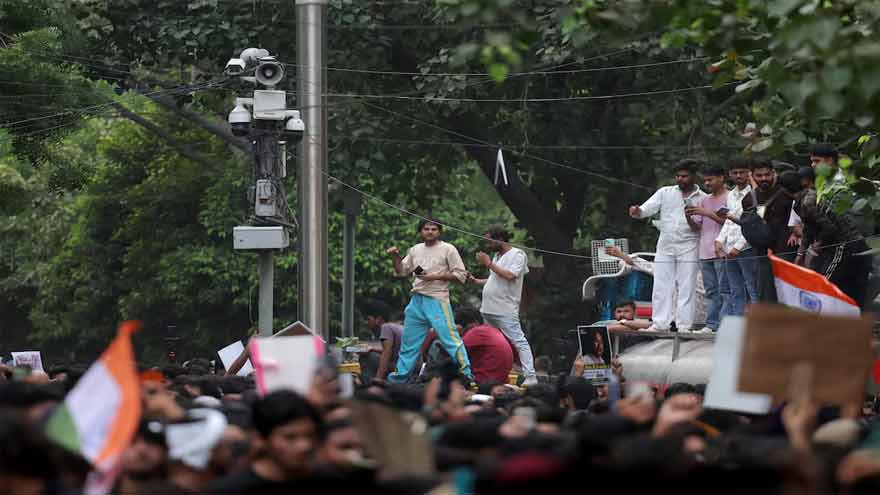
Indian digital rights activists and student leaders are challenging Prime Minister Narendra Modi’s government in the Delhi High Court over the deployment of artificial intelligence-powered mass surveillance during recent youth protests in New Delhi.

Student activist Aishe Ghosh filed a petition with the Delhi High Court seeking to declare the police’s mass surveillance of demonstrators unconstitutional. The lawsuit requests the immediate destruction of all personal and biometric data collected during the demonstrations and asks the court to establish clear binding guidelines governing the use of surveillance technologies at public gatherings.

The controversy intensified after photographs circulated showing a mobile police surveillance unit, branded “Ikshana” and developed alongside security firm CP Plus, deployed at the main protest site. The vehicle featured telescopic masts providing 360-degree coverage, AI-powered cameras, and real-time facial recognition capabilities that displayed face accuracy metrics to match attendees against law enforcement databases.

Furthermore, police officers were documented recording the social media handles of arriving participants. Digital rights organisations, including the Internet Freedom Foundation, have formally requested the Delhi Police Commissioner to delete all biometric data gathered during the events.

Advocates emphasise that India currently lacks a dedicated legal framework governing police deployment of facial recognition systems, making such intrusive measures disproportionate and illegal.

During court proceedings, Solicitor General Tushar Mehta defended law enforcement actions, arguing that expectations of privacy at a public gathering were misplaced and asserting that the security measures were absolutely necessary in the interest of public order.

Delhi Police maintained that the technology was used solely to identify individuals with criminal histories and count crowd size without restricting freedoms.

The court challenge continues despite the end of the student demonstrations, which were triggered by widespread examination paper leaks in national competitive tests.

The protests culminated in the resignation of Union Education Minister Dharmendra Pradhan and the announcement of a government panel tasked with overhauling the national examination system.

Similar Posts

  • |

    Fifty UK police chiefs urge prime minister to halt early release of PC Harper’s killers

    Fifty police chiefs from across the United Kingdom have sent a joint letter to Prime Minister Andy Burnham, urging the government to exhaust every legal avenue to prevent the early release of the teenagers convicted in the 2019 death of PC Andrew Harper. PC Harper, a 28-year-old Thames Valley Police officer, died after being dragged behind a getaway car following a quad bike theft in Berkshire. Two of the men convicted of his manslaughter, Jessie Cole and Albert Bowers, were sentenced to 13 years in 2020. Under recent legislative changes to manage severe prison overcrowding, both men are due to become eligible for release in January after serving half their sentences. The intervention by police chiefs across England, Scotland, Wales, and Northern Ireland supports Burnham’s recent declaration that he is confident a legal resolution can be found to halt their discharge. In Downing Street, officials reiterated that the government intends to do everything within its power to block the early release. Beyond the specific case, the letter highlights broader concerns regarding public safety, victim impact, and officer morale. The police chiefs argued that reducing sentences for individuals involved in the deaths of emergency service personnel undermines the perceived sacrifice of officers who put themselves in harm’s way to protect the public. The police leaders called on the government to mandate explicit public protection reviews before amending release terms for offenders convicted of serious violence or causing death, while also ensuring bereaved families are formally consulted whenever significant sentencing changes are implemented.

  • |

    Spain hero Marc Cucurella’s hairstyle has an emotional secret

    Spain’s FIFA World Cup-winning defender Marc Cucurella has become known around the world for his distinctive long, curly hair. But behind the trademark look lies a deeply personal story of love, fatherhood and unwavering support for his family. Following Spain’s World Cup triumph over Argentina, renewed attention has focused on the emotional reason Cucurella has chosen to keep his hair long. According to media reports, the Spanish international deliberately leaves his curls untied during matches so that his eldest son, Mateo, who has autism, can easily recognize him on the pitch. For Cucurella, his hairstyle is far more than a fashion statement. It is a symbol of his bond with his son and a reminder of the responsibilities and love that come with being a father. The touching story has resonated with football fans around the world, offering a glimpse into the personal challenges the defender has faced away from the spotlight. Reports say Cucurella and his partner, Claudia Rodríguez, went through an emotionally difficult period after Mateo was diagnosed with autism. In an Amazon Prime documentary, Rodríguez recalled how the couple struggled when they realized their son was developing differently from other children. She revealed that the experience was emotionally overwhelming. There were days when Cucurella would take Mateo to school and return home in tears, all while the family was preparing to welcome their second child, Rio. Cucurella has also spoken openly about how difficult it was to come to terms with his son’s diagnosis. However, he said the experience strengthened his commitment to supporting his family through every challenge. As Spain celebrates its World Cup success, Cucurella’s story has become an inspiring reminder that behind every sporting hero is a personal journey filled with sacrifice, resilience and unconditional love. For many fans, his iconic hairstyle now represents something far greater than football—it reflects the enduring power of family.

  • | |

    NCLEX programme under fire: only 7 nurses pass out…

    Islamabad: A Government backed programme designed to help Pakistani nurses qualify for international jobs came under strong questioning in the National Assembly after lawmakers raised concerns over the transparency, student selection and results of the NCLEX Nursing Training Programme. The National Assembly Standing Committee on Federal Education and Professional Training questioned how a Rs 150 million programme selected its training partner and why only seven nurses had cleared the NCLEX exam out of 500 trainees so far. The committee supported opportunities for Pakistani nurses to work abroad but demanded complete transparency regarding the programme’s planning, the selection of the implementing partner, and the use of public money. The issue was discussed during the 25th meeting of the committee, where members reviewed the performance and implementation of the NCLEX Nursing Training Programme launched by the National Vocational and Technical Training Commission (NAVTTC). NAVTTC Executive Director Muhammad Amir Jan informed the committee that before this initiative, Pakistani nurses had to travel to countries such as Dubai, Bahrain, Turkey and Thailand to appear in the NCLEX examination. He said that with support from SIFC, NAVTTC was given responsibility to bring the examination system to Pakistan for the first time through Pearson VUE during 2024 and 2025. Officials informed the committee that the programme was designed to train 500 nurses. The training phase has been completed, 182 nurses have applied for the NCLEX examination and seven nurses have successfully cleared the test. However, members questioned the low success rate and asked whether the programme was producing the expected results. One committee member pointed out that seven successful candidates out of 500 trainees represented a very small percentage and questioned whether the programme needed improvements before more public funds were spent. NAVTTC officials defended the programme, saying that NCLEX is a difficult international examination and nurses who pass the test still require additional time before moving abroad for employment. Officials said nurses might need eight to eighteen months after passing the exam before they can travel for work opportunities. The committee also raised questions about the selection of the implementing partner, the Institute of Contemporary Studies. Members questioned whether a public advertisement was issued before selecting the organisation or if other institutions were given an opportunity to compete. They said programmes funded through public money must follow transparent procedures to maintain public confidence. NAVTTC officials explained that the programme was developed under an industry led model and was based on a proposal received from the Pakistan Nursing and Midwifery Council. They said such programmes do not always follow open advertisement procedures because they are based on specific industry requirements. However, members questioned whether a government body could recommend a specific private organisation without a competitive process. The committee also raised concerns about the role of the Pakistan Nursing and Midwifery Council. Members noted that in previous discussions, representatives of the council had stated they were not fully aware of the nurse selection process and training arrangements. NAVTTC officials responded that the council had formally approached NAVTTC for the project and that decisions taken by government bodies should be accepted by all stakeholders involved. Financial matters also came under discussion. NAVTTC informed the committee that the total project cost was Rs 150 million and that Rs 87 million had been released so far. Officials clarified that the remaining funds would be released only after achieving agreed results under a performance-based payment system. They said a bank guarantee was also available to protect government funds. The committee also questioned the quality and locations of the training centres. MNA Dr Shazia Sobia Aslam Soomro raised concerns about some training locations, including Matta in Swat, and asked how proper facilities and monitoring were ensured in those areas. NAVTTC officials responded that Khyber Medical University conducted training in Matta and promised to provide complete details of nurses trained there. Questions were also raised about trainer qualifications. Members asked how individuals with nursing degrees could provide NCLEX preparation training. Officials explained that trainers must themselves be NCLEX qualified according to programme requirements. The committee further discussed the selection of nurses for training. NAVTTC officials said their role was to set eligibility criteria, not directly select candidates. They explained that under the pay for success model, the training provider selects participants because the provider is responsible for results. At the conclusion of the meeting, the committee decided to invite the Pakistan Nursing and Midwifery Council in the next session to clarify the selection process of nurses and the appointment of the training partner. Chairperson Mahtab Akbar Rashdi said that every concern must be properly addressed because public funds were involved and the programme was created to provide international opportunities for Pakistani nurses.

  • |

    China and Japan give conflicting accounts of ministers’ ASEAN meeting

    China and Japan have offered different versions of whether their foreign ministers spoke during last week’s ASEAN meetings in the Philippines, highlighting the continued strain in relations between the two neighboring countries. Japanese Foreign Minister Toshimitsu Motegi said after the regional gathering that he had briefly spoken with Chinese Foreign Minister Wang Yi when the two crossed paths during the event. According to Motegi, the short conversation included discussion about bilateral relations, which Japan considers an important step in maintaining communication despite ongoing tensions. However, China’s Foreign Ministry rejected that account. Speaking at a regular press briefing on Monday, spokesperson Lin Jian said Wang Yi had no meeting scheduled with the Japanese side during his visit to Manila and insisted that no informal conversation or exchange took place at the venue. The conflicting statements reflect the growing diplomatic divide between Beijing and Tokyo, whose relationship has worsened significantly since last November. The decline followed comments by Japanese Prime Minister Sanae Takaichi regarding Taiwan, which China strongly condemned. Japan has expressed interest in improving ties with China and continues to support dialogue at every level. Motegi said maintaining communication is essential because both countries play a major role in preserving peace and stability across the region. Although he described his interaction with Wang as a discussion on bilateral relations, Japanese media reported that the exchange was limited to greetings and brief pleasantries. Prime Minister Takaichi said on Monday that contacts between the two governments remain active through various diplomatic channels, including the exchange Motegi referred to during the ASEAN meeting. The current tensions stem from remarks Takaichi made shortly after becoming prime minister. During a parliamentary session, she was asked whether a Chinese military blockade or attack on Taiwan could trigger Japan’s collective self defense policy. She replied that such a situation could threaten Japan’s survival and therefore might meet the legal conditions for military involvement alongside an ally, most likely the United States. China viewed those comments as crossing a major diplomatic red line. Beijing considers Taiwan part of its territory and strongly opposes any statement or action that it believes supports Taiwan’s independence or suggests foreign military involvement in a future conflict. Taiwan, meanwhile, governs itself independently despite China’s territorial claims. Although Takaichi later said she would avoid discussing specific military scenarios in future parliamentary debates, she has refused to withdraw her original remarks. Her position has continued to frustrate Beijing and has made efforts to restore stable relations more difficult. The dispute has affected more than diplomacy. Economic ties have also been impacted, with reports of fewer Chinese tourists visiting Japan and growing concern in both countries over each other’s expanding military capabilities. The disagreement over what happened during the ASEAN meeting has become another sign of the deep mistrust that continues to shape relations between Asia’s two largest economies.

  • | | |

    Dar targets $20bn Pakistan-US trade

    Deputy Prime Minister and Foreign Minister Ishaq Dar has expressed confidence that Pakistan and the United States can increase bilateral trade in goods to $20 billion within the next five years. Dar said Pakistan’s trade in goods with the US stood at $9.4 billion during the last fiscal year. He described the US as Pakistan’s largest single-country export market. Addressing a US Congressional Delegation and American business representatives, Dar said stronger trade and investment ties could create new opportunities for companies in both countries. He said closer economic cooperation could also generate employment, encourage innovation and support long-term economic growth. Dar highlighted several areas where Pakistan and the US could expand commercial cooperation. These include information technology, artificial intelligence, energy, manufacturing, agriculture and critical minerals. He said Pakistan is already an important buyer of American cotton and soybeans. The country is also becoming a growing market for US hydrocarbons. At the same time, Pakistan’s increasing demand for advanced machinery, technology and capital goods could create opportunities for American manufacturers, he added. Dar said the presence of more than 80 US companies in Pakistan demonstrated growing confidence in the country’s market and economic potential. He welcomed the interest shown by American companies in Pakistan’s technology, energy, critical minerals and defence sectors. The foreign minister also pointed to the US Exim Bank’s $1.25 billion financing for the Reko Diq project as an indication of increasing US confidence in Pakistan’s investment prospects. Dar encouraged American businesses to establish partnerships with Pakistani companies and explore long-term investment opportunities. He said Pakistan had improved its infrastructure over the past decade through modern highways, ports and logistics networks. These developments, he added, had strengthened the country’s position as a potential trade and investment gateway. The government is also working to make the business environment more investor-friendly. Dar said regulatory procedures had been simplified to reduce bureaucratic delays and make licensing and approvals easier. He said Pakistan wanted to deepen cooperation with the US across both goods and services. Technology, AI, energy, manufacturing, critical minerals and agriculture were among the sectors identified for greater collaboration. Dar also highlighted the broader improvement in Pakistan-US relations. He said frequent high-level contacts under Prime Minister Shehbaz Sharif and US President Donald Trump had helped strengthen bilateral engagement. He said his meetings with US Secretary of State Marco Rubio had also focused on strengthening relations and discussing regional developments. The foreign minister stressed that parliamentary engagement was equally important. He said regular interaction between lawmakers could improve mutual understanding and strengthen institutional ties. Dar said Pakistan’s engagement with the US Congress had increased significantly over the past year. The interaction has included lawmakers from both political parties and key congressional committees. The two countries also discussed regional security and stability. Dar said stronger Pakistan-US relations could contribute to peace and stability in the wider region. He also recalled Pakistan’s role in facilitating dialogue between the US and Iran. Dar said Islamabad remained committed to dialogue, diplomacy and peaceful solutions to regional disputes. The foreign minister separately received a US congressional delegation comprising Representatives Ryan Zinke and Michael James Baumgartner. During the meeting, both sides discussed ways to expand cooperation in trade, investment, IT, energy and other areas. The US lawmakers acknowledged the contribution of the Pakistani community to American society and economy. They described the diaspora as an important link between the two countries.

  • |

    India Temple stampede leaves 7 dead, dozens injure…

    NEW DELHI: A crowded morning of worship turned tragic at the Ashok Dham Temple in India’s Bihar state on Monday after a stampede-like incident killed at least seven devotees and injured more than a dozen others. The incident occurred in Lakhisarai district as thousands of worshippers gathered at the temple on the third Monday of the Hindu month of Sawan. Local reports said the crowd surged suddenly, creating panic outside the shrine. Officials said the arrival of two trains between around 6:30am and 6:45am sharply increased the number of people near the temple. The sudden rush reportedly caused a barricade to break, leaving people falling over one another. Initial reports also suggested that an electrical pole or wire may have fallen, triggering panic among worshippers. Authorities have yet to establish the exact sequence of events, and an investigation is underway. Emergency teams and district officials rushed to the scene after the incident. Several injured people were taken to nearby hospitals for treatment, while authorities worked to restore order and manage the remaining crowds. The tragedy has renewed concerns about crowd-control arrangements at major religious gatherings in India, where large numbers of devotees often converge at temples during important festivals. Officials said rescue and relief operations were continuing, while authorities were monitoring the situation around the temple. The incident comes as religious sites across the region experience heavy attendance during the Sawan season, highlighting the importance of effective crowd management, emergency access and safe movement routes.

Leave a Reply

Your email address will not be published. Required fields are marked *