canvas color rescued
|

How canvas and color rescued Winston Churchill

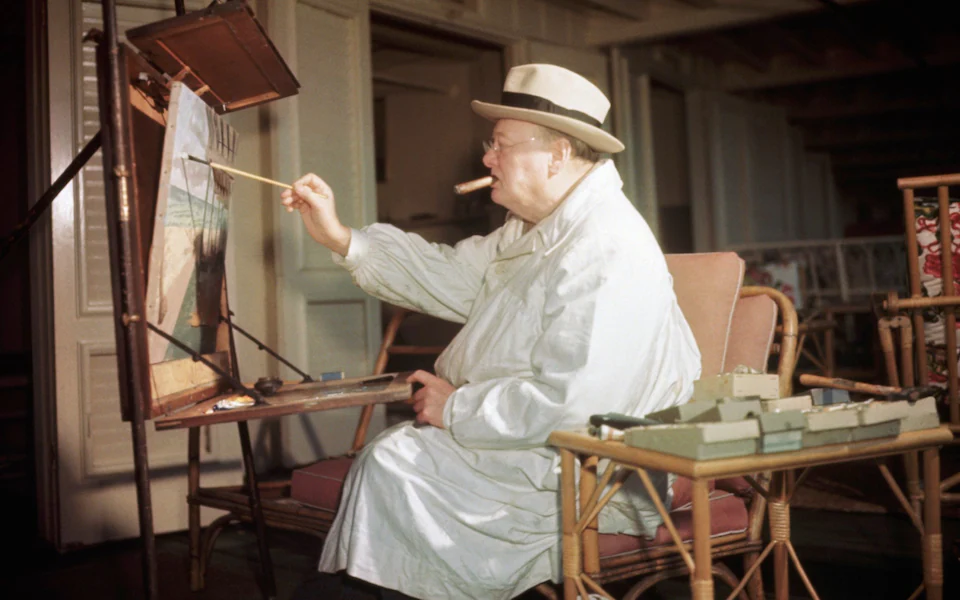
When history pictures Sir Winston Churchill, it summons the same iconic image of the stoic wartime leader. This typical leader with a bulldog scowl possesses cigar clamped between his teeth and a V-for-victory sign raised to a resilient nation. Yet behind the fierce political maneuvers lay a deeply sensitive man fighting severe emotional exhaustion. There’s a major landmark exhibition in London, titled Winston Churchill: The Painter. It has kept Britain’s titan grounded: his lifelong, intense passion for oil painting.

The 1915 Catalyst

Churchill did not pick up a paintbrush as a youth or a rested pensioner. He was forty years old and engulfed in the darkest catastrophe of his career. Following the disastrous Gallipoli campaign in 1915 during the First World War, Churchill was stripped of his post at the Admiralty. He got abruptly casted into political exile. So, he felt his mind consumed by overwhelming anxiety and listlessness. He had described himself as a deep-sea creature suddenly hauled to the surface. He suffered from a terrifying drop in pressure.

In desperation, he picked up a set of children’s paints belonging to his young family members. What began as a tentative experiment to stave off despair quickly blossomed into an obsession. As Churchill would later recall, The Muse of Painting came to my rescue. The canvas provided something his turbulent political career rarely allowed: a realm where he held absolute command over every stroke, texture, and hue.

From Cautious Strokes to Bold Expressionism

The exhibition traces Churchill’s artistic maturation across five decades and more than fifty rare works, many loaned from private collections where they have remained hidden from public view for generations. Initially guided by artistic mentors such as Sir John Lavery and Sir William Nicholson, Churchill’s early works were cautious and subdued, capturing war-torn landscapes on the Western Front during his subsequent military service in France.

However, as his confidence grew, so too did his appetite for vibrant color and energetic compositions. Influenced by French Post-Impressionism, Churchill developed an eye for brilliant light and rich pigment. He famously declared his disdain for muted palettes, writing that he felt genuine pity for poor, timid browns in favor of unapologetic cobalt blues, emerald greens, and fiery terracottas.

Whether rendering the lush water garden at Chartwell or capturing the sun-drenched architectural marvels of Marrakech, Churchill painted with the same he brought to the House of Commons. Morocco, in particular, held a magical appeal for him. He returned there six times, captivated by the dramatic contrast between the snow-capped Atlas Mountains and the luminous desert plains.

Art as Solace and Soft Diplomacy

For Churchill, painting was never a mere hobby to kill time; it was a psychological anchor and a companion through severe personal tragedies. When his three-year-old daughter Marigold tragically died of sepsis in 1921, or when political fortunes ebbed during his wilderness years in the 1930s, Churchill retreated to his studio at Chartwell. Surrounded by paint tubes housed in old cigar humidors, he labored for hours at his easel, finding peace in the disciplined focus required to translate nature onto canvas.

Beyond personal healing, his artwork doubled as subtle political allegory and warm diplomacy. Paintings like The Beach at Walmer (1938) depicted a historical cannon watching over innocent swimmers. This artwork hinted at his growing anxiety over looming European conflict long before others acknowledged the threat. Later in life, he frequently gifted canvases to world leaders, bodyguards, and trusted confidants, using his art as a bridge of personal warmth.

 A Portrait of the Man

Ultimately, exploring Churchill’s canvases fundamentally reframes our understanding of one of history’s most formidable figures. The bold brushstrokes reveal an individual far more vulnerable, contemplative, and joyful than the uncompromising statesman of public memory. By stepping behind his easel, we discover that the stubborn courage that helped save the free world was nurtured, in no small part, by the quiet sanctuary of color and light.

 

Similar Posts

  • Viral video highlights risky school route in India

    Millions of children around the world go to school every day but for some simply reaching the classroom can be a dangerous journey. In India a viral video has raised concerns after showing schoolchildren taking a highly risky route to get to school in Madhya Pradesh’s Vidisha district. The students reportedly have to jump across a river embankment to reach their school while strong water flows below. The dangerous journey has shocked people on social media and raised serious questions about the safety of the children. Parents and local residents say there is no safe route for the children to reach school forcing them to take the dangerous path every day. The situation becomes even more risky during the rainy season when the water level and flow increase. Locals have urged the authorities to inspect the area immediately and provide a safe and permanent route for the students instead of waiting for a tragic accident to happen.

  • Rewriting the history of early universe

    For centuries, human understanding of the universe was limited to the narrow band of visible light that reaches our eyes. We gazed through glass lenses at distant stars and planetary bodies. We suddenly assumed that what we saw was the complete picture of existence. However, the modern era of observational astronomy is proving that the vast majority of cosmic history has been hidden in plain sight. The history is obscured by dense cosmic dust clouds and rendered invisible to standard optical instruments. Today, scientists are piercing through these ancient barriers, effectively looking back in time to the very dawn of creation. The core of this astronomical revolution lies in how light travels across cosmic distances. As the universe expands, light emitted by the earliest stars and galaxies stretches out. Over billions of years, visible light waves elongate into invisible infrared wavelengths. It’s a phenomenon known to astrophysicists as redshift. To traditional telescopes, these primordial structures appear as empty voids of black space. However, advanced infrared technology allows researchers to detect the heat signatures and stretched light of these ancient entities. They’re now capturing photons that began their journey over thirteen billion years ago. Recent data gathered from these cutting-edge observatories has shattered long-held scientific assumptions. Previously, mainstream astrophysical models suggested that the early universe was a disorganized environment where galaxies took several billion years to unite into orderly structures. Yet, newly analyzed images reveal fully formed, structured spiral galaxies operating merely a few hundred million years after the Big Bang. These massive cosmic bodies, with billions of bright stars, existed far earlier than existing theoretical frameworks predicted. The discovery has forced cosmologists to reconsider how cosmic matter gathered and condensed during the universe’s formative epochs. Infrared observation is providing unprecedented insight into the life cycles of stars and the creation of essential elements. Dense interstellar clouds or stellar nurseries are so choked with cosmic dust that light from developing protostars cannot escape. Infrared instruments can look directly into these opaque cradles. Therefore, revealing the exact thermodynamic processes that trigger the birth of new solar systems. Scientists can now track how heavy elements such as carbon, oxygen, and iron are synthesized in the cores of giant stars. They can find out how heavy elements subsequently dispersed across space when those stars explode in supernovae. The implications of these discoveries extend far beyond theoretical physics. They touch upon fundamental questions about the origins of life itself. Astronomers are evaluating whether the ingredients for life are common throughout the Milky Way and beyond. All by tracing the distribution of organic molecules and water vapor within dust clouds around infant star systems. As technology advances, data continues to pour in from space. Humanity stands on the precipice of a new paradigm in space exploration. The ability to peer through cosmic dust and decode the earliest moments of light does not just illuminate distant galaxies. It also offers a clearer understanding of the universal processes that ultimately led to the formation of our own planet. The invisible cosmos is finally making itself known, proving that the night sky holds far more history than we ever imagined.  

  • New drug treatment Center opens in Karachi

    Karachi: Sindh Health Minister Dr. Azra Fazal Pechuho has inaugurated a new Opioid Agonist Maintenance Therapy (OAMT) Center at Jinnah Hospital to help people recovering from drug addiction. Speaking to the media the minister said the center will support people in gradually overcoming addiction and returning to a healthy normal life. Patients will receive medical treatment regular health monitoring counseling and rehabilitation services under one roof. Dr. Pechuho said the facility will be staffed by experienced doctors and trained healthcare workers who will closely monitor patients throughout their recovery. She also stressed the need to speed up HIV screening so that more cases can be detected early and  treated without delay. Commenting on reports of a patient’s death at Jinnah Hospital the health minister said that every loss of life is deeply tragic. If negligence was involved she said a full and transparent investigation must be carried out to identify those responsible. She added that no patient’s death should ever be treated as unimportant and strongly condemned any remarks that appeared to downplay such incidents.

  • Why Popcorn became the ultimate movie snack

    Watching TV or a movie often feels incomplete without something to eat. For many people popcorn is the first snack that comes to mind. But have you ever wondered how popcorn became the most popular food at movie theaters? The tradition began in the 19th century when popcorn became a popular snack at fairs festivals and circuses. In those days it was usually sold from small street carts. A major turning point came in 1885 when the first popcorn machine was invented. This made it easier to prepare fresh popcorn quickly and sell it to large crowds. By 1907, the United States had nearly 5,000 movie theaters with tickets costing just 5 cents. Popcorn sellers started placing their carts outside theaters where moviegoers could easily buy popcorn before going inside. As movie theaters became more modern and luxurious many owners banned outside food. However the rule did not last long. By the 1930s theaters began selling popcorn inside and outside their buildings realizing it was a profitable business. Today popcorn is one of the biggest sources of income for many cinemas with some estimates suggesting it accounts for up to 85% of concession stand sales. Another reason popcorn became the perfect movie snack is that it is light easy to eat and does not make much noise allowing people to enjoy their film without disturbing others.

  • Marriage can change couples personalities, study reveals

    Marriage is often described as a situation where “those who marry regret it and those who do not marry regret that too.” Now, scientists have revealed a surprising effect that marriage can have on couples. According to researchers, the first two years of marriage can bring significant changes to the personalities of newly married couples. A joint study by the University of Georgia and the University of California found that personality changes during the first two years of marriage can have important long-term effects on marital relationships. According to the study, newlyweds experience noticeable changes in their personalities and these changes can influence their satisfaction with their relationship with their spouse. The research found that during the first 18 months of marriage, husbands tend to become more dependent on their wives and increasingly focus their attention on their wives rather than the outside world. The study also found that wives experienced reductions in anxiety, depression, feelings of inferiority, restlessness and stress. These positive personality changes were observed among couples of different age groups. However, researchers also noted one negative development: compatibility between husbands and wives tended to decrease. The researchers said that, overall, the findings show that men and women undergo significant personality changes soon after marriage and these changes can be important for developing a healthy long-term relationship. The findings of the study were published in the journal Developmental Psychology. Spousal support and stress Earlier, a study conducted by Binghamton University in the United States in April 2024 found that feeling a lack of support from a spouse can increase physical stress. This feeling can raise levels of cortisol, a hormone associated with stress. Cortisol works with parts of the brain involved in regulating mood, motivation and behaviour. Researchers said that people’s perceptions of their spouse’s support become stronger over time allowing them to predict how their partner is likely to behave in different situations. They further noted that support from a spouse is more important than people may expect.

  • Keeps you full for longer

    Garlic is not the only food with useful nutrients. Roti especially whole wheat roti can also provide important nutrients and may have some benefits when eaten after cooling. May help control blood sugar When cooked roti cools down some of its starch can change into resistant starch.  Research has found that roti kept for about 24 hours may contain more resistant starch than fresh roti. This type of starch is digested differently from regular starch and may help reduce the rise in blood sugar after a meal.  However more research is still needed. Good for digestion resistant starch can support healthy bacteria in the large intestine.  If the roti is made from whole wheat flour its fiber may also help prevent constipation and support better digestion. Keeps you full for longer The fiber and resistant starch in roti may help you feel full for a longer time.  Eating it with healthy foods such as yogurt eggs or vegetables can make it a more balanced breakfast. A nutritious breakfast option Whole-wheat roti contains fiber vitamins and minerals making it a useful part of a healthy and balanced breakfast. Important note Stale roti is not automatically healthier than fresh roti.  Its nutritional value depends on the type of flour how the roti is prepared and how safely it is stored. Always make sure stored roti is kept properly to avoid spoilage.

Leave a Reply

Your email address will not be published. Required fields are marked *