ukrainian ambassador visits
| | |

Ukrainian Ambassador Visits Pattaya to Strengthen Ties and Boost Tourism Cooperation

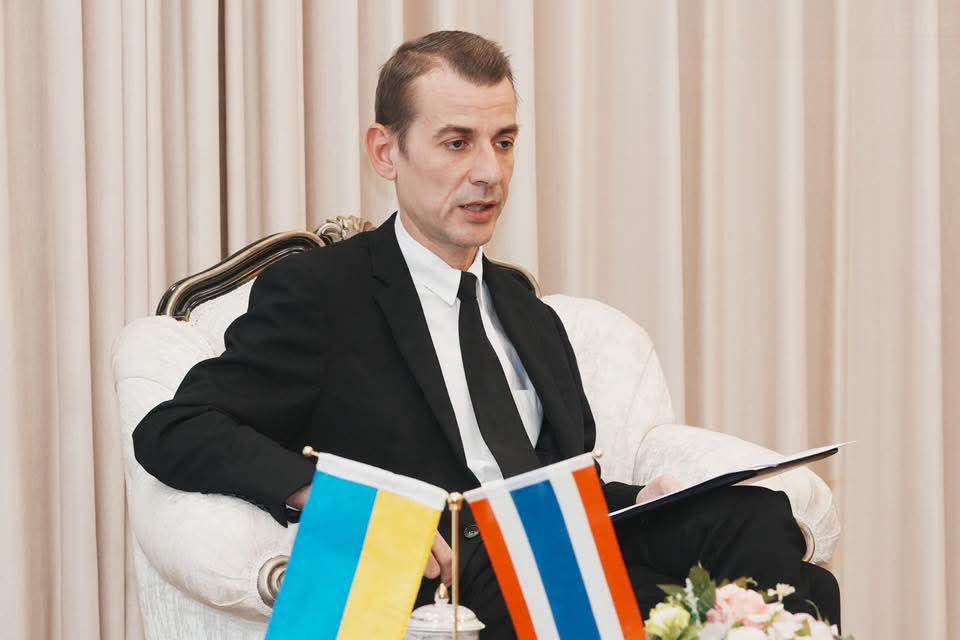
Pattaya, July 23rd, 2026 – Mayor Poramese Ngamphichet of Pattaya City, together with city executives and heads of government departments, welcomed H.E. Mr. Viktor Semenov, Ambassador of Ukraine to Thailand, and his delegation at Meeting Room 132 of Pattaya City Hall.

The visit was to discuss avenues for cooperation and further strengthen bilateral relations between Pattaya and Ukraine.

During the meeting, the Ukrainian Ambassador expressed admiration for Pattaya’s continuous development, which has elevated it into one of Thailand’s leading tourist destinations and a popular choice among Ukrainian visitors. He pointed to the city’s strong tourism potential, safety standards, and quality of services.

Mayor Poramese stated that Pattaya was delighted to host the Ambassador and his team, describing the occasion as a valuable opportunity to build on existing friendly relations. He reaffirmed the city’s full readiness to care for and facilitate tourists from all groups.

Pattaya continues to advance its vision of becoming a “Quality Tourism Destination,” with a strong emphasis on safety, service standards, and sustainable tourism. These efforts seek to build confidence and deliver positive experiences for visitors from around the world, including those from Ukraine. The visit marks another important step in enhancing Pattaya’s international image and reinforcing its role as a quality tourism city ready to welcome travelers globally.

News by: Miss Siraprapha Thongsamut
Photos by: Mr. Somprasong Photphan
Public Relations Division, Tourism and Sports Office, Pattaya City

Similar Posts

  • | |

    Colombia’s death toll from earthquake climbs…

    Rescue crews continue combing through collapsed buildings across western Colombia after a powerful magnitude 7.4 earthquake struck the region on Monday, August 10, with officials confirming the death toll has risen to at least 164 people. Authorities said more than 880 people have sustained injuries, while over 3,200 remain unaccounted for as soldiers, emergency responders and local volunteers work through debris from dozens of collapsed structures. Thousands of residents have been forced from their homes since the quake struck, adding to the scale of the humanitarian response now underway. The earthquake flattened multi story buildings in cities including Pereira and Cali, and severely damaged one of the towers of a historic cathedral in Manizales. The tremor originated at an intermediate depth with its epicenter located near San José del Palmar in the western department of Chocó, causing widespread destruction across Pereira, Cali, Manizales and other communities in Colombia’s coffee growing region. Residential buildings, hospitals, schools and key infrastructure, including several regional airports, all suffered severe damage in the quake. At one city hospital, several upper floors, including sections dedicated to pediatric care, collapsed inward, trapping some patients inside and forcing hospital staff to treat roughly 600 additional patients outdoors on a street littered with debris, according to hospital director Irne Torres Castro, who spoke to a Colombian television network. That same city saw some of the earthquake’s most extensive destruction, with entire residential blocks reduced to piles of concrete and twisted metal. Video circulating online captured buildings shaking violently as residents fled into the streets, while separate footage showed a regional airport swaying dramatically during the quake as large sections of ceiling came down around people sheltering inside. Among the most widely shared images online is footage showing the Cathedral Basilica of Our Lady of the Rosary shaking and partially collapsing. The cathedral, built in the 1920s, holds the distinction of being Colombia’s tallest cathedral and ranks among the highest neo Gothic churches anywhere in the Americas. The disaster struck just days after Abelardo De La Espriella was sworn in as Colombia’s president, immediately confronting his new administration with a major crisis. The earthquake also comes with memories still fresh of a pair of devastating earthquakes that struck neighboring Venezuela in June. Colombia’s national government has declared a state of emergency and mobilized the military, police and specialized rescue units to lead recovery operations, while accepting offers of international assistance as the search for survivors continues. The disaster adds to a string of major seismic events across the region in recent months, underscoring the ongoing vulnerability of Andean nations to powerful earthquakes and the strain such disasters place on emergency infrastructure even in areas with established disaster response systems.

  • | | | |

    Iran ready to resist pressure as Hormuz talks near…

    TEHRAN: Iran is prepared to continue resisting mounting pressure, Foreign Minister Abbas Araghchi said, as Tehran and Oman move closer to an agreement on managing navigation through the strategically vital Strait of Hormuz. Araghchi said Iran would not forget what it described as the unjust bloodshed of its martyrs and would not forgive those responsible. His remarks come amid continuing tensions between Tehran and Washington and uncertainty over the future of negotiations. The Iranian foreign minister also warned that talks with the United States would not resume if Washington continued to violate the memorandum of understanding between the two countries. According to Araghchi, Iran and the United States are currently not engaged in direct negotiations. However, messages are being exchanged through intermediaries, keeping a narrow diplomatic channel open despite the broader standoff. The most immediate development concerns the Strait of Hormuz, a critical waterway for international energy shipments. Araghchi said negotiations between Iran and Oman over a new arrangement for maritime traffic were in their final stages. He stressed, however, that reaching an agreement with Oman would not automatically mean the strait would be fully reopened. Instead, the proposed arrangement would establish new maritime routes between Iran and Oman. The two countries have previously agreed to work together on future navigation management, shipping services and related arrangements while emphasizing safe passage and their sovereign rights over their territorial waters. The issue has become a major point of contention in wider diplomatic efforts, with Tehran insisting that US actions under the memorandum must be addressed before normal negotiations can resume. For now, the emerging Iran-Oman arrangement could offer a potential pathway for maritime traffic, but significant political hurdles remain. With Tehran maintaining its tough stance toward Washington, the next stage of diplomacy could determine whether the strategic waterway moves toward greater stability or remains at the center of regional tensions.

  • | |

    State Department report calls for greater civilian…

    The US State Department said Wednesday that Pakistan needs to strengthen civilian oversight of public finances to improve fiscal transparency, releasing findings that highlighted persistent gaps in how the country discloses key financial information. The department’s assessment described fiscal transparency as a core component of effective public financial management, noting that it allows citizens to understand how government revenues and tax dollars are spent. That visibility into budgets, the report said, gives citizens the tools they need to hold their governments accountable. The findings arrive weeks after Pakistan’s National Assembly passed an 18.8 trillion rupee Finance Bill for 2026 to 2027 in June, which included a defence budget of 3 trillion rupees, with at least 335 billion rupees coming from provincial contributions. In its 2026 Fiscal Transparency Report on Pakistan, the State Department said the country continues to fall short in disclosing important financial data, particularly around debt obligations and the budgets of military and intelligence agencies. The report found that Pakistan’s government did not publish its executive budget proposal within a reasonable timeframe and made only limited information available on debt obligations, including debt held by major state owned enterprises. It further noted that military and intelligence budgets remain outside the scope of adequate parliamentary or civilian oversight. The assessment also pointed to areas of progress. During the review period, the report said, Pakistan’s government made its enacted budget and end of year financial reports widely and easily accessible to the public, including through online platforms. It found that publicly available budget documents offered a substantially complete picture of most planned government expenditures and revenues, including revenue generated from natural resources. The report described the information contained in the budget as generally reliable and subject to audit by the country’s supreme audit institution, which it said meets international standards of independence. Audit reports, the department noted, are published within a reasonable period and contain substantive findings. It also found that the government has specified, and largely followed in practice, clear legal criteria and procedures for awarding natural resource extraction contracts and licenses, while making basic information about such awards publicly available. The report added that Pakistan’s sovereign wealth fund operates under a sound legal framework and that the government publishes accessible information on public procurement contracts. Among its recommendations, the State Department urged Pakistan to make its executive budget proposal available to the public within a reasonable timeframe, disclose more detailed information on government debt, including debt tied to state owned enterprises, and bring military and intelligence agency budgets under parliamentary or civilian oversight. Responding to questions about the report during a weekly press briefing, Foreign Office spokesperson Tahir Andrabi acknowledged that the report had been released the previous day. He said Pakistan adheres to internationally recognized best practices around fiscal transparency, budgeting and financial disclosure, while also operating within its own constitutional, legislative and regulatory frameworks. Andrabi noted that Pakistan remains engaged in an ongoing International Monetary Fund program centered on structural reform and improved fiscal management. He said the country has completed three IMF reviews so far, adding that the reform measures taken under the program have drawn broad recognition, including credit rating upgrades from three international rating agencies as well as positive assessments from the IMF itself.


  • | | |

    Urmila Matondkar’s ex-husband Mohsin Akhtar shar…

    Mohsin Akhtar, the former husband of veteran Bollywood actress Urmila Matondkar, has shared a fresh collection of romantic photographs with his new wife, Nida Bhatt, giving fans another glimpse into their wedding celebrations. The 43-year-old businessman and model posted photographs from his walima ceremony several months after announcing his marriage to Nida. Alongside the pictures, Mohsin shared an emotional message expressing his love and appreciation for his new wife. In his heartfelt post, Mohsin described Nida as much more than his wife, calling her his “home” and “peace.” He also promised to stand by her, value her and continue loving her throughout every chapter of their journey together. The new photographs offer glimpses of the couple celebrating their marriage with family and friends. Mohsin had previously shared pictures from his wedding with Nida in June, officially revealing details of his new marriage to his followers. His latest social media post has attracted attention largely because of his previous high-profile marriage to Urmila Matondkar, one of Bollywood’s well-known actresses. Before marrying Nida, Mohsin was married to Urmila. The couple tied the knot on February 4, 2016, in an intimate ceremony attended by close friends and family members. Their relationship attracted considerable attention at the time, partly because of their age difference and their interfaith marriage. Mohsin, who comes from a Kashmiri business background and has worked as a model, is around 10 years younger than Urmila. Following their separation, both have continued with their respective lives and careers. Mohsin’s latest posts now focus on his new relationship and marriage, with his affectionate message to Nida offering a glimpse into his current personal life. The newly shared wedding photographs have given fans a closer look at the celebrations surrounding Mohsin and Nida’s marriage. His romantic caption has also drawn attention, particularly his description of his wife as his source of comfort and happiness. While Urmila Matondkar remains a prominent name in Indian cinema, Mohsin Akhtar’s latest social media update has shifted the spotlight toward his new chapter in life. The couple’s wedding pictures are continuing to attract interest online as fans react to the romantic moments and Mohsin’s emotional message for his new bride.

  • | | | | |

    Deputy Interior Minister Leads Illegal Hotel Inspections in Krabi

    Krabi – Deputy Interior Minister Polapee Suwunchwee led a surprise inspection of two suspected unlicensed hotels in Ao Nang, Krabi, on July 24, expanding a nationwide crackdown on illegal hotel operations and suspected nominee businesses. The inspections followed complaints that some properties were operating without required licenses. One property, a luxury pool villa advertised on […]

  • |

    Unesco reports 2.4 million Afghan girls barred from secondary education under Taliban rule

    Roughly 2.4 million Afghan girls have been systematically denied access to secondary education since the Taliban regained power in 2021, the United Nations Educational, Scientific and Cultural Organisation (Unesco) announced, urging an immediate end to the policy. The UN agency noted that the number of girls excluded from high school has grown by 200,000 over the past year and warned that the figure could reach nearly four million by 2030 if the restrictions remain in place. Afghanistan remains the only country in the world where female students are formally prohibited from attending school beyond the primary level. The current restrictions mark a stark reversal of educational progress achieved over the preceding two decades. In 2001, female enrolment was severely limited, but by 2021, nearly one million girls were actively attending secondary schools across the country. Beyond human rights concerns, Unesco highlighted the severe long-term economic fallout, estimating that the prohibition on female education and employment could cost the Afghan economy $9.6 billion (£7.5 billion) by 2066. The wider educational landscape in Afghanistan faces critical systemic strain. More than half of primary-school-aged children are out of school entirely, and over 90 per cent of 10-year-olds are unable to read basic text. Infrastructure deficits, including widespread shortages of clean drinking water, sanitation, and heating, alongside recurrent natural disasters continue to exacerbate the ongoing crisis.

Leave a Reply

Your email address will not be published. Required fields are marked *