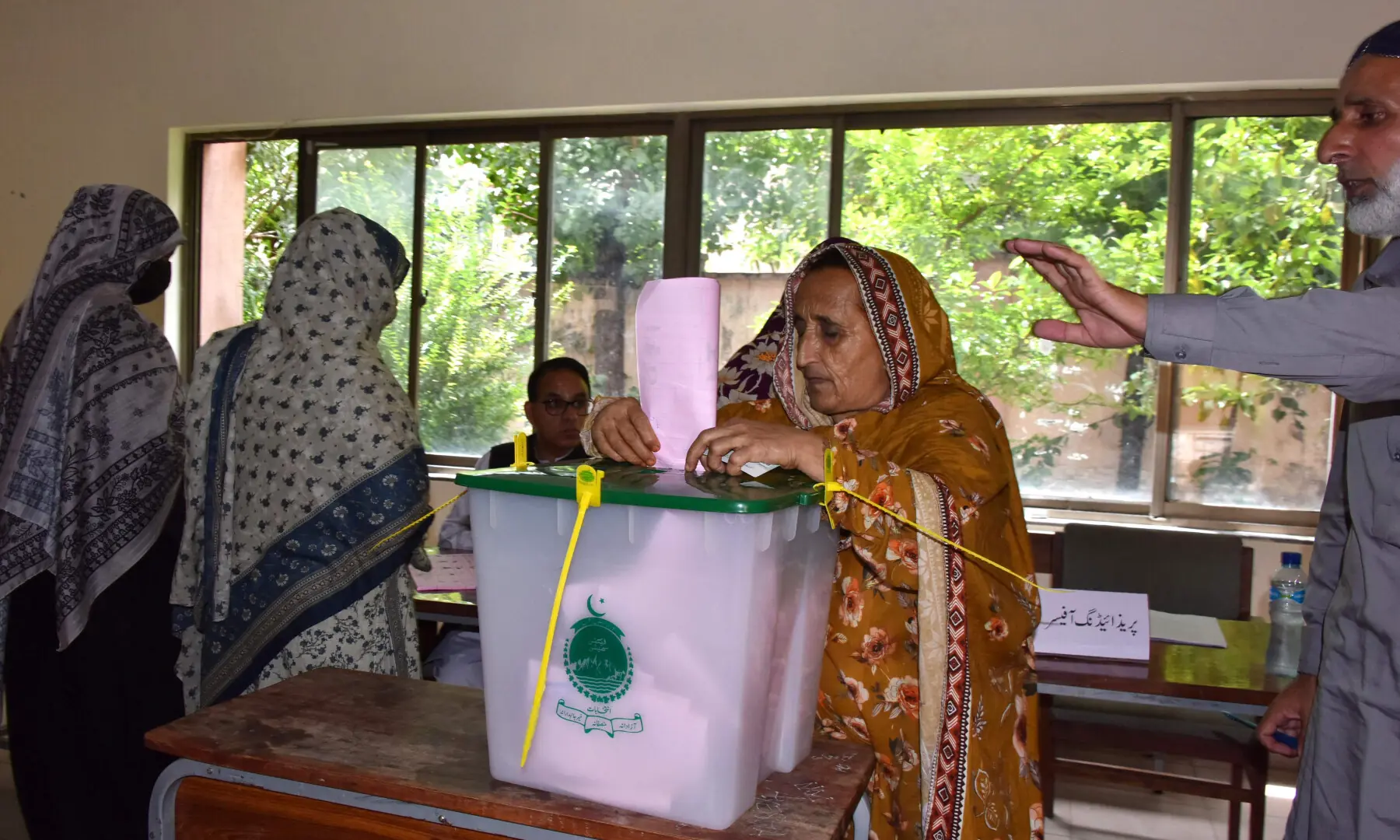
ajk polling extended
| |

AJK polling extended amid rain, PPP alleges electi…

Polling continued on Sunday in the second phase of the Azad Jammu and Kashmir (AJK) elections, with voters casting ballots in eight of the nine constituencies in the Muzaffarabad division and all 12 refugee constituencies.

The polling process began at 8am and was initially scheduled to conclude at 5pm. However, an AJK Election Commission spokesperson announced a one-hour extension, allowing voters to cast their ballots until 6pm.

Heavy rainfall forced authorities to postpone polling in LA-27 (Muzaffarabad-I), AJK Chief Election Commissioner Ghulam Mustafa Mughal said.

More than 300 candidates are contesting the seats in the Muzaffarabad division and the 12 constituencies reserved for refugees settled in various parts of Pakistan.

Meanwhile, Pakistan Peoples Party (PPP) Chairman Bilawal Bhutto-Zardari renewed his allegations of electoral irregularities, accusing the Pakistan Muslim League-Nawaz (PML-N) of attempting to influence the voting process during the second phase as well.

In a post on X, Bilawal condemned what he described as an attack on PPP’s regional president Chaudhry Latif Akbar, who is also contesting from LA-31 (Muzaffarabad-V). He alleged that elements linked to the PML-N were responsible for the incident and claimed that PPP worker Mushtaq Shah was killed in the same constituency.

Bilawal accused the PML-N of using intimidation and violence to interfere with the electoral process and called for the immediate arrest of those responsible for the alleged attack on Akbar and the killing of the party worker.

In another statement, the PPP chairman alleged that attacks had targeted his party’s voters as well as the AJK president. He said the contest in Muzaffarabad had turned into a struggle between the PPP’s political principles and what he described as the PML-N’s use of threats, coercion and alleged rigging.

The PPP also submitted a formal complaint to the AJK Election Commission, alleging that Akbar faced a physical assault while participating in election-related activities on polling day. The party named three individuals in connection with the incident and said it had initiated the process of registering a first information report (FIR).

The PPP urged the Election Commission to investigate the alleged security failure and determine how the incident occurred despite security arrangements at the polling site.

AJK Prime Minister Faisal Mumtaz Rathore, who belongs to the PPP, also took notice of the incident. He directed the chief secretary and inspector general of police to investigate the matter and ensure that those responsible face legal action.

Similar Posts

  • | | |

    Saudi Arabia rolls over $5bn Pakistan deposit

    Pakistan’s external financing pressure has eased after Saudi Arabia extended a $5 billion deposit for another three years, State Bank of Pakistan Governor Jameel Ahmad said on Wednesday. The rollover will give Pakistan additional breathing space as it manages its external debt obligations and works to strengthen its foreign exchange position. According to the governor, the Saudi deposit has been extended until December 2028. The development has reduced Pakistan’s gross external financing requirement for the current fiscal year to around $21.5 billion. Pakistan has received a total of $8 billion in deposits from Saudi Arabia. This includes $3 billion received in April this year. The remaining $5 billion had previously been rolled over annually. The latest arrangement provides Pakistan with a longer repayment period and reduces immediate pressure on its external account. Ahmad said lower interest costs on foreign debt had also helped reduce Pakistan’s financing requirements. He estimated the reduction at nearly $500 million. Pakistan continues to rely significantly on external financing to meet debt repayments and cover external account needs. The government is seeking to increase exports, attract investment and improve other sources of foreign exchange. The governor said the International Monetary Fund has projected Pakistan’s external financing requirements at around $30 billion for the next fiscal year. However, he said the estimate could be revised downward if the government succeeds in securing additional longer-term financing and improving external inflows. According to Ahmad, Pakistan’s $21.5 billion financing requirement includes around $7.3 billion in cash deposits and approximately $3.5 billion in foreign commercial loans maturing during the year. Pakistan also owes around $250 million to Kuwait through a long-standing cash deposit arrangement. The governor did not comment on reports concerning Pakistan’s request for a $10 billion credit facility from the United States. He said the federal government would be in a better position to respond to the matter. Pakistan also repaid a $1.3 billion Chinese commercial loan during July. The repayment temporarily reduced the country’s foreign exchange reserves to around $17.3 billion as of July 17. Ahmad said China was expected to refinance the amount, with the funds potentially arriving next month. Of Pakistan’s total external financing needs, around $7.5 billion represents net debt repayments. The country had already repaid approximately $2.2 billion during July, reducing the pressure for the remaining months of the fiscal year. The central bank governor also revealed that the State Bank had purchased around $9 billion from the local foreign exchange market during the previous fiscal year. The purchases were aimed at strengthening the country’s foreign exchange reserves. Over the past three years, the central bank’s total purchases from the market have reached around $28 billion. The State Bank expects workers’ remittances to continue supporting Pakistan’s external position. Remittances are projected to help finance a significant portion of the expected trade deficit. The central bank has also set a target of increasing foreign exchange reserves to $20.20 billion by the end of December 2026. Meanwhile, Ahmad told the Senate Standing Committee on Finance that the federal government had not allocated a subsidy for remittance transfers. He said commercial banks would now bear the cost of transferring workers’ remittances. Overseas Pakistanis sending money home would not be charged additional transfer fees. The committee also reviewed banking charges and services, including SMS alerts and card transactions.

  • | |

    IMF pushes Pakistan provinces for rs430bn tax incr…

    ISLAMABAD: The International Monetary Fund (IMF) has asked Pakistan’s provincial governments to generate an additional Rs430 billion in tax revenue during the current fiscal year, as part of broader efforts to strengthen public finances and increase provincial own-source revenues. According to official details, the proposed increase in tax collection is equivalent to 0.3 per cent of Pakistan’s Gross Domestic Product (GDP) and is expected to be shared among the four provinces in line with their allocations under the National Finance Commission (NFC) Award. The move is aimed at improving fiscal sustainability by encouraging provinces to rely more on locally generated revenues rather than transfers from the federal government. Officials believe stronger provincial tax collection would also help create greater financial discipline and support long-term economic reforms. Sources said each province would contribute to the additional revenue target based on its respective share under the NFC formula, although specific collection targets for individual provinces have yet to be announced. The recommendation comes as Pakistan continues implementing economic reforms under its programme with the IMF, with revenue mobilisation remaining one of the key priorities for both the federal and provincial governments. Meanwhile, the federal government has decided to establish an inter-ministerial committee, to be headed by the prime minister, for the implementation of decisions made by the National Economic Council (NEC). According to officials, the committee will include federal and provincial ministers along with senior government representatives. It will be responsible for monitoring the execution of national policies, reviewing progress on major development initiatives and ensuring timely implementation of decisions taken by the NEC. The committee is also expected to strengthen coordination between the federation and the provinces, particularly on economic planning, fiscal reforms and development projects that require close cooperation among different levels of government. Government sources said improved coordination is considered essential for achieving national economic objectives and ensuring that development programmes are implemented efficiently across the country. Economists say increasing provincial tax revenues has long been a key recommendation of international financial institutions, which argue that greater fiscal autonomy can improve governance, reduce dependence on federal transfers and create a more balanced financial system. The IMF’s latest recommendation is likely to shape upcoming provincial budgetary decisions as governments evaluate measures to expand their tax base while balancing the need to protect economic activity. The proposed revenue measures are expected to remain a major focus of fiscal policy discussions in the months ahead.

  • | |

    Senate debates Imran Khan’s health after opposit…

    The Senate held a detailed discussion on the health of PTI founder Imran Khan. The discussion was held after a demand by Opposition Leader Allama Raja Nasir Abbas. The Senate proceedings were also suspended to take up the issue. Speaking in the Senate, Raja Nasir Abbas said Imran Khan was facing punishment for crimes he had not committed. He described the former prime minister’s health as a highly sensitive matter. The opposition leader urged the government to show restraint. He said political differences should not lead to anyone being subjected to unnecessary suffering. Raja Nasir Abbas said the government should focus on resolving the country’s problems instead of pursuing political revenge. He also questioned whether the priority was to fix the system or settle political scores. He demanded that Imran Khan be allowed to meet his personal doctors. He said access to proper medical care was essential, particularly because of concerns about the PTI founder’s health. The opposition leader also called for Imran Khan to be shifted to a hospital if necessary. He demanded that a meeting with him should be allowed. Raja Nasir Abbas said such measures could help prevent a serious situation in the future. He stressed that the authorities should take the health concerns seriously. He also called for politicians to be given an opportunity to run the country. He said political issues should be resolved through political means. The opposition leader also raised the issue of PTI women who are currently in prison. He called for greater attention to their situation. During the debate, Raja Nasir Abbas addressed PML-N Senator Rana Sanaullah. He said Rana Sanaullah knew that the cases against him had not been filed by politicians. Rana Sanaullah responded by asking Raja Nasir Abbas who had filed the case against him. The exchange highlighted the political tensions between the government and opposition benches in the Senate. The debate also brought renewed attention to Imran Khan’s health and the opposition’s demand for greater access to medical care and personal doctors. Opposition lawmakers have continued to raise concerns about the PTI founder’s condition and have called for his medical needs to be addressed without political considerations.

  • PAAM rejects DRAP Rules 2026, warns alternative medicine sector

    ​LAHORE: Kashif Aslam Malik, Chairman of the Pakistan Association of Alternative Medicine (PAAM), has completely rejected the proposed DRAP Rules 2026, labeling them an unscientific plot against the local alternative pharmaceutical industry, Homeopathy, and Unani medicine. He stated that the allopathic pharmaceutical bureaucracy within the Drug Regulatory Authority of Pakistan (DRAP) is attempting to forcefully impose itself on the alternative medicine sector. In reality, the 5-year Pharm.D curriculum completely lacks education and technical training on homeopathic potentization, Unani herbal formulation, or nutraceutical manufacturing. He questioned the legal and scientific authority of allopathic pharmacists who have never studied these disciplines to act as self proclaimed experts and draft policies for this sector. ​Kashif Aslam Malik emphasized that under the universal principle of “right expertise for the right job,” the regulatory framework, registration, and licensing for alternative medicines must strictly be developed under the direct supervision of qualified specialists in Homeopathy, Unani, and Nutraceutical sciences. Imposing these unilateral rules and rigid allopathic SOPs will bankrupt over 80% of small and medium-sized enterprises (SMEs), resulting in widespread unemployment for thousands of homeopathic doctors, Unani practitioners, and industrial workers, while depriving the public of affordable, natural healthcare options. PAAM demands an immediate halt to these rules, the formation of a committee comprising specialized alternative medicine experts, and the establishment of an independent authority modeled after India’s Ministry of AYUSH. He warned that if DRAP attempts to force these rules through, PAAM will unite all industry stakeholders to fight a nationwide battle across the media, judiciary, and public spheres.

  • | |

    Candidate dies during Islamabad Police recruitment…

    ISLAMABAD: A 25-year-old man died while taking part in a physical test for recruitment into the Islamabad Police. The deceased was identified as Ishaq. He had travelled from Sarai Naurang in Lakki Marwat to participate in the recruitment process. According to police, Ishaq was taking part in the running test when he suddenly collapsed. He reportedly became unconscious during the physical activity. Police officials immediately arranged an ambulance to take him to the Pakistan Institute of Medical Sciences (PIMS) in Islamabad. Ishaq was shifted to the hospital’s emergency department for medical assistance. However, doctors said that he had already died while being transported to the hospital. The young man could not be revived after reaching the medical facility. The incident occurred during the physical testing stage of the Islamabad Police recruitment process. The test requires candidates to take part in physical activities as part of the selection procedure. The sudden death of the young candidate has raised concerns about the circumstances surrounding the incident. However, police have not yet provided further details about the exact cause of death. It was also not immediately clear whether Ishaq had any previous medical condition or whether he had undergone a medical examination before taking part in the physical test. Authorities are expected to examine the circumstances surrounding the incident. Further information may emerge after the relevant medical and official procedures are completed. The death has brought attention to the physical demands placed on candidates during police recruitment tests. Candidates are required to meet prescribed physical standards before progressing to further stages of the selection process.

  • | |

    Major breakthrough in Mir Raza Ali murder case as …

    Police have made significant progress in the murder investigation of IBA student Mir Raza Ali, who was abducted and later found dead in Karachi. Authorities have recovered the victim’s mobile phone and other evidence from the crime scene while denying reports that the body showed signs of torture or burning. According to police officials, the investigation into the killing of Mir Raza Ali, a resident of PECHS Society, is ongoing. The young student’s body was found on Wednesday from a hilly area in Gulistan-e-Johar Block 1 after he went missing during the night between Tuesday and Wednesday. Police said Mir Raza Ali had left his residence through an online taxi service before disappearing. Following the discovery of his body, a special investigation team and crime scene experts visited the area to collect evidence and determine the circumstances behind the murder. During the search operation, police recovered the victim’s iPhone from behind Nasir Tower Apartments, located around 200 metres away from the crime scene. The mobile phone is reportedly password-protected, and investigators are making efforts to access its data for further clues. Police also recovered a weapon cover, believed to be linked to the firearm used in the incident. Authorities have obtained the victim’s call data record (CDR) and are preparing a route map to track his movements before the murder. The police surgeon stated that Mir Raza Ali was shot once in the chest from the front. The bullet passed through his body, but officials found no evidence of physical torture or burning on the victim’s body. A team comprising SSP District East Zubair Nawaz Sheikh, SP Gulshan-e-Iqbal Ghulam Shabbir Saraki, SHO Ferozabad Adeel Afzal, and other investigation and crime scene experts inspected the site and surrounding areas. Investigators are currently examining approximately 50 phone numbers identified through the call data record. Police officials have claimed that around 50 percent of the case investigation has been completed and further developments are expected as evidence is analyzed. The recovered mobile phone, weapon-related evidence, and digital records are being considered important parts of the investigation. Police officials have assured that all available resources are being used to identify those responsible for the killing and bring them to justice.

Leave a Reply

Your email address will not be published. Required fields are marked *