apple risks losing
| |

Apple risks losing $500 billion in market value

The renowned and highly valued technology company Apple is facing the risk of losing its status as the world’s most valuable company.

According to media reports, Apple’s supply chain could be affected due to the AI chip crisis.

Analysts say that slower-than-expected growth in the company’s services business along with pressure on its supply chain has further increased concerns among investors.

Meanwhile, weaker financial forecasts have dealt a major blow to Apple.

According to the British news agency, Apple’s shares fell by around 10% on Friday raising concerns that the company’s market value could decline by approximately $500 billion.

Similar Posts

  • |

    Australian police charge Russian-Australian man over alleged Russian spy operation

      Australian authorities have charged a 27-year-old Russian-Australian man with foreign interference after alleging that he attempted to pass sensitive information about Ukrainian military activities to individuals connected to Russian intelligence. Australian Federal Police Commissioner Krissy Barrett said the man had undertaken what police described as “military-style” training in Russia in October 2024. After completing the training, he returned to Australia and allegedly remained in contact with people he believed were associated with Russian intelligence agencies. According to investigators, the man later travelled to Ukraine in 2025 and enlisted in the Ukrainian armed forces. His position allegedly gave him access to sensitive information concerning Ukrainian military personnel, military units and their locations. Police claim that the man subsequently provided, or attempted to provide, information obtained during his time in Ukraine to people he believed were working for Russian intelligence. Authorities said the alleged actions could have placed Ukrainian military personnel at risk by exposing information about their movements, units or locations. Commissioner Barrett stressed that Australia would not tolerate individuals using the country as a base for foreign interference activities. She said the case demonstrated the government’s determination to protect Australia and its international partners from espionage and interference conducted on behalf of foreign powers. Police also confirmed that there was no evidence the accused had received military training in Australia. At the time of his arrest, he was unemployed. His identity has not been publicly released. Investigators from the Australian Federal Police and the Australian Security Intelligence Organisation worked together on the case. Several search warrants have already been carried out as part of the investigation. Barrett said further arrests could not be ruled out as authorities continue examining the circumstances surrounding the alleged activities.   ASIO Deputy Director-General Claire McGuinness also issued a warning to foreign governments involved in interference operations. She said the case demonstrated Australia’s “zero tolerance” approach toward foreign interference and espionage. The accused was scheduled to appear before a court in Brisbane on Friday to face the charges. If convicted of intentionally engaging in foreign interference, he could face a maximum sentence of 20 years in prison under Australian law. The case is the eighth instance in which an individual has been charged in Australia with offences connected to espionage or foreign interference. Australian security officials have previously identified Russia as a significant espionage threat. In 2024, authorities charged Russian-born Australian citizens Kira Korolev and her husband, Igor, with allegedly spying for Moscow. Police accused the couple of obtaining sensitive material linked to Australia’s military. Both had lived in Australia for more than a decade, became Australian citizens and retained Russian passports. The latest investigation highlights Australia’s growing concerns over foreign intelligence operations and the potential use of individuals with access to military or national-security information. Authorities have emphasized that anyone suspected of assisting foreign intelligence services could face serious criminal consequences under Australia’s foreign-interference laws.

  • |

    China rejects Pakistan’s waiver request

    Chinese lenders and Independent Power Producers (IPPs) have turned down Pakistan’s request to write off nearly Rs 170 billion in late-payment surcharges. The refusal highlights the growing friction between the two long-standing allies as Pakistan struggles to navigate a staggering power-sector circular debt that continues to drag down its broader economy. The unpaid dues owed to 18 Chinese-backed power generation projects established under the CPEC have now increased to approximately Rs 423 billion. The financial bottleneck stems from a combination of structural inefficiencies within Pakistan’s domestic energy distribution network and systemic delays in clearing operational invoices. Under the original 2015 CPEC Energy Framework Agreement, Pakistan was legally obligated to ensure full and timely payments to power producers, backed by a designated revolving fund to cushion investors against domestic liquidity shortfalls. As payment deadlines were repeatedly missed over recent years due to severe foreign exchange constraints, contractual interest penalties accumulated to the tune of Rs 170 billion. While local power suppliers previously accepted debt-restructuring deals and fee write-offs to ease the burden on state coffers, Chinese energy firms have maintained a strict stance, citing global precedent and financial commitments to their own institutional lenders. This refusal creates an immediate impasse for Pakistan’s Ministry of Energy and financial regulators. The federal government had structured a massive Rs 1.225 trillion banking facility intended to retire the country’s broader circular debt stock. However, disbursement terms mandated that power producers accept renegotiated terms or offer discounts on late-payment fees before receiving principal clearances. Because the Chinese IPPs declined to waive the surcharges or offer similar concessions, billions in funds remain locked, leaving power plant operators facing severe liquidity squeezes that threaten regular fuel procurement and plant operation. Total Outstanding Dues: Rs 423 Billion. Requested Surcharge Waiver (Rejected): Rs 170 Billion. Principal Energy Cost Owed: Rs 253+ Billion. Pakistani negotiators are exploring alternative financial maneuvers to manage the expensive debt burden. Seeking low-interest bilateral funding including potential long-term loan packages in the range of $6 billion to $10 billion from partner nations like Saudi Arabia to retire high-cost Chinese energy loans. Requesting cabinet approval for extensions on expiring domestic banking facilities to prevent immediate default claims. Balancing the debt burden through structured tariff pass-throughs, though consumer capacity to absorb higher electricity prices remains extremely strained. The dispute underscores a delicate transition in the CPEC bilateral relationship. While both nations remain deeply committed to long-term strategic partnership and Phase-Two infrastructure development, commercial reality is setting a firmer baseline. Moving forward, resolving the sovereign debt backlog will require transparent structural reforms within Pakistan’s power distribution setup rather than relying on debt waivers from foreign investors.  

  • | |

    Gaza funeral held for 112 bodies retrieved from ru…

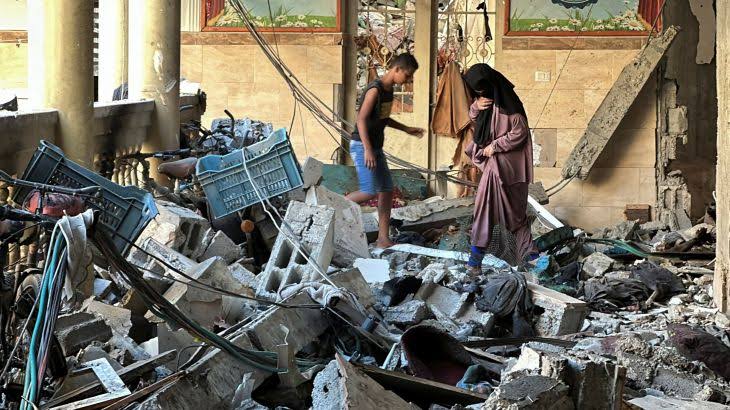
    Palestinians in Gaza held funeral prayers on Tuesday for 112 people whose remains were recovered from the rubble of homes destroyed during the war between Israel and Hamas. Thousands of mourners gathered for the funeral in Gaza City’s Sabra neighborhood, where the bodies, draped in Palestinian flags, were laid out near the ruins of the destroyed homes before the procession began. The victims are set to be buried afterward at the Baptist Cemetery in the Zeitoun neighborhood, south of Gaza City. The dead belonged to the Al Hasayneh and Abu Sharia families, who were killed when their homes were bombed while they were sheltering inside on November 23, 2023. Given the scale of the casualties, the funeral ranks among the largest recorded in Palestinian history. Civil defense teams recovered the bodies from the rubble on Saturday. A Civil Defence statement said the victims included 40 children, 38 women and seven people with disabilities. Civil Defence official Mohammad Abu Dan said search teams have so far been unable to locate 157 additional bodies still believed to be buried under the rubble. More than 73,000 people have been killed and over 174,000 injured in Gaza since the war began in October 2023, according to local health authorities. Despite a ceasefire agreement that took effect on October 10, 2025, Israeli forces have continued carrying out attacks across the territory, killing 1,250 Palestinians and injuring 4,110 others since the truce began, Gaza’s Health Ministry said. Palestinian authorities estimate that around 9,500 people remain missing under the rubble of buildings destroyed across the territory. A day earlier, at least 19 Palestinians were killed by Israeli fire over a 24 hour period, pushing the overall death toll since October 2023 to 73,375, according to the Health Ministry. Officials said the toll included 18 people killed directly by Israeli forces and one person who died from wounds sustained in an earlier attack. The ministry reported that 35 additional injured people were taken to hospitals during the same period, bringing the total number of injuries to 174,220. The ministry said Saturday that 152 people were killed in Gaza during July, the highest monthly death toll recorded since the start of the year, despite the ceasefire that took effect in October 2025. The truce followed nearly two years of war that began on October 8, 2023, and caused widespread destruction across the territory, affecting an estimated 90 percent of civilian infrastructure. The United Nations has put the cost of reconstruction at approximately 70 billion dollars, underscoring the scale of rebuilding that lies ahead even as sporadic violence continues despite the formal end of large scale hostilities.


  • | | |

    Pakistan taps global banks for $2bn bond plan to s…

    ISLAMABAD: The federal government has taken a major step toward raising at least $2 billion from international capital markets during the 2026-27 fiscal year by appointing leading global financial institutions to manage its upcoming sovereign bond issuances. After completing a competitive selection process under the Requests for Proposals (RFPs), the government finalized three separate banking consortiums to advise and arrange conventional Eurobonds, International Sukuk, and Pakistani rupee-denominated, US dollar-settled bonds. The move is part of Pakistan’s broader strategy to diversify external financing sources and strengthen long-term access to global capital markets. For the Eurobond programme, the selected consortium comprises Standard Chartered Bank, Citibank, Deutsche Bank AG, Emirates NBD Capital, and MUFG Securities Asia Limited. The International Sukuk consortium includes Standard Chartered Bank, Dubai Islamic Bank PJSC, Citibank, Emirates NBD Capital, and Mashreq Bank PSC. Meanwhile, Standard Chartered Bank, Citibank, and Deutsche Bank AG will oversee the issuance of PKR-denominated bonds settled in US dollars. Finance Minister Senator Muhammad Aurangzeb formally launched the government’s partnership with the selected institutions during a virtual meeting held from Washington, D.C. The discussions focused on implementing Pakistan’s Global Medium-Term Note (GMTN) Programme and International Sukuk Programme, which are expected to support the country’s future borrowing plans. According to the Finance Ministry, the sovereign capital market programme will include both conventional and Islamic financing instruments. Once all regulatory requirements and documentation are completed, Pakistan plans to make regular international bond issuances whenever financing needs arise, rather than treating the initiative as a one-time exercise. Officials said the strategy is designed to establish a more stable, diversified, and sustainable external financing framework. The inclusion of MUFG Securities Asia Limited and Mashreq Bank in the banking consortiums is also expected to expand Pakistan’s engagement with a wider network of leading international financial institutions, enhancing investor confidence and broadening access to global markets.

Leave a Reply

Your email address will not be published. Required fields are marked *