arshad nadeem loses
| |

Arshad Nadeem loses Commonwealth javelin title

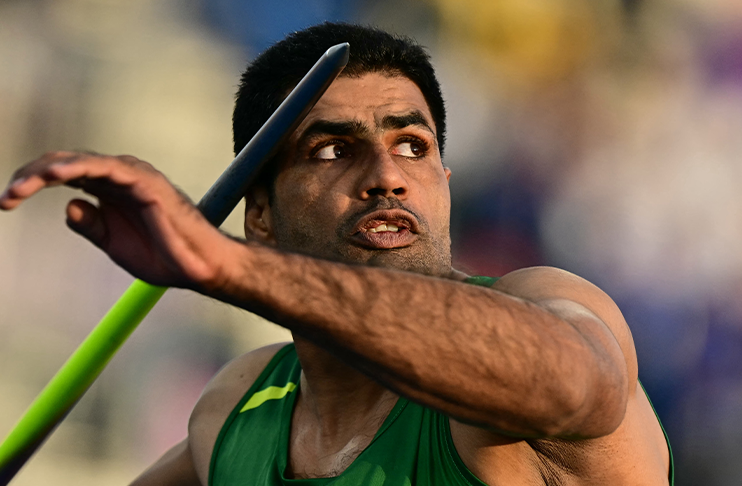
Pakistan’s Olympic champion Arshad Nadeem was unable to defend his Commonwealth Games men’s javelin title after finishing ninth in the final at Scotstoun Stadium in Glasgow on Friday.

The 29-year-old struggled throughout the competition and failed to qualify for the final three attempts. His title defence began with a foul on his opening throw, followed by a best effort of 77.41 metres in the second round. The distance briefly placed him on the leaderboard, but stronger performances from his rivals pushed him down to ninth among the 12 finalists.

Sri Lanka’s Rumesh Tharanga Pathirage produced a sensational throw of 89.75 metres in the second round to secure the gold medal. Although all five of his remaining attempts ended in fouls, his winning mark remained unmatched for the rest of the competition.

With the victory, Pathirage became only the third South Asian athlete to win the Commonwealth Games men’s javelin title. His triumph also ended Sri Lanka’s 20-year wait for a Commonwealth Games gold medal, with the nation’s previous gold coming at the 2006 Melbourne Games.

India’s Neeraj Chopra claimed the silver medal with a season-best throw of 85.83 metres, also achieved in the second round. Fellow Indian athlete Yash Vir Singh secured bronze with a personal-best effort of 85.41 metres on his final attempt.

The event also marked a historic achievement for India, as it was the first time the country won two medals in the men’s javelin competition at the Commonwealth Games.

Men’s Javelin Final Results:

Gold: Rumesh Tharanga Pathirage (Sri Lanka) – 89.75m

Silver: Neeraj Chopra (India) – 85.83m

Bronze: Yash Vir Singh (India) – 85.41m

Similar Posts

  • |

    Bob Johan Veldhof appointed Pakistan head coach after reshuffling

    LAHORE: The Pakistan Hockey Federation (PHF) has reshuffled its recently appointed foreign coaching staff, elevating Bob Johan Veldhof from goalkeeping coach to head coach as Pakistan prepares for the upcoming FIH World Cup. The decision places Veldhof in charge of the national side for the World Cup, which will be jointly hosted by the Netherlands and Belgium from August 15 to 30. PHF president Mohyuddin Ahmad Wani confirmed the reshuffle, explaining that Herman Kruis, who was initially appointed as the national team head coach and National Hockey Coaching Advisor, will now focus solely on his advisory responsibilities. Kruis was appointed on July 3 for an initial two-year period. Soon afterwards, Veldhof joined the coaching setup as goalkeeping coach, while David Dwyer was brought in as high-performance coach. Chris Bowen was assigned a dual responsibility as technical coach and sports psychologist, while Adnan Zakir became the only Pakistani among the newly appointed coaches, taking charge of junior talent identification. The latest changes have effectively altered the hierarchy of the coaching group just weeks before the World Cup, with Veldhof now taking on the most important technical role. The PHF has been looking to strengthen Pakistan’s coaching structure as the national team attempts to regain its place among the world’s leading hockey sides. Veldhof’s elevation also gives him a major challenge on the international stage. With the World Cup approaching, he will be expected to prepare the team tactically while ensuring the players are physically and mentally ready for a demanding tournament. Wani also provided an update on the role of former Pakistan captain and Olympian Tahir Zaman. Zaman, who was appointed Director High Performance on May 21, will now serve as an adviser to the PHF president. The latest reshuffle comes at a crucial stage for Pakistan hockey, with the federation relying on its revamped coaching setup to improve the team’s international performances. With the World Cup only days away, attention will now turn to how quickly Veldhof can settle into his new role and guide Pakistan through one of the sport’s biggest tournaments.

  • | | | | |

    Iran claims strike on Amazon data center in Bahrai…

    TEHRAN/MANAMA: Iran has claimed that it targeted an Amazon data center in Bahrain in what it described as part of its ongoing retaliatory campaign against the United States, marking a dramatic new allegation that could further heighten tensions across the Middle East. According to Iranian state media, the Islamic Revolutionary Guard Corps (IRGC) said the operation targeted an Amazon facility that it alleged was providing information and technological support to the US military. Iranian officials claimed the installation was successfully struck and destroyed during the operation. However, the statement was not accompanied by any evidence, satellite imagery, or operational details to substantiate the claim. As of Friday, no independent organization had verified that an attack had taken place or confirmed any damage to the reported facility. Neither Amazon, the Bahraini government, nor US officials had issued an official response by the time of publication. There has also been no confirmation from independent monitoring groups regarding the alleged strike or its potential impact. The claim comes amid rapidly escalating tensions between Iran and the United States, with both sides exchanging accusations over recent military operations in the region. Tehran has repeatedly warned that any military bases or strategic facilities used by Washington for operations against Iran would be considered legitimate targets for retaliation. Iranian officials reiterated that stance following the latest announcement, saying that infrastructure allegedly supporting US military activities could face further attacks if hostilities continue. Security analysts say the claim is particularly significant because it involves a major global technology company rather than a conventional military installation. If independently verified, it would represent one of the first publicly acknowledged cases in which Iran has declared a large international technology facility as the target of a military operation. Experts also cautioned that the absence of independent verification makes it impossible to determine whether the reported strike occurred or whether the alleged target sustained any damage. They noted that governments involved in conflicts often release competing narratives, making external confirmation essential before drawing conclusions. The latest claim underscores the growing overlap between military conflict and critical digital infrastructure, raising fresh concerns about the security of data centers and technology assets in regions experiencing geopolitical instability. For now, the reported attack remains an unverified Iranian claim, with the international community awaiting official responses and independent assessments to establish what, if anything, occurred on the ground.

  • | |

    Trump imposes up to 100% tariff on Chinese drones

    WASHINGTON: US President Donald Trump has announced tariffs of up to 100 per cent on imported drones and certain drone components, escalating Washington’s efforts to reduce dependence on Chinese technology and strengthen America’s domestic unmanned aircraft industry. The White House said the new duties were introduced on national security grounds and would target specific unmanned aircraft systems considered particularly sensitive. The measures cover larger unmanned aerial systems weighing more than 25 kilograms at take-off. Drones equipped with technologies considered important to national security, including thermal imaging systems and drone docking stations, will also face the additional tariffs. Under the new policy, smaller drones will be subject to a 25pc tariff, while larger and more technologically sophisticated systems could face duties of up to 100pc. The structure means the final tariff will depend on a drone’s weight, size and capabilities. The decision comes as the United States seeks to reduce its reliance on Chinese-made drones and strengthen domestic supply chains for critical technologies. Chinese manufacturers have long held a significant position in the global and US drone market, particularly in consumer and commercial unmanned aircraft. The Trump administration argues that drones have become increasingly important to national security, surveillance and other sensitive operations. Officials therefore want to encourage greater production of drones and key components inside the United States. The tariffs could have an immediate impact on the prices of some imported drones, potentially making Chinese-made models significantly more expensive for American buyers. Businesses that rely on drones for commercial, industrial or specialised operations could also face higher costs. At the same time, Washington expects the policy to encourage US manufacturers to expand production and invest in domestic drone technology. The move marks another step in the broader US strategy of limiting dependence on China in strategically important technologies while promoting American manufacturing and supply-chain security.

  • | |

    Federal Shariat Court to hear challenge to under-1…

    ISLAMABAD: A legal challenge to Punjab’s recently enacted law criminalising marriages involving individuals under the age of 18 has moved forward after the Federal Shariat Court cleared procedural objections and directed that the petition be fixed for hearing. The petition, filed by Mufti Muhammad Aslam through his counsel Mudassar Chaudhry Advocate, questions key provisions of the Punjab Child Marriage Restraint Act 2026. The Governor of Punjab, through the provincial secretary, and other relevant authorities have been named as respondents in the case. According to the petition, Sections 2(d), 2(c) and other provisions of the law are inconsistent with the Constitution and Islamic principles. The petitioner argues that declaring marriages involving individuals under the age of 18 as a criminal offence is contrary to Shariah and contends that the state has no authority to interfere in matters governed by Islamic law. The petitioner has requested the court to declare the provisions prescribing criminal penalties for under-18 marriages unlawful and strike down the disputed sections of the Act. The plea also seeks a stay on the implementation of the law until the Federal Shariat Court reaches a final decision. The case had initially faced a procedural objection because it challenged an ordinance that has since been passed by the Punjab Assembly and enacted as law. After the legislation was formally approved, the petitioner amended the plea to challenge the Act instead of the ordinance and resubmitted it before the court. Following the amendment, the Registrar of the Federal Shariat Court removed the objection and ordered that the matter be scheduled for hearing before the bench. The upcoming proceedings are expected to attract significant legal and public attention, as they concern the interpretation of child marriage laws, constitutional provisions and Islamic jurisprudence. The court’s eventual ruling could have important implications for the implementation of the Punjab Child Marriage Restraint Act 2026 and the broader debate surrounding the legal age of marriage in Pakistan. Until the court hears the matter, the law remains in force unless a stay order is granted during subsequent proceedings.

  • |

    South Korea records hottest day in history as temperatures reach 42.5C

    South Korea has recorded its highest temperature since weather records began more than 100 years ago, as an intense heatwave continues to grip the country and authorities urge people to avoid outdoor activities. The Korea Meteorological Administration said the southeastern city of Yangsan reached 42.5 degrees Celsius on Sunday afternoon, setting a new national temperature record. Yangsan has remained at the centre of the prolonged heatwave, with temperatures exceeding 40 degrees Celsius for five consecutive days. Other major cities, including Daegu and Busan, have also experienced temperatures climbing into the upper 30s. The extreme weather has forced many people to seek shelter in air conditioned shopping centres, cafes and other indoor spaces. In Seoul, residents gathered in public places with cooling facilities to escape the dangerous heat. Office worker Ju Dong Yeol said staying outdoors had become almost impossible and that spending time in air conditioned buildings was the only practical way to cope with the soaring temperatures. Authorities have issued emergency heatwave alerts in more than 20 areas across the country. The warning system, introduced this year, is activated when the expected heat index reaches 38 degrees Celsius or when actual temperatures are forecast to climb to at least 39 degrees Celsius. Weather officials advised residents to stop all outdoor activities immediately, remain in cool locations and drink plenty of water to reduce the risk of heat related illnesses. The Korea Meteorological Administration also warned that indoor spaces without air conditioning could become dangerous during the ongoing heatwave. Officials encouraged people, particularly children, older adults and those with health conditions, to use designated cooling centres whenever possible. Weather data show that South Korea has experienced a sharp increase in the number of extremely hot days over recent decades. During the past five years, the country has recorded an average of 19 heatwave days each year, compared with only eight days annually during the 1970s. A heatwave day is officially defined as one in which temperatures reach at least 33 degrees Celsius. The severe weather has also disrupted sporting events. South Korea’s professional baseball league cancelled a second consecutive game in the city of Changwon after temperatures climbed to 39.5 degrees Celsius. The Korea Baseball Organisation said the decision was made to protect the health and safety of players, officials and spectators while the heatwave warning remained in effect. Scientists have repeatedly warned that human induced climate change is making extreme weather events such as heatwaves more frequent and more intense around the world. Experts also point to the return of the El Nino climate pattern this year, which increases sea surface temperatures in the Pacific Ocean and can contribute to unusually hot weather in many regions. South Korea is not alone in facing extreme heat. Several European countries have also experienced prolonged heatwaves this summer, with temperatures rising above 40 degrees Celsius in parts of southern and central Europe. Governments across the region have issued health warnings, battled wildfires and advised residents to avoid outdoor activities during the hottest hours of the day. Italy has also placed many of its major cities under the highest level of heat alert as temperatures continue to rise.

  • |

    Imtiaz Ali celebrates ‘Main Vaapas Aaunga’s rare 50-day run

    Main Vaapas Aaunga has pulled off something most films rarely manage. The Partition-era love story has slowly grown into one of this year’s standout box office stories. What makes it even more special is that it did so purely on word of mouth. Helmed by filmmaker Imtiaz Ali, the film brings together Diljit Dosanjh, Naseeruddin Shah, Sharvari, and Vedang Raina. It has now completed a full 50 days in theatres. The film continues to draw audiences well into its eighth week of release. Trade data from Sacnilk shows the film was made on a budget of nearly Rs 70 crore. Its collections have now touched Rs 99.21 crore worldwide. For a film that opened on a slower note, this steady climb marks a genuine turnaround. Marking the milestone, the 55-year-old director shared a warm, personal note with fans. His message centered entirely around gratitude for the audience’s support. “50 days in cinemas!! This is a rare feat for any film,” Ali wrote. He said his first thought upon reaching this milestone was one of thankfulness toward viewers. According to him, it was ordinary moviegoers who connected emotionally with the story and then encouraged friends and family to watch it too. He described this word of mouth as something that happened simply because people liked the film, with no other push behind it. Imtiaz Ali also spoke about what this success represents for the Hindi film industry at large. He called the audience’s warm response a source of encouragement for filmmakers everywhere. He also noted that this love would continue pushing him to create better, more engaging cinema going forward. The Rockstar director did not limit his gratitude to his own project. He also congratulated the broader Hindi film industry for the healthy theatre attendance seen throughout the year. Main Vaapas Aaunga initially opened across 804 screens spanning 59 countries. The film’s reach later grew further, with 15 additional European territories added to its release. Interestingly, the film also found strong footing in cities not traditionally known as Hindi cinema strongholds, including Bengaluru, Hyderabad, Chennai, and Kolkata. Given its consistent run and growing numbers, Main Vaapas Aaunga looks set to remain a major talking point in Bollywood for weeks to come.

Leave a Reply

Your email address will not be published. Required fields are marked *