
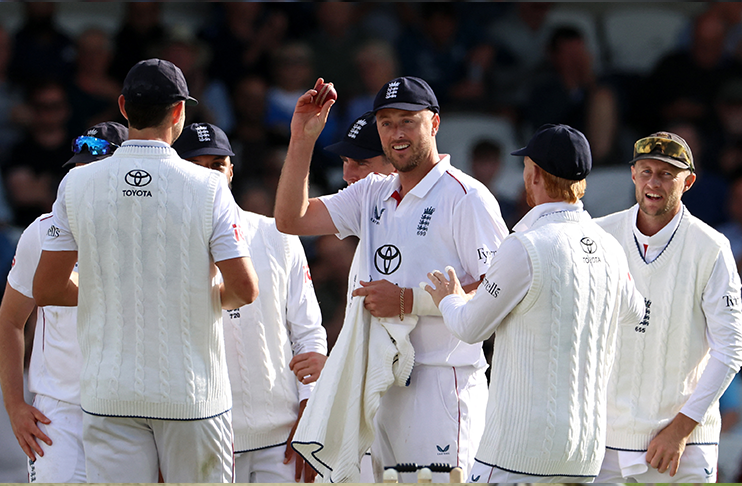
pakistan crushed england
|

Pakistan crushed by England, slide to WTC bottom

LEEDS: Pakistan’s World Test Championship campaign suffered another setback on Friday as they slipped to the bottom of the WTC 2025-27 standings after England completed a crushing innings victory in the first Test at Headingley.

The defeat leaves Pakistan with just two wins from seven matches and a points percentage of 19.05, increasing the pressure on the team ahead of the remaining two Tests of the three-match series.

England, meanwhile, remain seventh in the standings with a points percentage of 29.76, having won five of their 14 matches.

Australia continue to dominate the WTC table. They sit top with seven wins from nine Tests, collecting 84 points at a winning percentage of 77.78. Defending champions South Africa are second with three wins from four matches and a 75% percentage.

New Zealand occupy third place, followed by Bangladesh and India.

Pakistan’s latest defeat exposed familiar problems with both their batting and ability to handle England’s pace attack. After being asked to bat, Pakistan were dismissed for just 171 in their first innings.

England’s bowlers Ollie Robinson and Josh Tongue were particularly effective, claiming five wickets each.

England then turned their advantage into a commanding position, piling up 409 runs in their first innings. Jordan Cox, Joe Root, Harry Brook and Dan Lawrence all contributed half-centuries, while Pakistan spinner Ali Usman fought back with an impressive five-wicket haul.

Pakistan entered their second innings facing a massive 238-run deficit and needed a determined batting effort to save the match.

Instead, their resistance lasted only 37.3 overs.

Pakistan were bowled out for 135, handing England a comprehensive innings victory and leaving their opponents with a 1-0 lead in the series.

Robinson was the standout performer. His eight wickets across the match earned him the Player of the Match award and helped England secure a dominant start to the series.

Pakistan had entered the England tour after drawing their two-Test series against the West Indies 1-1, but their Headingley collapse has put their WTC campaign under renewed pressure.

With two Tests still remaining, Pakistan will need a dramatic turnaround in batting consistency and bowling execution to keep their hopes of climbing the championship table alive.

Similar Posts

  • | |

    Sahibzada Farhan overtakes Abhishek Sharma to claim no. 2 in ICC T20I rankings

    Pakistan’s opening batter Sahibzada Farhan has moved up to second place in the newest ICC Men’s T20I batting rankings, released on Wednesday. He has pushed past India’s Abhishek Sharma in the process. Farhan, who is 30 years old, now holds 848 rating points. That puts him just ahead of Abhishek, who slipped down to third place with 819 points. Abhishek’s drop followed a difficult stretch of form. He struggled during recent tours to Ireland, England, and Zimbabwe, and those low scores clearly took a toll on his ranking. At the very top, India’s Ishan Kishan remains untouched. He continues to hold the No. 1 spot with 910 rating points. Outside of the shakeup between Farhan and Abhishek, the rest of the top five batters stayed largely the same, with no major shifts to report. A little further down the list, India’s Tilak Varma made progress too, climbing two places to sit sixth overall. Meanwhile, England saw a small dip, as both Harry Brook and Jos Buttler each fell one spot. South Africa’s Dewald Brevis had reason to celebrate, breaking into the top 10 for the first time after advancing one position to land at 10th. Perhaps the most eye-catching move, though, belongs to a teenager. Fifteen-year-old Vaibhav Sooryavanshi jumped an astonishing 230 places, landing at 48th with 536 points. That leap comes right after he was named player of the series during Zimbabwe’s tour, a clear sign of his rapid rise in the format. Turning to the bowlers, Afghanistan’s Rashid Khan remains comfortably at the top of the T20I bowling charts. Pakistan’s Abrar Ahmed continues to hold second place, sitting on 736 points, while England’s Adil Rashid rounds out the top three. Further down the bowling table, Mohammad Nawaz stayed steady at 10th with 658 points. Fast bowler Salman Mirza also made a small gain, moving up one place to 15th. Not everyone rose, though. India’s Varun Chakaravarthy dropped three spots and fell out of the top 10 entirely. On the flip side, Australia’s Nathan Ellis had a good update, climbing into the top five bowlers with 675 rating points to his name.

  • | |

    University Road corridor to be completed by Septem…

    Sindh Senior Minister for Transport Sharjeel Inam Memon has said that 80 to 85 per cent of the work on the corridor along Karachi’s University Road has been completed. He said the remaining work is expected to be finished by September 15, after which the road project will be fully completed. Sharjeel Memon made the remarks during a visit to the BRT Red Line project. He reviewed the ongoing construction work and the traffic situation along University Road. The minister said traffic is currently moving smoothly on the road and that there are no major disruptions to the flow of vehicles. He also announced that a large number of double-decker buses are expected to arrive in Karachi next month. Electric vehicles will also be introduced as part of efforts to improve the city’s public transport system. According to the minister, the Sindh government has already approved 500 electric buses. He added that Pink Scooties would soon be made available for women as part of initiatives aimed at improving mobility and transportation options. Sharjeel Memon said the provincial government was working on several public service projects across different sectors. He maintained that the Pakistan Peoples Party comes to power through the public mandate and focuses on completing development and welfare projects after assuming office. Speaking about Thar, the minister said the region has extensive coal reserves that can be used to generate relatively inexpensive electricity. He said Thar coal could also be utilised to meet the energy requirements of power plants across Pakistan. He further highlighted what he described as the Pakistan Peoples Party’s contribution to the country, including its role in Pakistan’s development as a nuclear power. Discussing the performance of the Sindh government, Memon said work was continuing around the clock in different departments. He said significant progress had been made on a housing programme aimed at constructing 2.1 million homes, with a large number of houses already completed. The minister described the housing initiative as one of the largest projects of its kind in the world. He also referred to the Shahrah-e-Bhutto, saying heavy traffic on the newly constructed road demonstrated its importance and success. He claimed Sindh was the only province focusing on practical development rather than political propaganda. On Karachi’s transport needs, Memon said public transport services would be expanded across the city without discrimination. He said voters could support any political party, but the government would continue to provide transport facilities in every part of Karachi. The minister also highlighted developments in Sindh’s healthcare sector. He said the provincial government was providing free and modern medical facilities and had introduced several initiatives before similar measures were adopted elsewhere. Memon also pointed to the province’s air ambulance service, saying the facility had already been operational for some time.

  • |

    PSX faces heavy selling as KSE-100 index drops over 1,300 points

    KARACHI: Selling pressure intensified at the Pakistan Stock Exchange (PSX) on Tuesday as investor sentiment weakened amid growing uncertainty over the prospects of a peace agreement between the United States and Iran and the reopening of the strategically important Strait of Hormuz. The benchmark KSE-100 Index came under pressure during the trading session, losing more than 1,300 points as investors remained cautious and reduced exposure to major stocks across several sectors. At around 2pm, the KSE-100 Index stood at 179,996.62 points, showing a decline of 1,313.66 points, or 0.72%, from the previous close. The market witnessed broad-based selling, with several major sectors contributing to the decline. Automobile assemblers, cement companies, commercial banks, fertiliser manufacturers, oil and gas exploration firms and oil marketing companies (OMCs) remained under pressure. Several index-heavy stocks also traded in negative territory. Prominent companies including HUBCO, Mari Petroleum (MARI), Oil and Gas Development Company (OGDC), Fauji Fertilizer Company (FFC), Habib Bank Limited (HBL), MCB Bank, Meezan Bank (MEBL) and United Bank Limited (UBL) were among the stocks weighing on the benchmark index. Previous session also ends lower The latest decline follows a weak close in the previous trading session. On Monday, the PSX initially moved higher but lost momentum during the second half of the session as investors opted to book profits in heavyweight shares. The KSE-100 Index eventually closed at 181,310.28 points, down 119.74 points, or 0.07%. The continued weakness suggests that investors are closely monitoring developments in international markets, particularly the situation surrounding oil supplies and the Strait of Hormuz. US-Iran tensions keep markets on edge Global financial markets remained unsettled on Tuesday as hopes for an agreement between Washington and Tehran appeared to fade. Negotiations aimed at ending the conflict and restoring normal shipping through the Strait of Hormuz have encountered fresh difficulties. US President Donald Trump on Monday responded to Iran’s conditions for a possible peace agreement by putting forward his own demands, including calls for compensation related to deaths and losses associated with wars, attacks and protests. The tougher rhetoric has raised concerns that diplomatic efforts could take longer, potentially prolonging disruptions around the crucial maritime route. The Strait of Hormuz is one of the world’s most important energy corridors, and prolonged disruption to shipping through the waterway could have significant consequences for crude oil supplies and global energy prices. Oil prices climb to highest level since July 31 The uncertainty surrounding the situation was reflected in international oil markets. Brent crude futures climbed to around $88 per barrel, while US West Texas Intermediate crude futures rose to approximately $82.45 per barrel. Both benchmarks reached their highest levels since July 31 after recording gains of roughly 5% during Monday’s trading session. Higher oil prices are a major concern for economies that depend heavily on imported energy. For Pakistan, sustained increases in global crude prices could increase the country’s import bill and place additional pressure on external accounts, inflation and domestic fuel prices. The rise in energy prices is also being closely watched by investors because higher input costs can affect corporate profitability and influence monetary policy expectations. Asian markets remain cautious The uncertainty was not limited to Pakistan. Asian equity markets moved within a narrow range as investors assessed the potential impact of rising energy prices on inflation and economic growth. MSCI’s broadest index of Asia-Pacific shares outside Japan moved between gains and losses before trading modestly higher. South Korea’s Kospi also recorded a slight increase. However, the escalation in tensions around the Gulf kept overall market sentiment fragile, with investors remaining wary of further developments that could affect energy supplies and global trade. US stock futures were also slightly positive on Tuesday. Nasdaq futures rose around 0.28%, while S&P 500 futures gained approximately 0.1%, following a weaker session on Wall Street on Monday. Inflation data in focus Investors are also awaiting the latest US consumer price data, which could provide further clues about the direction of interest rates and inflationary pressures in the world’s largest economy. The increase in crude oil prices has added another element of uncertainty ahead of the inflation report. A sustained rise in fuel and energy costs could complicate efforts to bring inflation closer to central-bank targets. For Pakistani investors, the combination of geopolitical uncertainty, higher global oil prices and pressure on heavyweight shares is likely to remain a key factor influencing trading sentiment in the near term.

  • | |

    Azma Bukhari hits back at Sharjeel Memon over AJK …

    Punjab Information Minister Azma Bukhari has strongly criticised Sindh Minister Sharjeel Memon over his remarks about the Azad Jammu and Kashmir (AJK) elections. Azma Bukhari told Memon to “drink cold water and pour some on his head,” saying the election was over and the people of AJK had already delivered their verdict. She said the election results had proved the Pakistan Peoples Party’s (PPP) calculations wrong and dismissed its allegations regarding pre-poll rigging. Bukhari claimed that a PML-N candidate had recovered bags containing ballot papers from the residence of a PPP candidate one night before polling. Taking a sharp jibe at the PPP, she said its “arrow had disappeared in the valleys of Kashmir,” while the PML-N’s “lion” was roaring across the region. She said AJK voters had given their verdict in favour of PML-N leader Nawaz Sharif during the first phase of the elections. Bukhari urged the PPP to learn to accept defeat instead of raising allegations whenever it loses an election. She said political parties should celebrate victories but also show maturity in defeat. She further questioned the PPP’s position on elections in Gilgit-Baltistan. Bukhari asked whether the party considered those elections transparent because it had formed the government there. She said it was unfair to describe an election as transparent when a party wins and allege rigging when it loses.

  • |

    Texas governor targets Muslim airport facilities

    Texas Governor Greg Abbott has ordered a review of state grants provided to Dallas Fort Worth International Airport (DFW) and Houston’s George Bush Intercontinental Airport (IAH), alleging that facilities for Muslim passengers to perform ablution and pray could amount to religious discrimination. Abbott’s office said the matter has also been referred to the US Department of Transportation for investigation and possible action. According to a statement from the governor’s office, state grants provided to entities operating airports in Texas will be reviewed to determine whether existing funding should be withdrawn or whether the airports should be denied future state funding. Abbott has argued that providing facilities specifically associated with one religion at government-owned facilities could raise concerns under religious discrimination laws. The governor’s office said DFW International Airport is planning to establish a dedicated ablution facility for Muslim passengers. At George Bush Intercontinental Airport, a similar facility has reportedly already been established, along with a designated space for prayer. Abbott has written to US Transportation Secretary Sean Duffy, asking the Department of Transportation and the Federal Aviation Administration (FAA) to immediately review the existing or proposed religious facilities at both airports. He has also called for corrective or legal action if federal authorities determine that any violations have occurred. The Texas governor maintains that both airports receive federal funding and are therefore required to comply with federal laws prohibiting discriminatory practices. In his statement, Abbott said the proposed ablution facilities appear to provide a special accommodation to a particular section of the population based on religion, which he considers potentially unlawful. He further argued that because the airports are publicly owned, government authorities cannot give preference to one religious viewpoint over others. Abbott reiterated his position on social media, saying that government facilities funded by taxpayers should not allow what he described as unlawful religious discrimination.

  • |

    Saudi, US officials discuss rising regional tensions

    Saudi Crown Prince Mohammed bin Salman and US Central Command chief Admiral Brad Cooper have discussed efforts to contain escalating tensions in the Middle East, with the two sides also reviewing defence cooperation and regional security. According to Saudi state media, the meeting focused on developments across the region and measures aimed at reducing tensions. Officials also discussed ways to strengthen security and stability amid the continuing US-Iran conflict and growing concerns over maritime traffic. The talks came as Saudi Arabia announced progress toward activating a multinational defensive maritime alliance. Representatives from 39 countries attended the alliance’s latest planning meeting in Jeddah, while 13 countries have joined the initiative. Saudi authorities described the meeting as an important step toward putting the maritime alliance into operation. The initiative comes as security concerns continue to grow around the Strait of Hormuz, one of the world’s most important energy routes. Tensions around the strategic waterway have intensified during the US-Iran conflict. Disruptions to shipping have raised concerns about global supplies of oil and liquefied natural gas, while diplomatic efforts to secure freedom of navigation remain uncertain. US Vice President JD Vance has said that keeping energy prices affordable for American consumers is currently Washington’s top priority in the conflict. Vance said the administration wanted to maintain lower oil and gas prices while also ensuring that Iran could not acquire a nuclear weapon. His remarks came as the prolonged conflict continued to affect energy markets and increase pressure on the US economy. Meanwhile, US Treasury Secretary Scott Bessent warned that Washington was preparing unprecedented economic measures against Tehran. He said the United States would combine intensified economic pressure with restrictions linked to Iran’s control of the Strait of Hormuz. US Defence Secretary Pete Hegseth also said Washington had the military capability to maintain its naval blockade of Iran for an extended period. He said American ships could be rotated to sustain the operation. The confrontation has severely affected Iran’s economy and disrupted its access to international trade. Tehran, meanwhile, has sought to use the Strait of Hormuz as leverage in negotiations with Washington. Iran has demanded the removal of economic sanctions and the release of frozen assets as part of conditions for restoring normal maritime traffic. Commercial traffic through the Strait has fallen sharply since the conflict began. The decline has heightened fears that a prolonged disruption could further affect global energy supplies. Two vessels linked to Abu Dhabi National Oil Company were reportedly attacked while passing through the waterway, prompting condemnation from the UAE. The situation has also kept oil markets volatile. Although crude prices declined recently amid concerns over weaker demand and rising US inventories, renewed attacks and threats of further escalation have continued to unsettle investors. The International Energy Agency has revised its forecast for global oil supply, projecting a larger decline than previously expected. Economists have warned that a prolonged conflict could weaken global economic growth and increase the risk of recession in some regions. US President Donald Trump has faced growing domestic pressure over the conflict, particularly as higher fuel costs weigh on American consumers. Washington has continued imposing sanctions on Iran, while efforts to bring Tehran back to negotiations have so far produced limited results.

Leave a Reply

Your email address will not be published. Required fields are marked *