questions mount over
|

Questions mount over funding as violence mars London Kashmir protest

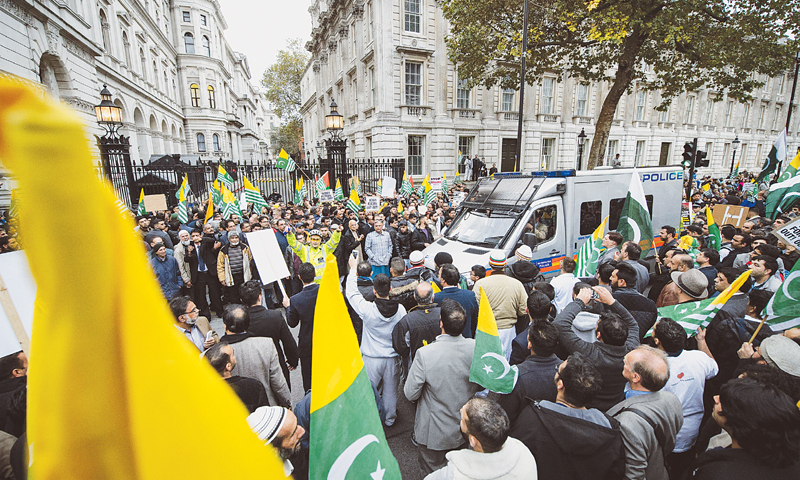
A protest held in central London in the name of solidarity with Kashmir has come under scrutiny following allegations over its funding and organisation, while reports of violence against a senior journalist have further fuelled controversy surrounding the demonstration.

According to claims circulating among sections of the British Pakistani and Kashmiri community, around 50 coaches were arranged to transport participants from Bradford, Manchester and Birmingham to London. Some community members have alleged that the overall cost of the mobilisation exceeded £500,000 and have publicly questioned who financed the event, calling for greater transparency over its funding and logistics.

Community sources further alleged that some families were offered a free day trip to London, including complimentary coach travel, to encourage participation in the demonstration. According to the sources, the offer attracted families who joined the trip.

Allegations circulating on social media have also suggested that foreign elements including Indian agencies may have supported the protests through there frontmen’s

Some members of the community further claimed that the number of British Pakistanis and Azad Kashmiris attending the protest was lower than expected, while participants from other communities appeared more visible.

The demonstration was overshadowed by the alleged assault on senior Pakistani journalist Murtaza Ali Shah while he was covering the protest. Reports of the incident have drawn concern from journalists and media organisations, with calls for those responsible to be identified and held accountable.

Witnesses also alleged that some protesters behaved aggressively towards members of the media, raising concerns about press freedom and the safety of journalists covering public demonstrations. Media observers said any intimidation or violence against journalists undermines democratic values and damages the credibility of a protest.

The protest took place amid continuing demonstrations by sections of the Kashmiri diaspora over developments in Pakistan-administered Kashmir. While organisers described the event as a show of solidarity with Kashmir, the allegations over funding, crowd mobilisation and the reported violence have shifted attention to the conduct and organisation of the demonstration.

The organisers have not publicly responded to the allegations regarding the event’s funding, logistics or the reported assault on the journalist. Community representatives have called for full transparency over the financing of the protest and urged all parties to ensure that future demonstrations remain peaceful and respectful of media freedom.Organisers have rejected claims of Indian funding by saying there members contributed for the arrangements.

Similar Posts

  • |

    Leaked FIFA letter congratulates Argentina on World Cup runner-up finish

    A letter written by FIFA President Gianni Infantino to Argentine Football Association President Claudio Tapia has reportedly surfaced amid an ongoing FIFA investigation into the post-match confrontation following the 2026 World Cup final. In the letter, Infantino referred to Argentina’s defeat against Spain in the final played on July 19, 2026. He congratulated Argentina on securing the silver medal and praised the team’s overall performance throughout the tournament. Infantino described Argentina’s World Cup campaign as an impressive achievement. He also praised the players and head coach Lionel Scaloni for their hard work, professionalism and commitment to football. The letter has emerged at a sensitive time for Argentine football. FIFA is currently investigating a confrontation between players following the final. Tensions reportedly rose after Argentina lost to Spain in extra time. The atmosphere remained tense during the trophy presentation, with most Argentine players reportedly turning their backs while the Spanish team received the trophy. A physical altercation between players also reportedly took place after the match. FIFA is examining the incident as part of its formal disciplinary process. The leaked correspondence, however, focuses on Argentina’s sporting achievement rather than the post-match controversy. Infantino’s message praised the team for reaching the final and securing the runners-up position. Sending formal congratulatory letters to medal-winning teams is a customary FIFA practice following the conclusion of major international tournaments. Argentina’s silver-medal finish marked the culmination of a strong World Cup campaign, despite the team falling short against Spain in the final.

  • |

    Russia ready for Ukraine peace ideas, but sets con…

    MOSCOW: Russia is prepared to consider fresh proposals aimed at ending the war in Ukraine, but any initiative must take account of what Moscow describes as the “realities on the ground”, a senior Russian diplomat said on Friday. Deputy Foreign Minister Sergei Ryabkov said Moscow remained willing to maintain dialogue with Washington, while questioning whether the United States could exert enough influence over Kyiv and its European supporters to move negotiations forward. His comments came as diplomatic efforts to end the conflict remain largely stalled, with international attention also focused on the wider tensions surrounding the war in Iran. In an interview with Russian media outlet News.ru, Ryabkov said Moscow had seen signs that Washington was prepared for constructive discussions and showed some understanding of Russia’s position. “At this stage, it is more important to what extent Washington is able to influence the decisions of the Kyiv regime and its European sponsors,” he said. Ryabkov accused some European countries of continuing to seek what he called a “strategic defeat” of Russia, highlighting one of the central obstacles facing any potential peace agreement. Moscow Awaits New Proposals Russia and the United States have held discussions aimed at finding a path towards ending the Ukraine conflict, but negotiations have made little visible progress. The Kremlin said on Thursday that it had not received information about a possible new visit to Moscow by US presidential envoys Jared Kushner and Steve Witkoff. The two have previously played prominent roles in contacts with Russian officials. US Secretary of State Marco Rubio said last month that Washington remained committed to helping end the war after meeting Russian Foreign Minister Sergei Lavrov in Manila. However, Rubio also warned against expecting a rapid agreement, saying Washington was attempting to find a middle ground between the positions of the two sides. Ryabkov said Russia would be ready to examine any proposals put forward by Washington, provided they were consistent with Moscow’s stated objectives. “The Russian Federation is ready to listen to any reasonable proposals and ideas that are in line with the goals set by the Russian president and meet the ‘realities on the ground’,” he said. Territorial Disputes Remain Central The comments underline the continuing importance of territory in the negotiations. After almost four and a half years of war, Russia controls around one-fifth of Ukraine’s internationally recognised territory. Moscow has repeatedly said it is willing to negotiate, but insists that any settlement must acknowledge what it calls the new realities created by the conflict. Ukraine and its Western allies have opposed recognising Russian territorial gains, making the issue one of the most difficult elements of any potential peace agreement. The challenge for Washington is therefore not simply bringing Moscow and Kyiv back to negotiations, but finding terms that could satisfy competing demands over territory, security guarantees and the future political order in the region. Nuclear Dialogue Also on the Table Ryabkov also signalled that Moscow wants to keep diplomatic channels open with Washington on nuclear weapons. The issue has gained urgency since the New START treaty expired in February, leaving Russia and the United States without binding limits on their strategic nuclear arsenals for the first time in more than five decades. Moscow has said it would continue observing the treaty’s limits on missiles and warheads as long as Washington does the same. “We remain open in the future to find political and diplomatic ways to stabilise this area,” Ryabkov said. The nuclear issue adds another layer to an already complicated US-Russia relationship. Even as the two countries remain deeply divided over Ukraine, Moscow appears keen to prevent the collapse of communication on strategic weapons. For now, Russia’s message is that the door to diplomacy remains open — but only proposals that reflect Moscow’s stated conditions and its view of the battlefield are likely to receive serious consideration. With the war continuing and previous negotiations stalled, the next major test will be whether Washington can persuade Kyiv, Moscow and European governments to move beyond competing positions and return to substantive peace discussions.

  • |

    Israeli banks plan to end services for Palestinian banks raising fears of financial crisis

    Israeli banks have informed Palestinian financial institutions that they plan to end key banking services within the coming weeks, a move that has sparked concerns about serious economic disruption in the occupied West Bank. Officials on both sides say the decision could affect trade, salaries, and the daily financial operations that rely on cooperation between the two banking systems. The banking relationship allows Palestinian institutions to process transactions in Israeli shekels, the currency widely used in the Palestinian territories. These services are essential for paying for electricity, water, fuel, food imports, and other goods purchased from Israel. They also help transfer wages earned by thousands of Palestinians employed in Israel. According to Palestinian banking officials, five local banks that depend on Israel’s Bank Hapoalim for correspondent banking services have been told those arrangements will end on August 13. Other Palestinian banks that work through Discount Bank have reportedly been informed that their services will stop on September 1 unless a solution is reached. Israel’s Finance Ministry confirmed that both banks had announced plans to discontinue their correspondent banking services. The ministry said the decision reflects increasing legal and financial risks faced by Israeli banks while handling transactions for Palestinian institutions. In a statement, the ministry said it is holding discussions with the banks to find a way to continue these services while protecting Israel’s economic and security interests. Officials are exploring options that would allow financial cooperation to continue under conditions that reduce legal exposure for the banks involved. The banking arrangements have long depended on a government backed legal guarantee that shields Israeli banks from liability related to transactions carried out on behalf of Palestinian financial institutions. This protection is renewed every six months by the Israeli government. However, banking officials say commercial lenders no longer believe the existing guarantees provide enough protection. They argue that the risks of possible money laundering claims or allegations linked to terrorist financing have increased over time. According to one Israeli banking official, the banks believe the responsibility should now be taken over directly by the government instead of remaining with private financial institutions. Discount Bank confirmed that it had informed Israeli authorities of its concerns regarding the growing risks associated with these services. The bank said it has a responsibility to protect its depositors and shareholders while operating within an increasingly complex legal environment. Bank Hapoalim said the issue remains under review and did not provide further details. Economic experts warn that ending these banking links could have serious consequences for the Palestinian economy. Without access to correspondent banking services, businesses and individuals may be forced to rely more heavily on cash transactions. That shift could weaken the formal banking sector, reduce financial transparency, and encourage the growth of an informal economy. The decision could also place additional pressure on the Palestinian Authority, which already faces severe financial difficulties. The Authority depends heavily on local banks to finance public sector salaries and cover budget shortfalls. Financial analysts warn that if banks lose access to essential payment systems, the government’s ability to meet its financial obligations could be significantly weakened. A Palestinian businessman with close connections to the banking sector said the stability of local banks is closely tied to the stability of the Palestinian Authority. He warned that serious disruption to the banking system could have wider political and economic consequences across the West Bank. The latest development comes as the Palestinian Authority continues to struggle with reduced revenues after Israel suspended the transfer of customs and tax funds collected on its behalf. Those funds account for around two thirds of the Authority’s income, leaving its finances under increasing strain. Unless an agreement is reached soon, officials fear the planned banking cutoff could deepen the economic challenges already facing Palestinians in the occupied territory.

  • |

    Receding Danube River reveals World War II remains in Budapest

    A severe drought across Europe has caused water levels in the Danube River to drop to record lows, exposing the remains of two World War II German soldiers and military equipment near central Budapest. The discovery was initially reported by a passerby who spotted a motorcycle handlebar protruding from rocks along the riverbank near Batthyany Square. Recovery operations conducted by the German War Graves Commission alongside Hungarian military historians unearthed a largely intact Wehrmacht motorcycle, identified as a DKW NZ 350-1 model, along with anti-tank mines that prompted a brief deployment of bomb disposal personnel. The site yielded well-preserved personal items, including intact identification tags, a wedding ring, and a Kuban shield combat decoration. Experts noted that a combination of riverbed mud and petroleum slowed the decay of the artifacts and human remains over the past eight decades. Analysis of the identification tags revealed that one soldier served in the Wehrmacht while the other belonged to the Waffen-SS. Because both halves of the soldiers’ identification tags remained intact rather than split, as was customary when casualties were processed, investigators confirmed that neither death was officially recorded during the war. The commission has initiated bone analysis and archival checks to identify the deceased before their eventual burial at the German war cemetery in Budaors.

  • |

    Diplomatic storm erupts over podcast banter involving Japanese prime minister

    Australian Prime Minister Anthony Albanese is facing intense political backlash after a podcast appearance triggered a high-profile diplomatic row with Tokyo. The controversy stems from an episode, recorded in July, in which Albanese discussed a pair of prized crown melons presented to him during a May bilateral meeting by Japanese Prime Minister Sanae Takaichi. During the segment, podcast host Nikki Osborne made an explicit joke comparing the fruit to female anatomy, to which Albanese responded with agreement. The exchange went largely unnoticed upon release but reignited publicly after Shingo Yamagami, Japan’s former ambassador to Australia, published a scathing opinion piece accusing the Australian leader of casually mocking a key strategic ally. Yamagami described the remarks as a sexist insult that betrayed the close diplomatic bond between the two nations, noting that crown melons are highly valued cultural gifts in Japan, often worth upwards of 30,000 yen (£150) each. Opposition leaders in Canberra immediately seized on the commentary, demanding an official apology from Albanese for what they termed “classless” and disrespectful conduct. Albanese rejected calls to apologise in parliament, insisting that the partnership between Australia and Japan remains as strong as ever and pointing out that the joke was initiated by the host rather than himself. Senior Labor Party ministers also defended the prime minister, arguing that the comments were taken out of context by political opponents and former diplomats. The episode marks the second time Albanese has faced criticism over his appearance on the show, following a prior apology for crude remarks regarding pop star Kylie Minogue.

Leave a Reply

Your email address will not be published. Required fields are marked *