austria opens police
| |

Austria opens police station at house where Hitler…

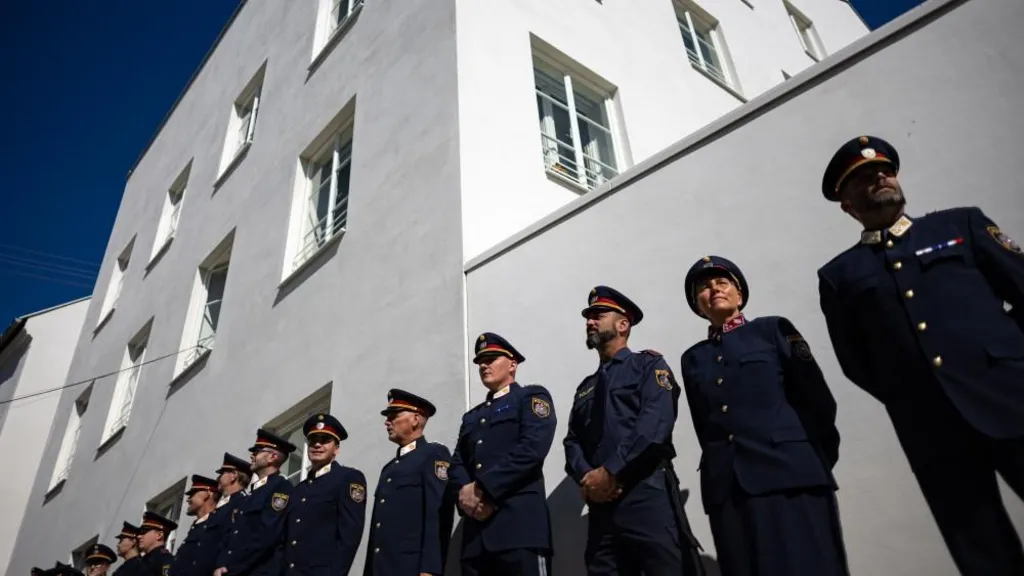
Austria has opened a police station inside the house in Braunau am Inn where Adolf Hitler was born, closing out years of debate over how to handle the building’s dark history.

The 17th century structure once operated as an inn and served as the birthplace of the Nazi dictator in April 1889. Authorities have now completed a substantial renovation that changed the building’s facade, though managing the site has posed a persistent challenge for Austrian officials determined to prevent it from turning into a destination for neo Nazi pilgrimage.

Hitler lived in the building, located at Salzburger Vorstadt 15, for only a few weeks before his family relocated to another address in Braunau. The family left the town permanently when Hitler was three years old. He briefly returned to Braunau in 1938 while traveling to Vienna after annexing Austria into Nazi Germany.

Interior Minister Gerhard Karner attended the opening ceremony alongside other local officials, which featured police musicians performing on tuba and other brass instruments. Karner said Austria is taking responsibility for what he called the terrible legacy of the past, adding that although deciding the building’s fate proved difficult, he believes the new police station represents a fresh chapter for the site. He said the building will now stand as a place representing democracy, the rule of law, security, freedom and human dignity. A Catholic police chaplain then blessed two crosses that will hang inside the new station.

For decades, Austria’s interior ministry rented the building from its former owner, a local woman named Gerlinde Pommer, paying her generous rent in an effort to keep the property from becoming a site for far right tourism. A local charity used the building for years as a day center and workshop for people with special needs, but the organization had to vacate in 2011 after Pommer blocked planned renovations. She also repeatedly declined to sell the property to the government, leaving the building empty for several years while she and authorities disputed terms.

In 2016, Austria’s parliament passed legislation allowing the government to seize the property from Pommer, paying her compensation of 812,000 euros. She later challenged the amount in court, arguing it was too low, but ultimately lost the case.

Wolfgang Sobotka, who served as interior minister at the time, suggested the building should be demolished and replaced with a new structure altogether, echoing an earlier proposal from a Russian lawmaker who had offered to purchase the house and destroy it. Both ideas drew significant criticism, with opponents arguing that tearing down the building would amount to denying Austria’s Nazi era history.

In 2019, the government unveiled plans to convert the building into a police station and launched an EU wide competition inviting architects to submit design proposals. Officials subsequently spent millions of euros renovating the structure, transforming its appearance dramatically from its earlier state.

The building, now painted white both inside and out, features extensive oak woodwork throughout, while an original winding staircase and arched entrance hall have been preserved from the earlier structure. The transformation marks a stark contrast to the building’s condition decades ago, when the Lebenshilfe charity operated a small shop in one of its front rooms.

Police Chief Inspector Ludwig Heise said he feels fortunate to work in such a modern facility, noting the additional space compared to previous quarters, though he added that beyond its size, the station functions just like any other police facility in Austria.

The reopening marks the culmination of a long and often contentious effort by Austrian authorities to neutralize the symbolic weight of Hitler’s birthplace, transforming a site once feared as a potential magnet for extremist sympathizers into a functioning symbol of the democratic institutions Austria has built in the decades since the Second World War.

Similar Posts

  • | |

    Hafiz Naeem announces nationwide strike on Septemb…

    Jamaat-e-Islami chief Hafiz Naeemur Rehman has announced a nationwide strike on September 3, saying he will visit different cities to persuade traders to join the party’s ongoing protest movement. Addressing a press conference in Lahore, Hafiz Naeem said the party would hold a major public gathering in Faisalabad on Friday, followed by another gathering in Lahore and then Peshawar. He said he would also meet industrialists and traders in Faisalabad to discuss their concerns and encourage them to participate in the movement. He announced that sit-ins would also begin in Quetta from the following day. Hafiz Naeem said the protests and sit-ins would continue until the government accepted the party’s demands. He added that consultations were under way over a possible call for a march towards Islamabad. The Jamaat chief said the party was not yet formally announcing a wheel-jam strike, but expressed the view that the September 3 strike could eventually turn into a complete shutdown. He strongly criticised prolonged power outages across the country and questioned who would be held responsible for the situation. He said ending load-shedding was among the key demands of the protest movement. He also demanded the withdrawal of fixed charges imposed on electricity bills and called for the immediate termination of agreements with independent power producers. Hafiz Naeem accused the government of burdening citizens with rising fuel and electricity costs. He said gas shortages had also reached alarming levels, despite consumers paying high prices for the commodity. Criticising the government’s taxation policies, he alleged that authorities were focused on collecting taxes while businesses were being pushed towards closure. He accused government officials of enjoying expensive facilities at the expense of ordinary citizens. The Jamaat chief warned that if the levy and so-called “bhatta tax” were not withdrawn, no one would be able to stop a mass public movement. He further alleged that the government had been formed through what he described as a “Form 47” mandate and claimed that the party’s protests had exposed irregularities involving diesel pricing. According to Hafiz Naeem, additional refinery charges were being imposed on locally produced diesel, further increasing the burden on consumers and businesses. He also raised questions over the deaths of 14 children in the fire at Pakistan Institute of Medical Sciences (PIMS), demanding accountability over the incident and criticising the hospital’s administration. The Jamaat chief also accused the country’s three major political parties of engaging in what he described as a political “noora kushti”, alleging that they were creating the appearance of confrontation while avoiding substantive action. Hafiz Naeem said Jamaat-e-Islami would continue its campaign until its demands were addressed and urged traders, industrialists and citizens to join the protest movement.

  • |

    Umerkot flour millers reject Rs128/kg official rate, seek fresh price review

    UMERKOT: Flour mill owners in Umerkot district have rejected the government-fixed price of Rs128 per kilogram, arguing that the sharp increase in wheat prices has pushed their production costs far above the officially notified rate. The millers said the prevailing wheat price in the open market had climbed to around Rs125 per kilogram, while additional expenses related to milling, labour, electricity, transportation and other operations had increased the overall cost of producing flour to nearly Rs140 per kilogram. They maintained that selling flour at Rs128 per kilogram was therefore commercially unsustainable and would force mill owners to operate at a loss. In this regard, representatives of the flour milling industry have submitted written applications to the Mirpurkhas commissioner and the Umerkot deputy commissioner, requesting authorities to reconsider the existing flour price and determine a new rate based on prevailing market conditions and production costs. The mill owners also raised objections to what they described as excessive administrative action against flour mills across the district. They specifically complained about raids and wheat seizures allegedly carried out by assistant commissioners in Umerkot, Kunri, Samaro and Pithoro. According to the millers, government policy allows flour mill owners to maintain wheat stocks of up to 850 bags per stone at their mills or designated warehouses. They alleged that despite the provision, local administrative officials had conducted raids on mills and storage facilities and seized wheat stocks. The mill owners termed the alleged seizures unjustified and said such actions were creating additional difficulties for an already financially pressured industry. They urged the authorities to ensure that enforcement measures were carried out strictly in accordance with the relevant government policy. The millers further called for an investigation into alleged irregularities involving food department inspectors. They demanded that senior provincial officials examine the complaints and take appropriate action if any wrongdoing is established. They appealed to the Sindh chief minister, provincial food secretary, Mirpurkhas commissioner, Umerkot deputy commissioner and other concerned authorities to intervene in the matter and review the officially fixed flour price. The mill owners argued that the price should be determined after taking into account the current cost of wheat as well as electricity, labour, transportation, maintenance and other expenses associated with flour production. They warned that continued enforcement of a price they consider economically unviable could increase financial losses for flour mills and put further pressure on the district’s milling industry. The millers said they were willing to cooperate with the administration in maintaining the availability of flour and preventing unjustified price increases, but stressed that any official pricing mechanism must reflect actual market and production costs. They also urged the provincial government to establish a transparent mechanism for monitoring wheat stocks and flour prices so that disputes between millers and local administrations could be resolved through clear rules rather than repeated raids and seizures.

  • |

    Eva Mendes calls out fake AI photo of Gosling and Depp at comic-con

    Eva Mendes has called out a viral AI-generated image that falsely showed Ryan Gosling and Johnny Depp posing together at San Diego Comic-Con. The 52-year-old actress spoke up this past weekend, right after her longtime partner Gosling was revealed as Marvel’s new Ghost Rider. Both Gosling and Depp did attend Comic-Con last week. But they showed up on different days and never actually crossed paths. The AI-made image told a different story, showing the pair walking side by side through the convention crowd. Depp appeared in character as Ebenezer Scrooge, while another figure, tagged online as Slopaxo, also showed up in the doctored photo. The image came from an account called @opavisions. Its caption claimed that watching Gosling, Depp, and Slopaxo “moving through the crowds like the unlikeliest best-friend trio” was one of the weekend’s best moments. It described candid walks, fan interactions, and spontaneous stops, framing the whole thing as a genuine, memorable sighting. Mendes was not having it. She commented directly on the post: “FAKE. Please let People know when you are putting out AI.” Her message was blunt and left no room for confusion. The account responded quickly, adding a disclaimer: “DISCLAIMER: THIS WAS AI***.” It also thanked Mendes for speaking up, promising to be clearer about AI content going forward, and voiced appreciation for both her and Gosling’s careers. In a separate comment, the account issued a short apology: “Ok we will sorry.” Meanwhile, Depp’s actual Comic-Con appearance last Thursday turned heads for real. He looked almost unrecognizable dressed as Ebenezer Scrooge, promoting his upcoming film “Ebenezer: A Christmas Carol,” set to hit theaters November 13. The panel took place near a snow-covered mock storefront built in San Diego’s Gaslamp district, adding to the film’s wintry atmosphere. A source close to the event said Depp received a warm reception from fans, some of whom dressed up as characters from his most famous roles. The incident adds to a growing pattern of AI-generated celebrity images spreading online before being debunked, highlighting how quickly convincing fakes can circulate and how important it is becoming for creators to label AI content clearly from the start. https://www.instagram.com/p/DbRGQNOzbkR/?utm_source=ig_web_copy_link&igsh=NTc4MTIwNjQ2YQ==

  • |

    Right-wing party proposes armed forces intervention to halt Channel crossings

    Reform UK has proposed an extensive military-led framework aimed at completely stopping small boat migration across the English Channel. The policy proposal outlines leveraging combined military and intelligence tracking technology to create a heavily monitored sea border, alongside granting emergency powers to armed forces to intercept vessels and push them back toward French territory. The plan includes expanding detention facilities to enable immediate offshore or domestic processing and deportation without eligibility for standard asylum routes. To facilitate these changes, the party stated it would pursue major legal shifts, including withdrawing the United Kingdom from the European Convention on Human Rights and replacing current national human rights legislation with a new domestic framework. Critics and legal scholars have questioned the feasibility of the measures, pointing out potential conflicts with international maritime agreements and international law. Meanwhile, Prime Minister Andy Burnham stated his administration would maintain a relentless focus on tackling immigration networks through increased enforcement and cross-border security cooperation.

  • |

    Modi forms task force to reform exam system

    Indian Prime Minister Narendra Modi has announced a high-powered task force to reform the country’s examination system following weeks of student-led protests over alleged irregularities in major entrance exams. The announcement came a day after Education Minister Dharmendra Pradhan resigned, as the government faced growing pressure from students and opposition groups demanding changes to the examination process. Modi said the new task force would be headed by Nandan Nilekani, co-founder of technology company Infosys. The panel will focus on improving the examination system and making it more transparent, reliable and technology-driven. In a video message posted on social media, Modi said the government wanted to restore confidence in upcoming examinations as quickly as possible. He stressed that the system must ensure greater transparency and make effective use of technology. The protests had been led in large part by supporters of the social media-driven Cockroach Janta Party (CJP). Thousands of students and young people gathered at New Delhi’s Jantar Mantar over several weeks, making the demonstrations among the most significant anti-government protests in India in recent years. The movement initially focused on alleged problems and irregularities in examinations, but its demands later expanded. Protesters also raised concerns about unemployment, limited opportunities for young people and what critics described as the government’s increasingly authoritarian approach. The protest site was largely cleared on Sunday. Municipal workers washed the surrounding roads and began repainting walls covered with slogans, posters and graffiti. Some protesters criticised the decision to remove the writings, saying the messages represented an important record of the movement. Rahul, a protester who had visited the site, said demonstrators had photographed and recorded the posters and slogans before they were removed. He said they wanted the material to remain documented and remembered. Some young people who travelled long distances to participate in the demonstrations arrived after the protest had already ended. One 19-year-old participant said he had travelled for around 20 hours after seeing videos of the demonstrations on Instagram. He said he wanted to witness the atmosphere and join other young protesters. Another visitor accused the government of worsening the situation by attempting to suppress the demonstrations. He argued that the crackdown had contributed to the protests becoming larger.

  • | | |

    Oil prices slip despite Gulf tensions as markets f…

    LONDON: Global oil prices edged lower on Thursday as investors shifted their attention from escalating military tensions in the Gulf to the resilience of energy supplies flowing through the region’s critical shipping routes. Brent crude futures fell 96 cents, or 1.06%, to $89.78 per barrel, while US West Texas Intermediate (WTI) crude declined 64 cents, or 0.76%, to $83.82 per barrel. The retreat came just a day after both benchmarks posted sharp gains, reflecting the market’s growing tendency to react briefly to geopolitical developments before refocusing on supply fundamentals. Oil markets had surged on Wednesday after US President Donald Trump warned Iran of a forceful response following an alleged Iranian missile strike on a US military base in Jordan. The rally was further fuelled by fresh US military operations against Iranian targets and joint US-Saudi strikes on Iran-backed armed groups in Iraq, heightening fears of wider regional instability. Despite the renewed military activity, analysts said traders are increasingly assessing whether the conflict will significantly disrupt global oil exports. Market participants remain closely focused on the Strait of Hormuz, a strategic waterway that traditionally carries nearly one-fifth of the world’s oil and gas shipments. According to energy consultancy Rystad Energy, around 13 million barrels of Gulf oil per day are still reaching international markets despite severe disruptions and restrictions in the region. Analysts noted that alternative shipping routes and logistical adjustments have helped prevent a complete supply shock. Lin Ye, Vice President of Commodity Markets at Rystad Energy, said geopolitical headlines continue to trigger rapid price spikes, but such rallies often fade as investors evaluate actual supply conditions and ongoing diplomatic efforts. Meanwhile, shipping challenges persist after Iran’s closure of the Strait of Hormuz and the Iran-aligned Houthi movement’s naval blockade in the Red Sea. Even so, some cargoes, particularly those linked to Chinese buyers, continue to move through alternative channels. IG market analyst Tony Sycamore said the longer alternative export routes remain operational, the weaker Iran’s leverage over the Strait of Hormuz becomes. He added that markets are increasingly adapting to prolonged disruptions, reducing the lasting impact of geopolitical shocks on crude prices. Although volatility remains elevated, traders are now placing greater emphasis on uninterrupted oil flows rather than military rhetoric, suggesting that supply resilience could continue to shape global energy markets in the weeks ahead.

Leave a Reply

Your email address will not be published. Required fields are marked *