belgium wildfire spreads
|

Belgium wildfire spreads toward Germany

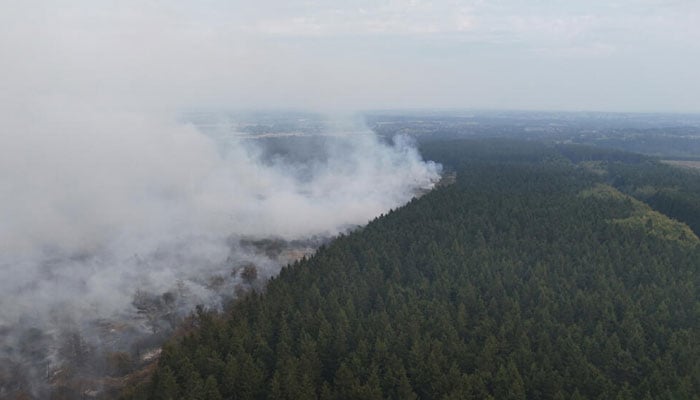
A massive wildfire has engulfed around 3,000 hectares of forest in Belgium, with flames now moving toward the German border in what authorities describe as the country’s worst recorded forest fire.

According to international media reports, firefighters, military personnel, helicopter crews and local farmers are working together to contain the blaze. Strong efforts are underway as the fire continues to threaten forested areas near the German border.

Authorities have urged residents who evacuated their homes to remain away for the time being, warning them not to return until officials declare the areas safe.

Emergency teams are focusing on preventing the fire from spreading further toward Germany. Helicopters are assisting ground crews by monitoring the flames and supporting firefighting operations in difficult-to-reach areas.

Data from the European Forest Fire Information System (EFFIS) indicates that the blaze is the largest forest fire ever recorded in Belgium. The fire has already affected more than twice the area destroyed by a major wildfire in the country in 2011.

The wildfire comes as several parts of Europe face extreme heat and prolonged dry conditions. Rising temperatures, low rainfall and dry vegetation have increased the risk of wildfires across the continent, putting forests, communities and emergency services under growing pressure.

Similar Posts

  • |

    US war on iran costs $37.5bn so far: Pentagon

    The United States has spent 37.5 billion dollars on its war against Iran to date, US Defence Secretary Pete Hegseth told lawmakers at a Senate Appropriations Committee hearing in Washington, while calling on Congress to approve additional funding for the conflict. The statement comes six months ahead of midterm elections, where Democrats lead in public opinion polls and are attempting to link the unpopular war with broader economic affordability concerns. Hegseth stated that the 37.5 billion dollar figure covers specific operational aspects of the war as well as anticipated expenditures through September 30, though the exact calculations used by the Pentagon were not detailed. The funding request follows President Donald Trump’s call for nearly 90 billion dollars in supplemental funding last month, primarily for the Iran conflict, setting up legislative friction with lawmakers who express frustration over the war’s trajectory and communication. Both Democratic and Republican members of Congress criticised the administration for a lack of transparency since US and Israeli military operations against Iran began on February 28. Senator Patty Murray warned that the president’s severe threats against civilian infrastructure risk war crimes and a prolonged conflict, while Senator Kirsten Gillibrand criticised contradictory statements from the administration regarding the duration and scope of the war. Hegseth warned lawmakers that without an urgent influx of capital, military training operations would need to be curtailed. Chairman of the Joint Chiefs of Staff General Dan Caine acknowledged that while service members would receive their pay, the Pentagon could face challenges covering equipment maintenance and investments in future capabilities due to strains on its nearly 1 trillion dollar budget. In response, Hegseth urged Congress to approve not only the supplemental package but also a 1.5 trillion dollar defence budget for 2027, describing any failure to fund the department at that level as the single greatest threat to national security. The appeal for funds follows the breakdown of a fragile ceasefire earlier in the month, leading to daily reciprocal strikes between US and Iranian forces. US troop casualties have risen to 18 killed and approximately 430 injured, including 100 wounded since July 7, though the Pentagon noted that 96 per cent of those injured have returned to active duty. Meanwhile, President Trump has threatened to expand targets to include Iranian energy plants, bridges, the Kharg Island oil hub via ground forces, and the deep-underground Pickaxe Mountain nuclear-linked facility, stating that a strike on the mountain site would occur in the near future.

  • |

    China holds military drills near disputed Scarborough Shoal

    China’s military carried out joint naval and air exercises around the disputed Scarborough Shoal in the South China Sea on Saturday, saying the operations were intended to strengthen combat readiness and protect what it considers its territorial and maritime rights. The People’s Liberation Army Southern Theater Command said the drills took place in the waters and airspace surrounding the shoal, which China refers to as Huangyan Dao. The area is also claimed by the Philippines, where it is known as Bajo de Masinloc, and has long been one of the region’s most contested maritime zones. In a statement, the Chinese military said the exercises were a necessary response to actions by what it described as “certain countries” that it claimed were disrupting peace and stability in the South China Sea. The statement did not identify any country by name, but the Scarborough Shoal has remained at the centre of ongoing tensions between China and the Philippines. The Philippine embassy in Beijing did not immediately comment on the military exercises or respond to requests for a statement. According to the Chinese military, the operation was designed to test the coordination and readiness of naval and air forces while improving their ability to respond to security challenges in the region. Officials said the exercises would help strengthen China’s capability to defend its territorial claims and safeguard its maritime interests. On the same day, Chinese authorities also announced new rules governing the Huangyan Island National Nature Reserve, which was established in September 2025. State news agency Xinhua reported that the updated policy bans unauthorised fishing, mining, coral collection, giant clam harvesting and other activities considered harmful to the protected marine environment. Chinese officials said anyone found violating the new regulations would face legal action under the country’s laws. The measures are intended to strengthen environmental protection while reinforcing China’s administrative control over the disputed area. The Scarborough Shoal has been a source of repeated diplomatic and maritime disputes for years. Both China and the Philippines claim sovereignty over the area, and encounters between their coast guards and fishing vessels have frequently heightened tensions in the South China Sea. The latest military exercises are expected to draw close attention from neighbouring countries and regional observers, as competing territorial claims continue to shape security concerns in one of the world’s busiest and most strategically important waterways.

  • |

    25 US states challenge Trump’s new tariffs in court

    NEW YORK: A coalition of 25 US states has filed a lawsuit against the administration of President Donald Trump, seeking to block a new round of tariffs imposed on imports from dozens of countries. The legal challenge was submitted to the US Court of International Trade in New York, where the states asked the court to suspend the tariffs, declare them unlawful and order the federal government to refund businesses that have already paid the import duties. The coalition argued that the administration exceeded its legal authority by introducing sweeping tariffs under Section 301 of the Trade Act of 1974. According to the lawsuit, the investigations cited by the administration as justification for the tariffs were used as a pretext to impose broad trade restrictions. The disputed tariffs, ranging from 10% to 12.5%, were introduced last month and apply to imports from 60 trading partners, covering a significant share of goods entering the United States. The Trump administration has defended the measures, saying they are intended to address concerns related to forced labour in international supply chains and to protect American trade interests. The White House maintains that the tariffs were imposed within the government’s legal authority and remain an important tool for securing fair trade practices. A White House spokesperson said the administration is using powers granted under US trade law to respond to what it considers unfair policies and practices affecting American commerce. Officials also argued that Section 301 tariffs have previously withstood legal scrutiny and continue to be a lawful instrument of trade policy. The lawsuit follows earlier legal disputes over President Trump’s tariff policies. Previous tariffs introduced under emergency economic powers were struck down by the US Supreme Court earlier this year, prompting the administration to replace them with the current Section 301 measures after a temporary global tariff expired in July. The states involved in the case contend that the latest tariffs are arbitrary and unlawful, arguing that while they support efforts to combat forced labour worldwide, such concerns cannot be used to justify what they describe as an illegal expansion of presidential tariff powers.

  • | | | |

    Iran accuses EU of hypocrisy as war tensions rise

    Iran has accused the European Union of hypocrisy over its criticism of Iran’s human rights record. Iranian Foreign Ministry spokesman Esmaeil Baghaei made the remarks in response to comments by EU foreign policy chief Kaja Kallas. Baghaei said the EU could not claim to defend human rights while, in Iran’s view, supporting military actions against the country. He accused European governments of providing logistical and technical assistance that Iran says has helped attacks against civilians and critical infrastructure. Baghaei also criticised the EU for what he described as its failure to condemn attacks on Iran. He said European officials had not shown enough concern over Iranian civilians, including children, killed during the conflict. He said the EU’s position had damaged its credibility and called its approach hypocritical. The accusations come as the conflict between Iran and the United States enters another dangerous phase. US President Donald Trump said Israeli Prime Minister Benjamin Netanyahu will visit Washington next Tuesday. The meeting is expected to focus heavily on the ongoing conflict with Iran. The announcement comes after another wave of US military strikes against targets in Iran. Trump has continued to threaten stronger military action while also keeping the possibility of negotiations open. He said Washington is currently talking with Tehran and suggested that Iranian officials appear more serious about negotiations than before. At the same time, Trump warned that the US military remains prepared for further action. He said Washington faces two possible paths. One is to continue expanding military operations. The other is to reach a diplomatic agreement. The Strait of Hormuz remains at the centre of the crisis. The strategic waterway is a major route for global energy supplies. The conflict has already disrupted shipping and pushed oil prices higher. It has also raised concerns about inflation and a wider global economic slowdown. The situation has become more complicated with Houthi attacks in the Red Sea. The group has declared a naval blockade targeting Saudi Arabia and has threatened commercial shipping. A Saudi vessel suffered minor damage in a Red Sea attack on Friday, according to Saudi state media. The Saudi-led coalition later said it had carried out strikes against Houthi military positions in Yemen. The reports could not be independently verified. Iran has also issued increasingly strong warnings to US forces in the region. The US military has carried out air strikes against Iran for several consecutive nights. Iran’s Health Ministry said dozens of people had been killed and hundreds wounded since fighting resumed in late June. Iranian military officials have also threatened retaliation against US personnel for Iranian casualties. The conflict has already resulted in US military deaths and injuries, according to American officials. Meanwhile, Pakistan is exploring possible diplomatic channels to help revive stalled talks between Washington and Tehran. Pakistani officials have reportedly held exploratory discussions as international efforts increase to find a way out of the conflict. China has also been pushing for renewed negotiations. The fighting is also affecting global energy markets and shipping routes. Oil prices surged after attacks on Saudi-linked shipping in the Red Sea. Brent crude later fell but remained close to $100 a barrel. Several tankers have reportedly changed their routes because of security concerns around the Red Sea. Some vessels are taking longer routes through the Suez Canal and around Africa. Shipping through the Strait of Hormuz has also fallen sharply. Iran has meanwhile claimed attacks on US military positions in Kuwait and other parts of the Gulf. Kuwait said its air defence systems were responding to hostile targets launched from Iran. Iran’s Revolutionary Guards also claimed to have damaged a surveillance facility associated with the US Fifth Fleet in Bahrain

  • | |

    Aramco profit soars 44% despite Houthi attack thre…

    Riyadh: Saudi oil giant Aramco has reported a 44% increase in profits, with company officials saying recent attacks by Yemen’s Houthi rebels failed to disrupt its production or operations. Aramco President and CEO Amin H. Nasser said attempts to target the company’s facilities, including sites near the Red Sea, had no significant impact on its oil output or operational capacity. He credited the company’s strong security measures and operational planning for ensuring uninterrupted production and energy supplies. Speaking to reporters, Nasser said Aramco continued to operate normally despite heightened regional tensions, demonstrating the resilience of its infrastructure and workforce. He added that the company’s strong financial performance reflects its ability to maintain stable energy production while reinforcing its position as a leading global supplier. Energy analysts say Aramco’s ability to keep production steady despite ongoing security risks is crucial for maintaining stability in global oil markets. They also believe the company’s latest results highlight investor confidence and the resilience of Saudi Arabia’s energy sector amid continued regional uncertainty.

  • |

    China and Japan give conflicting accounts of ministers’ ASEAN meeting

    China and Japan have offered different versions of whether their foreign ministers spoke during last week’s ASEAN meetings in the Philippines, highlighting the continued strain in relations between the two neighboring countries. Japanese Foreign Minister Toshimitsu Motegi said after the regional gathering that he had briefly spoken with Chinese Foreign Minister Wang Yi when the two crossed paths during the event. According to Motegi, the short conversation included discussion about bilateral relations, which Japan considers an important step in maintaining communication despite ongoing tensions. However, China’s Foreign Ministry rejected that account. Speaking at a regular press briefing on Monday, spokesperson Lin Jian said Wang Yi had no meeting scheduled with the Japanese side during his visit to Manila and insisted that no informal conversation or exchange took place at the venue. The conflicting statements reflect the growing diplomatic divide between Beijing and Tokyo, whose relationship has worsened significantly since last November. The decline followed comments by Japanese Prime Minister Sanae Takaichi regarding Taiwan, which China strongly condemned. Japan has expressed interest in improving ties with China and continues to support dialogue at every level. Motegi said maintaining communication is essential because both countries play a major role in preserving peace and stability across the region. Although he described his interaction with Wang as a discussion on bilateral relations, Japanese media reported that the exchange was limited to greetings and brief pleasantries. Prime Minister Takaichi said on Monday that contacts between the two governments remain active through various diplomatic channels, including the exchange Motegi referred to during the ASEAN meeting. The current tensions stem from remarks Takaichi made shortly after becoming prime minister. During a parliamentary session, she was asked whether a Chinese military blockade or attack on Taiwan could trigger Japan’s collective self defense policy. She replied that such a situation could threaten Japan’s survival and therefore might meet the legal conditions for military involvement alongside an ally, most likely the United States. China viewed those comments as crossing a major diplomatic red line. Beijing considers Taiwan part of its territory and strongly opposes any statement or action that it believes supports Taiwan’s independence or suggests foreign military involvement in a future conflict. Taiwan, meanwhile, governs itself independently despite China’s territorial claims. Although Takaichi later said she would avoid discussing specific military scenarios in future parliamentary debates, she has refused to withdraw her original remarks. Her position has continued to frustrate Beijing and has made efforts to restore stable relations more difficult. The dispute has affected more than diplomacy. Economic ties have also been impacted, with reports of fewer Chinese tourists visiting Japan and growing concern in both countries over each other’s expanding military capabilities. The disagreement over what happened during the ASEAN meeting has become another sign of the deep mistrust that continues to shape relations between Asia’s two largest economies.

Leave a Reply

Your email address will not be published. Required fields are marked *