beyond public finance

Beyond Public Finance: Towards Constitutional Poli…

The preceding parts of this series began with a simple question: why do technically sound economic and tax reforms repeatedly fail in Pakistan? The answer cannot be found in tax rates, revenue targets or administrative capacity alone. Pakistan’s fiscal failures arise from the constitutional and political order within which taxation, expenditure, borrowing and distribution take place

The country does not merely have an inefficient tax system. It has a fiscal state whose incentives favour immediate extraction, selective enforcement, negotiated privilege and recurring external dependence.

The previous part IX applied this framework to contemporary proposals for closing Pakistan’s tax gap. Empirical estimates of untaxed capacity, sectoral inequality and revenue potential are valuable. 

Data tell us where disparities exist and what additional resources might theoretically be mobilised. However, data do not explain why those disparities have survived repeated reform efforts, nor why the same burdens continue to fall upon documented businesses, salaried persons and ordinary consumers. That explanation lies beyond public finance.

Constitutional Political Economy (CPE) begins from the recognition that the state is not an abstract guardian automatically pursuing collective welfare. It consists of institutions and individuals responding to incentives, protecting authority, bargaining over resources and operating within formal and informal rules. 

Fiscal outcomes reflect the distribution of political power as much as principles of efficiency or equity. Pakistan’s tax crisis is the fiscal expression of that political order.

Revenue without a fiscal compact

A sustainable tax system rests upon a fiscal compact between citizen and state. Citizens contribute according to lawful and reasonably distributed burdens. The state, in return, provides security, justice, education, healthcare, infrastructure, economic opportunity and protection against vulnerability. 

Pakistan has progressively weakened both sides of that compact. The state demands more from those already visible while tolerating privileges for those capable of political resistance

Citizens encounter taxes in electricity bills, fuel prices, banking transactions, telecommunications, imports, contracts and ordinary consumption. Much of this extraction occurs without determining their actual income or ability to pay.

Public services remain inadequate and uneven. Taxpayers are then told that services cannot improve because revenue is insufficient. The state responds to the resulting mistrust with more withholding, surveillance and coercion. 

This creates a destructive cycle: weak services reduce consent; declining consent increases reliance on coercive collection; coercion deepens mistrust; mistrust encourages informality; and informality becomes the justification for still more transaction-based taxation. A fiscal compact cannot be created through fear.

Restoring income taxation

The first requirement is to restore the meaning of income tax. Income taxation should ordinarily measure net income after legitimate costs and losses and impose liability according to capacity to pay. Pakistan has instead constructed a vast structure of advance, minimum, final, presumptive and withholding taxes imposed upon transactions, turnover and gross receipts.

This structure is administratively convenient. It allows the state to collect through banks, employers, utilities, import authorities and private businesses without developing the institutional capacity to determine real income. Its convenience is precisely the problem.

Withholding should remain where deduction at source is logically connected with the recipient’s income and operates as an adjustable advance—principally salaries, dividends and profit on debt. It should not function as a substitute for return-based taxation, proper assessment and intelligent audit.

Turnover cannot permanently replace income. A business earning a narrow margin cannot justly be taxed in the same manner as one earning extraordinary profits merely because both record similar receipts. Minimum and presumptive regimes penalise investment, distort business structures and convert losses into taxable events.

The objective should not be abolition of withholding overnight. It should be a legislated transition towards a system in which withholding becomes limited, adjustable and subordinate to final determination of income.

A genuine value added tax

The second requirement is restoration of sales tax as a genuine value added tax. Pakistan has retained the vocabulary of VAT while repeatedly breaking its chain through exemptions, special schedules, blocked credits, fixed regimes, multiple rates and arbitrary restrictions. The result is cascading, litigation, refund accumulation and a bias against documented production.

A genuine VAT should apply through a broad and coherent base, a substantially lower standard rate and unrestricted adjustment of legitimate input tax

Exemptions should be confined to carefully identified necessities and public-interest activities. Refunds should be treated as taxpayers’ money, not as an unofficial source of financing for the state.

The constitutional division between sales tax on goods and services need not condemn businesses to fragmented administration. Harmonised definitions, a common return, integrated registration, shared information and an agreed clearing mechanism can preserve provincial taxing authority while reducing compliance costs.

Coordination is essential. Re-centralisation is not. Pakistan’s federation was not designed solely for administrative convenience. Article 160 of the Constitution protects the distribution of specified revenues between the Federation and provinces, while Article 140A requires devolution of political, administrative and financial responsibility to elected local governments. 

Fiscal reform must strengthen all three levels of constitutional government rather than treating provinces and local bodies as spending agencies dependent upon federal discretion. 

Ending taxation through labels

A constitutional fiscal order must also respect the actual nature of each levy. Parliament cannot convert a provincial tax into a federal tax merely by attaching a different label. Nor can the executive create a new taxable event through rules, notifications or administrative directions where the legislature has not imposed one.

Article 77 requires federal taxation to rest upon parliamentary authority. Articles 4, 24 and 25 bring legality, protection against arbitrary deprivation and equality into the same constitutional inquiry. Legislative enactment is indispensable, but enactment alone does not validate a levy that exceeds legislative competence, discriminates irrationally or denies due process

The annual Finance Act should not be used as a container for major structural changes receiving limited parliamentary examination. Essential elements of a tax—the subject, person liable, measure, rate and taxable event—must be stated clearly in primary legislation.

Delegated legislation may implement the law. It cannot become an alternative legislature.

Expenditure is the other side of taxation

The debate over Pakistan’s tax-to-GDP ratio often proceeds as though every additional rupee collected automatically advances public welfare. It does not.

Taxation and expenditure form a single constitutional relationship. Additional revenue may finance education and healthcare. It may also be absorbed by debt servicing, administrative expansion, losses of state-owned enterprises, poorly targeted subsidies, opaque procurement and privileges protected from scrutiny.

Pakistan’s official tax-expenditure reporting itself demonstrates that concessions operate like spending conducted through the tax system. The Tax Expenditure Report 2026 estimated tax concessions for fiscal year 2024–25 at approximately Rs. 2.353 trillion. These concessions embody distributive choices as real as appropriations appearing in the budget. 

Every exemption should have a stated objective, estimated cost, defined duration and measurable outcome. Concessions that cannot demonstrate public benefit should lapse automatically.

The same discipline must apply to direct expenditure. Parliamentary scrutiny should extend beyond total allocations to outcomes, beneficiaries and opportunity costs. Public accounts must reveal who ultimately receives subsidies, guarantees, concessional financing and protection from market competition.

Citizens cannot be expected to finance indefinitely a state whose expenditure priorities remain insulated from them.

Independent administration and adjudication

Tax reform cannot succeed while policy, administration, investigation, recovery and adjudication remain entangled.

Tax policy should be developed transparently through a professional body answerable to Parliament and required to publish the expected incidence, revenue effect and constitutional basis of proposed measures. Administration should focus on facilitation, risk-based enforcement and accurate determination of liability rather than annual collection pressure.

Disputes require independent and specialised adjudication. A taxpayer challenging the revenue authority should not remain trapped within institutions structurally dependent upon the same executive machinery.

Delayed justice is itself a fiscal burden. Money remains blocked, business decisions are postponed, contingent liabilities accumulate and confidence in lawful administration declines.

Effective remedies are not concessions to taxpayers. They are part of the constitutional infrastructure of revenue mobilisation.

Digitalisation under law

Pakistan does not lack data. Identity records, financial transactions, property ownership, travel, utility consumption, vehicle registration and corporate information already create an extensive digital footprint. 

The decisive issue is how public power uses that information.

Digitalisation can reduce compliance costs, identify inconsistencies and support risk-based audits. It can also facilitate indiscriminate notices, automated demands, surveillance and selective enforcement.

Technology must operate under law. Taxpayers should know what information is held, how it is used and how an incorrect inference may be challenged. 

Algorithms should assist lawful decision-making, not replace reasoned orders or reverse the burden of proof.

A defective fiscal state does not become just by becoming digital. It may merely become more efficient at reproducing its defects.

Moving beyond external compulsion

Pakistan’s present economic programme continues to emphasise broadening the tax base, improving administration, strengthening spending efficiency, reforming state-owned enterprises and enhancing public financial management. 

These objectives are necessary and appear repeatedly in the country’s engagements with the International Monetary Fund (IMF). 

External programmes can enforce immediate discipline. They cannot create lasting constitutional ownership.

A reform adopted to secure the next review may produce compliance with a benchmark. A reform developed through informed parliamentary consent, federal agreement and public accountability is more likely to survive political change.

Pakistan must move from reforms designed for external certification to reforms grounded in domestic legitimacy.

The central question should not be whether the IMF approves a tax measure. It should be whether the measure advances a coherent constitutional fiscal compact that Pakistan would choose even in the absence of external pressure.

From rent distribution to productive citizenship

The deeper transformation concerns incentives. A rent-based political economy rewards access to authority. A productive political economy rewards innovation, labour, investment, competition and creation of value. Tax policy should reinforce the latter.

This requires withdrawal of arbitrary exemptions, protection from monopolies and cartels, predictable energy and tariff policies, neutral investment allowances, effective loss relief and stable rules. It also requires accessible education, justice, infrastructure and finance so that citizenship, rather than inherited privilege or political connection, determines economic opportunity.

The purpose is not a weak state. Pakistan needs a capable state strong enough to enforce general rules, protect competition, collect lawful revenue and provide public goods.

The required state must also be constitutionally restrained: strong against evasion and corruption, but equally strong against privilege, arbitrariness and abuse by its own institutions.

The constitutional fiscal compact

The series has moved from public finance to Constitutional Political Economy; from tax neutrality to political choice; from technical reform to institutional incentives; from strategic rents to the buffer-state thesis; from Western public-choice theory to Abu Yusuf and Ibn Khaldun; and from revenue arithmetic to constitutional legitimacy. A coherent conclusion now emerges.

Pakistan requires a fiscal compact founded upon constitutional competence, representative consent, equality, due process, predictable taxation, accountable expenditure, genuine federalism, empowered local governments and effective remedies.

Its success will not be measured by the tax-to-GDP ratio alone. It will be measured by whether taxation encourages production rather than rent-seeking; whether burdens reflect capacity rather than visibility; whether revenue finances human and productive capability; whether institutions themselves obey the law they enforce; and whether citizens can see a fair relationship between what they contribute and what the state provides.

No single Finance Act can produce this transformation. It requires sustained reconstruction of fiscal institutions and the political incentives governing them.

The first step is intellectual honesty. Pakistan’s economic crisis is not merely a shortage of revenue. It is the consequence of a state that has repeatedly sought resources without reconstructing the constitutional relationship upon which legitimate revenue depends.

Taxpayers are not subjects from whom the maximum possible amount must be extracted. They are citizens whose consent, enterprise and trust constitute the real foundations of the state

The ultimate purpose of taxation is not to enlarge state power over citizens. It is to enable citizens, through a constitutionally restrained and democratically accountable state, to secure justice, dignity and shared prosperity. Only then will taxation cease to be an instrument of extraction and become an expression of constitutional citizenship.

[Concluded]

____________________________________________________________________

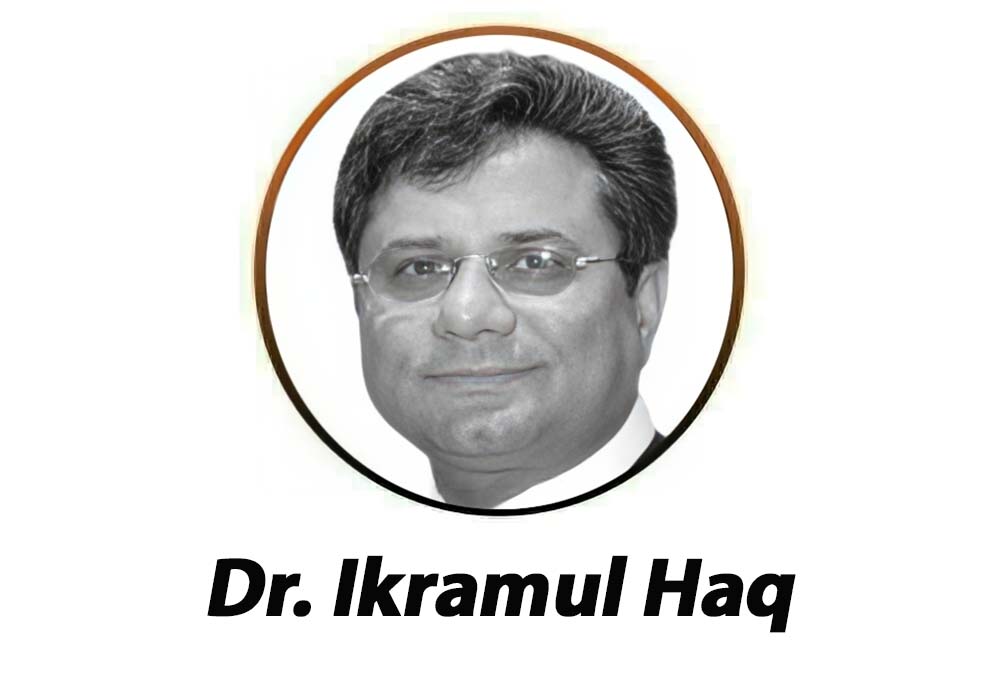
Dr. Ikramul Haq, Advocate Supreme Court, Adjunct Faculty at Lahore University of Management Sciences (LUMS), member Advisory Board and Visiting Senior Fellow of Pakistan Institute of Development Economics (PIDE), holds an LLD in tax laws. He was full-time journalist from 1979 to 1984 with Viewpoint and Dawn. He also served Civil Services of Pakistan from 1984 to 1996. 

Similar Posts

  • Can Pakistan live on a Borrowed Revolution?

    The most pitiable creature I know is not the beggar who asks for bread but the gentleman who must borrow a personality. He dresses in another man’s taste, speaks in another man’s phrases and mistakes imitation for refinement. He is everywhere respectable and nowhere original. Nations occasionally acquire the same unfortunate habit. Their politics become echoes, their ideals reflections, and their revolutions little more than borrowed costumes. There was a time when borrowing was the necessity of poverty. We borrowed machines because we had no factories, medicines because we had no laboratories, and books because we had no presses. Such borrowing was neither shameful nor unusual; indeed, civilisation itself advances through exchange. The Greeks borrowed from Egypt, the Arabs preserved and enlarged the inheritance of Greece, Europe rediscovered Aristotle through Muslim Spain, and Japan modernised by learning from the West without surrendering its soul. Borrowing knowledge is the beginning of wisdom. Borrowing identity is the beginning of decline. There is another form of borrowing that no customs official can intercept and no tariff can discourage. It enters silently through the imagination. A society begins by borrowing opinions, then aspirations, then indignation. Before long, it borrows its heroes, its villains, its vocabulary and, eventually, its revolutions. It ceases to ask, “What does our history require?” and instead asks, “Whose history should we imitate?” That, I fear, is the predicament into which much of Pakistan’s public discourse has drifted. During the past several weeks, social media has been flooded with admiration for the recent political resistance witnessed across the border in India. Video clips have travelled faster than thoughtful analysis. Slogans have crossed the Wagah frontier with greater ease than ideas. Among countless young Pakistanis one question has become almost fashionable, Why can’t Pakistan have a movement like this? The question is understandable. It is also profoundly revealing. Hidden within it is an assumption that our political future must resemble somebody else’s present; that history unfolds according to a universal script; that every nation matures by repeating the experience of another. It is an assumption born not of confidence but of intellectual dependency. The tragedy, therefore, is not that Pakistanis admire another people’s courage. Every decent society can appreciate courage wherever it appears. The tragedy is that many have become convinced that courage itself must now be imported. We seem increasingly unable to recognise our own political inheritance unless it first receives foreign approval. This habit is hardly confined to politics. It has become the defining condition of our intellectual life. We borrow theories from European universities before examining our own social realities. We borrow ideological fashions from America before asking whether they illuminate Pakistani society. We borrow debates from social media and mistake them for scholarship. We consume outrage manufactured elsewhere and wear it as though it were tailored for our own circumstances. We have become, in the deepest sense of the phrase, tenants in the house of our own imagination. The irony is painful. No civilisation lacking confidence in itself has ever become creative. Creation begins where imitation ends. Shakespeare borrowed stories but produced Hamlet. Iqbal studied Nietzsche and Bergson yet remained unmistakably Iqbal. Muhammad Ali Jinnah mastered the constitutional traditions of Britain but transformed them into a political movement rooted in the aspirations of Indian Muslims. Great minds borrow raw material; they do not borrow finished identities. The same principle governs nations. Civilisations borrow in order to create. Declining societies borrow in order to imitate. Perhaps nowhere is this confusion more visible than in our understanding of resistance. Resistance has become one of the most romantic words in modern political vocabulary. It evokes images of heroic crowds, defiant slogans, dramatic confrontations and triumphant victories. Social media, with its appetite for spectacle, has transformed resistance into a global performance. Every protest becomes a cinematic narrative; every confrontation seeks an audience; every slogan aspires to immortality through a hashtag. But history is not written in hashtags. Nor are nations transformed by theatrical moments alone. The anthropologist Leila Abu-Lughod offered an important warning nearly three decades ago in her influential essay The Romance of Resistance. She argued that scholars often romanticise resistance as though every act of opposition were inherently emancipatory. Such a view, she suggested, ignores the complex relationships of power, culture and history within which resistance acquires meaning. Acts of dissent cannot be detached from the societies that produce them. They are rooted in particular institutions, historical memories and cultural conditions. Her insight deserves careful attention today. To ask why Pakistan does not produce resistance identical to India’s is rather like asking why the Indus refuses to flow like the Ganges. Rivers obey their own geography. Nations obey their own history. Every meaningful political movement is shaped by its unique historical circumstances. The French Revolution emerged from fiscal collapse and aristocratic privilege. The American Revolution arose from disputes over representation and imperial authority. South Africa’s democratic transition was forged in the struggle against apartheid. None of these experiences can simply be photocopied for another society. History does not distribute identical examinations to different nations. Each country answers its own questions. Yet we continue searching for borrowed answers. Perhaps this is because borrowed revolutions are emotionally satisfying. They spare us the difficult labour of self-examination. It is always easier to admire another nation’s struggle than to confront the unfinished responsibilities of our own. Admiration demands nothing. Citizenship demands everything. That distinction has become blurred in contemporary Pakistan. Our public imagination has fallen in love with the romance of beginning anew. Every few years another movement captures our attention. We invest it with almost mythical expectations. We hope it will accomplish what institutions, constitutions and patient political reform have failed to achieve. We long for redemption through spectacle. But mature nations are not built upon permanent excitement. They are built upon permanent institutions. Hannah Arendt observed in On Revolution that the enduring achievement of successful revolutions lies not in the destruction of an old order but in the establishment of a

  • Imran khan’s health and the state’s respon…

    It’s not about the prisoner’s health only its about Pakistan. When a state holds a political leader in prison, it assumes a responsibility that goes beyond the enforcement of a court sentence. It assumes responsibility for the person’s safety, dignity and health. That principle should be beyond politics. In Pakistan, however, even a prisoner’s eyesight has become part of the country’s bitter political struggle. The continuing controversy over Imran Khan’s health is therefore about much more than one man. It raises a fundamental question about the relationship between the citizen and the state: what happens to individual rights when political conflict becomes so intense that every state decision is viewed through the prism of partisan politics? Imran Khan, Pakistan’s former prime minister and one of its most influential political figures, has been in prison since 2023 in connection with multiple legal cases. His supporters have repeatedly raised concerns about his health and access to appropriate medical care. More recently, particular concern has focused on his eyesight. Reports in early 2026 said that Khan had developed a retinal condition affecting his right eye. His family and political representatives questioned whether he had received adequate specialist treatment, while the authorities maintained that he was being properly cared for. A government-appointed medical board subsequently reported improvement in his eyesight. The conflicting accounts should not be allowed to become another chapter in Pakistan’s political war. There is a remarkably simple way to address the problem: independent medical assessment and complete procedural transparency. If Khan is medically stable, independent specialists should be able to establish that fact. If he needs treatment, it should be provided without delay. If his family disputes the government’s medical assessment, credible specialists should be permitted to review it. There should be no political advantage in either concealing a medical problem or exaggerating one. This should be obvious in any functioning democracy. Yet Pakistan’s political history makes it anything but simple. For decades, political power in Pakistan has been accompanied by institutional confrontation. Governments have used legal and administrative mechanisms against their opponents, only to find themselves out of power and vulnerable to similar treatment later. Political parties that once demanded accountability have subsequently complained of victimisation when they became targets themselves. The result is a vicious cycle in which accountability is increasingly viewed through the language of revenge. Imran Khan’s imprisonment has become one of the most visible manifestations of that crisis. His supporters see him as the victim of an establishment-backed campaign to remove him from politics. His opponents argue that the cases against him are matters of law and accountability and that political popularity cannot place anyone above the law. Both arguments can be debated. Courts can determine questions of guilt and innocence. Voters can judge political performance. Parliament can debate constitutional questions. But none of these arguments should determine the standard of medical care available to a prisoner. That distinction is essential. The state has the authority, within the law, to imprison a person. It does not acquire unlimited authority over that person’s body or dignity. Detention restricts liberty, it does not erase humanity. This principle becomes even more important when the prisoner is a former head of government. The treatment of such a person inevitably becomes a test of institutional maturity. The government may have legitimate reasons for keeping Khan imprisoned, but it should have an equally compelling interest in ensuring that his medical treatment cannot reasonably be portrayed as political punishment. The irony is that transparency would serve everyone. It would protect Khan from inadequate treatment. It would protect his family from uncertainty. It would reassure his supporters. And it would protect the government from accusations that medical care is being manipulated for political purposes. Instead, Pakistan often chooses the opposite path. Official statements are followed by political counterstatements. Medical reports become partisan documents. Families make allegations. Governments issue denials. Social media turns uncertainty into outrage. And a question that should have been answered by doctors becomes another battlefield between political camps. This is not merely a communications failure. It is an institutional failure. A credible democratic state must have mechanisms capable of resolving such disputes without requiring citizens to choose which political side they trust. Pakistan could establish precisely such a mechanism. High-profile prisoners could be examined by independent medical boards selected through transparent professional criteria. Prisoners could have access, where appropriate, to independent specialists. Medical records could be maintained according to professional standards, while necessary information could be shared with families and the courts. Where a serious disagreement arises, an independent medical opinion should be available. Such safeguards should not be created specifically for Imran Khan. They should apply to everyone. The ordinary prisoner matters too. Pakistan’s prisons contain thousands of people whose health concerns rarely receive national attention. They may not have political parties, lawyers appearing on television every evening, influential families or millions of supporters on social media. Yet their right to humane treatment is no less important. Indeed, the treatment of ordinary prisoners may be the more meaningful measure of the state’s commitment to human rights. But Khan’s case provides Pakistan with an unusual opportunity. Because his imprisonment is already under intense national and international scrutiny, the government can demonstrate that the state is capable of separating political disagreement from humanitarian responsibility. That would require political courage. A government does not become weaker by allowing an opponent proper medical treatment. It becomes weaker when it appears afraid of transparency. A government does not demonstrate authority by controlling every narrative. It demonstrates authority by allowing facts to withstand scrutiny. This is particularly significant for Pakistan’s international reputation. Pakistan frequently presents itself as a democratic state committed to constitutionalism, human rights and the rule of law. Yet international credibility is not built through diplomatic declarations alone. It is built through conduct, especially when circumstances are politically uncomfortable. The treatment of political opponents is one of the clearest indicators of democratic health. A democracy cannot be judged only by how it treats

  • Who Is Responsible for the Truth?

    One question stayed with me long after I attended a workshop under the project titled ‘Digital Trust and Free Expression in the Era of AI’, organized by the Department of Media and Development Communication, University of the Punjab with the support of the U.S. Mission to Pakistan in partnership with the Pakistan-U.S. Alumni Network, was, ‘How will we preserve digital trust and free expression in the age of AI’? As AI becomes an integral part of digital journalism, the question is no longer whether it should be used, and more importantly who should be held responsible when things go wrong. Artificial Intelligence has definitely proven to be a powerful tool for journalists. It can summarize long reports, translate content into multiple languages, follow breaking news, analyze vast quantities of data and even write complete news reports in seconds. All of these capabilities have revolutionized newsroom processes and enabled journalists to process information more efficiently than ever before. But efficiency is not the only measure of ethical journalism. Journalism isn’t about being fast, it’s about informing the public accurately, fairly and responsibly. One of the most valuable lessons I learned from the workshop was that AI does not understand information; it predicts the most likely response based on patterns in the data it has learned from. This distinction is important because when reliable information is unavailable at the time, AI generates responses that seem convincing but inaccurate, but are wrong, which is often referred to as AI hallucination. What’s most concerning is that the AI generated mistakes can appear convincing enough for people to accept them as true. This poses an ethical question: Who should be held responsible if AI-generated news contains misleading information? The burden can’t be placed entirely on the algorithm. AI has no moral judgement or legal accountability. It cannot distinguish between public interest and public harm and is not aware of the social consequences of publishing inaccurate information. This means that the responsibility rests with those who decide to employ these technologies: journalists, editors, newsroom leaders, and media organizations. While AI can help create content, it cannot replace responsibility. This is where ethics become more important than technological advancements. Checking information should not take a back seat to the ‘Publish first’ mentality. With all of the digital platforms that exist today, misinformation can spread from continent to continent within minutes and corrections often fail to reach the same audience. Each unverified headline altered photo or AI-generated mistake can damage the public’s trust, both in a specific news organization and in journalism.   The discussions also reinforced the importance of Media and Information Literacy (MIL). Verification is not only the responsibility of journalists, but also something that is necessary for every digital citizen. Learning how to use reverse image search, source verification techniques, and critical evaluation of online information is no longer an option, it’s essential for protecting ourselves from deception. As AI-generated content becomes increasingly sophisticated, it is essential to verify information before accepting it as true. AI will continue to evolve and so will digital journalism. The challenge is not innovation itself but using it responsibly. Trust is not something algorithms can build, it is something that can be gained only through transparency, accountability and a steadfast dedication to truth. While adopting new technologies to do journalism, let’s not forget that the tools should enhance journalism’s values, not shape journalism. AI may help write the news, but only humans can uphold the ethics behind it. The views, thoughts, and opinions expressed in this blog are solely those of the author and do not necessarily reflect the official policy or position of the U.S. Mission to Pakistan or USEFP.

  • Pakistan’s Governance Crisis

    Since its inception, Pakistan has been confronted with a multitude of complex and interwoven challenges that have persistently constrained its political stability, economic progress, institutional development, and social transformation. While the nature and intensity of these challenges have evolved over time, their cumulative impact has continued to impede the country’s pursuit of sustainable development and national prosperity. Among these enduring national challenges, the governance crisis has emerged as one of the most pressing concerns, posing serious implications for sustainable development, institutional resilience, socioeconomic progress, and the country’s long-term stability. A number of instances can be quoted to highlight the dismal situation of governance in Pakistan. The very first among these is the lack of citizens’ interest in participation. Citizens are not sufficiently aware of their participatory rights; therefore, they do not keep an eye on public officials and don’t raise their voices when their legal rights are violated by the elite class of the state. Moreover, in terms of transparency, Pakistan is far behind the required standards. According to the 2025 Corruption Perception Index published by Transparency International, Pakistan scored 28 out of 100 and ranked 136th out of 182 countries, indicating a high perceived level of public sector corruption. Furthermore, it is our bad luck that the situation of the rule of law has always been in trouble since 1947. Unfortunately, the rule of law has been confined to the conventional concept of law enforcement, internal security, and crime control, while, at the same time, it overlooks the basic elements, including transparency, accountability before the law, and the equal, just, and clear application of the law. Although, the state has numerous accountability committees and agencies to hold corrupt individuals accountable and curb corrupt practices in society. But still, the state is struggling to implement accountability in its true sense. Ignoring the major causes that have led to the deplorable situation of governance in Pakistan would be totally unjust. These include a number of factors that have directly or indirectly facilitated its existence. In this context, political instability is the biggest cause of bad governance in Pakistan. For most of the time, a myopic approach is adopted by political parties to establish their own governments. They remain engaged in the struggle for power while toppling governments by hook or by crook. Likewise, the relevant institutions do not respond immediately to the emergence of new challenges, leading to dearth of responsiveness in institution’s working.   In addition to it, the lack of strategic vision of the political leadership is also a factor which hits the structure of governance in Pakistan. Quite understandably, Political leaders have failed to foresee Pakistan’s emerging challenges and to cope with the persistent challenges that the state has been confronting for a long time. Keeping in view the crunch of governance, whom should be blamed and held accountable? It is the need of the hour that well-crafted and result-oriented policies regarding governance be formulated and effectively implemented to address the issue in its true spirit. Social media should play its crucial role in spreading awareness. Democracy should be strengthened. Posting, transfer, and promotion of bureaucrats should be done on merit. Last but not the least, the right to information should be guaranteed to citizens as provided under Article 19A of the Constitution of the Islamic Republic of Pakistan. These bold steps can place Pakistan in the list of countries having good governance.

  • Trump Era is over?

    Donald John Trump entered the White House as the 45th President of the world’s oldest constitutional democracy in January 2017. As incumbent he lost the election at the end of his four-year term. He took oath of office as the 47th head of state in January 2025. As there is a two-term constitutional restriction most Presidents falter in the later years of power. It was George Washington, the founding father and the first President who set this tradition of going home after eight years at the helm. Franklin Delano Roosevelt ( FDR ) the 32nd President served from 1933 to 1945 until his death in office. He is the longest serving US President. As his rule stretched over four terms, a constitutional amendment was made to restrict the term in office to two. Since then, craziness of the final term has increased manifold as humans are fond of building their legacy to be remembered for all times to come. Richard Nixon had to resign in his second term on charges of break-in and lying. President Ronald Reagen got involved in the Iran Contra Affair that seriously dented his popularity. Jimmy Carter was a great President who never got a second term. Bill Clinton did well in his first term but then had to face impeachment because of the Monica Lewinsky affair in the second. Bush Sr had single term while Bush Jr started the Afghanistan war which proved to be disastrous. Barrick Hussain Obama promised to end wars but badly failed. In fact, the inferno spread in the entire Middle East. Joe Biden did not run for office for the second term as the first was not very glorious and he was out of steam so he nominated his Vice President for the top slot. Legacy is earned not forced. There are no short cuts to lasting glory. Craziness does not help it only complicates. Capturing and killing head of states in the 21st century indicates brutalized narrow thinking and over simplification of the long-term complexities. Such an approach may have worked in the 18th of 19th century but not anymore. Trump wanted to control oil. He first took control of Venezuela by abducting its President through palace intrigue. Most countries in the Middle East ( ME ) were already subservient. He decided to take control of Iran as was done in the decade of the fifties when Shah was reinstated through CIA action. Mohammaed Mussadiq the elected President was captured and imprisoned. The Pahlavi Dynasty ruled Iran till 1979 when it was over thrown by the Islamic Revolution led by Imam Khomeni. Since then, the country has been struggling for its sovereignty At the behest of the rogue Israeli Prime Minister Benjimin Nathenyau, Trump decided to attack Iran and kill its top leadership through clandestine on the ground information sharing and intrigue. Imam Khamenei, the successor to Imam Khomeni, was assassinated but the regime survived. Iran decided to retaliate. The US bases were the closet targets. Israel looked the other way for self-preservation leaving USA to face the wrath. The vulnerability of the oil rich states was exposed. Reality set-in. Yankees have to go home was the clear verdict. Power structure in the entire ME is gearing for change. Mecca Joint Defense Agreement ( MJDA ) has been signed by Turkey, Pakistan and Saudi Arabia, others may join soon. A reasonable peace agreement can provide the much-needed face saving for Pakistan is on the forefront. The Abraham Accord to legitimize the illegitimate state of Israel has been thrown in the cold storage. After Iran, Trump also sought regime change in Afghanistan which has not happened so far. His heroics have failed to produce results. Losers are rejected by the American public. Congressional elections are scheduled for Nov. The polls are not favorable for the Republicans. If Democrats gain control of the house, Trump may have to face impeachment. It will then be the end of his political ambitions, leaving behind a legacy of ill-planned misadventures for personal glorification. Fall of the most powerful leader of the only super power of the world will certainly have ripple effects. First, it will be the totally dependent and subservient leadership in the ME followed by other friendly regimes. The countdown has started for Trump. Collateral damage has to be understood and contained. I remember the words of the legendary Cricket Captain Hafiz Kardar when Pakistan was at the verge of victory in the Oval cricket test in the decade of the fifties; ” Only rain can save England from defeat “. Pakistan prevailed, Fazal Mahmood emerged as a hero. Since then, there has been no looking back. Pakistan emerged as a major player in the cricketing world. Trump should pray for divine intervention otherwise it is all over for him and his cronies.

  • The Gen Z and Its Vision of Pakistan

    Pakistan presents a distinct demographic profile in the 21st century. According to the Pakistan Bureau of Statistics and UNFPA, 64% of the population is under the age of 30, with a median age of 20.8 years. This structure situates Pakistan within the category of youth-majority states. Consequently, an analysis of contemporary Pakistan is inseparable from an analysis of Generation Z, defined as individuals born approximately between 1997 and 2012. This cohort is not a prospective entity. It constitutes the current labor force, consumer base, and increasingly, the primary agents of cultural and economic production. The characteristics of Pakistani Gen Z can be understood through three interrelated dimensions: adaptability, initiative, and connectivity. The first dimension is adaptability coupled with digital fluency. This generation represents the first cohort in Pakistan to mature entirely within a digital ecosystem. DataReportal’s 2026 report indicates 111 million internet users and 71.1 million social media users in Pakistan, with internet penetration at 48.5%. The primary mode of access remains mobile broadband, which has effectively decentralized information and opportunity. This environment has cultivated rapid skill acquisition. The ability to learn and deploy new tools is reflected in economic outcomes. Pakistan currently ranks 4th globally in freelance earnings on platforms such as Upwork and Fiverr. Estimated annual freelance exports exceed $400 million. This phenomenon, often termed “digital remittances,” enables participation in the global economy without physical migration. The geographic implications are significant: a software developer in Peshawar, a content creator in Multan, and a designer in Lahore operate within the same digital marketplace, competing on skill rather than location. The second dimension is initiative and entrepreneurial orientation. In response to structural constraints in traditional employment, Gen Z has demonstrated a marked propensity toward self-directed economic activity. Data from the State Bank of Pakistan indicates a rising proportion of SME financing directed to individuals under 35. This is manifested in the proliferation of micro-enterprises, including e-commerce ventures, content creation channels, and home-based businesses. The underlying logic is one of experimentation and iteration: initiate at a small scale, acquire feedback, and scale operations. Importantly, this trend is not confined to metropolitan areas. Digital platforms have reduced barriers to market entry for individuals in Gilgit, Quetta, and rural Sindh, enabling access to national and international consumers. A craftswoman in interior Sindh can, through social commerce, reach buyers in Karachi and Dubai. This represents a structural shift in how economic value is created and distributed. The third dimension is connectivity and civic awareness. Pakistani Gen Z is the most interconnected generation in the nation’s history. Multilingualism is normative, with Urdu, English, and regional languages such as Punjabi, Sindhi, Pashto, and Balochi used fluidly. This linguistic dexterity mirrors a broader cultural orientation that is simultaneously local and global. This connectivity correlates with heightened awareness of social and global issues. During the 2022 floods, youth networks coordinated relief, fundraising, and volunteer mobilization within hours, utilizing WhatsApp, Facebook, and other platforms. The same infrastructure is used for peer-to-peer learning, dissemination of job opportunities, and advocacy around public health and education. Surveys by Gallup Pakistan and various youth organizations indicate participation rates in volunteerism among 18-30 year olds are substantially higher than in previous cohorts. Beyond present attributes, it is critical to articulate the vision of Pakistan held by this generation. Based on available survey data, academic research, and observable behavior, three core elements emerge. The first element is a vision of inclusive economic participation. Gen Z conceptualizes economic contribution beyond formal employment. The priority is productivity, skill utilization, and value creation. Key sectors of engagement include information technology, freelancing, e-commerce, EdTech, AgriTech, and creative industries. There is also a measurable increase in female participation. PBS data indicates that women constitute approximately 30% of registered freelancers, reflecting both economic necessity and changing social norms. The overarching goal is to convert Pakistan’s demographic dividend into tangible economic output. The second element is a vision of competency-based development. This cohort places primacy on skills, portfolios, and demonstrable output over credentials alone. There is growing demand for vocational training, digital literacy, artificial intelligence tools, and communication competencies. The emerging model is decentralized: one individual acquires a skill and disseminates it within their network. This peer-learning architecture has the potential to address gaps in formal education through non-formal channels. The third element is a vision of contributory citizenship. Gen Z associates nation-building with direct action. This includes environmental initiatives such as tree plantation, public health campaigns such as blood donation, and educational outreach in underserved areas. The conception of patriotism is thus operationalized. It is expressed not only through symbolic observance on 14th August, but through sustained engagement in community development. The narrative of 1947 is understood as securing independence. The narrative of 2026, from this perspective, is about deploying that independence toward institutional and social strengthening. Pakistan’s strategic advantage lies in this human capital. The generation is characterized by adaptability, enterprise, and networked awareness. The realization of this potential is contingent on the alignment of opportunities in skills development, digital infrastructure, and platforms for civic engagement. The trajectory of Pakistan will be determined in classrooms, in digital workspaces, in small enterprises, and in the aggregate of individual decisions made by over 110 million young citizens. With continued emphasis on learning, collaboration, and productive engagement, Gen Z possesses the capacity to advance national development objectives. This is their Pakistan, and the process of building it is already underway.

Leave a Reply

Your email address will not be published. Required fields are marked *