chinese military researchers
| | |

Chinese military researchers tap US AI models to train defense systems

BEIJING, China – Chinese military researchers have used outputs from leading US artificial intelligence models developed by OpenAI and Anthropic to train domestic AI systems to advance China’s defense capabilities, according to a Reuters review of more than 80 Chinese academic papers and patents.

The previously unreported findings offer a rare glimpse into how military and security-linked institutions in China are leveraging cutting-edge US AI models as a shortcut to developing specialized systems of their own, despite Washington’s efforts to restrict Beijing’s access to advanced chips and other strategic technologies.

The documents show widespread use of a technique known as “model distillation,” in which outputs from a powerful AI system are used to train smaller, specialized models that can be deployed locally without the enormous computing requirements needed to build frontier AI systems from scratch.

Reuters’ review, which included research compiled by the Washington-based Jamestown Foundation and shared exclusively with the news agency, showed distillation is widely used by researchers linked to the People’s Liberation Army and other military institutions.

The papers suggest Chinese defence institutions see leading US AI models as both a source of technical insight and a way to close the gap with American rivals.

The dispute centers on unauthorized extraction, not distillation itself, a widely used industry practice.

The issue has emerged as a major flashpoint ahead of US-China talks on AI governance and safety. US officials have accused some Chinese entities of using distillation to extract capabilities from American AI models, potentially undermining export controls and infringing intellectual property rights.

China has rejected the accusations, saying Washington is pursuing AI “hegemonism” while arguing that US firms have engaged in similar practices.

Chinese developers have also disputed claims that their AI advances rely on foreign models. AI startup Moonshot last week denied allegations by the Trump administration that its Kimi K3 model was built using distillation, saying it was driven by proprietary innovations.

Sunny Cheung, a Jamestown fellow who analyzed over 60 of the papers, said Chinese military scientists are systematically capturing the reasoning steps of Western models to adapt them for surveillance, cyber warfare and tactical decision-making.

“Teaching a model the right answer is one thing but teaching it the reasoning behind the answer is much harder,” said Cheung.

“These papers show Chinese military-linked researchers are trying to transfer that expensive, proprietary reasoning from Western models into smaller systems they can control and deploy locally.”

Reuters verified the academic literature and identified an additional two dozen military-linked case studies.

One paper published last year by researchers in PLA Unit 96941, a military intelligence and cyber-warfare unit in Beijing, described using OpenAI’s GPT-3.5 to process sensitive military source code.

The researchers said third-party models were unsuitable for handling classified information. To overcome that limitation, they used GPT-3.5 to summarize software code and trained a domestic model on those summaries to run entirely within Chinese military networks.

The White House, Pentagon, China’s foreign ministry, the PLA and OpenAI did not respond to requests for comment.

Wide use, from monitoring to military

Chinese researchers have used distillation for purposes ranging from content monitoring to military deployment, Reuters’ and Jamestown’s review of the papers showed.

At the North University of China, which has close links to the country’s weapons industry, researchers used Anthropic’s Claude 3 Haiku to generate synthetic training data for a text classification model for social media monitoring and content moderation.

Anthropic said it does not provide commercial access to Claude in China or to Beijing-controlled firms and uses monitoring systems to detect policy violations.

The company added that distilled models may lose the original systems’ safety safeguards, potentially allowing sensitive capabilities to be transferred to models beyond its control.

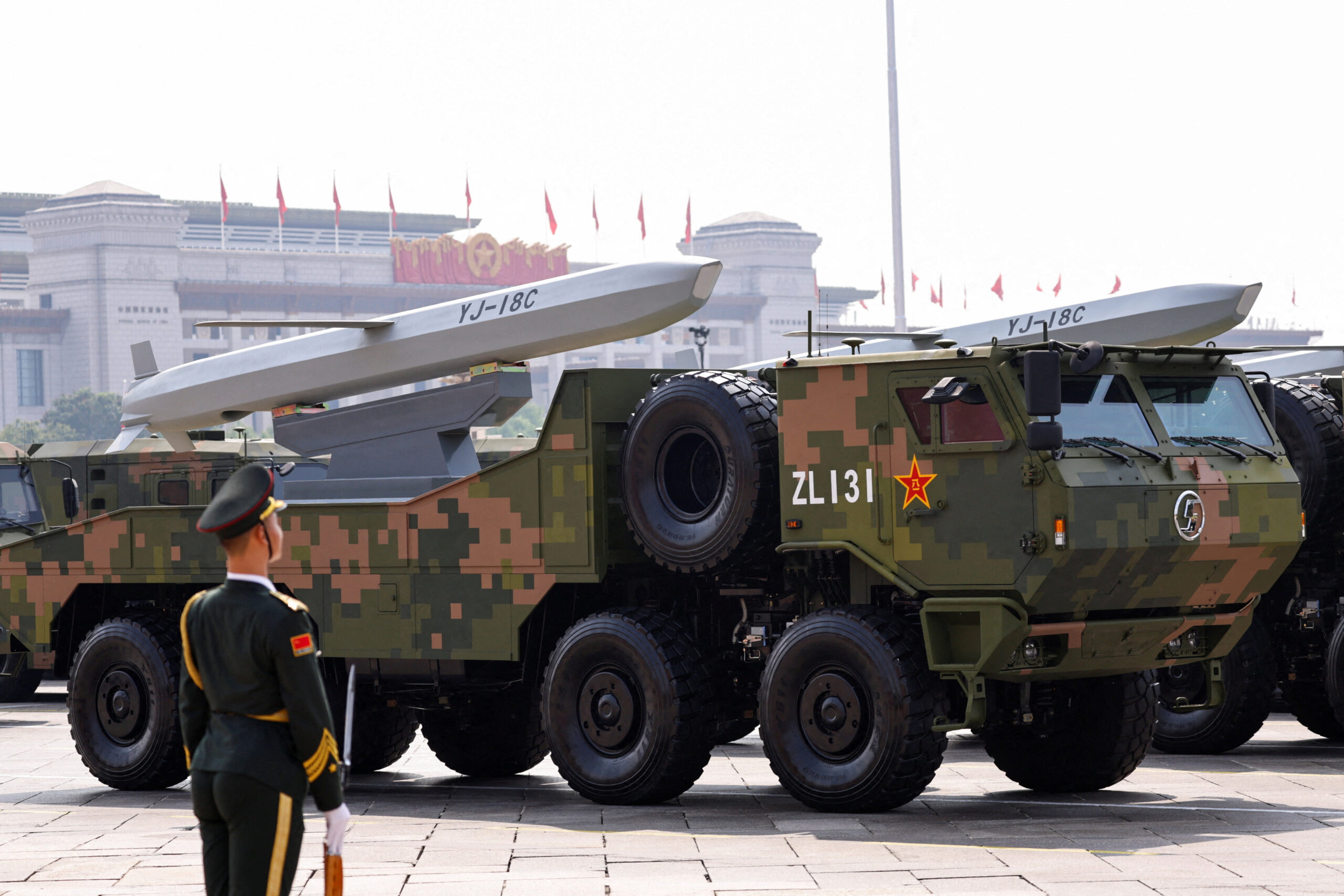
A 2024 paper from the People’s Liberation Army’s National University of Defense Technology described using distillation to shrink an image-processing model for deployment on unmanned aerial vehicles, allowing drones to analyze live video and support navigation and targeting decisions in real time even when communications are cut.

Similarly, researchers at China’s Academy of Military Sciences used distillation to run a target-recognition model on tactical hardware during simulated maritime operations involving drones, ships and unmanned submarines, a study published earlier this year showed.

Benefits and limits

China has embraced distillation as it seeks to compete with the US in frontier AI while facing constraints on advanced computing resources due to Washington’s export controls on high-end chips. Central and local governments have promoted “model lightweighting” and edge computing, directing subsidies and research funding toward technologies that enable AI models to run on drones, satellites and other devices with limited processing power.

Experts caution, however, that distillation has significant limitations.

As Chinese AI models close the gap with their US counterparts, military researchers are also examining distillation as a potential security risk.

In January, researchers at the Army Engineering University published a paper on the threat of “data-free distillation,” a method of reverse-engineering a model’s capabilities without direct access to its core parameters.

To counter that vulnerability, they proposed defense mechanisms designed to mask the hidden logical information exposed in a model’s public outputs.

Distilled models also inherit only selected capabilities and cannot fully replicate the broad intelligence of frontier systems.

Trevor Koverko, co-founder of AI data company Sapien, said distilled models remain less capable than their teacher models.

“It is best understood as transferring selected capabilities into a cheaper, locally controlled system, not achieving independence from frontier AI.” – Rappler.com
Similar Posts

  • |

    Trump approves landmark US-Saudi nuclear pact

    US President Donald Trump has approved a landmark civilian nuclear agreement with Saudi Arabia, marking a major step in expanding strategic cooperation between the two countries. The proposed deal is expected to remain in effect for 30 years and is valued at tens of billions of dollars. The agreement is designed to support the development of Saudi Arabia’s civilian nuclear energy program while giving American companies a leading role in building the kingdom’s nuclear infrastructure. It is expected to create significant investment opportunities for US firms and strengthen long-term energy cooperation between Washington and Riyadh. Under the proposed framework, American companies could participate in constructing nuclear facilities across Saudi Arabia. The agreement also allows for the possibility of building a uranium enrichment plant in the kingdom if future joint studies by both governments determine that such a project is necessary. US officials say the deal will enable Washington to remain closely involved in the development of Saudi Arabia’s nuclear program. They believe this cooperation will help ensure that the kingdom’s nuclear activities remain focused on peaceful civilian purposes. The Trump administration is expected to submit the agreement to the US Congress in the coming days. The pact is being introduced under Section 123 of the US Atomic Energy Act of 1954, which provides the legal framework for civilian nuclear cooperation between the United States and foreign countries. Once submitted, Congress will have about 90 days to review the agreement. If lawmakers do not reject it during the review period, the agreement will automatically enter into force. Blocking the deal would require Congress to pass a joint resolution with enough votes to override a possible presidential veto. According to officials familiar with the proposal, the agreement does not include the “Gold Standard,” a condition that permanently bars partner countries from enriching uranium or reprocessing spent nuclear fuel. These activities can potentially be used in the production of nuclear weapons. The proposed agreement also reportedly does not include the International Atomic Energy Agency’s Additional Protocol. This protocol allows international inspectors to conduct broader inspections and monitor undeclared nuclear facilities. Its absence has raised concerns among some non-proliferation experts and lawmakers. US officials, however, insist that the agreement contains strong safeguards required under American law. They stress that the deal does not obligate the United States to transfer sensitive uranium enrichment technology or nuclear fuel cycle capabilities to Saudi Arabia. Instead, it establishes a legal pathway for future civilian cooperation while requiring separate approvals for any advanced technology transfers. The agreement follows earlier discussions between senior US and Saudi officials, who signed a preliminary framework last year to expand cooperation in the peaceful use of nuclear energy. The proposal has generated debate in Washington. Several Democratic lawmakers, along with some Republicans, have argued that stronger safeguards should be included before the agreement is approved. They believe stricter restrictions are necessary to reduce the risk of nuclear weapons proliferation in the Middle East. Saudi Arabia has repeatedly stated that its nuclear program is intended to meet growing energy demands and diversify the country’s energy resources. However, Crown Prince Mohammed bin Salman has previously said that if Iran were to acquire a nuclear weapon, Saudi Arabia would also seek similar capabilities. His remarks have fueled international concerns about a possible regional nuclear arms race.

  • |

    Bangladesh hints at joining Pakistan-Saudi-Türkiy…

    DHAKA: Bangladesh has signalled that it could consider joining the emerging economic or defence framework involving Pakistan, Saudi Arabia and Türkiye, opening a potentially significant new chapter in regional diplomacy and security cooperation. Bangladesh Prime Minister’s Foreign Affairs Adviser Humayun Kabir said Dhaka was taking a positive view of the possibility of becoming part of a framework involving the three countries. His comments come only weeks after Pakistan, Saudi Arabia and Türkiye signed the Makkah Joint Defence Agreement. The agreement, signed in Makkah on Aug 7, commits the three countries to strengthening collective security and defence cooperation. It also states that an armed attack against any one of the three signatories would be regarded as an attack against all three. Kabir, speaking to Bangladesh’s state news agency, indicated that Dhaka would examine the idea through the lens of its own national interests and the rapidly changing global economic and trade environment. “The government is following a Bangladesh First policy,” Kabir said, according to reports, stressing that national interests remain at the centre of Dhaka’s foreign policy. The remarks are particularly noteworthy because Bangladesh has recently been working to strengthen practical ties with Pakistan. Kabir said the two countries were seeking greater cooperation in trade and people-to-people contacts, suggesting that economic engagement could form an important part of the relationship. For Pakistan, Bangladesh’s interest could give the Makkah framework a wider South Asian dimension. For Saudi Arabia and Türkiye, Dhaka’s possible participation could also expand the reach of an arrangement that the signatories have described as defensive rather than directed against any particular country. Turkish President Recep Tayyip Erdogan has said the agreement is open to other friendly countries seeking peace, prosperity and stability in the region. Turkish officials have also stressed that the pact does not identify a common enemy and is intended to strengthen defence cooperation and collective deterrence. Bangladesh’s possible move comes as Dhaka is also deepening its relationship with Saudi Arabia. Kabir said Prime Minister Tarique Rahman is expected to visit Saudi Arabia following an invitation from Crown Prince Mohammed bin Salman. The visit could provide an opportunity for discussions on economic cooperation, regional security and Bangladesh’s possible role in broader regional frameworks. For now, Dhaka has not announced any formal decision to join the defence agreement. But its positive signal is already attracting attention, particularly because Bangladesh’s participation could reshape the strategic picture across South Asia and the wider Muslim world. The next step will likely depend on how Dhaka assesses the proposed framework against its national interests, economic priorities and wider foreign-policy objectives.

  • |

    EU fines Google $1 billion over competition violations

    The European Union has imposed a heavy fine on Google for allegedly using its dominance in the search engine sector to suppress other companies. According to a statement issued by the European Commission, Google illegally used its dominant position in the search engine market to reduce competition. The statement said that Google has been fined €890 million (around $1 billion) for this violation. The move is expected to increase trade tensions between the European Union and the United States as the Trump administration has warned of possible retaliatory measures and described EU trade policies as “unfair.” According to the European Commission, Google unfairly used its dominant search engine position to promote its own services including shopping, travel, gaming and other platforms reaching more users. The commission stated that Google placed its own services higher in search results while pushing competing services lower. The statement further explained that under the European Union’s Digital Markets Act, technology companies cannot show such biased behavior toward their own services and must follow transparent, fair and non-discriminatory policies. The European Commission also accused Google of unfairly preventing developers from informing users about alternative payment options on the Google Play Store as this could reduce Google’s service fees. This action was also considered a violation of the Digital Markets Act which aims to prevent large technology companies from establishing monopolies. According to the statement, Google must comply with the decision within 60 days otherwise additional penalties may be imposed. On the other hand, Google said in a statement that the decision would harm European consumers. This is not the first time the European Union has fined Google. In 2018, the EU imposed a $4.7 billion fine on Google over the alleged abuse of its dominance in the Android mobile operating system market and Google’s final appeal against the decision was rejected. In 2017, Google was fined $2.8 billion for abusing its dominance in the search sector while in 2024 its final appeal was also rejected.

  • | | | | |

    Trump drops major statement on Iran: what China an…

    Washington: U.S. President Donald Trump has said he does not believe that China or Russia are supplying weapons to Iran, citing assurances he received from the leaders of both countries. Speaking to reporters, Trump said Chinese President Xi Jinping had assured him that Beijing would not provide weapons to Iran under any circumstances. According to Trump, the Chinese leader also stated that the policy applies to Chinese companies, preventing them from supplying arms to Tehran. Trump said he trusts President Xi’s commitment in the context of U.S.-China relations and believes China is adhering to that position. The U.S. president also said Russian President Vladimir Putin had informed him that Moscow would not sell weapons to Iran. Trump’s remarks come amid continued international attention on Iran’s military capabilities and regional security. However, he did not provide additional details or evidence to support the statements, nor did he elaborate on whether the assurances were part of recent diplomatic discussions. The comments reflect Washington’s ongoing focus on limiting the transfer of advanced military equipment to Iran as regional tensions and global security concerns continue to evolve.

Leave a Reply

Your email address will not be published. Required fields are marked *