
chinese scientists unlock

Chinese Scientists Unlock New Secrets of the M87 Supermassive Black Hole

Humanity made history in 2019 by capturing the very first image of a distant black hole. Now, researchers are diving much deeper into this dark and fascinating cosmic mystery. Chinese scientists have successfully decoded the complex radiation secrets of the supermassive black hole in galaxy M87.

They have taken a massive leap forward in the field of global astrophysical research. Experts have officially moved from simply seeing a black hole to actually reading its hidden properties. This incredible breakthrough reveals how violent radiation behaves near the very edge of the cosmic abyss.

Key Takeaways

  • Chinese researchers successfully mapped the M87 black hole’s radiation spectral index for the very first time.
  • The groundbreaking study reveals how superheated plasma behaves and dramatically changes near the black hole’s edge.
  • Combining multiple telescope frequencies allows experts to finally understand black hole physics dynamically instead of statically.

The Giant at the Center of M87

The M87 black hole is an absolute cosmic giant located deep inside the Virgo constellation. It sits approximately 55 million light-years away from our own bustling home planet. This supermassive entity is mind-bogglingly heavy, weighing about 6.5 billion times more than our Sun.

Its sheer massive size makes it a truly perfect target for deep space observation. The historic 2019 photograph showed a glowing, donut-shaped ring of light around a stark, dark center. That incredibly dark, mysterious shadow is widely known as the event horizon of the black hole.

Gravity is exceptionally strong there, meaning that absolutely nothing, not even light, can escape its powerful inward pull. However, the glowing ring you see in photos is made of extremely hot, highly energized plasma. This superheated matter swirls rapidly around the black hole at speeds closely approaching the speed of light.

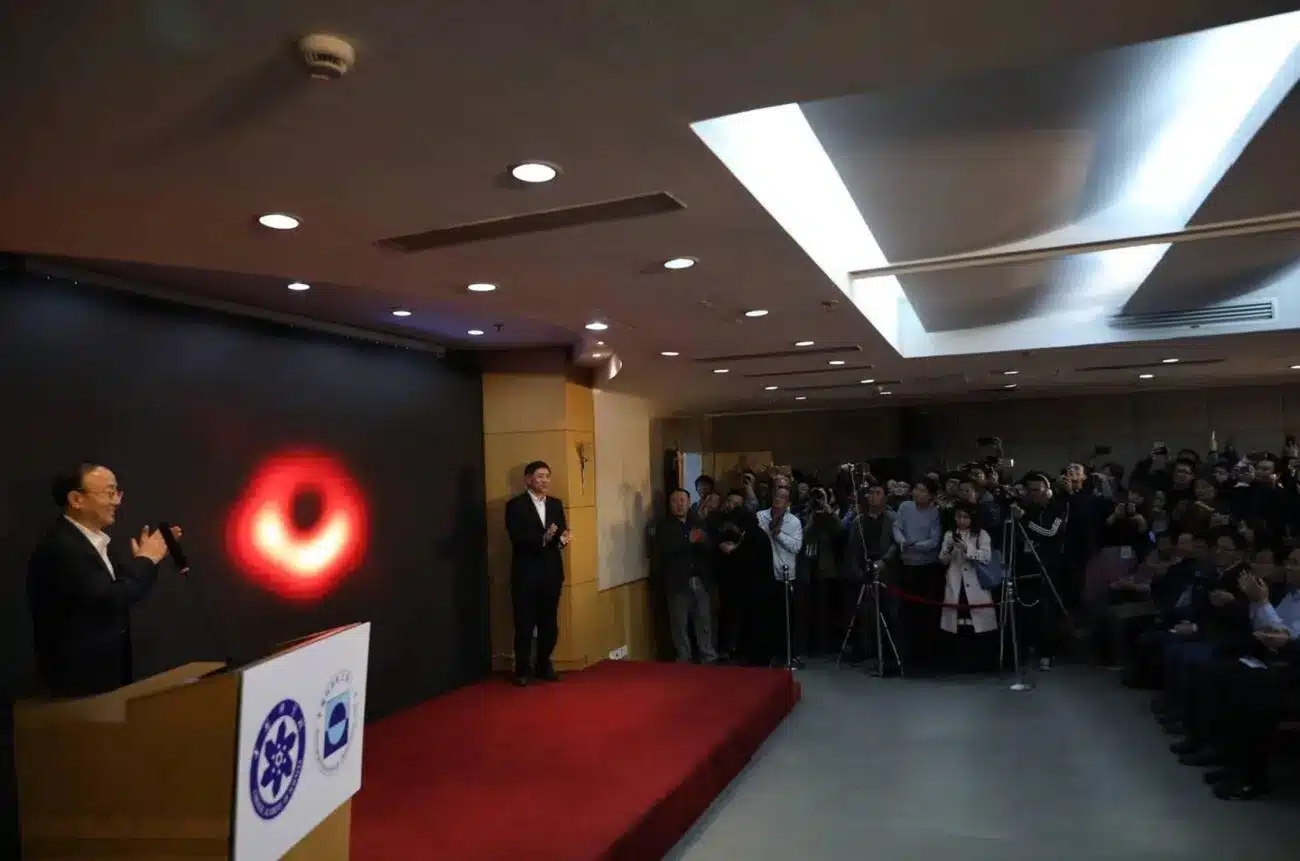
(190410) — SHANGHAI, April 10, 2019 (Xinhua) — The first-ever image of a supermassive black hole at the heart of the distant galaxy M87 is released during a press conference held by Shanghai Astronomical Observatory (SAO), in east China’s Shanghai, April 10, 2019. The image of the black hole, based on observations through the Event Horizon Telescope (EHT), a planet-scale array of eight ground-based radio telescopes forged through international collaboration, was unveiled in coordinated press conferences across the globe at around 9:00 p.m. (Beijing time) on Wednesday. The landmark result offers scientists a new way to study the most extreme objects in the universe predicted by Albert Einstein’s general relativity. (Xinhua/Jin Liwang)

The Glowing Ring and Event Horizon

Understanding this glowing cosmic ring has become a major priority for dedicated astronomers all around the world. The bright ring is essentially an accretion disk made of shredded stars and ancient cosmic gas. As this massive cosmic material falls inward, it heats up and glows brightly in the endless dark.

Until very recently, scientists could only see the general, fuzzy shape of this incredibly bright plasma ring. They lacked the detailed analytical data needed to understand the specific physical properties hiding deep inside it. The new Chinese-led research finally provides the missing scientific pieces to this highly complex astronomical puzzle.

Decoding the Complex Radiation Secrets

This recent, groundbreaking study brings us much closer to understanding this extreme and chaotic space environment. A dedicated team of experts from the Shanghai Astronomical Observatory led this vital research effort. The Chinese Academy of Sciences proudly announced and published these fascinating new scientific findings on July 20.

The detailed study officially appeared in the highly prestigious Astrophysical Journal Letters for extensive global review. Researchers successfully created the first-ever spatially resolved spectral index map of the massive M87 black hole. This highly detailed map shows exactly how the black hole’s radiation uniquely changes with distance from its core.

Lu Rusen, a prominent and respected researcher at the observatory, explained the deep significance of this map. He noted that the spectral index effectively helps track unique, frequency-dependent energy emissions in the dark. It serves as an incredibly vital tool to safely probe highly complex radiation processes in deep space.

Synchrotron Self-Absorption Explained

Near the black hole’s dark, crushing center, the scientific team discovered a strongly positive spectral index. This simply means the core energy emission is heavily affected by something called synchrotron self-absorption. In simple, everyday terms, the incredibly dense cosmic plasma actually absorbs a massive amount of its own light.

High-energy particles zoom through intense magnetic fields, creating bright light that gets entirely trapped inside the thick gas. Because the material is so tightly packed together, the intense radiation cannot easily escape into open space. This phenomenon creates a dense, glowing fog of trapped energy right near the black hole’s event horizon.

Mapping the Outward Changes

As you move further away from the dense center, the cosmic space environment changes very dramatically. The glowing matter naturally becomes optically thin at much greater distances from the crushing, central core. This highly important shift happens at exactly 30 microarcseconds away from the black hole’s dark center point.

Interestingly, this specific, microscopic distance perfectly matches the glowing ring seen in previous 3.5-mm telescope observations. This clearly proves that the glowing ring is directly tied to the nearby plasma’s active physical state. It gives scientists a totally fresh and very exciting look at black hole accretion and massive energy jets.

Accretion simply refers to the violent process of cosmic matter slowly falling into the deep black hole. As matter rapidly falls inward, it heats up and releases intense, highly concentrated bursts of pure radiation. Meanwhile, massive jets of extreme energy blast outward into deep space directly from the black hole’s poles.

Accretion Disks and Powerful Jets

These magnificent cosmic jets are truly some of the most powerful and mysterious forces in the entire universe. They can easily travel outward for thousands of light-years across the entire, massive span of the host galaxy. Scientists have long wondered exactly how black holes consistently manage to launch these massive, destructive energy beams.

By accurately mapping the radiation gradient, researchers can finally see where these violent jets get their incredible energy. The new spectral map thoroughly shows the direct physical connection between the feeding black hole and the resulting jets. It successfully provides solid evidence of exactly how plasma behaves right before it gets violently blasted into space.

Combining Global Telescope Data

This incredible scientific discovery was definitely not made by just one single telescope looking at the night sky. The talented Chinese-led team carefully analyzed vast amounts of deep-space data from massive global telescope networks. They brilliantly combined multiple international observations to get a much clearer, highly accurate picture of the cosmos.

The skilled researchers diligently conducted a highly complex dual-frequency joint analysis to successfully achieve these groundbreaking results. Previous single-frequency telescope images only showed us the basic spatial structure of the massive, dark black hole. They essentially gave us a beautiful, yet entirely static snapshot of the black hole’s outer, visible appearance.

By actively combining different light frequencies, smart scientists can now decode completely hidden, highly complex physical properties. This highly advanced, innovative method reveals the exact, real-time state of the superheated plasma swirling around the center. It totally transforms modern black hole research from taking static pictures to running highly dynamic physical diagnosis.

Moving From Static to Dynamic Science

The newly mapped spectral index is truly a major game-changer for the ongoing future of modern space astronomy. It significantly helps experts accurately measure the specific energy levels of tiny particles living near the black hole. Different colors and frequencies of captured light reveal vastly different core temperatures and intense magnetic field strengths.

Understanding these minute, complex details directly helps us learn exactly how the massive black hole actively feeds. It completely and utterly revolutionizes our current understanding of extreme physics in the deepest, darkest corners of space. The verified findings from this vital research perfectly match our best theoretical models of the known, observable universe.

A New Era of Space Exploration

We are currently entering a wonderful, brand new era of dynamic and highly detailed outer space exploration. According to the latest reports from Xinhua News, the Shanghai Astronomical Observatory continues to lead the way forward in complex astrophysics research. Their recent, truly groundbreaking work easily sets a new golden standard for international scientific collaboration everywhere.

In the near future, dedicated global astronomers hope to successfully map many more supermassive black holes. They desperately want to clearly see if these strange radiation rules apply across the entire, ever-expanding universe. New, highly advanced telescope technologies will undoubtedly make these complex observations even sharper and more accurate very soon.

For right now, the giant M87 black hole easily remains humanity’s absolute best, most reliable cosmic laboratory. Brilliant Chinese scientists have clearly proven that we can do much more than just take pretty space pictures. We are finally and truly learning how to actively read the deepest, darkest secrets of our fascinating universe.


Similar Posts

  • | | |

    Man arrested after alleged sexual assault of woman…

    A 28-year-old man has been arrested on suspicion of sexually assaulting a 20-year-old woman on Brighton Beach, as Sussex Police continue their investigation into the incident. According to police, the alleged assault took place overnight between Tuesday and Wednesday on Brighton seafront. Officers responded to reports of the incident and immediately secured the area near the Brighton i360 tower, where forensic specialists examined the scene and gathered evidence. A significant police presence remained at the location while investigations were carried out. Sussex Police confirmed that a 28-year-old suspect was taken into custody on suspicion of rape. Authorities said the man remains under investigation and has not yet been formally charged. Under UK legal procedures, suspects are considered innocent unless proven guilty in court. Police have not released the identity of either the suspect or the victim. Officials also declined to disclose the suspect’s nationality, explaining that such information is generally not made public before formal charges are filed. The force said the woman is receiving support from specially trained officers and victim support services as the investigation continues. Authorities emphasized that protecting the victim’s privacy remains a priority. Investigators have appealed to members of the public who were in the Brighton Beach or Brighton i360 area at the time of the alleged incident to come forward with any information. Police are particularly interested in mobile phone footage, photographs, CCTV recordings, or eyewitness accounts that could assist with the ongoing inquiry. Sussex Police stressed that the investigation is still in its early stages and that further updates will be released as more information becomes available. Officers urged the public to avoid speculation while inquiries are ongoing. The latest investigation comes only weeks after another high-profile criminal case involving a sexual assault on Brighton Beach concluded in court. In that separate case, three men were convicted and sentenced to lengthy prison terms for the rape of an unconscious woman. That case is unrelated to the current investigation but has drawn renewed attention to public safety along the popular seaside destination. Police have reiterated their commitment to conducting a thorough investigation into the latest allegations and ensuring that anyone with relevant information contacts the authorities. The outcome of the case will depend on the evidence gathered during the investigation and any subsequent legal proceedings.

  • | | | |

    Iran ready to resist pressure as Hormuz talks near…

    TEHRAN: Iran is prepared to continue resisting mounting pressure, Foreign Minister Abbas Araghchi said, as Tehran and Oman move closer to an agreement on managing navigation through the strategically vital Strait of Hormuz. Araghchi said Iran would not forget what it described as the unjust bloodshed of its martyrs and would not forgive those responsible. His remarks come amid continuing tensions between Tehran and Washington and uncertainty over the future of negotiations. The Iranian foreign minister also warned that talks with the United States would not resume if Washington continued to violate the memorandum of understanding between the two countries. According to Araghchi, Iran and the United States are currently not engaged in direct negotiations. However, messages are being exchanged through intermediaries, keeping a narrow diplomatic channel open despite the broader standoff. The most immediate development concerns the Strait of Hormuz, a critical waterway for international energy shipments. Araghchi said negotiations between Iran and Oman over a new arrangement for maritime traffic were in their final stages. He stressed, however, that reaching an agreement with Oman would not automatically mean the strait would be fully reopened. Instead, the proposed arrangement would establish new maritime routes between Iran and Oman. The two countries have previously agreed to work together on future navigation management, shipping services and related arrangements while emphasizing safe passage and their sovereign rights over their territorial waters. The issue has become a major point of contention in wider diplomatic efforts, with Tehran insisting that US actions under the memorandum must be addressed before normal negotiations can resume. For now, the emerging Iran-Oman arrangement could offer a potential pathway for maritime traffic, but significant political hurdles remain. With Tehran maintaining its tough stance toward Washington, the next stage of diplomacy could determine whether the strategic waterway moves toward greater stability or remains at the center of regional tensions.

  • |

    Trump appoints Will Scharf as new White House counsel

    US President Donald Trump has named Will Scharf as the incoming White House counsel and assistant to the president, succeeding David Warrington on September 1, 2026. Warrington, who previously served as general counsel for Trump’s campaign and managed initial administration legal affairs, will be departing for the private sector. Scharf currently serves as the White House staff secretary, a role where he manages the daily flow of papers and documents reaching the president’s desk. In addition to these duties, he chairs the National Capital Planning Commission, where he helped fast-track approvals for a controversial $400 million White House ballroom project. A former federal prosecutor and appellate law clerk, Scharf joined Trump’s personal legal team in 2023. He played a central role in defending Trump across several high-profile legal battles, including the federal election interference case and the landmark presidential immunity ruling before the US Supreme Court. In his new post, Scharf will lead the administration’s legal strategy. His responsibilities will include overseeing executive privilege, managing judicial nominations, liaising with the Department of Justice, and preparing for potential congressional inquiries ahead of the upcoming midterm elections.

  • |

    Afghan fathers struggle as girls remain barred from secondary schools

    KABUL: Afghan fathers are facing growing distress as their daughters remain unable to continue their education beyond primary school under restrictions imposed by the Taliban authorities. Families across Afghanistan say the education ban is creating deep emotional and financial pressure. Some fathers are openly questioning the policy, despite their religious beliefs and support for other government measures. The Taliban administration has defended the restrictions as temporary and based on its interpretation of religious principles. However, many Afghan men say they cannot understand why girls should be prevented from receiving secondary education. A United Nations survey conducted last year found that about nine out of 10 Afghan men considered it important for girls to attend secondary school. Nearly two-thirds also viewed supporting a daughter’s education as a religiously commendable act. Girls were barred from secondary schools after the Taliban returned to power in 2021. Women were later also prohibited from attending universities. The restrictions have affected a large number of young Afghan women and girls. For many families, the approaching end of primary education has become a source of fear. Fathers worry that their daughters will lose their chance to pursue higher education and build professional careers. One father, identified as Ahmad, said he had never imagined that his daughters could be forced to stop studying. His wife is a mathematics teacher who is also unable to continue teaching secondary-level students. Ahmad said his eldest daughter is approaching the end of primary school. The family has considered private and underground educational options, but the cost is difficult to manage. Another father, a doctor identified as Mohammad, said he had always wanted his daughters to attend leading universities. He believes women are essential to Afghanistan’s development and should have opportunities beyond household responsibilities. His daughters are approaching the age when they will be forced to leave formal schooling. The family has considered sending them abroad, including to Pakistan, but changing regional circumstances have made that option difficult. Some families have turned to private schools that secretly provide general education alongside religious studies. These institutions often charge high fees and may not provide recognised graduation certificates. Parents also fear that authorities could take action against schools operating outside official restrictions. This leaves families caught between protecting their children and trying to continue their education. Another father from Kandahar said his young daughter has a strong interest in astronomy. She asks questions about the solar system, gravity and science. The girl reportedly asked her father how she could continue learning if she could not study beyond the sixth grade. Her question has become a painful reminder of the limited opportunities available to girls. Some families have moved to Kabul in search of better educational opportunities. Others are relying on online courses, home schooling and secret classes. The restrictions are also affecting children emotionally. Parents say many girls feel frustrated, isolated and uncertain about their future. One father said his teenage daughter often stays at home and becomes deeply upset when she thinks about her education. He said he sometimes leaves the room because he cannot control his emotions and ends up crying privately. Another family has created a home-schooling routine using old secondary-school textbooks. The parents try to maintain a school-like schedule so their daughters can continue learning. However, the parents say home education cannot fully replace a formal school environment. They worry about the lack of recognised qualifications, social interaction and access to trained teachers. Some girls have also begun attending secret classes. Their families remain concerned about possible consequences if the authorities discover them. The prolonged restrictions have created uncertainty for an entire generation of Afghan girls. Parents fear that years without formal education will limit their daughters’ future opportunities

  • | |

    Human-like robotic head amazes people with realist…

    The gap between humans and machines is becoming smaller as robotics technology continues to advance. A Chinese startup has introduced a highly advanced robotic head that can imitate human facial expressions, attracting attention for its realistic movements and lifelike appearance. The company reportedly behind the innovation is AgiHead Farm, founded in 2024 by Columbia University engineer Yuhang Hu. The startup introduced the robotic head known as Origin M1, which aims to create more natural interaction between humans and machines. Unlike traditional robots that often display limited movements, the robotic head is designed to reproduce subtle facial expressions. These include eyebrow movements, slight smiles, eye movements, and other small changes that are important for human communication. The robot uses a silicone-based outer layer and a network of miniature motors placed beneath the surface. These motors work similarly to human facial muscles by expanding and contracting to create different expressions. This technology allows the robot to respond in a way that appears more natural compared with earlier robotic systems. The robotic head is also equipped with cameras hidden inside its eyes, allowing it to observe its surroundings and track movement. Built-in microphones and speakers enable it to listen and communicate with people, creating the possibility of more interactive human-machine conversations. The advanced technology comes with a high price tag. According to reports, the most sophisticated version of the robotic head costs around $150,000, making it primarily a product for research institutions, technology companies, and specialized applications. The company aims to further improve the system by adding lip-sync technology and advanced artificial intelligence models. Future versions could potentially understand human speech better and respond with facial expressions that match the tone and emotions of a conversation. Experts believe that realistic facial expressions are one of the biggest challenges in developing human-like robots. While robots have made significant progress in movement and artificial intelligence, creating machines that communicate naturally through facial expressions remains a complex field. The development of lifelike robotic faces represents a major step in robotics research. As artificial intelligence and robotics continue to evolve, technologies like Origin M1 could influence future applications in education, healthcare, customer service, and human-computer interaction.

  • |

    Commercial shipping through critical Middle Eastern corridors stays subdued amidst mixed diplomatic signals

    Commercial vessel traffic through key maritime chokepoints in the Middle East, specifically the Strait of Hormuz and the Bab el-Mandeb, remained virtually unchanged, as maritime operators maintained a cautious stance amid conflicting signals regarding diplomatic negotiations. Data tracked by maritime analytics firm Kpler showed that eight vessels transited the Strait of Hormuz, consisting of five tankers and three bulk carriers, matching the previous day’s tally. Six of the vessels were inbound toward the Persian Gulf, while two made the outbound journey. Prior to the escalation of hostilties in late February and subsequent Iranian restrictions across the waterway, the strait typically logged between 130 and 140 daily vessel movements. Concurrently, tracking data recorded an Abu Dhabi National Oil Company (ADNOC) liquefied natural gas (LNG) carrier, the Mubaraz, emerging outside the Strait of Hormuz bound for India’s Dahej terminal in Gujarat. The shipment represents the third successful LNG transit by the vessel carrying cargo loaded from Das Island since regional maritime disruptions intensified. At the Bab el-Mandeb strait, daily transits held steady with 20 vessels passing through the passage, evenly split between entries and exits. Industry analysts emphasized that published transit totals reflect only ships navigating with active Automatic Identification System (AIS) transponders, noting that a significant volume of commercial traffic continues to operate with disengaged transponders to mitigate security risks. The persistent stagnation in maritime trade follows conflicting geopolitical communications. While Qatari mediators indicated progress in preliminary discussions aimed at bringing an end to hostilties, official statements from Tehran denied direct bilateral talks with Washington, noting instead that discussions mediated through Oman remain focused on managing navigation and security protocols through the strait.

Leave a Reply

Your email address will not be published. Required fields are marked *