chula thai red

Chula, Thai Red Cross Society Partner to Bring ‘SALYWA’ Artificial Saliva to Patients 

Chulalongkorn University, in collaboration with the Thai Red Cross Society and Specialty Innovation Co., Ltd., held a press conference announcing the licensing agreement for research utilization and the launch of “SALYWA”, an artificial saliva product made from Thai herbal extracts. The product is designed to relieve dry mouth and reduced saliva production, particularly among cancer patients undergoing radiation therapy and elderly individuals. The initiative aims to bring Thai research into practical use under the concept of “Innovation for Society.”

The press conference took place on March 6, 2026, at the reception hall on the 1st floor of the Somdet Phra Nyanasamvara (Charoen Suvaddhano) Building, Thai Red Cross Society. The event featured Prof. Dr. Wilert Puriwat, President of Chulalongkorn University; Mr. Tej Bunnag, Secretary-General of the Thai Red Cross Society; and Assoc. Prof. Dr. Panvipa Krisdaphong, Managing Director of Specialty Innovation Co., Ltd., who discussed the goals of the collaboration to promote Thai innovation for societal benefit and to advance research toward industrial-scale production.

The event also included a panel discussion titled “Artificial Saliva Innovation: From Research to the SALYWA Product.” The session highlighted the ideas and development process behind transforming laboratory research into a practical product. Speakers included Assoc. Prof. Dr. Pichit Suwanprakorn, Chairman of the Education and Research System Management Committee at the Thai Red Cross Society; Assoc. Prof. Dr. Kanaungnit Kingpetch, the lead researcher from the Faculty of Medicine at Chulalongkorn University; and Assoc. Prof. Dr. Panvipa Krisdaphong, with the discussion moderated by Dr. Kittilak Julasathien.
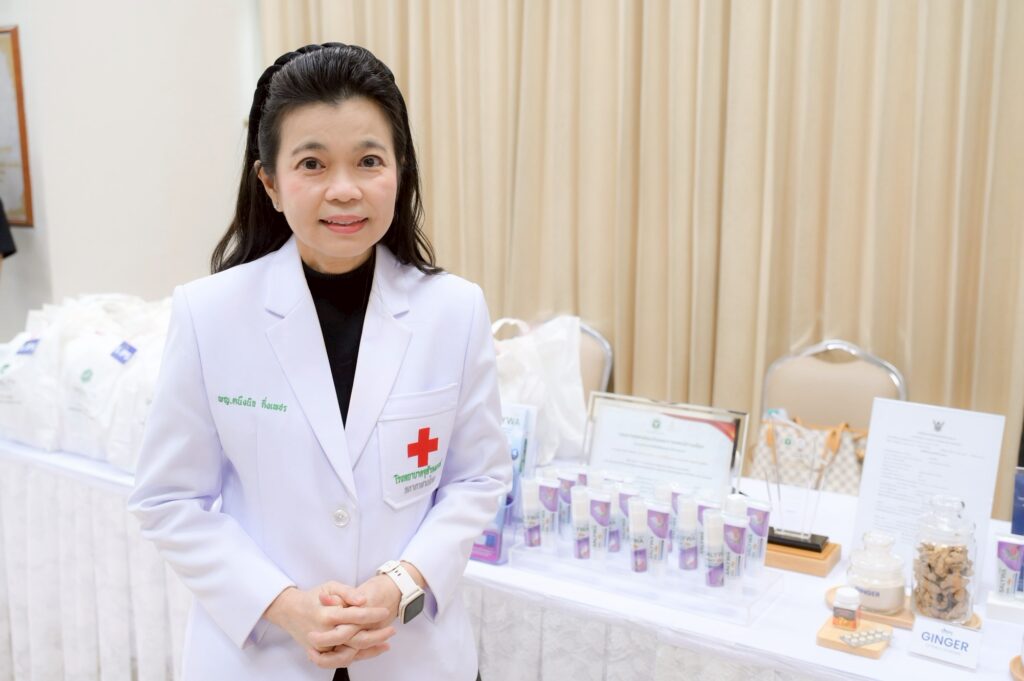
Assoc. Prof. Dr. Kanaungnit Kingpetch, the lead researcher from the Faculty of Medicine at Chulalongkorn University.
Assoc. Prof. Dr. Kanaungnit Kingpetch, the lead researcher from
the Faculty of Medicine at Chulalongkorn University. Photo: Chulalongkorn University.

SALYWA: Artificial Saliva from Thai Herbal Research

SALYWA is an artificial saliva innovation developed from research conducted by Assoc. Prof. Dr. Kanaungnit Kingpetch and her team from the Faculty of Medicine, Chulalongkorn University. The innovation is protected under a petty patent jointly held by Chulalongkorn University and the Thai Red Cross Society.

The product is formulated using Thai herbal extracts, particularly ginger extract, which helps stimulate natural saliva secretion. It features a Dual-Action concept, designed both to coat the oral cavity and increase moisture, leaving users with a comfortable and refreshed feeling after use.

Addressing Chronic Dry Mouth

Chronic dry mouth (Xerostomia) is a common condition, especially among head and neck cancer patients receiving radiation therapy. More than 70–80% of such patients experience reduced salivary gland function, which can cause difficulty eating and swallowing and increase the risk of oral infections.

At the same time, Thailand is rapidly becoming a fully aged society, with more than 13 million people aged 60 and above, representing over 20% of the population. This makes dry mouth and reduced saliva production a significant health issue affecting the quality of life of many people.
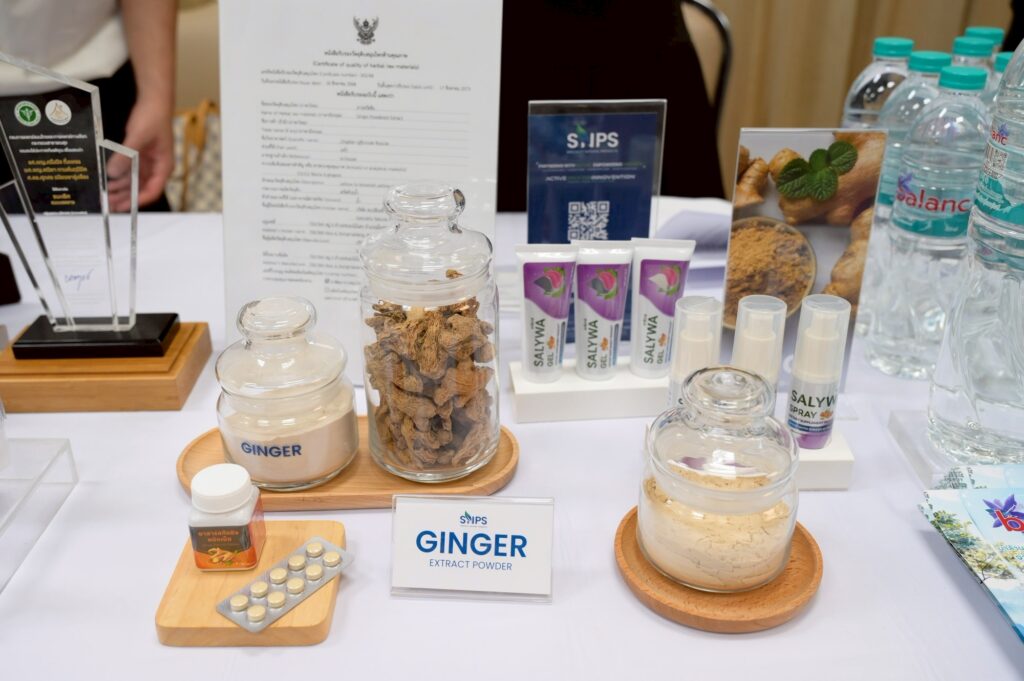
Thai herbal extracts, ginger extract, which helps stimulate natural saliva secretion.
Thai herbal extracts, ginger extract, which helps stimulate natural saliva secretion. Photo: Chulalongkorn University.

Product Details

SALYWA is designed to be easy to use and safe, classified as not a drug and sugar-free, making it suitable for elderly individuals, cancer patients, and people with low saliva production.

The product is available in two forms:
• Artificial saliva gel – 50 ml, 300 THB
• Artificial saliva spray – 30 ml, 275 THB
Users can rinse or spray the product in the mouth 3–4 times daily when experiencing dry mouth or when additional oral moisture is needed.

Innovation for Society

This collaboration reflects the concept of “Innovation for Society.” In addition to selling the product at a standard price, the private sector also supports the distribution of artificial saliva products through a charitable fund. These products will be provided free of charge to underprivileged patients, enabling them to access Thai-developed innovations.

The initiative highlights the role of collaboration between academic institutions, healthcare organizations, and industry in transforming research knowledge into sustainable societal benefits.

Those interested in supporting the project can donate to the “Artificial Saliva Support Fund for Patients” at the Donation Center, Administration Building, King Chulalongkorn Memorial Hospital, Thai Red Cross Society (Tel. +66 2 256 4000 ext. 4397).

Continue reading a full article on the website: https://www.chula.ac.th/en/news/292774/

By Chulalongkorn University

Similar Posts

  • Former Abbot of Wat Rai Khing Jailed for 50 Years Over 2 Billion Baht Fraud

    NAKHON PATHOM — The former abbot of one of Thailand’s most well-known temples has been sentenced to 50 years in prison for conspiring with other defendants to embezzle approximately 2 billion baht from temple funds, in a corruption case that has shaken public confidence in the country’s Buddhist clergy. Police Raid Renowned Temple in $9M […]

  • | | |

    SECP registers record 5,438 new companies in July

    The Securities and Exchange Commission of Pakistan (SECP) recorded its highest-ever monthly company registrations, with 5,438 new companies incorporated during July, reflecting growing business activity and investor confidence in the country’s corporate sector. According to the SECP, five international companies established offices in Pakistan during the month. The foreign firms are from Malaysia, the United Arab Emirates (UAE), and China, highlighting continued overseas interest in Pakistan’s business environment. The commission said 112 newly registered companies include foreign directors, indicating increasing international participation in the local corporate sector. Of the total registrations, 3,148 were private limited companies, while 2,117 were single-member companies. In addition, 127 limited liability partnerships (LLPs) were incorporated during the month. The SECP also registered 28 non-profit organisations and 18 public companies. Provincially, Punjab accounted for the largest share of registrations, with 2,756 companies, representing 51% of the total. Islamabad followed with 1,053 companies, while Sindh registered 864, Khyber Pakhtunkhwa 450, Gilgit-Baltistan 180, and Balochistan 135 new companies. The information technology (IT) sector recorded the highest number of new incorporations, with 1,008 companies registered during July. Other major sectors included trading with 845 new companies, services with 638, and construction with 348 registrations. The SECP also reported significant growth in other industries, with 256 companies registered in the food and beverages sector, 207 in tourism, 181 in e-commerce, 165 in education, 162 in real estate development, and 145 in corporate agriculture. The record number of company registrations reflects continued expansion across multiple sectors of Pakistan’s economy and increasing formalisation of businesses under the country’s corporate regulatory framework

  • Asia’s First Tomorrowland Music Festival is Coming to Thailand in Chonburi 2026

    BANGKOK – Thailand’s Board of Investment (BOI) has granted incentives for the organization of the globally renowned Tomorrowland music festival in Chonburi province in December 2026. This marks the festival’s first entry into Asia and is projected to generate an economic impact of approximately 21 billion baht over a five-year period. Thailand to Make History […]

  • | | | |

    Roman-Era masterpiece found hidden beneath fields …

    Archaeologists have uncovered a stunning 4th-century Roman mosaic beneath farmland in England, offering new insight into life during the period when Britain was part of the Roman Empire. The remarkable mosaic was discovered at the remains of an ancient Roman villa in Devon. Made from thousands of colorful stones arranged into intricate floral patterns, the artwork is believed to date back to the fourth century AD. The discovery provides fresh evidence of the wealth, architecture and cultural influence that existed in Roman Britain. The Roman Empire controlled much of Britain from around AD 43 until around AD 410, leaving behind numerous settlements, villas, roads and other archaeological remains. Alongside the mosaic, archaeologists discovered a large and sophisticated Roman bathhouse near the site. The complex reportedly contained several small pools, walls decorated with colorful plaster and a range of other ancient artifacts. The excavation was carried out over a two-month period by archaeologists from the University of Exeter and Cotswold Archaeology. Volunteers also participated in the work, helping researchers investigate the agricultural land located between the Devon villages of Hill Barton and Sampford Peverell. The archaeological team already knew that the Roman villa and surrounding working areas were potentially important for understanding the spread of Roman culture across Devon. However, the latest findings have revealed that the site was considerably larger and more significant than previously understood. Project leader Dr Susan Greaney said the discoveries could help researchers better understand Roman cultural influence and its interaction with local communities in the region. The detailed mosaic is particularly significant because such decorative artwork can provide clues about the status and lifestyle of people who lived at Roman villas. Its elaborate design and the presence of a substantial bathhouse suggest that the site was an important settlement rather than a simple rural dwelling. Archaeologists will now continue studying the discoveries and artifacts recovered from the site. Researchers hope the evidence will shed more light on how people lived, worked and adopted Roman customs in southwest England nearly 2,000 years ago. The Roman mosaic discovered in Devon is another reminder of how much of Britain’s ancient history remains hidden beneath modern farmland. Further archaeological investigation could reveal even more about the communities that lived in the region during the final centuries of Roman rule.

  • | |

    LHC dismisses PTI’s Minar-e-Pakistan rally p…

    The Lahore High Court on Wednesday dismissed a petition filed by the Pakistan Tehreek-e-Insaf (PTI), which sought permission to hold a public rally at Minar-e-Pakistan in Lahore. During the hearing, the court ruled that the petition had become unnecessary because the Deputy Commissioner (DC) had already made a decision on the party’s request for the gathering. The bench observed that the court must act within the framework of the law and cannot intervene once the competent administrative authority has issued its decision. The judges noted that the matter no longer required judicial consideration, as the relevant government official had already exercised the authority assigned under the law. On this basis, the court dismissed PTI’s plea. The ruling marks another legal setback for PTI in its efforts to secure permission for a public meeting at the historic Minar-e-Pakistan venue, where the party has previously held major political gatherings. The decision leaves the administrative authorities’ determination on the proposed rally in place.

  • Thai Government to Curb Fare Hikes Amid Middle East War

    BANGKOK — Thailand’s Ministry of Transport is set to announce a ministerial regulation on Thursday to prevent public transport providers, including taxis, motorcycle taxis, and on-demand ride-hailing services, from arbitrarily increasing their fares in response to the ongoing conflict in the Middle East, Transport Minister Phiphat Ratchakitprakarn confirmed on Wednesday. Thailand has enough oil for […]

Leave a Reply

Your email address will not be published. Required fields are marked *