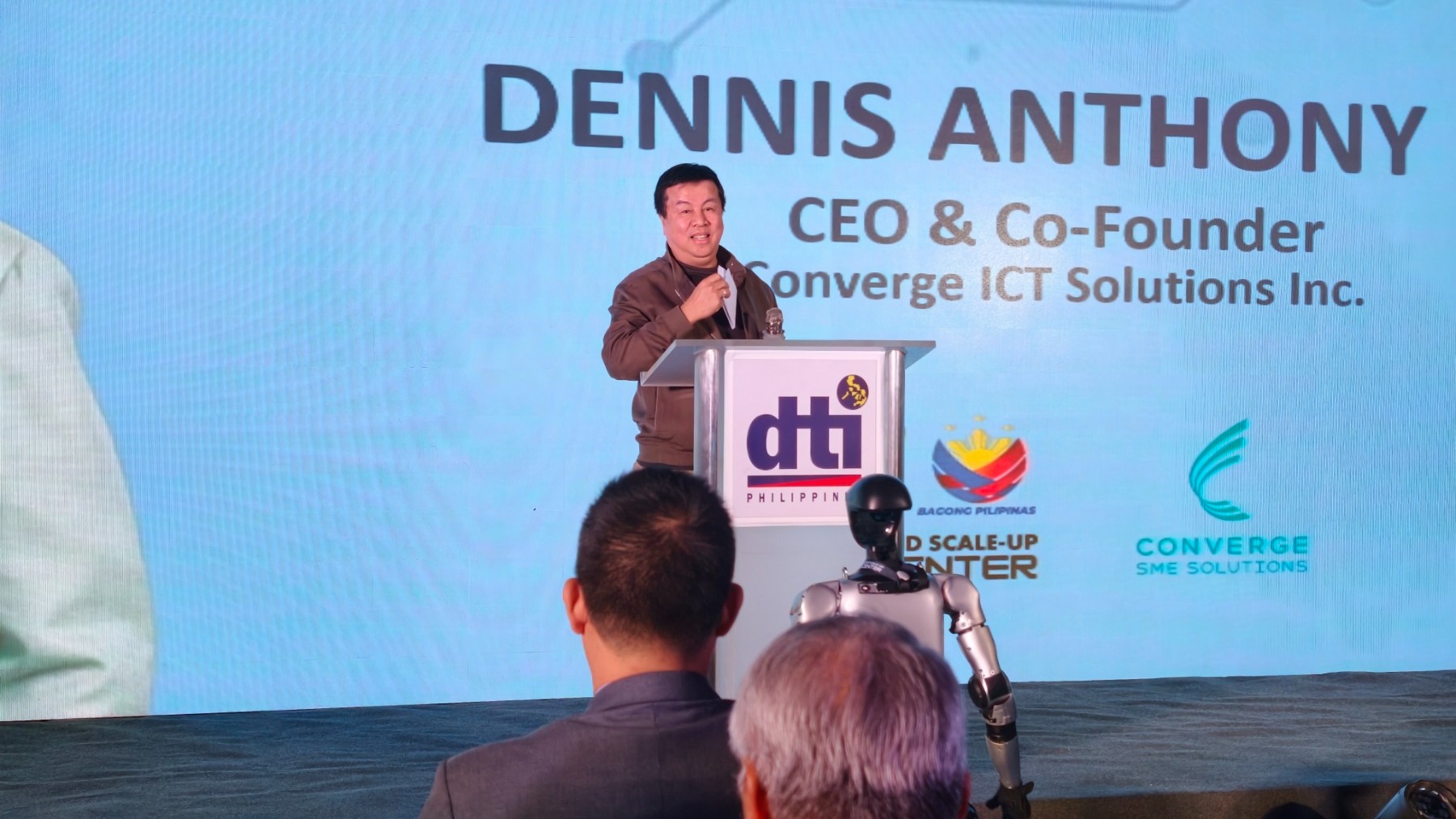
dti converge launch
|

DTI, Converge launch AI, digital transformation programs for MSMEs

MANILA, Philippines — The Department of Trade and Industry (DTI) and Converge ICT Solutions Inc. launched programs aimed at helping micro, small, and medium enterprises (MSMEs) adopt artificial intelligence and other digital technologies as part of efforts to make Philippine businesses more competitive.

The initiatives were unveiled on Tuesday, August 11 alongside the opening of the DTI Bagong Pilipinas AI and Scale-Up Center, a facility designed to give MSMEs, startups, and entrepreneurs access to AI training, technology tools, workspace, and business networks.

DTI Assistant Secretary Nylah Rizza Bautista said the center is intended for MSMEs that want to adopt AI but do not know where to start, as well as startups looking to expand and organizations seeking to turn ideas into practical business solutions.

“AI is no longer simply a technology of the future,” Bautista said in her welcome message. “It is already changing how businesses operate, compete, and grow.”

The approximately 380-square-meter center features coworking stations, meeting pods, training rooms, startup spaces, technology showcases, and high-speed connectivity. Its services are free, with MSMEs, startups, and aspiring entrepreneurs allowed to walk in or reserve slots via email (startup@dti.gov.ph) for scheduled activities.

The center will focus on three areas: helping businesses learn and adopt AI tools, allowing them to test and develop solutions, and connecting them with mentors, technology providers, industry leaders, government partners, and other innovators.

AI readiness, connectivity and skills

Converge founder and CEO Dennis Anthony Uy said the strategy for transforming MSMEs rests on three pillars: infrastructure for AI readiness, connectivity, and upskilling.

In her speech for the center’s launch, Uy said AI requires the necessary infrastructure, including access to data ecosystems and specialized software that may previously have been out of reach for smaller businesses.

The DTI is also partnering with Converge SME Solutions to provide high-speed, reliable, enterprise-grade fiber connectivity for the initiative.

Uy also emphasized the importance of training workers to use emerging technologies.

The AI and Scale-Up Center will provide entrepreneurs, managers, and workers with practical AI literacy and data-management skills, with the goal of ensuring that AI augments rather than replaces human capabilities.

Digital transformation campaign

The center forms part of a broader digital transformation partnership between Converge and the DTI, implementing an agreement they originally signed in November 2025.

Converge SME Solutions senior vice president Dindo Marzan said the programs were designed around the realities of small businesses, which often operate with lean teams and limited information technology resources. The offerings include business broadband and e-commerce connectivity solutions, as well as cloud-based tools, cybersecurity support, and productivity platforms.

The partnership will also conduct experiential activities, learning sessions, and workshops aimed at entrepreneurs in provincial areas and traditional industries. These activities include efforts to help MSMEs use AI to improve operations and develop new revenue opportunities.

Converge vice president Angela Gutierrez said the objective is to make digital transformation more accessible to smaller businesses.

“Our goal is simple: to ensure that even the smallest negosyo in the Philippines has the digital capability to compete not only locally, but globally,” she said. – Rappler.com

Similar Posts

  • | | |

    CM Punjab approves 800 mini dams for Potohar water…

    POTOHAR: Punjab Chief Minister Maryam Nawaz Sharif has approved an ambitious plan to construct 800 mini dams across the Potohar region over the next three years, marking one of the province’s largest initiatives aimed at improving rainwater storage and tackling water scarcity. The decision was taken during a high-level meeting on water conservation and groundwater management, where officials briefed the Chief Minister on ongoing efforts to protect Punjab’s water resources. Authorities informed the meeting that 110 mini dams have already been completed across the province, contributing to improved water preservation. The new project is expected to add storage capacity of approximately 32,000 acre-feet of rainwater, strengthening water security for agriculture and local communities. Maryam Nawaz also directed officials to prepare a comprehensive strategy for developing natural and artificial water bodies while calling for stronger legislation to regulate groundwater use. To improve oversight, dedicated personnel will be assigned to monitor water conservation initiatives. The chief minister instructed the agriculture, irrigation, housing and local government departments to work together to ensure the effective implementation of water-saving measures. Officials presented photographic evidence of recently completed mini dams in Attock, Talagang, Gujar Khan and Rawalpindi, highlighting progress already made in the region. During the briefing, authorities revealed that Punjab has developed a strategy to minimise water losses, which currently stand at around 30 per cent during distribution and 25 per cent during consumption. They also reported that the lining of 2,600 watercourses covering nearly 7,000 kilometres has already delivered significant water savings. Over the next three years, another 4,500 watercourses stretching 11,500 kilometres will be upgraded. The meeting was informed that high-efficiency irrigation systems have already conserved around 18,000 acre-feet of water while boosting crop productivity by nearly 50 per cent. The government now plans to extend modern drip and sprinkler irrigation systems to an additional 30,000 acres. Officials further stated that 100 groundwater recharge wells are already operational in the Gujranwala, Gujrat and Lahore divisions, with another 300 nearing completion to strengthen groundwater reserves. The chief minister also reviewed the availability of fertilisers across Punjab and approved the provision of 1,000 new laser land levellers to farmers at a 50 per cent subsidy during the current financial year to promote efficient farming practices. In a separate meeting on law and order, Maryam Nawaz directed authorities to adopt a zero-tolerance approach against rape, child abuse and corruption. She was also informed that the Safe City Project has now been implemented in all 43 districts of Punjab and is expected to be inaugurated soon, further enhancing public safety and surveillance across the province.

  • |

    EU to end automatic GSP+ extension from 2027, Pakistan told to submit fresh action plan

    ISLAMABAD: The European Union (EU) is set to introduce a revised mechanism for extending its Generalised Scheme of Preferences Plus (GSP+) trade facility from January 2027, under which beneficiary countries will no longer receive an automatic extension. The Commerce Ministry informed the National Assembly Standing Committee on Commerce on Wednesday that Pakistan would have to formally seek continuation of the GSP+ facility and submit an action plan covering its commitments under 32 United Nations conventions. Commerce Secretary Jawad Paul briefed the committee that the new GSP+ framework would come into force in January 2027, followed by a two-year transition period. During this period, countries benefiting from the scheme will be required to prepare and submit their respective plans, which will subsequently be assessed by the European Union. According to the secretary, the EU’s assessment of Pakistan contains both positive observations and areas of concern. Among the issues highlighted by the European bloc is the human rights situation in Pakistan, along with security and climate-related challenges. The briefing was given during a meeting of the National Assembly Standing Committee on Commerce chaired by Jawad Hanif. Members including Asad Alam Khan Niazi, Khurshid Ahmed Junejo, Shaista Pervaiz, Dr Ramesh Kumar Vankwani, Tahira Aurangzeb, Mir Amir Magsi, Dr Mirza Ikhtiar Baig and Kiran Haider attended the meeting. EU concerns discussed The committee asked the Commerce Ministry to explain the concerns raised by the European Union in its latest assessment of Pakistan and their possible implications for the country’s trade interests. Jawad Paul said the EU report had acknowledged the difficult circumstances Pakistan was facing, particularly in terms of security challenges, economic pressures and climate-related disasters, including floods. These factors, he said, had affected the country’s capacity to fully implement various commitments. He urged members of parliament to present Pakistan’s perspective during their engagements with European Parliamentarians and other EU representatives. The secretary maintained that Pakistan’s circumstances should be taken into account while evaluating the country’s performance under the GSP+ framework. He said the government needed to undertake fundamental measures to address the challenges identified by the EU while also ensuring that Pakistan’s position was effectively communicated to European stakeholders. The committee also expressed concern over the repeated absence of the Commerce Minister from its meetings and conveyed its displeasure over the matter. Tariff reforms aimed at boosting exports The meeting also reviewed the government’s tariff reforms and their impact on industrial competitiveness and exports. Committee members questioned whether exporters would be required to commit to specific export targets in return for government support. The committee chairman clarified that the measures being introduced should not be viewed simply as incentives for exporters, arguing that reductions in duties and taxes were intended to lower production costs and improve Pakistan’s competitiveness in international markets. Officials from the Commerce Ministry said the government had been pursuing a policy of reducing tariff protection and lowering the cost of imported raw materials. The objective, they said, was to enable domestic industries to become more competitive and increase their presence in international markets. As part of the reforms, tariffs on around 2,000 tariff lines were reduced last year to make raw materials and other industrial inputs available at lower prices. The secretary said tariff reforms were being implemented under the National Tariff Policy and that the government had provided an estimated Rs160 billion benefit to industry and exporters during the previous year. For fiscal year 2026-27, another Rs120 billion has been earmarked under the relevant support measures. According to the Commerce Ministry, the previous Rs120 billion package was associated with a $1.27 billion increase in exports during 2025-26. Jawad Paul acknowledged that the tariff changes could initially result in higher imports as industries gained access to cheaper inputs and machinery. However, he argued that the trade imbalance could gradually improve as increased industrial production translated into stronger exports. Committee seeks review of Pakistan-China trade agreement The standing committee also raised concerns over Pakistan’s trade deficit with China and identified the China-Pakistan Free Trade Agreement (CPFTA) as an issue requiring closer examination. Members asked the Commerce Ministry to provide a detailed presentation on the agreement’s impact on Pakistan’s exports, imports and overall trade balance. The committee also sought an update on the latest trade discussions between Pakistan and the United States. The Commerce Secretary assured members that a detailed briefing on the matter would be provided in an in-camera session. Export Development Fund restructuring reviewed The committee separately examined the restructuring of the Export Development Fund (EDF). Officials told the meeting that the management and decision-making structure of the fund had been moved towards greater private-sector participation, with leading exporters being given a more significant role in determining spending priorities. The committee welcomed the shift towards projects that have a direct and measurable connection with export growth rather than conventional infrastructure-focused initiatives. Members also reviewed the allocation of 40% of the Export Finance Scheme (EFS) portfolio for small and medium-sized enterprises (SMEs). They stressed that smaller businesses should have fair and sufficient access to export financing so that they can participate more effectively in international trade. Pakistan Reinsurance Company performance discussed The committee also reviewed the performance and investment strategy of Pakistan Reinsurance Company Limited (PRCL). Members were informed that the company retained nearly 30% of its risk domestically, while approximately 70% was placed in international reinsurance markets, including London, Dubai and Singapore. The committee chairman called for careful management of the company’s financial resources and urged officials to explore opportunities to improve returns without compromising risk-management standards. Proposed amendments for Karachi Chamber examined The committee considered the Trade Organizations (Third Amendment) Bill, 2026, a Private Member’s Bill seeking amendments to the Trade Organizations Act in relation to the Karachi Chamber of Commerce and Industry (KCCI). During the discussion, members examined the special status of KCCI and proposed exemptions from certain district-related provisions. The chairman directed that the proposed amendments be drafted in appropriate legal language in consultation with the Ministry of Commerce and the Ministry of Law and Justice

  • |

    AI errors hit report behind Australia’s under-16 ban

    A government-commissioned report that helped support Australia’s plan to restrict social media access for children under 16 has come under scrutiny after several inaccurate and apparently fabricated academic references were identified. The report, produced as part of a $3.48 million government-funded trial examining age-assurance technologies, was prepared by the Age Check Certification Scheme (ACCS). The organisation has acknowledged that ChatGPT was used to rewrite parts of the document after initially denying that artificial intelligence had been involved. An analysis of the report found six problematic citations in a chapter examining emerging technologies. Some of the digital object identifiers, or DOIs, reportedly directed readers to research papers that did not exist. Other references contained combinations of authors, journals and publication dates that could not be verified in academic records. In another case, a DOI reportedly led to a genuine research paper, but the paper did not support the claim attributed to it in the report. The controversy intensified after ACCS was questioned about the use of artificial intelligence. A spokesperson initially said no AI had been used in producing the report. The organisation later acknowledged that ChatGPT metadata was present in four links across two sections of the document. ACCS maintained that the metadata effectively disclosed the use of the tool and said the references had been manually checked. However, efforts to correct the disputed citations reportedly resulted in further inconsistencies. One example involved a research paper that an ACCS source said had been accessed in March 2025. According to the paper’s lead author, however, the research was not published until June 2025, raising additional questions about the accuracy of the report’s references. The report has attracted attention because it was used in the policy process surrounding Australia’s planned restrictions on social media for under-16s. Communications Minister Anika Wells had previously praised the report for identifying potential approaches to age verification. The minister’s department told a Senate inquiry that it had discussed the citation problems with ACCS. However, the department was reportedly informed about faulty links rather than allegations that some references had been fabricated. Australian National University academic Christian Downie warned that unreliable references can have serious consequences regardless of whether they were generated by AI or resulted from human error. He said inaccurate citations could contribute to poor policymaking and weaken public confidence in government-commissioned research. Independent Senator Fatima Payman also compared the controversy with a separate case involving Deloitte, which refunded part of a $440,000 government contract after problems were identified with AI-generated references.

  • |

    Pakistan weekly inflation rises as 20 essential items get costlier

    Weekly inflation in the country has recorded a slight increase. According to the Pakistan Bureau of Statistics (PBS), weekly inflation increased by 0.28%. During the week, prices of 20 essential commodities increased while nine items became cheaper and the prices of 22 items remained stable. According to the PBS, onion prices increased by 10.1% and chicken by 9.19%. The prices of gram lentils rose by 2.4% while the prices of ghee, flour and several other commodities also increased. The PBS said that tomato prices decreased by 6.82%. LPG, sugar, eggs and potatoes also became cheaper. Meanwhile, the price of a 20-kilogram bag of flour increased by up to Rs100 in one week. According to the PBS, the maximum price of a 20kg flour bag in the country is Rs3,133. In Karachi, the price increased by up to Rs100 to reach Rs3,000. In Larkana, the price of a 20kg flour bag also increased by up to Rs100 during the week reaching Rs2,600 in Khuzdar and Larkana. In Sukkur, the price of a 20kg flour bag increased by Rs60 while in Bannu it increased by Rs50. Following the increase, the price of a 20kg flour bag reached Rs2,950 in Bannu and Rs2,560 in Sukkur. In Islamabad, the price of a 20kg flour bag reached Rs3,133 while it stood at Rs3,100 in Peshawar and Rs3,093 in Rawalpindi. According to the PBS, a 20kg flour bag was priced at Rs2,960 in Bahawalpur while it reached Rs2,800 in Hyderabad, Multan, Sialkot and Gujranwala. In Sargodha, the price of a 20kg flour bag reached Rs2,793. In Quetta, a 20kg flour bag was priced at Rs2,750 while the price stood at Rs2,300 in Lahore and Rs2,200 in Faisalabad.

  • | | | |

    25kW solar users exempt from Nepra approval

    The National Electric Power Regulatory Authority (NEPRA) has introduced a major relief for small-scale solar consumers by amending the Solar Regulations 2026. The new changes remove a key regulatory requirement for consumers installing solar systems of up to 25 kilowatts (kW). According to an official notification issued by NEPRA, consumers with solar power systems of up to 25kW will no longer need to obtain prior approval from the regulatory authority before installing or connecting their systems. Instead, the power to grant approvals has now been delegated to the relevant electricity distribution companies (DISCOs). Consumers will be able to complete the approval process directly through their local power utility, eliminating the need to seek separate permission from NEPRA. The amendment is expected to simplify the procedure for residential, commercial and small business consumers who want to switch to solar energy. By reducing regulatory hurdles, the revised framework aims to make the installation process faster, easier and more efficient. Energy experts believe the decision will encourage more consumers to invest in solar power by shortening approval times and reducing paperwork. The move is also expected to support Pakistan’s growing transition towards renewable energy and lessen dependence on conventional electricity sources. The revised regulations are intended to improve access to clean energy while giving electricity distribution companies greater authority to process applications and facilitate small-scale solar projects more quickly.

Leave a Reply

Your email address will not be published. Required fields are marked *