ecb president lagarde
| |

ECB President Lagarde resigns at time of mounting challenges for Europe

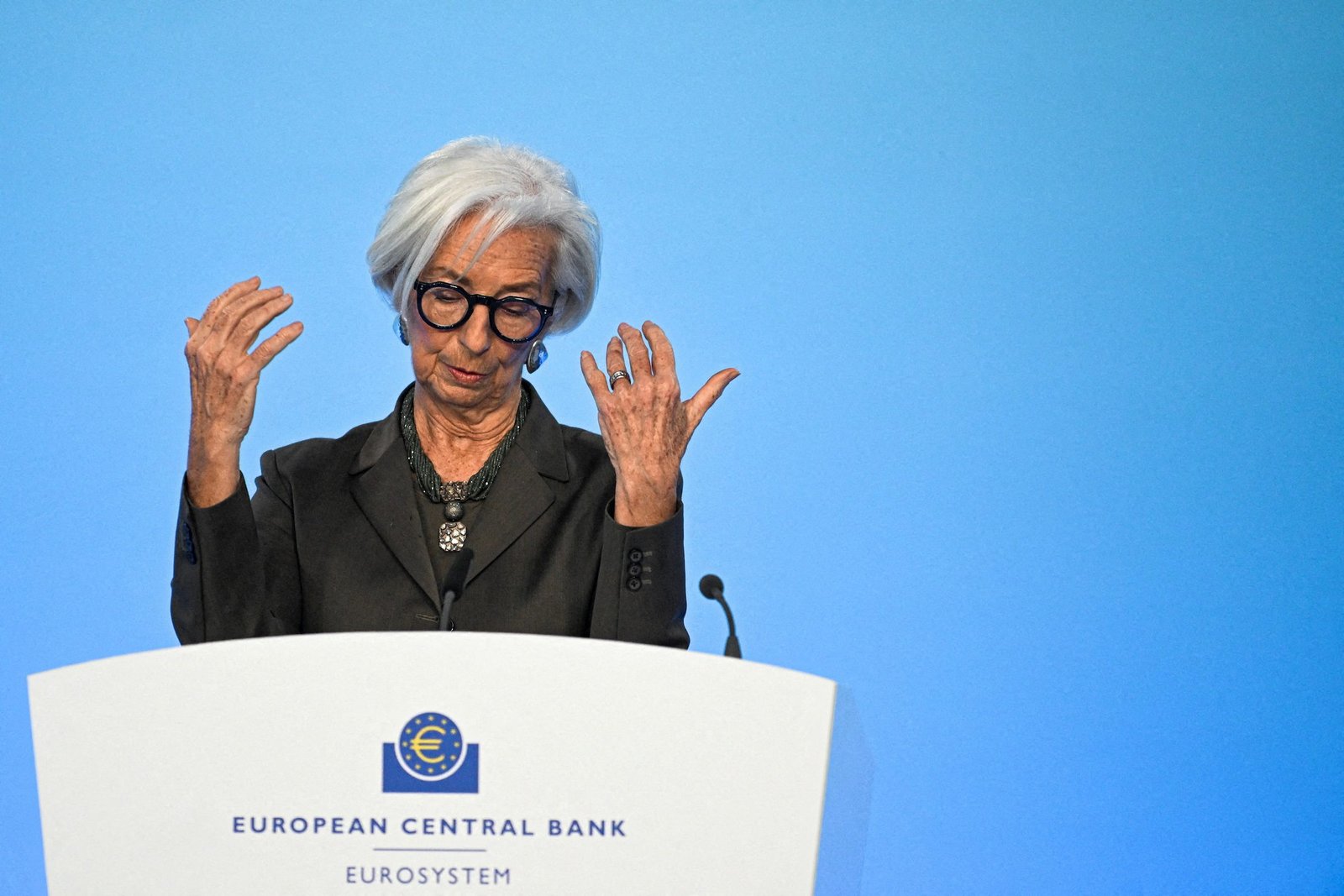
FRANKFURT, Germany – European Central Bank President Christine Lagarde announced her resignation on Thursday, October 29, ending months of speculation about her future just as Europe enters a period of rising economic volatility and divisive electoral politics.

Lagarde will step down on February 7, giving current European Union leaders time to pick a successor well before a French presidential election that polls show far-right candidate Marine Le Pen is favored to win.

The move comes as the ECB battles inflation risks from an Iran-driven oil shock while a sharp rise in bond yields, especially in France, threatens to dampen growth.

“I leave this institution with a sense of good work done and an ECB that is fit for the future,” Lagarde said in a short video shared on social media.

A source with direct knowledge of the matter said Lagarde had resigned so she could weigh in on political matters in her native France and globally. As ECB president, she was expected to remain neutral to safeguard the institution’s independence.

European Council President Antonio Costa said in a statement the process to find a successor for Lagarde would begin immediately. The former central bank governors of the Netherlands and Spain, Klaas Knot and Pablo Hernandez de Cos, are widely seen as frontrunners.

“The rumored successors are both very competent, well-established central bankers, so for markets, it won’t matter too much,” Piet Haines Christiansen, an economist at Danske Bank, said.

Financial markets did not move much after the announcement, with some analysts noting the ECB had by now built a reputation that outlived any of its leaders.

“The ECB is now quite well-established, the market is familiar with the way it operates,” Goldman Sachs’ head of Fixed Income Macro Investing Simon Dangoor said. “Our view is that institutional behavior is likely to outlast Lagarde, and be quite similar, whoever takes over.”

Lagarde’s term was scheduled to run until the end of October 2027, but speculation about an early departure had been mounting for months, with the World Economic Forum seen as a likely destination.

Rate hikes and bond turmoil

The ECB is in the middle of a rate-hiking cycle aimed at preventing an oil-price shock linked to the Iran war from feeding into other prices and wages.

But it must also contend with a surge in government bond yields — especially in debt-laden France — that has pushed up borrowing costs for households and businesses and which Lagarde has said will curb growth and inflation.

Caught between persistent inflation fueled by a renewed surge in energy costs and deteriorating financing conditions, the ECB is widely expected to keep its deposit rate at 2.5% on Thursday while signaling that another increase, potentially as soon as December, remains likely.

“There is likely a low bar to another hike in December, given the likelihood of another upward revision of the ECB’s inflation forecast due to higher energy prices,” Oliver Rakau at Oxford Economics said.

The ECB is due to announce its interest rate decision at 1315 GMT on Thursday, followed by Lagarde’s regular press conference at 1345 GMT.

Money markets are currently pricing another three rate increases from the ECB by the end of next year, which would take the deposit rate to 3.25%, a level that is widely seen as restricting economic growth.

French turmoil in focus but no action

The more immediate challenge for policymakers may be turmoil in bond markets.

A global rise in yields, fueled by stronger growth expectations, higher debt issuance and massive investment linked to artificial intelligence, is pushing up borrowing costs for governments, households and businesses alike.

In France, investors have become increasingly uneasy about the country’s growing debt burden and uncertain fiscal outlook following this year’s elections. Concerns have been amplified by suggestions from parts of the political left that debt held by the ECB could be written off.

The result has been a sharp increase in French borrowing costs. France is now paying some of the highest yields in a quarter-century to raise money on bond markets, while the premium investors demand to hold French debt over benchmark German bonds is larger than for any other euro zone country.

That has fueled speculation that the ECB might be forced to respond, if only verbally for now.

“They’ve typically come up with a new tool that’s customised for that specific set of circumstances,” said Dangoor at Goldman Sachs.

The ECB’s first line of defence would probably be flexible reinvestment of proceeds from bonds acquired during its vast asset-purchase programs of the previous decade.

Beyond that, it could activate its never-used Transmission Protection Instrument, a scheme designed to counter what policymakers deem unjustified market pressure. – Rappler.com

Similar Posts

  • | | | | |

    [Vantage Point] PROCAP: How a scam came to look legitimate

    A look at how an apparently well-organized, cross-border operation combined gaming, cryptocurrency, referral networks, purported insurance, technology, international events, prominent personalities, and genuine early payouts to manufacture credibility on an extraordinary scale

  • |

    High Commissioner Tipu Usman unveils people-centred consular reforms for British Pakistanis

    LONDON:Pakistan’s High Commissioner to the United Kingdom, Tipu Usman, has announced a series of people-centred reforms aimed at improving consular services for the British Pakistani community. As part of the new measures, consular services at the Pakistan High Commission in London will now begin at 8:00 am, Monday to Friday, increasing the number of appointments available each day and helping reduce waiting times. The High Commission has also introduced a daily walk-in facility from 3:00 pm to 4:00 pm, Monday to Friday, on a first-come, first-served basis. The service will cover passport issuance and renewal, NADRA-related services, document attestation, including Powers of Attorney, and Police Character Certificates. The reforms are among the first major public service initiatives introduced by High Commissioner Tipu Usman since assuming office. They are aimed at making consular services more accessible, efficient and responsive to the needs of overseas Pakistanis living in London and surrounding areas. Members of the British Pakistani community have welcomed the initiative, describing it as a practical step that will ease access to essential consular services and improve the overall public service experience at the Pakistan High Commission in London.

  • |

    China launches Arctic route to bypass global shipping chokepoints

    China is preparing to open a regular container shipping route through the Arctic as disruptions at major maritime chokepoints continue to affect global trade. The new service will operate through Russia’s Northern Sea Route along the Arctic coast. It is being presented as an alternative route between Asia and Europe. Chinese shipping company Sea Legend is expected to launch its first regular service on the route. The service will connect Ningbo in China with Felixstowe in the United Kingdom. The route has been described as the “Ice Silk Road”. It is designed to provide faster access to European markets. It could also improve trade links with Turkey and North Africa. The Arctic route could significantly reduce sailing times between China and Europe. The journey between Ningbo and Felixstowe normally takes around 40 days by traditional routes. The Northern Sea Route could cut the travel time by roughly half under suitable conditions. The route has gained attention as shipping companies look for alternatives to heavily congested and politically sensitive waterways. The Strait of Hormuz and the Bab al-Mandab have become major areas of concern for international shipping. Rising tensions in these regions have increased risks for vessels and raised costs for shipping companies. Marine risk experts say the Arctic is attracting greater interest from shipowners because it can offer shorter journeys and reduce exposure to geopolitical conflict zones. The Northern Sea Route is divided into 28 sections. Different rules and operating requirements apply along the route. Ships generally need permission from the Northern Sea Route administration, which is controlled by Russia’s state nuclear energy company Rosatom. Interest in the Arctic route is not new. Several international shipping companies have previously tested the Northern Sea Route. However, many European operators later avoided regular use of the route because of worsening relations with Russia. Concerns over the potential environmental impact of increased shipping in the fragile Arctic ecosystem have also remained a major issue. The changing climate has added another dimension to the debate. Shrinking sea ice has made some Arctic routes more accessible during parts of the year. The Arctic is now becoming an increasingly important area of competition among major powers. Russia considers the region strategically important for its economy and national security. It also views the Northern Sea Route as a major trade corridor. China has described itself as a “near-Arctic state” and has promoted the concept of a “Polar Silk Road”. Beijing sees greater Arctic access as an opportunity to expand trade and strengthen its global supply chains. The United States, meanwhile, has opposed efforts that could give Russia and China excessive control over Arctic routes. Washington has repeatedly supported freedom of navigation and greater international access to the region. The growing use of the Arctic shipping corridor could therefore have implications beyond commercial trade. For China, the route offers a potential way to reduce dependence on traditional maritime passages. For Russia, it could strengthen the economic importance of its Arctic coastline.

  • |

    Trump jokes about ICC as US steps up campaign against the court

    US President Donald Trump joked on Friday that he has not become a target of the International Criminal Court, making the remarks as his administration continues a diplomatic campaign against the Hague based institution and encourages member states to withdraw from it. Speaking during a cabinet meeting at the Camp David presidential retreat, Trump interrupted Secretary of State Marco Rubio while he was explaining the administration’s opposition to the court. Trump joked that there was no indication the ICC was pursuing him but added that it “could happen,” prompting laughter from those in attendance. The president then said Rubio was not trying to defend him but was instead supporting Israeli Prime Minister Benjamin Netanyahu, who is the subject of an arrest warrant issued by the ICC in 2024. Trump referred to the Israeli leader by his commonly used nickname, Bibi. The comments came as the United States continues to increase pressure on the International Criminal Court. In July, Washington launched a broad diplomatic effort aimed at weakening support for the institution. The campaign includes plans for additional sanctions against the court and calls on member countries to leave the organisation. Relations between the Trump administration and the ICC have remained tense. The United States has already imposed sanctions on several judges linked to the court, accusing it of overstepping its authority and threatening American interests. The International Criminal Court was established in 2002 to investigate and prosecute individuals accused of genocide, war crimes, crimes against humanity and other serious international offences when national legal systems are unwilling or unable to take action. Rubio repeated the administration’s criticism of the court during Friday’s meeting, describing it as an illegitimate international organisation. He said the United States had previously attempted to encourage reforms but claimed those efforts had failed. According to Rubio, the administration has now shifted its focus to reducing the court’s influence and encouraging more countries to reconsider their membership. He also said that five countries had either withdrawn from the ICC or announced plans to do so, adding that Washington hopes additional nations will follow the same path. Chad and Venezuela have recently declared their intention to leave the court. Neither the United States nor Israel is a member of the ICC. Both countries are not parties to the Rome Statute, the international treaty that created the court. Despite that, the ICC has continued to investigate cases involving several global conflicts, leading to repeated disagreements with governments that reject its jurisdiction. The latest remarks from Trump and Rubio underline the administration’s determination to challenge the authority of the International Criminal Court and strengthen its campaign against an institution it says exceeds its legal mandate.

  • |

    Romania shuts final nuclear reactor as severe Danube drought forces emergency energy measures

    Romania has completed a full shutdown of its Cernavoda nuclear power plant after severe drought dropped water levels in the Danube River to historic lows. The plant, which relies on the Danube for cooling and typically provides 20% of the country’s electricity generation, took its second reactor offline following the prior closure of its first reactor in late July. State operator Nuclearelectrica stated that the second reactor was shut down due to the ongoing drop in water levels, with no restart anticipated for at least ten days. To mitigate the energy shortfall, Romania declared a state of emergency for August, activated a 330-megawatt lignite-fired power plant, and requested that major industrial consumers and households curb power use during peak hours. Major automakers including Dacia and Ford have paused domestic production to help conserve power. The total shutdown immediately threatens energy security in neighbouring Moldova, which relies on Romanian imports to cover up to 60% of its electricity deficits. Moldovan authorities warned of potential rolling power cuts if alternative supplies cannot be secured from Ukraine or Western Europe. Across Europe, low river levels have similarly forced nuclear output reductions in France and triggered emergency engineering interventions in Hungary.

  • |

    Dubai launches tourist discount drive for residents

    Dubai has introduced a new initiative offering special discounts and benefits to residents who invite friends and family members to visit the emirate. The move aims to support the tourism sector, which has faced challenges due to regional tensions and declining visitor activity. Under the programme, residents can invite their relatives and friends to Dubai and receive benefits worth more than AED 3,000, including hotel stays, dining offers, entertainment experiences and attraction tickets. The initiative, called “A Dubai Invite,” encourages residents to become ambassadors for the city by promoting Dubai as a travel destination among their personal networks. The programme will continue until the end of October. Residents can register and nominate guests through an official platform, allowing invited visitors to access the available offers and experiences during their stay. The campaign comes during the summer season, which is traditionally a slower period for tourism in the United Arab Emirates due to extremely high temperatures that can reach around 50 degrees Celsius. Dubai remains one of the world’s leading tourism destinations, attracting millions of visitors every year with its luxury hotels, shopping centres, entertainment venues and iconic landmarks. However, the emirate’s tourism industry has faced pressure following regional security concerns. Earlier tensions in the Middle East affected travel patterns, with some tourists cancelling trips and hotels experiencing lower occupancy levels. The tourism sector has gradually shown signs of recovery after a ceasefire reduced tensions in the region. Industry officials said many hotels have increasingly relied on domestic visitors and local tourism activity during the recovery period. The Dubai government has also introduced financial support measures to help businesses affected by regional disruptions. Previous relief packages included fee reductions, exemptions for certain sectors and support measures for hospitality and aviation-related businesses.

Leave a Reply

Your email address will not be published. Required fields are marked *