explosion reported near
| |

Explosion reported near oil tanker off Oman coast,…

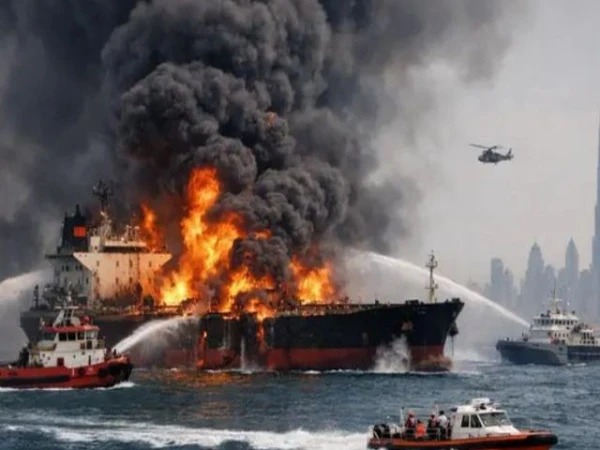
A powerful explosion was reported near a commercial oil tanker off the coast of Oman on Saturday, raising fresh concerns about maritime security in one of the world’s most strategically important shipping routes. Authorities have launched an investigation into the incident, while no casualties or damage have been reported so far.

According to the United Kingdom Maritime Trade Operations (UKMTO), a commercial vessel reported hearing a loud explosion followed by a large splash in the water near its location. The incident occurred approximately 21 nautical miles (39 kilometers) northeast of Khasab, Oman, close to the Strait of Hormuz.

Initial reports indicate that the explosion took place near the tanker rather than on board the vessel. The ship continued its voyage without reporting any structural damage, and there have been no reports of injuries among the crew.

In an official advisory, UKMTO confirmed that the cause of the explosion remains unknown and that investigations are ongoing. Authorities have not identified the source of the blast or determined whether it was the result of an accident, a security incident, or another cause.

Following the incident, UKMTO urged all commercial and cargo vessels operating in the Strait of Hormuz and surrounding waters to exercise extreme caution. Ship operators were advised to immediately report any suspicious activity, explosions, or security threats to the relevant maritime authorities.

The Strait of Hormuz is one of the world’s busiest and most strategically significant maritime chokepoints, serving as a vital route for global oil and liquefied natural gas exports. Any security incident in the area is closely monitored by governments, shipping companies, and energy markets because of its potential impact on international trade and energy supplies.

The reported explosion comes at a time of heightened tensions across the Middle East, with regional security concerns continuing to affect maritime operations. Although no link has been established between the blast and any ongoing geopolitical developments, the incident has renewed attention on the safety of commercial shipping in the Gulf region.

Maritime authorities are expected to release further details once the investigation progresses. Until then, vessels navigating the area have been advised to remain alert, follow official guidance, and maintain close communication with regional maritime security agencies.

Similar Posts

  • | |

    Zelensky removes army chief Syrskyi after week of …

    Ukrainian President Volodymyr Zelensky has dismissed the country’s commander in chief, Oleksandr Syrskyi, just days after removing popular Defence Minister Mykhailo Fedorov in a move that triggered widespread street protests across Ukraine. Early speculation that Fedorov’s removal stemmed from tension between him and Syrskyi was soon confirmed. Fedorov, 35, has drawn broad praise for reenergizing the defence ministry, driving reforms across the armed forces and pushing an anti corruption campaign. Syrskyi, 60, has been viewed by many in Ukraine as a Soviet trained commander resistant to sweeping changes within the military. In a farewell message posted on Telegram, Syrskyi defended his record, noting that the army he led through a difficult defensive campaign two years ago now stands on the offensive. He said he was handing over to his successor a force that is not just holding ground but advancing, and expressed hope that the offensive would continue. Zelensky named Mykhailo Drapatyi, 43, a popular and battle tested general, as Syrskyi’s replacement. Drapatyi said on Facebook that he would approach the role with full focus, responsibility and respect for those currently defending the country. He also thanked Syrskyi for his consistent work strengthening the Ukrainian army, saying he had grown up within it professionally. In a video posted late Tuesday, Zelensky thanked Syrskyi for his military leadership, including his role defending Kyiv during the earliest days of Russia’s full scale invasion in 2022. Zelensky also said he met with Fedorov earlier that day and offered him a worthy position within the government, though he did not specify whether Fedorov had accepted. Fedorov had been replaced last week by Yevhenii Khmara, a former senior official at Ukraine’s Security Service. Zelensky said all decisions would be formalized the following day. Fedorov congratulated Drapatyi on his new role, describing the appointment as a new source of hope in the broader fight of free people for freedom and justice, and calling it the voice of change that could no longer be ignored. Fedorov also said he called Syrskyi personally to thank him for defending the Kyiv region and for other significant battles, while adding that Ukraine needs to move even faster and correct past mistakes. Fedorov had only taken over as defence minister in January but quickly earned praise for using data driven analysis to improve battlefield performance. A former minister of digital transformation, he built a volunteer cyber unit known as the IT Army of Ukraine early in the full scale invasion. He later led a successful fundraising initiative called the Army of Drones and introduced elements of gamification into the war effort, creating a system that rewarded Ukrainian military units with credits for striking Russian targets. Fedorov’s removal sparked six days of widespread protests, placing mounting pressure on Zelensky to dismiss Syrskyi. Zelensky appeared to respond to that pressure by replacing him with Drapatyi, viewed as a younger and more innovative commander who is also considered a close friend of Fedorov’s. Fedorov’s clear support for Drapatyi’s appointment is likely to help ease the political tension that built up over the past week. Acting Defence Minister Khmara remains in his position for now, with Zelensky asking him and Drapatyi to develop a new defence strategy addressing issues including reform of the military corps system, weapons supply and drone capabilities. In an op-ed published Monday on the Militarny website, Syrskyi described his relationship with Fedorov as strictly professional and offered an apology if he had offended him. He said decisions surrounding military contracts, procurement and mobilization involve far more complexity than most people recognize, arguing that real progress, not public drama, ultimately determines the outcome of the war. Protesters are expected to continue pushing for Fedorov’s return to a position of genuine authority where he can keep driving innovation in Ukraine’s fight against Russia. Should that happen, Zelensky may succeed in repairing much of the immediate political damage, though many Ukrainians remain unlikely to forgive what they viewed as his original misstep in removing Fedorov in the first place.

  • |

    Michigan cyclosporiasis outbreak grows as health officials expand investigation

    Michigan has reported a sharp increase in cases of cyclosporiasis as health authorities continue to monitor one of the largest outbreaks of the intestinal illness in recent years. According to the latest update from the state’s health department, the total number of reported cases has climbed to 9,253, an increase of 1,077 infections since the previous report issued on Friday. The outbreak has led to 160 hospitalizations across the state. However, officials said no deaths have been recorded so far. Public health authorities are continuing to track new infections while working with federal agencies to identify the source of the outbreak and prevent additional cases. Cyclosporiasis is an intestinal illness caused by the Cyclospora parasite. People usually become infected after consuming food or water contaminated with human waste. Raw fruits and vegetables are among the most common sources of infection because they are often eaten without cooking, allowing the parasite to survive if proper food safety measures are not followed. The outbreak in Michigan is part of a wider public health concern affecting several states across the United States. Federal data show that 4,173 laboratory confirmed domestic cases have been recorded nationwide. In addition, the Centers for Disease Control and Prevention is reviewing more than 7,400 suspected cases that have not yet been confirmed through laboratory testing. Many of these reports have come from Michigan and neighboring Ohio. The US Food and Drug Administration and the CDC have expanded their joint investigation after identifying additional infections in four more states. Health officials are focusing on a possible link between the outbreak and shredded iceberg lettuce imported from central Mexico. The investigation now includes cases reported in Illinois, Indiana, Kansas, Kentucky, Michigan, Ohio, Oklahoma, Pennsylvania and West Virginia. Authorities are examining distribution records and supply chains to determine how contaminated produce may have reached consumers in different parts of the country. According to the FDA, epidemiological data collected by the CDC indicate that 1,947 people infected with the Cyclospora parasite had eaten food from Taco Bell restaurants before becoming ill. Investigators believe many of those infections may be connected to shredded iceberg lettuce supplied by Taylor Farms and served at Taco Bell locations. However, officials say the investigation is still ongoing and a final conclusion has not yet been reached. Health experts have reported cases of cyclosporiasis in at least 41 states this year, although not all infections are believed to be related to the current outbreak. Investigators are continuing to determine which cases are connected to the suspected contaminated lettuce and which may have originated from other sources. Symptoms of cyclosporiasis often include prolonged diarrhea, stomach cramps, nausea, fatigue and loss of appetite. While most people recover with appropriate treatment, the illness can be more serious for older adults and people with weakened immune systems. Health authorities continue to advise consumers to follow food safety practices and remain alert for symptoms as the investigation into the outbreak continues.

  • | |

    US and Japan join hands to stabilize weakening Jap…

    In a rare show of financial coordination, the United States and Japan have confirmed that they jointly intervened in currency markets last week to support the Japanese yen after it plunged to its weakest level in four decades against the US dollar. The move marks the first coordinated intervention between the two allies since 2011, when they acted together following Japan’s devastating earthquake and tsunami. The intervention comes as both governments seek to stabilize the yen and prevent further market volatility that could ripple across the global financial system. Japanese officials and US Treasury Secretary Scott Bessent made it clear that they are prepared to take additional coordinated action if needed to counter excessive fluctuations in the currency. Economists say the joint effort reflects growing concerns that a prolonged depreciation of the yen and instability in Japan’s government bond market could have wider consequences, including increased borrowing costs for the United States and heightened uncertainty in global markets. Analysts also believe that even limited interventions can discourage speculative trading by signaling that authorities are willing to act decisively. The yen has remained under pressure largely because Japan continues to maintain significantly lower interest rates than other major economies. While the Bank of Japan raised its benchmark interest rate to 1% in June—the highest level in nearly three decades—it remains well below the US Federal Reserve’s policy rate of 3.50% to 3.75%, making the dollar a more attractive choice for investors. Japan is also grappling with long-term economic challenges, including a shrinking working-age population, sluggish productivity growth and heavy dependence on imported energy priced in US dollars, all of which have contributed to the currency’s weakness. Japan’s Ministry of Finance stated that the coordinated intervention was aimed at countering excessive volatility and restoring orderly conditions in foreign exchange markets. Secretary Bessent echoed that message, saying the United States strongly supports Japan’s efforts to correct what it views as a significantly undervalued yen. President Donald Trump also defended the move, saying Japan had sought assistance in stabilizing its currency and reaffirming Washington’s commitment to supporting its longtime ally. Following the announcement, the dollar briefly weakened against the yen before regaining some ground. Market observers estimate that Japan may have spent nearly $59 billion purchasing yen in recent interventions, while reports suggest the United States may have bought between $5 billion and $10 billion worth of the Japanese currency, although US officials have not officially confirmed the amount. Financial markets are now closely watching whether further coordinated interventions will be required if pressure on the yen continues, with analysts expecting both governments to remain ready to act in order to preserve stability in global currency markets.

  • |

    South Korea estimates North Korea’s economy grew over 3 percent for third year

    North Korea’s economy expanded by more than three percent in 2025 for the third consecutive year, according to new estimates released by South Korea’s central bank. The report suggests that stronger economic and military cooperation with Russia played a major role in boosting growth despite North Korea’s continued international isolation. The Bank of Korea, which has published annual estimates of North Korea’s economy since 1991 because Pyongyang does not release official economic data, estimated that the country’s real gross domestic product grew by 3.5 percent last year. The report valued North Korea’s economy at approximately 38.26 trillion won, or about 26.6 billion dollars. According to Bank of Korea officials, expanded cooperation with Russia was one of the main reasons for the improvement. Analysts have said North Korea has strengthened ties with Moscow by supplying troops and military equipment for Russia’s war in Ukraine. In return, Pyongyang is believed to have received financial assistance, food supplies, energy resources and military technology. A Bank of Korea official said increased weapons exports to Russia supported growth in North Korea’s manufacturing sector. The official also noted that a rise in Russian tourists and improved transport links between the two countries contributed to stronger performance in construction and service industries. The report estimated that North Korea’s exports increased by 30 percent during 2025, reaching around 470 million dollars. Among the leading export products were prepared feathers and wigs, along with toys and sporting goods. Although the report did not identify all exported items, officials said stronger overseas sales contributed significantly to economic growth. The latest figures were released as reports continued to highlight growing military cooperation between Moscow and Pyongyang. Ukraine’s military intelligence, quoted by the Kyiv Independent, claimed that more than 7,000 North Korean troops were killed or wounded while fighting alongside Russian forces during military operations in Russia’s Kursk region between 2024 and 2025. Neither Russia nor North Korea has independently confirmed those figures. Separately, the Ukrainian human rights organisation Truth Hounds said Russia and North Korea are close to completing their first road bridge connecting the two countries. The group said such a link could strengthen military and economic cooperation by allowing easier movement of personnel, equipment and supplies across the border. The Bank of Korea also reported a significant increase in North Korea’s gross national income, which measures the total income earned by a country’s residents. The estimate showed GNI rising by 9.4 percent to 48.5 trillion won, or approximately 33.8 billion dollars. Officials said the increase was supported by higher foreign currency earnings, including income linked to North Korean personnel sent to Russia. Despite the recent growth, North Korea’s economy remains extremely small compared with its southern neighbour. According to the Bank of Korea, North Korea’s gross national income is still less than two percent of South Korea’s economy, highlighting the large economic gap that continues to separate the two countries. The latest estimates suggest that while North Korea remains under international sanctions and largely isolated from global markets, its expanding partnership with Russia is providing new sources of economic activity that have helped sustain growth for a third straight year.

  • |

    Ukraine submits peace proposals to US as Zelenskiy warns of autumn Russian draft

    Ukrainian President Volodymyr Zelenskiy announced that Kyiv has delivered fresh peace proposals to American negotiators aimed at ending the conflict with Moscow. He simultaneously warned that Russia intends to use its upcoming parliamentary elections to launch a new, large-scale military mobilisation. Speaking in his nightly address, Zelenskiy stated that the proposals handed to the United States focus on bolstering Ukraine’s defence capabilities, particularly air defence, while urging Washington to exert diplomatic and economic pressure on the Kremlin to halt the war. The movement in negotiations comes as U.S. envoys Steve Witkoff and Jared Kushner prepare for potential visits to both capitals, following a period where diplomatic efforts had largely stalled. Kyiv continues to press for an immediate ceasefire after nearly four and a half years of fighting, whereas Moscow insists any agreement require Ukraine to permanently cede four claimed regions. Zelenskiy also cited Ukrainian intelligence reports indicating that Russian President Vladimir Putin plans to exploit September’s parliamentary polls to orchestrate a rapid autumn draft. “They are preparing for mobilisation in the autumn, immediately after the imitation of parliamentary elections,” Zelenskiy said, estimating that Moscow aims to draft several hundred thousand additional personnel by the end of the year, alongside ongoing voluntary contract recruitment. The electoral warning follows a decision by Russia’s Supreme Court on Monday to bar the liberal Yabloko party, the country’s sole registered anti-war political group, from contesting the upcoming election. Kremlin officials have denied plans for a mandatory draft, pointing to 200,000 voluntary sign-ups recorded in the first half of the year.

  • | |

    Overseas Pakistanis welcome proposal for creation …

      Overseas Pakistanis have welcomed the proposal to create new provinces in the country, describing it as a positive step toward improving administrative efficiency, strengthening governance and bringing public institutions closer to citizens. Rajah Nasir Hussain, a representative of overseas Pakistanis and a prominent businessman from Gujar Khan, expressed his support for the proposal . He said the idea of creating seven provinces should be considered alongside the establishment of an eighth province comprising Islamabad and the Potohar region. According to Hussain, the creation of new provinces could help address administrative challenges and improve the delivery of public services. He stressed, however, that any decision regarding the creation of new provinces should be made through constitutional amendments and broad political consensus. He said the issue should not be treated as a matter of political rivalry or regional competition. Instead, it should be viewed as an administrative reform aimed at improving governance and ensuring that citizens in different parts of the country receive better access to state institutions and public services. Hussain also highlighted the important role played by overseas Pakistanis in the national economy. He said millions of Pakistanis living and working abroad contribute significantly to the country through remittances. The funds sent by overseas Pakistanis provide vital support to Pakistan’s economy and help strengthen the country’s financial system. He noted that overseas Pakistanis continue to make economic contributions despite living outside the country. Their remittances support families, increase foreign exchange inflows and contribute to economic stability. In his view, their role should therefore be recognised not only in economic terms but also through greater representation in the country’s administrative and political framework. Hussain argued that the government and political leadership should explore new mechanisms through which overseas Pakistanis can participate more effectively in national affairs. He said their experience of living and working in different countries gives them exposure to modern administrative systems, business practices and governance models that could potentially benefit Pakistan. He further suggested that overseas Pakistanis should have greater opportunities to contribute to policy discussions concerning economic development, investment, governance and administrative reforms. Their participation, he said, could help policymakers understand international practices and identify approaches that may be adapted to Pakistan’s circumstances. Regarding the proposed new provinces, Hussain emphasised the importance of consultation among all stakeholders. He said political parties, provincial governments, civil society, constitutional experts and representatives of the affected regions should be involved in the discussion before any final decision is taken. He maintained that the creation of provinces should be based on administrative requirements, population, geographical considerations, economic viability and the interests of local communities rather than short-term political objectives. The proposal to consider Islamabad and Potohar as an eighth province, he said, should also be examined within this broader framework. Such a move, if supported by constitutional and political consensus, could potentially improve administrative management and representation in the region. Hussain reiterated that overseas Pakistanis support reforms aimed at strengthening the country’s administrative structure. He said the debate over new provinces provides an opportunity to consider broader governance reforms while ensuring constitutional procedures and national consensus. He concluded that overseas Pakistanis should be regarded as important stakeholders in Pakistan’s future. Given their economic contributions and national role, developing effective mechanisms for their political and administrative representation should be considered a priority alongside wider institutional reforms.

Leave a Reply

Your email address will not be published. Required fields are marked *