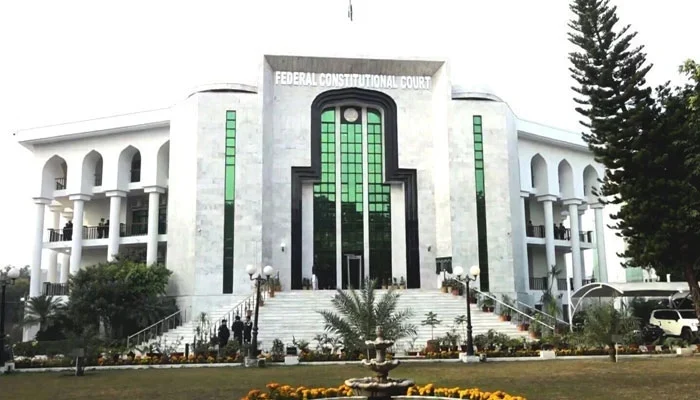
fcc refuses halt
| |

FCC refuses to halt inquiry against former NAB DG

ISLAMABAD: The Federal Constitutional Court (FCC) has declined to suspend inquiry proceedings against former National Accountability Bureau (NAB) Director General Saleem Shehzad, allowing an investigation into his alleged unlawful appointment and promotion to continue.

The decision came during a hearing of an appeal filed by Shehzad challenging a show-cause notice issued against him. He had requested the court to stay the inquiry until the case was decided, but the bench refused to grant interim relief.

A two-member bench headed by Justice Hassan Azhar Rizvi heard the appeal and directed the federal government to submit its response within three weeks before further proceedings.

The case revolves around allegations that Saleem Shehzad’s appointment and subsequent promotion within the National Accountability Bureau were made in violation of applicable rules and procedures. Authorities had earlier issued him a show-cause notice seeking an explanation over the alleged irregularities.

Former National Accountability Bureau (NAB) Director General Saleem Shehzad

Before approaching the Federal Constitutional Court, Shehzad had challenged the notice in the Islamabad High Court. However, after his petition was dismissed, he filed an appeal before the FCC, seeking legal protection against the inquiry.

During the hearing, the court did not interfere with the ongoing investigation, effectively allowing the relevant authorities to continue examining the allegations while the constitutional appeal remains pending.

Legal experts say the ruling does not determine Shehzad’s guilt or innocence but indicates the court’s reluctance to halt administrative proceedings before hearing the case in detail. The federal government’s reply is expected to play an important role in the next stage of the proceedings.

The case has attracted attention because it involves the appointment of a senior official in Pakistan’s top anti-corruption watchdog. Any findings from the inquiry could have broader implications for accountability, transparency and the process of appointments in public institutions.

With the inquiry set to continue and the government directed to file its response within three weeks, the Federal Constitutional Court is expected to take up the matter again after reviewing the submissions of both sides. The outcome could shape the future course of the legal challenge brought by the former NAB official.

Similar Posts

  • |

    Palace fears Harry could reach King Charles while Camilla’s away

    Prince Harry’s ongoing push to rebuild ties with the royal family may be approaching a pivotal moment. A new development has insiders within the Firm reportedly on edge. The concern centres around Queen Camilla’s upcoming girls’ trip, which happens to overlap with King Charles’s time at Balmoral in Scotland. According to celebrity reporter Rob Shuter and a Palace insider, this overlap has become a genuine point of worry. Camilla is widely believed to play a key role in tempering Charles’s emotional responses when it comes to Harry. She’s even reportedly rearranged her own schedule in the past just to be present during Harry’s summer meeting at Highgrove. A Palace source told Shuter that Harry is well aware of exactly when his father is most emotionally vulnerable. With Camilla away, one of the strongest steadying influences on Charles would temporarily be missing. The source explained that Harry understands his father on a deeply emotional level. According to the insider, Harry knows Charles misses him and senses that beneath the tension, the King still wants his son back. The source added that while Charles can be firm and composed in his role as monarch, Harry knows exactly how to reach him as a father. That emotional vulnerability is reportedly what worries palace insiders the most. Shuter noted that no dramatic gesture would even be necessary to make an impact. Even a simple phone call, he suggested, could open a door that officials would then struggle to close again. The timing adds another layer of complexity to the already delicate relationship between Harry and his father. With Camilla’s steadying presence temporarily out of the picture, palace insiders appear to be bracing for the possibility of an unplanned reconciliation attempt. Whether Harry chooses to act during this window remains to be seen, but the concern within palace circles suggests his opportunity is being taken seriously behind the scenes.

  • |

    Common mood-stabilizing drug may offer hope for Alzheimer’s disease

      Medical researchers have suggested that lithium, a widely available and inexpensive medication commonly prescribed to treat bipolar disorder and major depressive disorder, may also hold promise as a potential treatment for Alzheimer’s disease. Although the findings are encouraging, scientists stress that much more research is required before lithium can be recommended as a treatment for patients with Alzheimer’s. According to previous studies researchers found that people diagnosed with Alzheimer’s disease tend to have lower levels of lithium in their brains compared to healthy individuals. This observation led scientists to investigate whether restoring lithium levels could help protect the brain from the damage caused by the disease. To explore this possibility, researchers conducted laboratory experiments using mice genetically modified to develop Alzheimer’s disease. The study found that administering very low doses of lithium significantly improved the animals’ memory performance. In addition, the treatment reduced the harmful effects of brain cell damage that are typically associated with Alzheimer’s. These findings suggest that even small amounts of lithium may have protective effects on brain function. Scientists believe lithium works by helping to preserve the health of neurons, the specialized brain cells responsible for memory, learning, and thinking. The drug may also support communication between different regions of the brain by maintaining the connections between nerve cells. Since Alzheimer’s disease gradually destroys these connections, researchers believe lithium could potentially slow the progression of cognitive decline if administered during the early stages of the disease. Further support for this idea comes from a research paper published in the medical journal Translational Psychiatry. In the article, experts emphasized the need for more comprehensive studies to investigate the safety and effectiveness of low-dose lithium therapy for people with early-stage Alzheimer’s disease. They argued that while the initial findings are promising, larger clinical trials involving human participants are essential before any firm conclusions can be drawn. Experts from Alzheimer’s advocacy organizations have also responded cautiously to the research. Dr. Richard Oakley, Director of Research at the Alzheimer’s Society, said the findings contribute to the ongoing scientific discussion about lithium’s potential role in Alzheimer’s treatment. However, he warned that there is currently no conclusive evidence showing that lithium can prevent dementia or serve as a cure for Alzheimer’s disease. Dr. Oakley further explained that the human clinical trials conducted so far have been limited in size and scope. As a result, the available evidence is not yet strong enough to support the routine use of lithium for Alzheimer’s patients. He emphasized that larger, well-designed clinical studies are needed to determine the drug’s long-term benefits, possible side effects, and the most effective dosage. Alzheimer’s disease remains one of the world’s leading causes of dementia, affecting millions of people and placing a significant emotional and financial burden on families and healthcare systems. While current treatments can only help manage symptoms, researchers continue to search for therapies that can slow or stop the disease. If future studies confirm the benefits of low-dose lithium, this affordable and widely available medication could become an important addition to Alzheimer’s treatment. Until then, experts advise patients and caregivers not to use lithium for Alzheimer’s without medical supervision, as scientific evidence is still developing.

  • | | |

    Khamenei’s resurfaced message explains Iran’s …

    Tehran: A message previously shared by Iran’s Supreme Leader, Ayatollah Ali Khamenei, has resurfaced on social media during the Chehlum commemorations of Hazrat Imam Hussain (RA), drawing renewed attention to Iran’s stance against reaching a deal with the United States. The post, published on the social media platform X from Ayatollah Khamenei’s account, quotes a saying attributed to Imam Hussain (RA), emphasizing the duty to stand against oppression. The message states that those who fail to confront tyranny risk sharing the same fate as the oppressor. It concludes by saying that this principle is the reason Iran refuses to compromise with the United States, linking the country’s political position to its ideological beliefs. The message was originally posted on October 13, 2019, but has now been republished to coincide with the Chehlum observance honoring the martyrs of Karbala, highlighting the continued significance of its message in Iran’s political narrative.

  • | |

    Court grants interim bail to business partner’s …

      A Karachi Additional District and Sessions Court has granted interim bail to Abdullah, the brother of the business partner of young trader Mir Raza Ali, in connection with the businessman’s murder case. The court approved Abdullah’s interim pre-arrest bail until September 1, providing him temporary protection from arrest while the investigation into the case continues. Abdullah had approached the court seeking bail before arrest after being allegedly linked to the investigation surrounding Mir Raza Ali’s death. During the hearing, the court also issued notices to the investigating officer and the complainant in the case. The judge directed the applicant to submit surety bonds worth Rs100,000 as part of the conditions attached to the interim bail. According to Abdullah’s lawyer, there was no basis for treating his client as a suspect in the murder. The lawyer informed the court that Abdullah had a business-related connection with Mir Raza and used to supply chocolates to him. The defence further explained that Abdullah had spoken to Mir Raza by telephone on the night when the young trader left his home. According to the lawyer, the phone conversation took place at around 3:30am. The lawyer argued that the late-night phone call should be viewed in the context of their regular business dealings rather than being treated as evidence of involvement in the alleged crime. The defence also accused the police of harassing Abdullah during the investigation. His lawyer told the court that law-enforcement officials were repeatedly troubling the applicant despite the absence of any established evidence connecting him directly to the murder. The lawyer maintained that communication between Abdullah and Mir Raza at around the same time was not unusual. He explained that after completing his work, Mir Raza would generally speak with the applicant around that time. The defence therefore requested the court to provide Abdullah with protection from arrest while the authorities continued investigating the circumstances surrounding Mir Raza Ali’s death. After hearing the arguments, the court granted interim bail until September 1 and directed the relevant parties, including the investigating officer and complainant, to respond to the bail application. The applicant was also ordered to submit the required surety bonds. The court’s decision does not amount to a final determination regarding Abdullah’s involvement in the case. The interim bail merely prevents his immediate arrest while the matter is considered further by the court. The murder investigation remains ongoing, and the police are expected to examine the circumstances surrounding Mir Raza’s death, including his final movements, communications and interactions with people connected to him. The late-night telephone conversation between Mir Raza and Abdullah is among the details that investigators may consider while establishing a timeline of events. However, the defence has maintained that the conversation was consistent with their normal business-related communication. The case has attracted attention because of the young trader’s death and the subsequent investigation into people associated with him. Abdullah’s decision to seek pre-arrest bail indicates that he feared possible arrest during the investigation. The court’s issuance of notices to the investigating officer and complainant means that the prosecution and police will have an opportunity to present their position regarding the allegations and the bail request. For now, Abdullah remains protected by the interim bail order until September 1, subject to the conditions imposed by the court. Further proceedings are expected to determine the next legal steps in the case and whether the investigating authorities have sufficient evidence to proceed against him.

  • | | |

    Iran unleashes drone barrage on US bases

    The conflict between Iran and the United States intensified on Friday as Iranian military officials claimed to have carried out drone attacks on several military facilities used by US forces in Kuwait, Bahrain and Jordan. The developments came after fresh US airstrikes on Iranian targets, signalling another major escalation in the months-long regional confrontation. According to Iranian military statements, “Arash” attack drones targeted US military warehouses and troop positions at Camp Udairi, Camp Doha and Camp Arifjan in Kuwait. Iranian officials said the attacks focused on weapons storage sites, military equipment and logistical facilities. They warned that further military action would continue if attacks against Iran persisted. Iran also claimed responsibility for drone strikes on Sheikh Isa Air Base in Bahrain and Al-Azraq Air Base in Jordan. Iranian state media reported that fuel storage areas, aircraft hangars, maintenance facilities and accommodation used by US personnel were among the intended targets. However, there was no immediate confirmation from the United States, Bahrain, Jordan or Kuwait regarding the reported attacks. Officials in those countries also did not immediately report casualties or significant damage. Meanwhile, US forces reportedly carried out fresh airstrikes on an Islamic Revolutionary Guard Corps (IRGC) naval headquarters in the northern Iranian town of Zibakenar. Iranian authorities said the facility was hit but added that initial assessments showed no casualties. In Iraq, several explosions were reported near Erbil International Airport, where US-led coalition forces are stationed. Witnesses reported hearing air defence systems in operation while drones were seen flying over the area. Smoke was later observed rising near the airport complex. Iranian Foreign Minister Abbas Araghchi warned that any country assisting the United States in military operations against Iran would be held responsible under international law. He said Tehran reserved the right to respond with measures permitted under self-defence. Araghchi also criticised Washington over comments suggesting frozen Iranian assets could be used to compensate for damage caused to commercial shipping. He warned that confiscating another country’s assets would create a dangerous international precedent and undermine global financial stability. The military escalation has also affected global energy markets. Concerns over security in the Strait of Hormuz and the Red Sea have sharply reduced tanker traffic through key shipping routes. Shipping data indicated that only one oil tanker crossed the Strait of Hormuz on Thursday, the lowest daily figure in more than two months. The situation worsened after attacks on Saudi oil tankers in the Red Sea increased fears of further disruption to global energy supplies. Rising tensions pushed international oil prices above $100 per barrel, raising fresh concerns about inflation and the global economy. US President Donald Trump warned that Iran and the Iran-backed Houthi movement would face severe military consequences if attacks on commercial shipping continued. He said Washington was prepared to respond forcefully to any further threats against regional security and international maritime trade.

  • |

    Diljit Dosanjh surprised after failing to find a trash bin in Japan

    Indian singer and actor Diljit Dosanjh has impressed fans after sharing a glimpse of Japan’s remarkable cleanliness, expressing surprise at the country’s unique approach to waste management. Taking to Instagram, the popular star posted a video documenting moments from his visit to Japan, where he highlighted the country’s exceptionally clean streets and the discipline of its residents. In the video, Diljit is seen buying an ice cream during his outing. After finishing it, he begins looking around for a public trash bin to dispose of the wrapper. However, despite walking through neat and well-maintained streets, he is unable to find a single bin nearby. Amused by the experience, the singer jokingly remarks that Japan is so clean that it feels as though people have even “cleaned away the trash bins.” He points out that although there are hardly any public waste bins in sight, the streets remain spotless, with no litter visible anywhere. The video also captures several scenic views of Japan’s tidy roads and public spaces, giving fans a closer look at the country’s well-known culture of cleanliness and civic responsibility. Apart from exploring the streets, Diljit shares other memorable moments from his trip. He is seen shopping for a ring before heading to a local restaurant, where he enjoys traditional Japanese cuisine. The clips offer a mix of sightseeing, shopping and food experiences, giving followers a glimpse into his travel adventures. His lighthearted commentary and genuine curiosity quickly caught the attention of fans, many of whom praised Japan’s cleanliness while appreciating the singer’s humorous observations. Japan is widely recognised for maintaining exceptionally clean public spaces despite having relatively few public trash bins. The country’s approach is rooted in a long-standing culture of personal responsibility and respect for shared environments. Residents and visitors are generally expected to keep their waste with them after eating or drinking outdoors and dispose of it later at home or in designated recycling and waste collection areas. This practice helps reduce litter while encouraging individuals to take responsibility for the waste they generate. As a result, it is common for people visiting Japan for the first time to be surprised by the lack of public bins, especially when they notice how clean the streets remain despite their absence. Diljit’s latest travel update has once again showcased his ability to connect with audiences through simple, relatable experiences. His humorous search for a trash bin and appreciation for Japan’s unique cleanliness culture resonated with viewers, offering an entertaining yet insightful look at everyday life in the country. The Instagram video has sparked conversations among fans about Japan’s disciplined civic habits and the importance of maintaining clean public spaces, with many praising the country’s culture of responsibility and environmental awareness.

Leave a Reply

Your email address will not be published. Required fields are marked *