fenugreek seeds healthier

Fenugreek seeds for healthier hair

Many common kitchen ingredients can be useful for beauty and self care and fenugreek seeds are one of them.  They are often used in home remedies to help keep hair healthy and strong.

Fenugreek seeds contain nutrients such as protein, iron and other compounds that may support hair and scalp health.  They can help nourish dry hair strengthen the roots and make hair look softer and shinier.

Here are some simple ways to use fenugreek seeds for hair care.

For dry hair

Fenugreek can help add moisture to dry and dull hair.  Mix one tablespoon of ground fenugreek with two to three tablespoons of warm coconut oil.  Apply it to your hair after shampooing leave it for about 30 minutes, and then wash it out.

For stronger hair

Soak two tablespoons of fenugreek seeds overnight and blend them into a smooth paste.  Apply the paste from the roots to the ends before shampooing. This can help nourish weak and brittle hair.

For dandruff

Fenugreek may also help keep the scalp clean and reduce dandruff.  Mix three tablespoons of soaked fenugreek with half a teaspoon of lemon juice. Apply the mixture to your scalp leave it for around 15 minutes and then wash your hair.

For shinier hair

You can also use fenugreek water as a final hair rinse. Strain the water from soaked fenugreek seeds and pour it over your hair after washing. It can leave dry and dull hair feeling softer and looking shinier.

Similar Posts

  • Sindh’s Battle to Bring Every Child to School

    By Irfan Ali The most consequential asset of any province lies neither in its transport systems nor in the natural resources buried beneath its soil. It lies in the intellectual and productive potential of its people. Roads, bridges and public infrastructure may facilitate development, but it is an educated population that sustains it. For Sindh, therefore, the struggle to bring every child into the classroom is not merely an educational undertaking; it is a defining social and economic imperative. For years, the province’s education system has remained under intense public and media scrutiny. Dilapidated school buildings, a large out-of-school population, shortages of teachers, weak attendance mechanisms and the enduring controversy surrounding ghost employees have shaped much of the public discourse. These concerns are legitimate and cannot be dismissed. Yet they constitute only one side of a far more complex picture. Any balanced assessment must also take into account the extraordinary pressures under which Sindh’s education system has operated. Between 2010 and 2022, the province endured successive climate-related disasters that damaged educational infrastructure on an unprecedented scale. International and government-supported assessments indicate that more than 25,000 schools were partially or completely damaged during the catastrophic floods of 2010 and 2022. Approximately 5,655 educational institutions were affected in 2010, while the floods of 2022 damaged an estimated 19,808 schools. The consequences extended well beyond the destruction of buildings. Schools were converted into temporary shelters, access routes were washed away, communities were displaced and household incomes collapsed. For thousands of children, particularly those living in rural and flood-prone districts, the disaster widened the distance between home and classroom. Poverty, displacement and child labour compounded the risk of permanent educational exclusion, while girls faced the additional barriers of restricted mobility, safety concerns and the absence of nearby post-primary institutions. It is against this difficult backdrop that Sindh’s emerging education reforms must be understood. The province has not overcome its educational crisis, nor can decades of structural neglect be reversed within a single political or budgetary cycle. Nevertheless, a discernible change is taking place in the direction of policy. The emphasis is gradually shifting from fragmented interventions towards a broader framework encompassing school financing, teacher availability, institutional expansion, verified enrolment and digital accountability. One of the most notable developments has been the introduction of the School-Specific Budget, a decentralised financing mechanism intended to place limited but meaningful decision-making authority closer to the classroom. Under the initiative, school heads have been granted greater financial autonomy to address institution-specific needs rather than waiting for every minor repair or purchase to pass through layers of centralised administration. The programme was allocated Rs18.67 billion in the 2025–26 financial year. This was increased to Rs22.64 billion for 2026–27, reflecting a rise of approximately 21 per cent. The allocation for school furniture and fixtures was also raised substantially, from Rs3.81 billion to Rs7.62 billion. The significance of this reform lies not merely in the size of the allocation, but in the principle behind it. Schools do not face identical problems. An institution in a flood-affected village may urgently require roof repairs and drinking-water facilities, while an overcrowded urban school may need additional furniture, classrooms or sanitation arrangements. By allowing school administrations to respond to their own priorities, the School-Specific Budget introduces a degree of flexibility that has long been absent from public-school management. Across the province, the initiative has enabled schools to undertake essential repairs, restore classrooms, improve sanitation, purchase furniture and create safer and more welcoming learning environments. Such improvements may appear modest when viewed individually, but collectively they can strengthen parental confidence in public schools and help restore dignity to the learning experience. The battle against educational exclusion, however, cannot be won through infrastructure alone. Recognising the multiple social and economic factors that keep children outside school, the Sindh government, in collaboration with Unicef, has developed a five-year Multi-Sectoral Roadmap for Out-of-School Children and Adolescents. Covering the period from July 2025 to June 2030, the roadmap seeks to reduce the province’s out-of-school population by 50 per cent. Its multi-sectoral character is particularly significant. A child may remain outside school because of poverty, disability, child labour, the absence of identity documentation, inadequate transport or restrictive social norms. These barriers cannot be removed by the Education Department acting in isolation. They demand coordination across social protection, health, local government, civil registration and community-level institutions. The roadmap therefore represents an important conceptual shift. It treats educational exclusion not simply as a matter of insufficient enrolment, but as a broader social challenge requiring sustained and coordinated intervention. In doing so, it places the out-of-school child—not the administrative department—at the centre of policy. Teacher availability has been another persistent weakness of the public education system. A school without teachers may exist on official records, but it cannot function as an institution of learning. Sindh has sought to narrow this gap through one of the largest merit-based recruitment exercises undertaken in its education sector. Nearly 97,000 Primary School Teachers and Junior Elementary School Teachers were recruited through tests administered by Sukkur IBA University. The use of an independent testing service helped establish a more transparent route into public employment and strengthened the principle of merit in a sector historically vulnerable to political influence. The scale of the recruitment is important not only in numerical terms. Thousands of schools that had been operating with inadequate staff received additional teachers, while previously non-functional institutions gained the human resources required to reopen. The process also included women, persons with disabilities and members of minority communities, lending the recruitment exercise a wider dimension of social inclusion. The growing presence of female teachers is particularly consequential for rural and conservative communities. In many such areas, parents are more willing to enrol and retain their daughters when women teachers are available. Teacher recruitment, therefore, is not merely an employment measure; it is also a means of improving access, attendance and public confidence. The province has more recently expanded its focus towards specialised teaching categories. In July 2026, the government approved


  • |

    Press play on nostalgia

    There is an absurdly satisfying drama to slipping a shiny compact disc into a silver portable CD player. Next up, click the lid shut and voila! Listen to that faint mechanical whir-click as the laser reads the track. We live in an era where a glass smartphone screen gives you instant access to 100 million songs. And when one chooses to carry around a plastic disc player, it feels less like a modern inconvenience and more like a heroic act of rebellion. Well! In order to figure out why Gen Z is suddenly obsessing over vintage music players that take up actual pocket space, we have to look at the wild journey of how we got here. From Giant Plastic Discs to Invisible Spotify Soundtracks The evolution of portable music is essentially a history of humans constantly trading physical soul for pure convenience. The Boombox & Tape Era Back in 1979, the original Sony Walkman fundamentally changed society by letting people walk down the street with their own personal soundtrack playing on magnetic cassette tape. It was revolutionary, even if you occasionally had to fix a tangled tape using a No. 2 pencil. The Silver Disc Reign By the late 80s and 90s, the CD player (affectionately nicknamed the Discman, though brands like Goodmans ruled the market too) took over. Suddenly, music was crisp, digital and skip-resistant. The condition that provided your player had a reliable 45-second anti-shock buffer and you didn’t jump off while walking! Albums came with jewel cases, actual artwork and fold-out lyric booklets you could read on the bus. The MP3 Tidal Wave The early 2000s crushed physical media into tiny digital files. The iPod and cheap MP3 players meant you could hoard thousands of low-bitrate songs in your pocket. They effectively killed off the concept of buying an album just to listen to it as a cohesive story. The Infinite Streaming Void Today, platforms like Spotify and Apple Music serve us endless music on demand.  Every track on Earth is accessible with a single tap. That’s why music easily morphs into background noise rather than a meaningful event. The Retro Revival You’d think the generation born into high-speed Wi-Fi would turn their noses up at retro tech. However, physical music sales among young listeners are skyrocketing. It turns out that living entirely online gets exhausting. The antique way of listening to music hits differently for a few fun reasons. Spotify’s algorithm loves to push you into a hyper-specific mood bubble. On the other hand, physical disc into a portable player forces you to listen to an entire album from track 1 to track 20 the way the artist intended. On top, there are no skips, no ads, no doomscrolling while listening. There is a joy in pressing actual spring-loaded plastic buttons instead of tapping a flat screen. The mechanical clicks, volume dials and tangled headphone wires bring a sensory connection. In my opinion, a digital app just can’t match. In the subscription economy, you don’t own anything. If a streaming platform loses licensing rights, your favorite album vanishes overnight. A physical CD on your shelf, however, is yours forever. Now, let’s be honest! Pulled-out wired earbuds connected to a metallic silver CD player looking like straight out of Y2K sci-fi is an undeniable aesthetic flex.

  • Keep insulin safe in monsoon

    Monsoon rain may bring relief from the heat but it can create new problems for people with diabetes especially those who use insulin. Health experts say high humidity and changing temperatures can affect insulin if it is not stored properly. According to diabetes specialist Dr. Sameer Bhardwaj many people believe that keeping insulin away from direct sunlight is enough. However during the monsoon season high humidity can also damage insulin and reduce how well it works. If insulin loses its strength a person may continue taking the usual dose but their blood sugar levels can still rise without any clear reason. This can increase the risk of diabetes related health problems. Experts explain that insulin is a sensitive protein hormone that must be stored at the correct temperature. Too much moisture or frequent temperature changes can affect its quality even if the insulin looks normal. Doctors say there are three common mistakes people make during the monsoon. The first is relying only on cooling bags or cooling wallets. These products work well in dry weather but in humid conditions they may not stay cool enough which can reduce insulin’s effectiveness. The second mistake is storing insulin in the refrigerator door. Because the door is opened and closed often the temperature keeps changing. Experts recommend keeping insulin on the middle shelf of the refrigerator where the temperature is more stable. The third mistake is judging insulin only by its appearance. Insulin may still look clear and normal even after it has lost some of its effectiveness. If blood sugar levels keep rising despite following your diet medicine and insulin schedule the insulin itself may be the problem. Instead of increasing the insulin dose on your own doctors advise using a new insulin pen or vial that has been stored correctly and speaking with your healthcare provider if blood sugar remains high. To protect insulin during the monsoon experts recommend keeping insulin pens or vials in a clean airtight plastic or glass container to reduce exposure to moisture. It should also be stored at the recommended temperature and checked before each use. Health experts say that storing insulin properly during the rainy season is just as important as taking it on time. A small storage mistake can reduce its effectiveness and make blood sugar harder to control.

  • Hidden mistake challenge

    Do you enjoy solving brain teasers and visual puzzles? If yes this simple challenge is for you. The only rule is to find the answer within 5 to 10 seconds. The good news is that you do not need math skills or logical thinking to solve this puzzle. It is simply a test of how carefully you observe details. Take a close look at the picture and try to find the hidden mistake before time runs out. Many people cannot spot the error right away. In fact once they finally notice it they often wonder how they missed something so obvious. Most people immediately focus on the numbers in the image expecting to find a mistake there. Because of this they overlook the real error. If you could not find it within 10 seconds don’t worry. The mistake is not in the numbers. The hidden error is actually in the text beside them. The word “mistake” is spelled incorrectly. This happens because the brain naturally pays attention to the numbers first and assumes the text is correct. Only after checking the numbers does it begin to notice the writing. This simple puzzle shows how our brains can miss obvious details when our attention is focused somewhere else.

  • |

    New lizard species “Syrax” discovered in Thailand

    A new species of lizard has been discovered in Thailand. According to foreign media reports, the new species was discovered in western Thailand and has been given a name inspired by the popular series “House of the Dragon.” The lizard has been named “Syrax” after the dragon ridden by Queen Rhaenyra Targaryen in the series. Details about the discovery of the new lizard were published last month in the journal ZooKeys. The study found that the lizard belongs to a group known as mountain horned dragons and was discovered in the forests of the high-altitude areas of Mae Wong. Researchers explained that the name was chosen based on the lizard’s yellowish coloration, small size and large clutch size. Mountain horned dragons are known for the spiny projections on their necks and backs. The study also stated that further research is needed to fully understand the distribution of lizard species. Researchers also need to explore nearby mountain ranges to discover other hidden or previously undocumented species in the northern and western mountainous regions.

  • When global recognition becomes a local burden

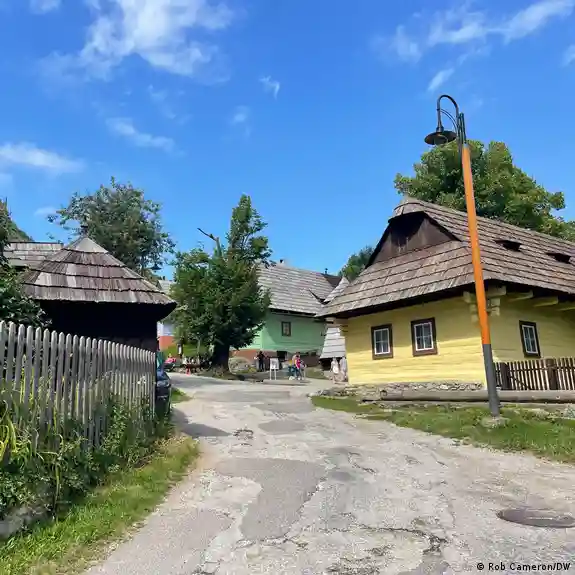
    In the Carpathian Mountains of central Slovakia lies Vlkolínec, a preserved settlement. This village is renowned for its pastel-painted timber cottages and traditional 19th-century folk architecture. It was inscribed as a UNESCO World Heritage site in 1993. Vlkolínec was celebrated not merely as a set of historical buildings, but as a living community. A rare surviving traditional rural life in Central Europe. However, three decades after receiving this prestigious designation, the small mountain is struggling with an existential dilemma. What was meant to be a cultural preservation has transformed into a challenge for the few villagers who still call Vlkolínec home. Now, frustration among permanent residents has reached a boiling point. There are calls to have the village removed from the UNESCO list altogether. When UNESCO designated Vlkolínec as a World Heritage site, one of the criteria was that it remained an inhabited settlement. At the time of inscription, the village was home to around 200 residents. Today, that permanent population has declined to just 14 to 17 people spread across four core families. In contrast to this dwindling resident count, Vlkolínec receives approximately 100,000 tourists every year. For the remaining inhabitants, the ratio of over 7,000 visitors per resident has basically altered the daily life. Locals report feeling as though they live inside a tourist zoo. The boundaries between public spaces and private homes are routinely ignored. Despite signs requesting privacy, visitors frequently wander into private yards, peer through kitchen windows, and treat active properties as open-access museum displays. The loss of privacy is compounded by anti-social tourist behavior. This conduct has been leaving locals feeling alienated in their own hometown. Overtourism is only one side of the coin. Residents also voice deep frustration over the rigid conservation framework that accompanies World Heritage status. Under national protection laws and strict UNESCO guidelines, historic homes face tight restrictions on modern modifications and physical alterations. Elderly villagers point out that these preservation rules have made customary rural activities increasingly difficult. Small-scale farming, livestock keeping, and land cultivation have gradually vanished. Surrounding agricultural terraces have become overgrown. Traditional meadow mowing has largely ceased as older generations pass away and younger generations move away. Furthermore, many of the village’s timber cottages have been bought up by outside buyers to serve as weekend holiday retreats. This phenomenon has increased the loss of a permanent, cohesive community. Some residents argue that revoking UNESCO status would reduce tourist pressure and ease regulatory burdens. However, municipal officials and heritage experts contend that delisting is neither practical nor the right solution. Local administrators in the nearby town of Ružomberok emphasize that UNESCO status brings significant heritage recognition and funding opportunities. Rather than abandoning the title, officials advocate for smarter tourism management. From a procedural standpoint, voluntary delisting at the request of a local community is virtually unprecedented in UNESCO’s history. The organization typically removes properties only when they lose their outstanding universal value due to severe destruction or irreversible development. The debate unfolding in Vlkolínec highlights a broader issue facing protected historic sites around the globe. How to balance global recognition and economic benefits with the rights and wellbeing of local inhabitants! Small historic communities across Europe and beyond battle with overcrowding and demographic decline. Vlkolínec serves as a reminder that preserving physical architecture alone is not enough. Without protecting the living social fabric of a community, world heritage sites risk turning into empty shells of their former selves.  

Leave a Reply

Your email address will not be published. Required fields are marked *