maryam announces basant
| |

Maryam announces Basant 2027 dates

Punjab Chief Minister Maryam Nawaz has announced that Basant will be celebrated in Lahore from March 12 to 14, 2027.

In a statement, Maryam said the announcement followed the successful celebration of Basant in 2026. She expressed hope that the festival would once again bring Lahore to life with colours, culture, music and celebrations.

The chief minister described Basant as a festival for the people. She encouraged citizens to participate in the celebrations and create lasting memories.

Maryam also invited overseas Pakistanis and international visitors to attend the event. She asked them to mark March 12 to 14 on their calendars and plan their visits to Lahore.

She said Lahore would once again be illuminated by the enthusiasm of the people during the festival.

The announcement comes as preparations for the 2027 celebrations are expected to build on the experience of the previous year. The provincial government is expected to focus on organising the festivities while ensuring that the celebrations are conducted in an orderly manner.

Maryam said she looked forward to welcoming visitors from Pakistan and abroad. She also expressed confidence that Basant 2027 would be organised successfully.

The festival is traditionally associated with colourful kites, cultural activities and public celebrations. Lahore has historically been at the centre of Basant festivities in Punjab.

Maryam concluded her announcement with a pledge to make Basant 2027 another successful and memorable celebration for the people.

Similar Posts

  • |

    AI manipulation claimed in PARC hiring; 105 candidates still waiting

    Islamabad: The Senate Standing Committee on National Food Security erupted in controversy today as concerns over recruitment at the Pakistan Agricultural Research Council (PARC) were aired with unprecedented intensity. Senators claimed that the federal research body may have violated constitutional equity, leaving candidates from Sindh and Balochistan sidelined while Punjab and Khyber Pakhtunkhwa dominated appointments. At the heart of the storm are 230 vacant posts at PARC. Although the posts were advertised nationwide and tested through the third party Candidates Testing Services (CTS), only 125 candidates have received appointment letters, leaving 105 hopefuls in limbo. Senator Poonjo Bheel voiced sharp criticism, accusing PARC of sidelining smaller provinces, potentially breaching Article 38(g) of the Constitution. “Appointments have disproportionately favored Punjab and KP,” he warned, “while Sindh and Balochistan candidates are deprived of their due share.” PARC representatives defended their process, noting that a few Sindh candidates were appointed purely on merit and promising interviews for remaining Sindh and Balochistan candidates in the coming week. Yet, the Committee remained unconvinced. Senators stressed that results should be announced simultaneously across all provinces, warning that staggered releases could create perceptions of bias. The session took an even more sensational turn when officials revealed allegations of a coordinated propaganda campaign against PARC. Officials claimed that artificial intelligence (AI) may have been used to manipulate recruitment results, prompting the Committee to recommend immediate show cause notices for any employees involved in such activities. The Chairman directed PARC to submit a detailed list of the appointing authorities responsible for each recruitment decision and a comprehensive record of the 105 pending candidates’ interviews. The Committee demanded transparency and accountability to prevent further distrust in the nation’s premier agricultural research body. The Committee’s stern message made it clear: “Merit alone cannot justify provincial inequity, and any manipulation digital or human will not be tolerated.” The meeting was attended by Senators Rahat Jamali, Shahadat Awan, and Poonjo Bheel, with the agenda moved by Senator Shahadat Awan deferred due to the absence of the Federal Minister and Secretary.

  • | |

    Arooj Aurangzeb calls out support for Indian Gen Z

    Arooj Aurangzeb is a name that carries real weight in Pakistan’s student activism circles. In 2019, she went viral after a video of her reciting a powerful poem during the student solidarity march spread rapidly across social media. She was protesting alongside thousands of other students who were demanding the restoration of student unions and proper political representation for young people within the country’s institutions. The videos from that movement were electric, emotional and widely shared, including hers. Seven years later, she is back in the public conversation, but this time it is not because of a protest. It is because of a contradiction she says she can no longer stay quiet about. When Indian students began protesting over the NEET paper leak at Jantar Mantar, demanding justice and systemic reform in the country’s examination system, Pakistani social media users responded with visible enthusiasm. Support poured in from across the border, with many Pakistanis praising the Indian Gen Z for their courage, awareness and refusal to be silent. Arooj Aurangzeb watched that wave of support and felt something shift inside her. She took to social media to point out what she saw as a glaring and painful inconsistency. While Pakistanis were celebrating the Indian protesters and calling their movement inspiring, many of those same people had ridiculed, trolled and dismissed her and her fellow students when they took to the streets in 2019 for exactly the same kind of systemic change. She did not hold back. She highlighted the irony directly, asking how the same people who mocked Pakistani students fighting for their rights could turn around and feel so moved by Indian Gen Z doing the same thing. Her post was not framed as anti-India. It was framed as a question about selective empathy and the way Pakistanis sometimes extend more admiration to voices from abroad than to those speaking up at home. The internet did not respond with silence. Reactions were divided and sharp. Some users sided with her immediately. “We never stand by our own heroes,” one person wrote, capturing the frustration that Arooj was articulating. Others pushed back, with one commenter arguing that the dynamics of Indian and Pakistani Gen Z are completely different and that direct comparisons were unfair. Another raised a pointed question of their own, asking why so many Pakistani revolutionaries eventually leave the country on foreign visas, a remark that suggested the critique went both ways. Arooj Aurangzeb’s voice in 2019 was a reminder that young Pakistanis were willing to stand up and demand something better. Her voice in 2026 is a reminder that those same young people are still watching, still paying attention, and still asking why the recognition they deserved then continues to be denied while admiration flows so freely elsewhere.

  • |

    Pakistan’s Commonwealth campaign ends with one medal

    Pakistan concluded its campaign at the 2026 Commonwealth Games in Glasgow with just one medal, marking the country’s poorest performance at the event in more than three decades. Pakistan sent a contingent of 21 athletes to compete across various disciplines but returned with only a single medal. The country’s sole podium finish came in women’s boxing, where Fatima Zahra secured a medal for Pakistan. The result marks the first time since the 1998 Commonwealth Games that Pakistan has finished the event with only one medal. In 1998, the country won a lone silver medal. It was also Pakistan’s weakest Commonwealth Games performance in the last 36 years. The only poorer result came in 1990, when the national contingent failed to win any medal. Pakistan’s hopes of improving its medal tally on the final day were dashed when judoka Shah Hussain Shah was eliminated in his opening bout, ending the country’s campaign without any further success. Shah Hussain Shah and Olympic javelin thrower Arshad Nadeem had been widely regarded as Pakistan’s strongest medal prospects heading into the Games. However, both athletes fell short of expectations and were unable to secure podium finishes. The disappointing campaign stands in sharp contrast to Pakistan’s performance at the previous Commonwealth Games held in Birmingham four years ago, where the country won a total of seven medals, including two gold medals. The latest results have raised concerns over Pakistan’s overall performance in international multi-sport events, with the country finishing the Glasgow Games with only one medal despite sending athletes in several disciplines.

  • |

    Starc’s 10-wicket blitz powers Australia to 51-run win over Bangladesh

    MACKAY: Mitchell Starc produced a devastating fast-bowling masterclass as Australia stormed back from their first-Test shock to beat Bangladesh by 51 runs in the second Test in Mackay on Sunday, levelling the two-match series. The Australian quick was virtually unstoppable, claiming 10 wickets for 51 runs in the match as Bangladesh’s batting collapsed twice inside two days. His performance transformed the contest after Bangladesh had stunned Australia with a nine-wicket victory in Darwin in the opening Test. Starc finished the second innings with four wickets for 39 runs after destroying Bangladesh’s top order with six for just 12 in their first innings. His match figures of 10-51 marked the fourth time he has taken 10 wickets in a Test, putting him at the heart of Australia’s emphatic response. Bangladesh began their second innings needing 147 runs to make Australia bat again. Instead, they quickly found themselves under intense pressure. Shadman Islam lasted only three deliveries before edging a moving Starc delivery to Marnus Labuschagne. Mominul Haque followed with a second-ball dismissal, losing his off stump without offering a shot and handing Starc a hat-trick chance. Captain Najmul Hossain Shanto survived the hat-trick ball and briefly attempted to steady the innings. He faced 46 deliveries before Nathan Lyon ended his resistance, with Shanto holing out to Starc at long-off for 31. Starc returned to strike again, tempting Litton Das into a loose shot that was caught at third slip without scoring. Pat Cummins then added to Bangladesh’s misery, dismissing Mehidy Hasan Miraz and Hasan Mahmud. Starc completed his 10-wicket haul when Taijul Islam was bowled for seven, while Lyon quickly cleaned up the tail. Earlier, Australia had been bowled out for 210, giving them a 146-run first-innings lead. Cameron Green top-scored with 67, while Nathan Lyon remained unbeaten on 32 after helping Australia cross the 200 mark. Bangladesh’s Shoriful Islam was the standout bowler for the visitors, taking seven wickets for 48 runs — the best figures by a Bangladeshi bowler in an away Test. Australia’s victory completed a dramatic turnaround in the series. Bangladesh had arrived in Mackay full of confidence after their historic win in Darwin, but Starc and Australia’s bowling attack ensured there would be no repeat. The result sets up a fascinating conclusion to the series, with Australia regaining momentum and Bangladesh left to regroup after a dramatic two-day collapse.

  • | |

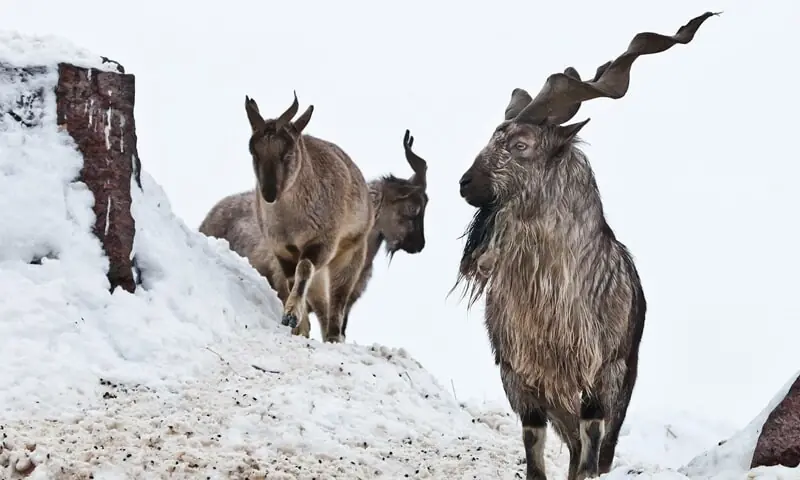
    GB to auction hunting permits for Markhor, blue Sh…

    GILGIT: The Parks and Wildlife Department of Gilgit-Baltistan is set to auction hunting permits for three Astore markhors, 14 blue sheep and 100 Himalayan ibexes under the region’s Trophy Hunting Programme for the 2026-27 season. The base price for an Astore markhor permit has been fixed at $200,000, making it the most expensive permit on offer. The minimum price for a blue sheep permit has been set at $25,000, while permits for Himalayan ibex will start at $11,000. According to the auction notice, four Astore markhors are included in the exportable quota. However, one permit from the previous hunting season has been carried forward, leaving three fresh permits to be auctioned this year. The open auction will take place on September 10 at the Forest Complex in Jutial, Gilgit. The trophy hunting season will begin on October 15, 2026, and continue until April 10, 2027, in accordance with the GB Trophy Hunting Guidelines 2019. Hunting will be permitted only within officially designated conservation areas. The department said the annual hunting quota has been determined following wildlife population surveys conducted by experts. GB Chief Conservator Parks and Wildlife Zakir Hussain said that the department collected approximately Rs350 million through permit auctions last year against a target of Rs550 million. He said several permits remained unused during the 2025-26 season, including those for two Astore markhors, five blue sheep and 10 exportable Himalayan ibexes. The unused permits resulted in an estimated revenue loss of around Rs200 million. According to officials, the cancellation of hunting plans by American and other international hunters was linked to the law-and-order situation following violent protests in Gilgit and Skardu. Local business owners and tourism operators have expressed concern over repeated increases in trophy hunting permit prices. They argue that higher baseline rates have discouraged foreign hunters and negatively affected businesses connected with hunting tourism. Ikram Beg, a local business owner who sells hunting equipment, said the trophy hunting programme was facing significant challenges. He claimed that the Wildlife Department had increased baseline prices by more than 300 per cent over the past two years without adequately incorporating recommendations from major stakeholders. According to Beg, excessive price increases could make Gilgit-Baltistan less competitive in the international trophy hunting market. He warned that declining international participation could reduce government and community revenues while weakening incentives for local residents to participate in wildlife conservation. Beg stressed that trophy hunting should primarily serve as a conservation mechanism rather than simply becoming a source of increased government revenue. He said the programme’s long-term success depends on reasonable pricing, international participation, transparent administration and meaningful financial benefits for local communities. Local stakeholders have called for a review of the permit rates and greater consultation with communities, conservation specialists and industry representatives. They have also demanded transparency and strict adherence to applicable rules and regulations. Although trophy hunting remains controversial internationally, its supporters argue that regulated hunting can generate funds for conservation, discourage illegal hunting and provide financial benefits to communities living near wildlife habitats. In Gilgit-Baltistan, the programme began with community participation in Bar Valley, Nagar, in 1990. Under the existing revenue-sharing model, approximately 80 per cent of licence revenue goes to local communitiesfor wildlife protection and conservation activities. The region’s challenging terrain and harsh weather also make trophy hunting highly demanding. Hunters must navigate steep and rugged mountain slopes while dealing with extremely cold conditions. Gilgit-Baltistan is home to diverse wildlife because of its varied ecosystems and climate. Species found in the region include Marco Polo sheep, ibex, markhor, urial, blue sheep, lynx, snow leopards, brown and black bears, wolves, foxes and golden eagles. However, wildlife experts and conservationists continue to face concerns over illegal hunting, inadequate wildlife management and the effects of climate change, all of which pose long-term threats to the region’s biodiversity.

  • | | |

    One missed bill enough for Lesco to pull the plug?…

    The month of July brings heat and humidity to Lahore. It also brings frequent power cuts, mainly from weather related issues. When it rains, and the atmosphere is muggy, power breakdown occurs and people expect that power will return soon after it goes. But there is a different kind of fear. This fear grows when a house sits dark while every other house on the street still has light. This means the power meter has been disconnected. Recent reports say that field staff of the Lahore Electric Supply Company (LESCO), have been harassing consumers. These reports say that officials are disconnecting power for people who have missed just one month of bill payment. This goes against the normal rule. Under the normal rule, a meter can only be disconnected after two months of non-payment. LESCO spokesperson Rabia Qadir has denied these reports. She said the company has not received any complaint about this issue. She said that rules made by the National Electric Power Regulatory Authority (Nepra), protect the rights and safety of consumers. Under these rules, a meter cannot be disconnected simply because one month of bill payment was missed. She also said that Lesco has not received any formal complaint against any sub-divisional officer, executive engineer, or lineman of any of its circle regarding such incidents. However, she said that some linemen may try to scare or pressure consumers. These linemen may threaten to disconnect a meter if the consumer does not pay the outstanding bill right away. She said this could happen in some cases and this was not the company’s policy. But she stressed that Lesco has a consumer complaint cell. All complaints are recorded there. She said that according to these records, no such complaint has come in. The situation on the ground appears more complicated. This reporter visited the consumer cell at the office of the Lesco chief officer. Several consumers were present there. Their complaints were about different issues. Some wanted correction of industrial bills. Others reported broken meters. When asked about the reports of meters being cut for a single month of default, one officer gave an important detail. They said this practice usually happens in June or July. They said the ministry gives instructions during these months to speed up bill recovery. The goal is to reduce financial losses. Staff at the office suggested that a proper response should come from Lesco Chief Executive Officer Ramzan Butt or his public relations office. However, the public relations office said that Ramzan Butt was in Islamabad for a meeting at the time. This problem is not limited to LESCO areas. Similar reports have come from areas covered by the Multan Electric Power Company. In Muzaffargarh, consumers who missed one month of payment received strict warnings from field staff. These staff members told consumers to avoid another default. If they defaulted again, they were told, their meters would be disconnected. According to the rules, a power connection cannot be cut through meter removal unless bills for both the current and the previous month remain unpaid. Yet for several months now, Lesco teams have continued cutting connections even when only one month of payment was missing. Other than power severe threats, the other main issue people face is take notice of a major problem in the new electricity bill format. The Pakistan Hosiery Manufacturers and Exporters Association in a letter to the prime minister said the revised bill has removed a lot of information that consumers used to see. He said this makes it hard for people to check their meter readings, units consumed, tariff calculations and other charges on their own. They say the changes seem to have been made without following the proper process set by the National Electric Power Regulatory Authority, known as NEPRA. No formal request for changing the bill format was filed with NEPRA and that consumers were never asked for their objections, nor were they given a chance to take part in a public hearing before the change was made. They say that bills are supposed to show the date when the connection or meter was installed, but this information is now missing. The removal of the meter reading snapshot is a serious problem, because consumers can no longer check if the reading used for their bill matches the actual reading at their home. Also, information about the meter reader, along with the date and time of the reading, has also disappeared. They say that when a meter is changed, the bill should show a snapshot of the final reading from the old meter, but distribution companies are not properly doing this. The new bills carry a QR code instead, but this cannot replace information that should be clearly printed on the bill itself. Many senior citizens, people living in rural areas, and low income households may not have smartphones or the internet access needed to scan a QR code. Economist and corporate lawyer Dr Ikramul Haq commented on this situation. He said that the conduct of power distribution companies is not simply a small technical mistake. He called it as a form of pressure against ordinary citizens. These citizens are already struggling with rising prices, high electricity rates, and falling purchasing power. He said that reports of field teams arriving at homes, treating consumers badly, and threatening immediate disconnection show the real human cost of this careless approach. He added that in some cases, meters were removed without any prior notice being given. Dr said explained that the legal position on this matter is very clear. Under the revised Consumer Service Manual issued by Nepra, electricity cannot be disconnected only because the bill for the current or previous month remains unpaid. A notice of seven days must be given along with the bill for the second month of default. Only after this notice period passes, and the default continues, can disconnection take place. He said that removing a meter involves even more safeguards under the rules. He

Leave a Reply

Your email address will not be published. Required fields are marked *