hafiz naeem rehman
| |

Hafiz Naeem Rehman reaffirms support for Iran


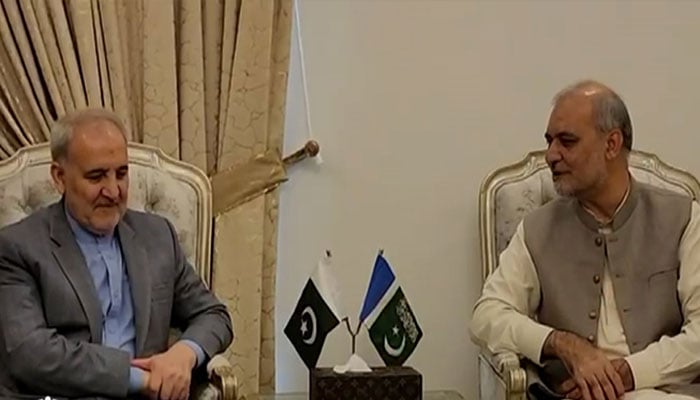
Ameer of Jamaat-e-Islami Pakistan, Hafiz Naeem Rehman, held separate meetings with the ambassadors of Iran and Afghanistan in Islamabad, where the leaders discussed regional developments, bilateral relations, and the importance of strengthening cooperation among neighboring countries.

Iranian Ambassador Reza Amiri Moghadam and Afghan Ambassador Sardar Ahmad Shakeeb separately visited Hafiz Naeem Rehman to offer their condolences on the passing of Amir-ul-Azeem, a senior Jamaat-e-Islami leader. The ambassadors expressed sympathy with the party leadership and prayed for the departed soul.

During his meeting with the Iranian ambassador, Hafiz Naeem Rehman highlighted the close historical and religious ties between Pakistan and Iran. He said the two neighboring countries share deep-rooted cultural, religious, and social bonds that have strengthened their relationship over the years. According to him, Pakistan and Iran are closely connected and should continue to work together in promoting peace, stability, and mutual prosperity in the region.

While meeting Afghan Ambassador Sardar Ahmad Shakeeb, the Jamaat-e-Islami chief said the people of Pakistan and Afghanistan are linked by centuries-old religious, historical, and cultural relations. He emphasized that the two countries have common interests and should continue to strengthen cooperation for the benefit of their peoples.

Hafiz Naeem Rehman stressed that differences between Pakistan and Afghanistan can be resolved through sustained dialogue, mutual trust, and regular communication. He said constructive engagement and confidence-building measures are essential to overcoming misunderstandings and creating a stable relationship between the neighboring countries.

Speaking about the broader regional situation, the Jamaat-e-Islami chief called for an immediate and comprehensive ceasefire in Iran, Gaza, and Lebanon. He said ending hostilities is essential to preventing further humanitarian suffering and restoring peace in the region. He emphasized that dialogue and diplomatic efforts should take precedence over military confrontation.

Hafiz Naeem Rehman also expressed solidarity with Iran in the face of what he described as American and Israeli aggression. He stated that the Iranian government and people deserve support during the current regional crisis and reaffirmed his party’s backing for Iran against external military actions.

The Iranian ambassador, Reza Amiri Moghadam, underscored the importance of closer cooperation among Pakistan, Iran, Saudi Arabia, and Türkiye. He said stronger collaboration between these influential Muslim countries is essential for ensuring lasting peace, stability, and economic development across the region. He noted that collective efforts and constructive dialogue could help address regional challenges and promote greater unity among Islamic nations.

During the separate meeting, Afghan Ambassador Sardar Ahmad Shakeeb also emphasized the significance of bilateral cooperation between Pakistan and Afghanistan. He said meaningful collaboration between the two neighboring countries is vital for achieving sustainable peace, regional stability, and economic progress. According to the ambassador, both countries have a shared responsibility to work together on issues of mutual interest and maintain regular engagement to strengthen their longstanding relationship.

The meetings reflected a shared commitment to enhancing regional cooperation and maintaining dialogue at a time of heightened geopolitical tensions. Both ambassadors and the Jamaat-e-Islami chief agreed that peaceful engagement, mutual respect, and stronger ties among neighboring countries remain essential for addressing common challenges and ensuring long-term stability in South and West Asia.

The discussions concluded with a renewed emphasis on promoting peace through diplomacy, strengthening regional partnerships, and fostering closer cooperation among Muslim countries to contribute to stability and prosperity across the wider region.

Similar Posts

  • |

    Capital Smart City emerges as Pakistan’s AI and …

    Habib Rafiq Limited’s vision transforms a real estate project into a technology-driven ecosystem Pakistan’s journey towards a digital future has entered a new phase with the inauguration of Sky47 Karakoram-01, the country’s largest AI-ready data centre and cloud infrastructure facility, at Capital Smart City near Islamabad.   The landmark project has placed Capital Smart City in the spotlight as an emerging hub for artificial intelligence, cloud computing and advanced digital services, attracting attention from Pakistan’s technology sector and international investors. The inauguration ceremony was attended by Prime Minister Muhammad Shehbaz Sharif and Chief of Army Staff and Chief of Defence Forces Field Marshal Syed Asim Munir, along with federal ministers, senior government officials, business leaders and technology experts. The launch of Sky47 Karakoram-01 represents a major development in Pakistan’s digital infrastructure landscape. The facility has been designed to support artificial intelligence applications, high-performance computing, cloud services, secure data hosting, cybersecurity and next-generation technology solutions. From smart city to digital technology hub Capital Smart City, located near Islamabad, is one of Pakistan’s largest and most ambitious real estate developments. Developed by Habib Rafiq Limited (HRL), the project was conceived as a modern smart city based on international standards, combining residential, commercial, educational and technological facilities. With the establishment of Pakistan’s largest AI data centre, Capital Smart City is expanding its identity beyond traditional real estate development and moving towards becoming a technology-led ecosystem. The integration of digital infrastructure, smart solutions and AI capabilities reflects a global trend where future cities are being designed around innovation, connectivity and knowledge-based economies. Habib Rafiq Limited — a legacy of development and innovation Habib Rafiq Limited (HRL) is one of Pakistan’s established engineering, construction and development companies with decades of experience in delivering major infrastructure and real estate projects. The company has contributed to Pakistan’s development landscape through projects in housing, construction, infrastructure and energy. HRL has built a reputation for undertaking large-scale developments with a focus on quality, modern planning and international standards. Capital Smart City represents one of HRL’s flagship projects, designed around the concept of a sustainable and technology-enabled urban environment. The company’s expansion into digital infrastructure through projects such as Sky47 reflects a broader vision of connecting Pakistan’s urban development with emerging technologies. Zahid Rafiq — vision behind the transformation At the centre of this ambitious journey is Mr Zahid Rafiq, Chairman Habib Rafiq Limited, whose vision has been focused on innovation, investment and long-term development. Under his leadership, HRL has continued to expand its portfolio beyond traditional construction and real estate, exploring opportunities in technology-driven projects and strategic investments. Zahid Rafiq has also been associated with major investments in Pakistan’s energy sector, contributing to the country’s economic development through diversification into key industries. His approach has been to combine infrastructure development with future-focused investment, creating projects that support economic growth, employment opportunities and technological advancement. Government support for digital transformation Addressing the inauguration ceremony, Prime Minister Shehbaz Sharif described Sky47 Karakoram-01 as an important step towards building a modern and prosperous Pakistan. The Prime Minister emphasised that investment in artificial intelligence, technology and digital infrastructure would help create opportunities for young people, strengthen the economy and improve Pakistan’s position in the global technology landscape. The participation of Field Marshal Syed Asim Munir highlighted the strategic importance of strengthening Pakistan’s digital capabilities and creating an environment that encourages investment and innovation. A new chapter for Pakistan’s technology ambitions The launch of Sky47 Karakoram-01 comes at a time when countries around the world are competing to build advanced AI infrastructure and secure digital ecosystems. Experts believe that access to high-performance computing and secure data facilities will be critical for Pakistan’s future growth in sectors including fintech, e-commerce, healthcare technology, education and artificial intelligence research. The development is expected to reduce dependence on overseas data hosting, improve digital security and provide Pakistani companies with advanced technological resources within the country. As Capital Smart City evolves into a technology-driven destination, the project represents a new model of urban development where real estate, artificial intelligence and digital innovation come together. For Pakistan, Sky47 Karakoram-01 is not only a data centre — it is a statement of ambition to become part of the global digital economy.

  • | |

    Houthis claim missile and drone attack on Saudi oil tankers

    Yemen’s Houthi movement has claimed responsibility for attacking two Saudi oil tankers in the Red Sea, marking a major escalation in regional tensions and raising fresh concerns over the security of one of the world’s busiest maritime trade routes. Houthi military spokesperson Yahya Saree said the group targeted the tankers, identified as ENCELA and LAYLIA, because they allegedly violated the maritime blockade the Houthis imposed on Saudi Arabia earlier this week. According to the spokesperson, the operation involved ballistic missiles, cruise missiles and drones. He claimed the strikes caused fires aboard both vessels and forced nearly 10 other commercial ships to abandon their planned routes and turn back. Saudi authorities have not officially commented on the Houthi claims. However, the United Kingdom Maritime Trade Operations (UKMTO), which monitors maritime security in the region, confirmed receiving a report from the captain of a tanker that an unidentified projectile had struck the vessel, sparking a fire. The crew managed to respond to the incident, and no casualties or environmental damage have been reported. The attack comes just days after the Houthis announced a maritime blockade against Saudi Arabia, saying the move was retaliation for recent military actions in Yemen. The group accused Riyadh of maintaining a long-standing blockade on areas under Houthi control and vowed to respond with similar measures at sea. The latest developments have increased fears over shipping through the Red Sea and the Bab al-Mandeb Strait, a strategic waterway linking the Red Sea to the Gulf of Aden. The route is vital for global energy supplies and international trade, carrying millions of barrels of crude oil and petroleum products every day. Shipping security in the region has already been under pressure because of wider Middle East tensions. Any prolonged disruption in the Bab al-Mandeb Strait could further affect global oil markets, increase transport costs and delay commercial shipping.

  • |

    Progressive outsider Abdul El-Sayed claims victory in Michigan Senate primary

    In a dramatic outcome that has sent shockwaves through the Democratic establishment, progressive public health advocate Dr Abdul El-Sayed has secured the Democratic nomination for the United States Senate in Michigan, narrowly defeating establishment-backed Representative Haley Stevens. The contest to replace retiring Democratic Senator Gary Peters had emerged as a central battleground between the party’s moderate and progressive factions. Stevens, a four-term congresswoman with deep ties to Washington leadership, had entered the primary with formidable institutional backing and substantial financial support, including over $30 million (£23.5 million) spent on her behalf by political action committees affiliated with the American Israel Public Affairs Committee (AIPAC). Despite being outspent by a margin of roughly nine to one, El-Sayed built a coalition anchored by strong turnout among young voters, working-class communities, and urban centres such as Detroit and Ann Arbor. Backed by prominent progressive figures including Senator Bernie Sanders and Representative Alexandria Ocasio-Cortez, El-Sayed campaigned on a platform of universal healthcare, campaign finance reform, higher taxes on wealthy corporations, and an immediate end to foreign military aid. “We built this campaign brick by brick”, El-Sayed told cheering supporters at his election night watch party in Detroit, emphasising that grassroots engagement ultimately proved more powerful than dark-money political action committees. The progressive momentum extended down-ballot across the state. In Michigan’s 13th Congressional District, Democratic Socialist Donavan McKinney unseated incumbent Representative Shri Thanedar, an outspoken supporter of military aid to Israel, while progressive activist William Lawrence clinched the nomination in another competitive congressional district. The primary result sets up a high-stakes November general election against Republican nominee Mike Rogers, a former congressman who ran unopposed. Rogers and national Republican strategists have already signalled plans to paint El-Sayed’s left-wing platform as out of touch with Midwestern swing-state voters. For Democrats, the contest will serve as an ultimate test of whether a bold progressive message can unite the party base and retain a seat vital to determining control of the US Senate.

  • |

    Gulf families seek fairer inheritance through UK law

    Wealthy families in the Gulf are increasingly preparing wills under British law to reduce the difference between the inheritance shares traditionally allocated to sons and daughters under Islamic law. According to a report in a Western publication, some experts have described the emerging trend as “Shariah Lite”, referring to families using the flexibility offered by English succession law to distribute their wealth among their children on relatively equal terms. British lawyers say families are increasingly exploring these legal arrangements to protect the financial future of their children, particularly in cases where they have only daughters or where daughters outnumber sons. Under traditional Islamic inheritance rules, the shares received by male and female heirs can differ depending on the family structure and circumstances. The growing use of foreign legal frameworks allows wealthy families with international assets to consider alternative succession arrangements within the limits of applicable laws. Experts say several factors are contributing to the trend, including changing attitudes among younger generations, increasingly complex marital arrangements and political uncertainty across parts of the Gulf region. These developments have encouraged affluent families to pay greater attention to estate planning, asset protection and succession arrangements to ensure that their wealth remains within the family and is transferred according to their wishes. Gulf states are also introducing legal systems that offer foreign residents and some families alternatives to traditional Sharia-based procedures. Abu Dhabi, for example, has established a separate civil legal framework for matters including divorce, providing an alternative route outside the traditional Sharia system. The growing interest in British wills highlights the changing approach of some wealthy Gulf families toward inheritance and succession planning, as they seek greater control over how their assets are distributed among future generations.

  • | |

    PM Shehbaz says trilateral pact aims to promote re…

    ISLAMABAD: Prime Minister Shehbaz Sharif has said the recently signed trilateral agreement is aimed at promoting peace, development and prosperity in the region and has no aggressive objectives. Addressing a meeting of the federal cabinet, the prime minister said efforts to formalise the arrangement had been underway for several years. He said the framework was officially formalised last year to pave the way for a formal agreement. Shehbaz said the latest development was another step in the ongoing dialogue and cooperation, culminating in the signing of a trilateral agreement on Friday. He stressed that the agreement was entirely defensive in nature and was not directed towards aggression against any country. According to the prime minister, the pact is intended to strengthen peace, stability and progress in the region. He described the agreement as a significant development not only for the three participating countries but also for the wider Muslim world. Shehbaz congratulated Deputy Prime Minister and Foreign Minister Ishaq Dar and Field Marshal Syed Asim Munir for their efforts towards finalising the agreement. He said the agreement was not the result of a recent initiative. Work on the arrangement had continued for several years before it was finally concluded on Friday. The prime minister expressed appreciation for the officials and leaders who contributed to the process and said the agreement represented an important step towards greater regional cooperation. He reiterated that the objective was to strengthen collective security while supporting peace, stability, development and prosperity across the region.

  • | | | |

    Six Palestinians killed, 37 injured in fresh Gaza …

    GAZA: At least six Palestinians have been killed and 37 others injured in fresh Israeli attacks on the Gaza Strip, according to the Palestinian Ministry of Health, adding to the mounting toll since the ceasefire in October 2025. The latest casualties were reported as attacks continued to affect different parts of the besieged territory. The deaths and injuries have once again raised concerns over the fragile situation in Gaza, where civilians continue to face the consequences of the prolonged conflict. According to the Palestinian Ministry of Health, more than 1,100 Palestinians have been killed and nearly 4,000 wounded since the ceasefire began in October 2025. The ministry said that more than 800 bodies have also been recovered from various locations since the ceasefire. The figures highlight the scale of the devastation and the continuing challenges faced by emergency teams searching affected areas. The latest violence comes despite the ceasefire that was expected to reduce bloodshed and provide relief to Gaza’s population. The renewed casualties have added further uncertainty to an already fragile situation. Meanwhile, tensions have also continued in the occupied West Bank. Palestinian authorities said 66 Palestinians were arrested in different parts of the territory. The developments come as the humanitarian situation remains a major concern, with communities in Gaza continuing to deal with the aftermath of months of fighting, widespread destruction and loss of life. For families in the territory, every new round of violence brings fresh fear and uncertainty. The latest deaths have once again put the spotlight on the fragile ceasefire and the urgent need to prevent further escalation. As the death toll continues to rise, attention remains focused on whether diplomatic efforts can restore lasting calm and protect civilians caught in the conflict.

Leave a Reply

Your email address will not be published. Required fields are marked *