hanif abbasi says
| |

Hanif Abbasi says India tops list of Pakistan’s enemies


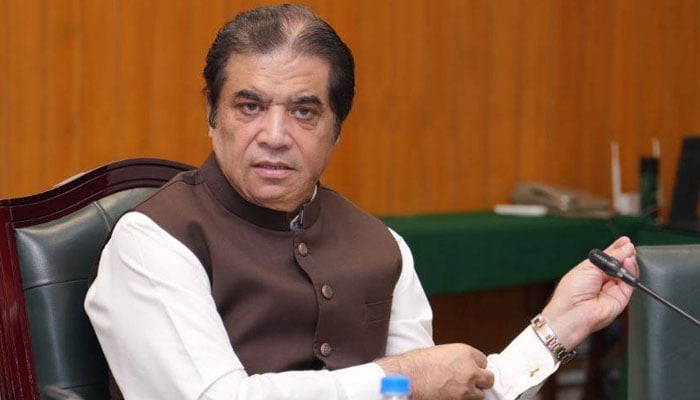
ISLAMABAD: Federal Minister for Railways Hanif Abbasi has said that only two or three countries can be considered enemies of Pakistan, with India at the top of the list. He said Israel and Afghanistan are also among the countries that PakistanFederal Minister for Railways Hanif Abbasi has said that only two or three countries can be considered enemies of Pakistan, considers hostile.

Speaking to journalists outside Parliament House, Abbasi said Pakistan does not regard all countries as enemies and stressed that the list is limited to a few states. His remarks came while discussing political and national issues with the media.

The federal minister also spoke about his views regarding Jamiat Ulema-e-Islam-Fazl (JUI-F) chief Maulana Fazlur Rehman, describing him as a respected political figure. Abbasi said he would advise Fazlur Rehman to avoid making decisions while angry, arguing that emotional reactions can sometimes lead to wrong choices.

Abbasi said that political differences were a normal part of democratic politics and that he was willing to accept opposition on political grounds. However, he drew a distinction between political disagreement and what he described as personal attacks.

The minister said he could tolerate political opposition but did not accept personal hostility. Referring to remarks previously made by Pakistan Tehreek-e-Insaf (PTI) founder Imran Khan about Maulana Fazlur Rehman, Abbasi said that some of the words used against the JUI-F leader had been deeply disturbing.

He said the language used against Fazlur Rehman was so harsh that it had left him shocked. According to Abbasi, political opponents could disagree with each other over policies, parties and political strategies, but personal criticism should not cross certain limits.

“Political opposition would not have been an issue,” Abbasi said, while arguing that the criticism directed at Fazlur Rehman went beyond ordinary political differences and became personal.

The minister’s comments reflect the continuing tensions and rivalries among Pakistan’s major political parties, where disagreements frequently extend beyond policy matters and involve criticism of individual political leaders.

Abbasi’s remarks also highlighted the importance of maintaining political restraint, particularly when disagreements become intense. His advice to Fazlur Rehman suggested that political leaders should avoid taking major decisions while angry or under emotional pressure.

The federal minister further indicated that political differences should be handled within the boundaries of democratic debate. While politicians may strongly oppose one another on ideological, policy or electoral matters, he suggested that personal attacks can deepen political divisions and make reconciliation more difficult.

His comments regarding Pakistan’s perceived hostile countries also came amid continuing discussions about the country’s regional and international relationships. India has historically remained a major source of tension between Pakistan and its eastern neighbour, while relations with Afghanistan have also faced challenges over security and border-related issues. Pakistan’s relationship with Israel remains particularly sensitive due to the Palestinian issue and Islamabad’s longstanding position on the conflict.

Abbasi’s statement therefore covered both domestic political differences and broader foreign-policy concerns. He emphasised that Pakistan has only a limited number of countries that it considers enemies, rather than viewing the wider international community through the same lens.

The minister’s comments are likely to draw attention because of his criticism of personal attacks in politics and his appeal for political leaders to exercise greater restraint. His remarks underline the distinction between legitimate political opposition and criticism that becomes personal, an issue that continues to shape political discourse in Pakistan.

Similar Posts

  • |

    Pakistan eyes PNSC ships to boost GCC trade amid shipping crisis

    ISLAMABAD: The government is considering a range of emergency measures, including the deployment of Pakistan National Shipping Corporation (PNSC) vessels, to keep Pakistan’s trade links with Gulf Cooperation Council (GCC) countries operational amid severe disruption to maritime traffic. The move comes as Pakistan’s exports to the GCC region declined significantly in July 2026, while imports also recorded a sharp fall compared with the same month last year, according to data shared by the Ministry of Commerce. The ministry’s figures show that exports to GCC countries dropped by around 12% year-on-year in July, reflecting the impact of heightened maritime security concerns and disruptions to established shipping routes. Exports to major Gulf markets decline Pakistan’s exports to the United Arab Emirates (UAE), its largest GCC trading partner, fell 9.5% in July 2026, reaching $144.6 million compared with $159.8 million recorded in July 2025. Exports to Saudi Arabia witnessed a steeper decline of 20.5%, falling to $42 million from $52.8 million a year earlier. Shipments to Oman decreased 3.7% to $15.8 million from $16.4 million. Pakistan’s exports to Bahrain suffered the sharpest percentage decline among the GCC markets, dropping 50.8% to $2.3 million from $4.2 million. Exports to Kuwait declined 7.4% to $7.4 million, while shipments to Qatar fell 4.2% to $8.7 million from $9 million in the corresponding month of 2025. The decline has raised concerns over the ability of Pakistani exporters to maintain regular deliveries to Gulf markets, particularly for goods that depend heavily on maritime transportation. GCC imports also fall sharply Pakistan’s imports from GCC countries also recorded a substantial decline during July. The Commerce Ministry reported that imports fell 32.5% year-on-year to $1.0009 billion from $1.4825 billion in July 2025. Imports from the UAE decreased 34.2%, falling to $380.7 million from $576.5 million. Imports from Saudi Arabia declined 4.7% to $295.3 million from $310 million, while purchases from Bahrain dropped 44.4% to $15.1 million from $27.2 million. The most significant declines were recorded in imports from Kuwait and Qatar. Imports from Kuwait plunged 92.8% to $9.5 million from $132.1 million, while those from Qatar fell 96.1% to $10.2 million from $261.8 million. Oman was the exception, with Pakistani imports from the country increasing 67.7% to $290.2 million from $173 million a year earlier. Month-on-month trade also weakens The trade slowdown was also visible on a month-on-month basis. Pakistan’s exports in July were 2.7% lower than in June 2026. However, the performance varied considerably across GCC destinations. Exports to the UAE increased 15.7%, while shipments to Kuwait and Qatar rose 19.4% and 88%, respectively. In contrast, exports to Saudi Arabia declined 34.5% during the month. Shipments to Oman fell 34.6%, while exports to Bahrain decreased 18.2%. Imports recorded an even sharper monthly decline, falling 32.5% in July compared with June. Imports from the UAE decreased 17.9%, while those from Saudi Arabia fell 41.4%. Imports from Oman declined 49.9%, and purchases from Qatar plunged 93.2%. Imports from Bahrain and Kuwait, however, increased during the month, rising 295.8% and 72%, respectively. Maritime security disrupts Gulf trade The Commerce Ministry linked the deterioration in trade flows to the worsening maritime security situation following the breakdown of an interim truce between the United States and Iran in July 2026. According to the ministry, the resulting security concerns severely affected international shipping movements through key maritime routes and created uncertainty for commercial vessels operating in and around the Gulf. The ministry said the waterway normally accommodates between 70 and 80 commercial vessel crossings each day. However, traffic reportedly dropped to as few as six vessels a day during the disruption, leaving hundreds of ships waiting outside the Strait of Hormuz. The ministry also referred to statements attributed to Iran’s Islamic Revolutionary Guard Corps (IRGC), according to which vessels were required to obtain permission to pass through the strategic waterway. Such developments, coupled with threats against shipping, significantly increased the risks and costs associated with maritime trade. Red Sea tensions add to shipping risks The Commerce Ministry also highlighted the impact of attacks attributed to Houthi militants on Saudi oil facilities and areas along the Red Sea coast. The resulting security threats to Saudi-linked vessels have increased concerns surrounding shipping through the Bab al-Mandab Strait, another critical maritime gateway connecting the Red Sea with the Gulf of Aden. With shipping operators facing heightened security risks, commercial maritime movement between Pakistan and GCC markets has been severely disrupted. The ministry said some Pakistani exports had consequently been shifted to air freight to ensure the delivery of goods to Gulf customers. However, air transport is considerably more expensive than sea freight, creating additional pressure on exporters and potentially reducing the competitiveness of Pakistani products in GCC markets. Government considers alternative shipping routes To reduce the impact of the disruption, the Commerce Ministry has proposed establishing dedicated feeder links between Karachi and safer maritime nodes outside the immediate Hormuz chokepoint. The proposed connections include Fujairah and Khor Fakkan in the UAE, as well as suitable Omani ports located outside the affected maritime corridor. Such routes could provide Pakistani exporters with alternative channels for moving cargo to the Gulf while reducing their exposure to disruptions around the Strait of Hormuz. The ministry has also recommended accelerating the operationalisation of multi-purpose passenger and cargo ferry services between Gwadar and GCC ports. The proposed ferry network is intended to provide another avenue for transporting commercial goods and passengers while strengthening Gwadar’s role as an alternative regional logistics hub. PNSC vessels under consideration Another option being examined by the government is the use of vessels operated by the Pakistan National Shipping Corporation to maintain trade connectivity with GCC destinations. The deployment of national-flag shipping capacity could provide greater control over cargo movement at a time when private commercial operators are facing security and logistical constraints. Officials believe that maintaining reliable access to Gulf markets is important because GCC countries remain a major destination for Pakistani exports and a key source of energy and other imported commodities. The proposed measures are therefore aimed

  • | |

    Italy’s fourth summer heat wave peaks as rec…

    Italy’s fourth heat wave of the summer reached its most intense point on Monday, with a record 25 cities placed under red heat alerts as temperatures climbed above 40 degrees Celsius in parts of the country, according to local media reports. Italy’s Health Ministry raised the number of cities under its highest heat risk warning from 23 on Sunday to 25 on Monday, marking the highest total recorded so far this summer. Only Reggio Calabria and Messina avoided the red alert designation, though both remained under yellow level warnings. The Po Valley and central regions of the country are experiencing the harshest conditions, while inland areas and Sardinia could also see temperatures exceed 40 degrees Celsius. In parts of central and northern Italy, overnight temperatures are expected to stay above 25 degrees Celsius, a pattern meteorologists have described as super tropical nights. The central province of Terni recorded a temperature of 41 degrees Celsius on Sunday. Experts have linked the extreme heat to a persistent African anticyclone combined with continued warming of the Mediterranean Sea, where surface temperatures have reached or surpassed 30 degrees Celsius across much of the basin. Meteorologist Lorenzo Tedici of iLMeteo.it said the accumulated heat is expected to fuel atmospheric instability, warning of strong afternoon thunderstorms forming over the Alps and Apennines. Italy’s Civil Protection Department has issued yellow alerts for heavy rainfall along the Apennine mountain range stretching from Umbria to Calabria, as well as in inland areas of Sicily. Tedici said a genuine shift away from the hottest phase of summer 2026 is unlikely before at least mid August. Authorities have also flagged an elevated risk of wildfires, placing Sicily and Emilia Romagna under orange alerts as the heat wave continues to grip the country. The extreme temperatures fit a broader pattern of intensifying summer heat across southern Europe in recent years, as scientists have repeatedly linked rising Mediterranean sea temperatures and more frequent heat waves to long term climate trends affecting the region’s weather systems.

  • | |

    Fatima Jinnah remembered for inspiring legacy on b…

    SIALKOT: Government College Women University Sialkot (GCWUS) commemorated the birth anniversary of Madar-e-Millat Fatima Jinnah, honouring her remarkable role in Pakistan’s independence movement, her commitment to women’s empowerment, and her lasting contributions to nation-building. In a statement issued on Friday, the university described Fatima Jinnah as one of the country’s most influential national figures. Born in Karachi on July 31, 1893, she remained a steadfast supporter of her brother, Quaid-e-Azam Muhammad Ali Jinnah, and played a pivotal role in encouraging Muslim women to actively participate in the struggle for an independent homeland. The university also highlighted her leadership in establishing the All India Muslim League Women’s Committee in 1937, an initiative that helped spread the message of the Pakistan Movement among women across the subcontinent and strengthened their political participation. Paying tribute to her humanitarian efforts, GCWUS noted that Fatima Jinnah also devoted herself to the rehabilitation of refugees and the provision of medical assistance following the creation of Pakistan. The university said her vision, courage, and dedication continue to inspire generations, reaffirming her enduring place in the country’s history as a symbol of patriotism, resilience, and public service.

  • | |

    Mathira and Sahiba’s runway walk goes viral after near falls

    Pakistani showbiz personalities Mathira and Sahiba have become the centre of attention on social media after videos from a fashion show went viral. The videos were widely shared by users. However, their runway walk itself was not the main reason for the attention. Instead, viewers focused on several incidents that took place during the fashion show. Mathira and Sahiba were among several celebrities who walked the runway during the event. The show featured a number of participants who appeared on the catwalk one after another. However, several participants struggled to maintain their balance while walking. Some were seen stumbling. Others appeared to come close to falling. The unusual moments were captured on video. The clips were later shared across social media platforms. The videos quickly attracted the attention of users. Many viewers began discussing the condition of the runway. Several social media users claimed that the runway appeared uneven. They suggested that its condition may have made it difficult for participants to walk properly. Some viewers questioned whether the runway had been properly inspected before the fashion show. Others criticised the event organisers. They said the catwalk should have been checked carefully before participants were allowed to walk on it. One social media user claimed that the runway was visibly damaged. The user said the problem should have been identified and fixed before the event. Another user pointed out that several participants appeared to struggle while walking. The comments were not limited to criticism of the organisers. Some users also discussed the skills required for runway walking. They argued that walking confidently on a fashion runway requires professional practice and training. According to these users, models and celebrities need to be comfortable with different types of catwalk surfaces. The viral videos have generated mixed reactions online. Some users focused on the condition of the runway. Others commented on the participants’ walking techniques. The incident has also raised questions about safety arrangements at fashion events. A properly prepared runway is important for participants because even a minor surface problem can affect their balance. The videos continue to circulate on social media. Users are sharing the clips while offering different explanations for what happened. Neither Mathira nor Sahiba’s runway appearance was the only part of the event discussed online. Instead, the moments when participants stumbled became the main talking point. The incident has once again highlighted how quickly unusual moments at entertainment events can attract attention on social media.

  • NADRA launches special registration facility for minorities

    The National Database and Registration Authority (NADRA) has introduced a special facility for members of minority communities. As part of activities marking National Minorities Day, NADRA has launched a special registration campaign from August 10 to 13. Under the campaign, special teams accompanied by mobile registration vans are visiting areas with large minority populations and providing citizens with identity-related services close to their homes. NADRA has urged members of minority communities to take advantage of the services being provided by these teams in their respective areas and ensure that they have valid legal identification. The mobile registration vans are also equipped with iris-scanning facilities. NADRA has strongly appealed to all citizens to make full use of this facility and get their iris scans completed without paying any additional fee.

  • |

    FBI questions Argentina FA president over $300m probe

    The US Federal Bureau of Investigation (FBI) has begun investigating Argentine Football Association (AFA) President Claudio Tapia as part of a wider inquiry into the alleged laundering of more than $300 million in sponsorship funds linked to the 2026 FIFA World Cup. According to international media reports, the investigation gained attention after Argentina’s national football team completed its World Cup campaign and was preparing to return to Buenos Aires from the United States on a charter flight. Reports said US authorities stopped Claudio Tapia before departure and questioned him for approximately 30 minutes. During the questioning, investigators reportedly took possession of his mobile phone as part of the ongoing inquiry into financial transactions connected to the case. Following the incident, some media outlets reported that Tapia had been arrested. However, the Argentine Football Association strongly rejected those claims. The association said neither Tapia nor AFA Treasurer Pablo Toviggino had been arrested or summoned by any US court. The football body did confirm that a third individual had received a subpoena to appear before a US grand jury. According to the association, investigators may seek information from that individual regarding certain officials and financial matters linked to the organisation. US investigators are reportedly reviewing commercial and sponsorship agreements valued at more than $300 million. The inquiry is focused on determining whether any funds connected to those agreements were transferred through the US banking system in a way that could indicate money laundering or other financial crimes. Investigators are also examining banking records showing that millions of dollars moved through several US financial institutions. Reports suggest that some of the funds remained in certain accounts for only a short period before being transferred to other destinations, prompting further scrutiny of the transactions. Authorities are analysing financial documents, payment records, and banking activities to determine whether the movement of funds complied with US financial regulations or involved attempts to conceal the origin or destination of the money. The investigation forms part of a broader examination of financial activities connected to Argentine football. It follows law enforcement operations conducted in Argentina last year as part of separate investigations into suspected money laundering involving football-related finances.

Leave a Reply

Your email address will not be published. Required fields are marked *